“The household chores are now on my shoulders.”
The words come from a girl quoted in a UNICEF study of children affected by labor migration in Uzbekistan. Her grandmother died when she was in seventh grade. By the time she spoke to UNICEF, her grandfather had also died the previous year. She described cleaning, cooking, washing clothes, and looking after her brother, a household’s work done by one child.
Her account raises a question that is rarely asked when an older sibling is praised for being helpful: who is looking after the child who is doing the looking after?
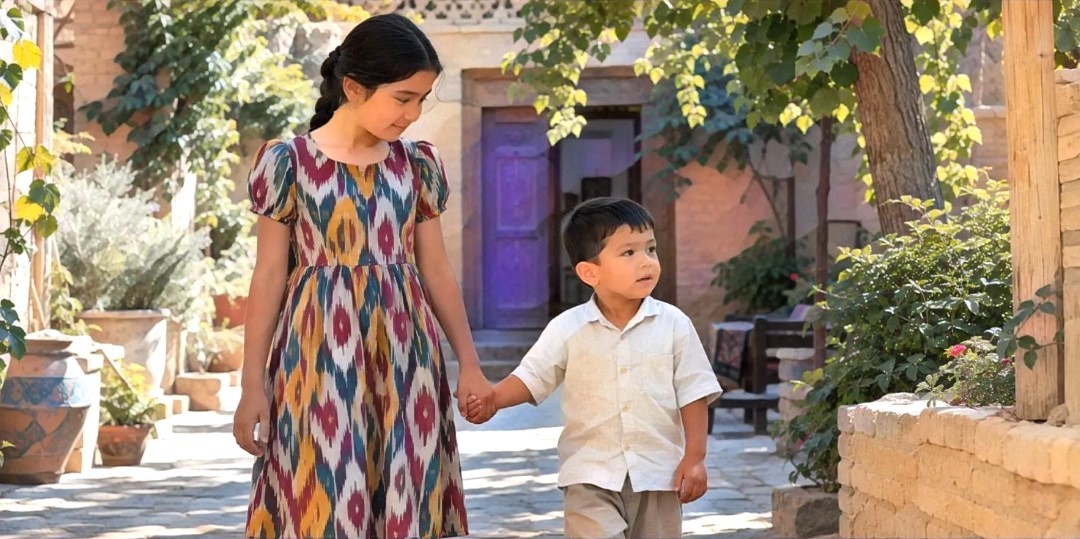
In Uzbekistan, caring for younger brothers and sisters is often understood as oilaga yordam, helping the family. An older sister watches a baby while her mother cooks. A brother takes a little sibling outside. These arrangements can express affection and solidarity, and build independence, patience, and practical skills.
But there is a difference between helping and becoming indispensable. What happens when caring for a younger sibling is no longer an occasional contribution, but the thing that decides how an older child spends their afternoons and how much freedom they have?
Different Families, Different Boundaries
In MEN AYOLMAN, a private Facebook community for Uzbek women, mothers were asked whether they let their children play outside without an adult, and whether they knew families where young children looked after even younger ones. The replies showed sharply different ideas of independence, safety and responsibility.
One mother let her 12-year-old and 2-year-old go outside together. The older child looks after the younger, but with precautions: the courtyard is enclosed, there are security cameras and a guard, and she watches from the window. She reminds the older child not to lose sight of the little one. In her view, children can play together if they are independent enough and the place is safe.
Another mother tried letting her six-year-old daughter go out with her four-year-old brother near their home. It did not work. The boy kept making demands, upsetting his sister and calling for his mother, who watched anxiously from the window and finally went outside herself. For her, it showed how hard it is to expect a young child to manage another child.
A different mother said that some families in her neighborhood send small children outside with older siblings, but objected because the older ones are children themselves. “You can’t entrust a child to another child.”
These comments concern outdoor supervision and are not a representative survey of sibling care in Uzbekistan. They show conflicting expectations: children should grow independent and responsible while being protected from burdens they may not be ready for.
These accounts focus largely on the younger child’s safety. The older child’s well-being receives less attention.
When Children Become Unusually Serious
Mutabar Ruzikulova, a kindergarten teacher in Uzbekistan, has watched how responsibility for younger siblings can shape children’s behavior. In an interview for this article, she described children who seemed to become unusually serious or independent after taking charge of someone younger.
Independence is part of growing up, she said, but some children appeared to carry responsibilities that were too heavy for their age. In her experience, this could come with anxiety, and sometimes jealousy: an older child may feel that a younger sibling receives the parental attention they still need themselves. The older child is asked to give care instead of receiving it.
Ruzikulova’s observations point to something adults can miss when they celebrate a child for being mature. A child who seems independent may be building useful skills or adapting to a household with little room for their own needs. Competence is not the same as emotional readiness.
What Psychological Research Says
Psychologists have studied experiences like these through the concept of parentification: children taking on adult-like or parent-like responsibilities that are developmentally inappropriate. The term should not be applied automatically to a child who does chores or occasionally babysits a younger sibling.
A 2023 systematic review in the International Journal of Environmental Research and Public Health, led by Jacinda Dariotis, identified 95 studies from six continents. It separates practical, or instrumental, parentification, such as meals and chores, from emotional parentification, where a child tends to the emotional needs of family members.
The findings are not uniformly negative. Some children reported maturity, coping skills, and resilience. But the review also found links with emotional difficulties, especially where children were expected to meet adults’ emotional needs. Outcomes varied according to the kind of responsibility, relationships, and support available. Helping around the house is not inherently harmful.
The concern grows when demands are excessive, unavoidable, or incompatible with the child’s own development. A child entertaining a three-year-old while a parent cooks nearby is in a different position from a child who supervises several younger siblings for hours while the adults are away.
What Happens When Parents are Absent
Uzbekistan’s own research shows how household duties can shift onto children when circumstances change. In 2019, UNICEF surveyed 702 children aged 11–17 in migrant households in four regions. About a third said they had taken on duties that parents used to perform. Among the 230 who described extra responsibilities, 25% said they now looked after siblings. UNICEF also reported a link between increased household duties and worse mood among children, although parental separation and financial worries were additional pressures.
The study also found that 98% of children were still attending school. That is significant, because the cost of heavy caregiving may not show up in enrollment figures. A child can attend every lesson and still struggle to find time for homework, friends, or rest.
Why Families Depend on Older Siblings
Families may depend on older siblings because they have no affordable or reliable childcare alternative.
Uzbekistan has expanded preschool education substantially. In February 2026, the government reported that coverage had reached 78%, although 39 districts and cities remained below 70%.
Even where kindergartens exist, they do not meet every family’s needs. A preschool place does not solve care for a baby, for the hours after school, or for evenings, weekends and holidays. Some parents work shifts. Others commute long distances. Grandparents and relatives may have duties of their own.
A World Bank study of preschool expansion estimated that greater access to childcare increased women’s labor-force participation. It shows that families’ decisions about work and care depend partly on whether formal childcare is within reach.
Are Girls Expected to Care More?
Mutabar Ruzikulova believes the responsibility placed on older children cannot be separated from the expectations placed on their mothers. Women, she says, are often expected to cook, clean, wash clothes, care for children and keep an orderly home, even when several small children make that hard. A messy house can become a source of criticism or conflict with husbands or in-laws. An older child may then become the person who watches a younger sibling while the mother attends to housework. Ruzikulova also observed that fathers are often less involved in everyday childcare in the families she meets.
The arrangement may keep daily life manageable, but unequal domestic responsibilities among adults can place extra burdens on children.
National research also shows that care work is unevenly shared. UNDP’s 2026 review Caring for the Future found that women perform more than twice as many hours of unpaid care as men. Whether daughters are asked to look after siblings more often than sons is a question the available data cannot yet answer.
Ruzikulova does not describe the problem as simple neglect. Families may be making hard choices under financial and social pressure.
The Older Child’s Rights Matter Too
Uzbekistan’s law recognizes that children have needs beyond their duties to their families. Article 77 of the Constitution makes parents and guardians responsible for children’s upbringing and development. Article 21 of the Law on Guarantees of the Rights of the Child protects every child’s right to rest and leisure appropriate to their age, health, and needs.
These provisions do not mean that ordinary family help violates a child’s rights. They protect the older child’s education, rest, and development alongside those of younger siblings.
Responsibility Should Not Mean Losing Childhood
Affordable childcare, support for low-income and migration-affected households, and after-school activities could give families alternatives. Greater involvement from fathers and other adults could also reduce the burden on older children.
Helping a younger sibling is not the same as raising one. But when a household depends on a child to carry responsibilities that belong to an adult, the difference can begin to disappear.
Before we celebrate a child for growing up so fast, we should ask whether they were given the chance to stay a child.