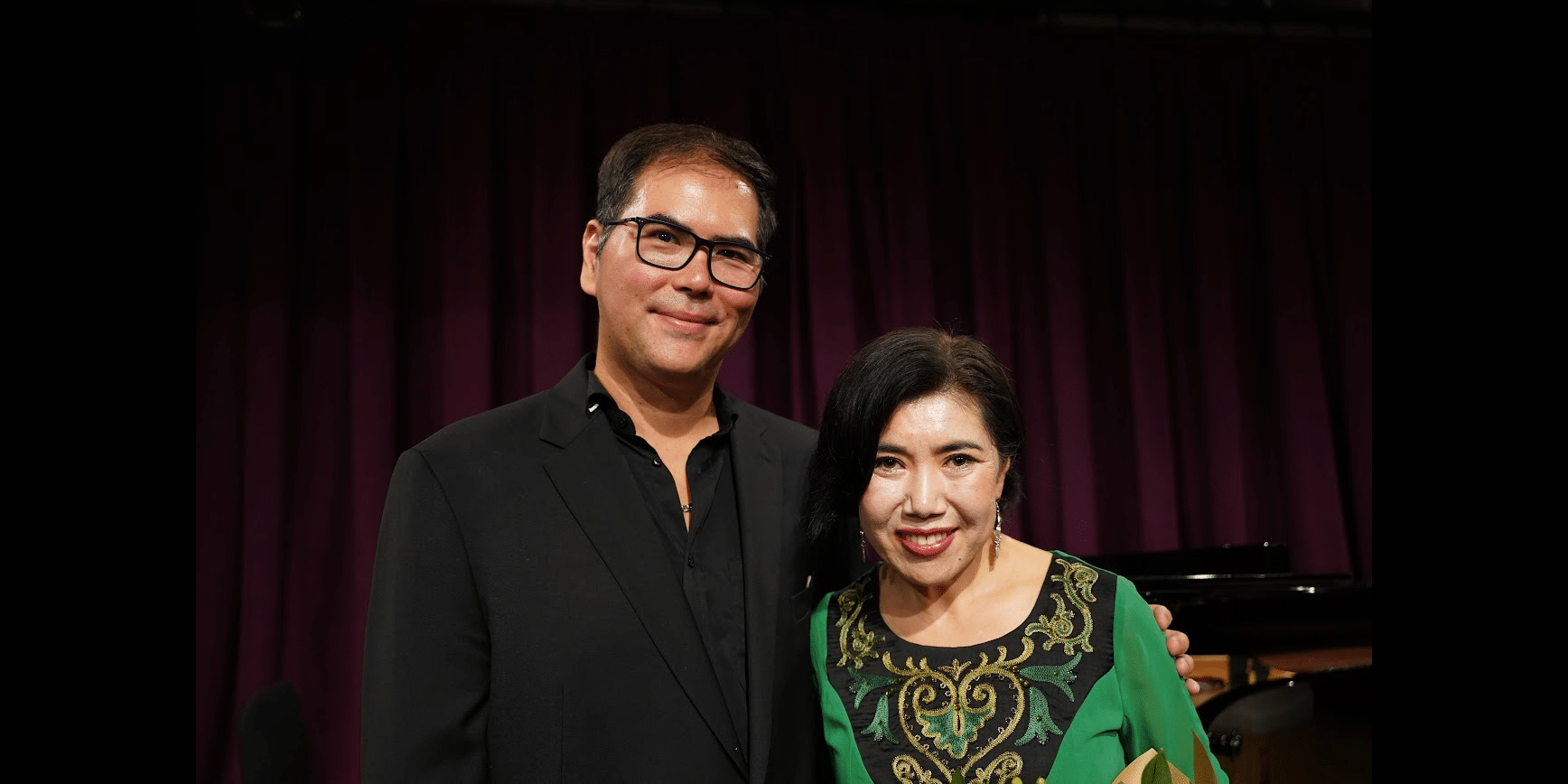
Pianist Aza Sydykov and cellist Nurmira Salimbaeva-Greenberg are on a mission to bring the music of Central Asia to a wider audience. The Kyrgyz musicians, now based in New York, recently brought their Sounds of Kyrgyzstan program to OPERA America’s National Opera Center in Manhattan as part of the Eurasia Festival. It included classical and folk music for cello and piano. Salimbaeva-Greenberg also played two traditional Kyrgyz instruments: the komuz, a three-stringed lute, and the kyl kyyak, a two-stringed older relative of the violin.
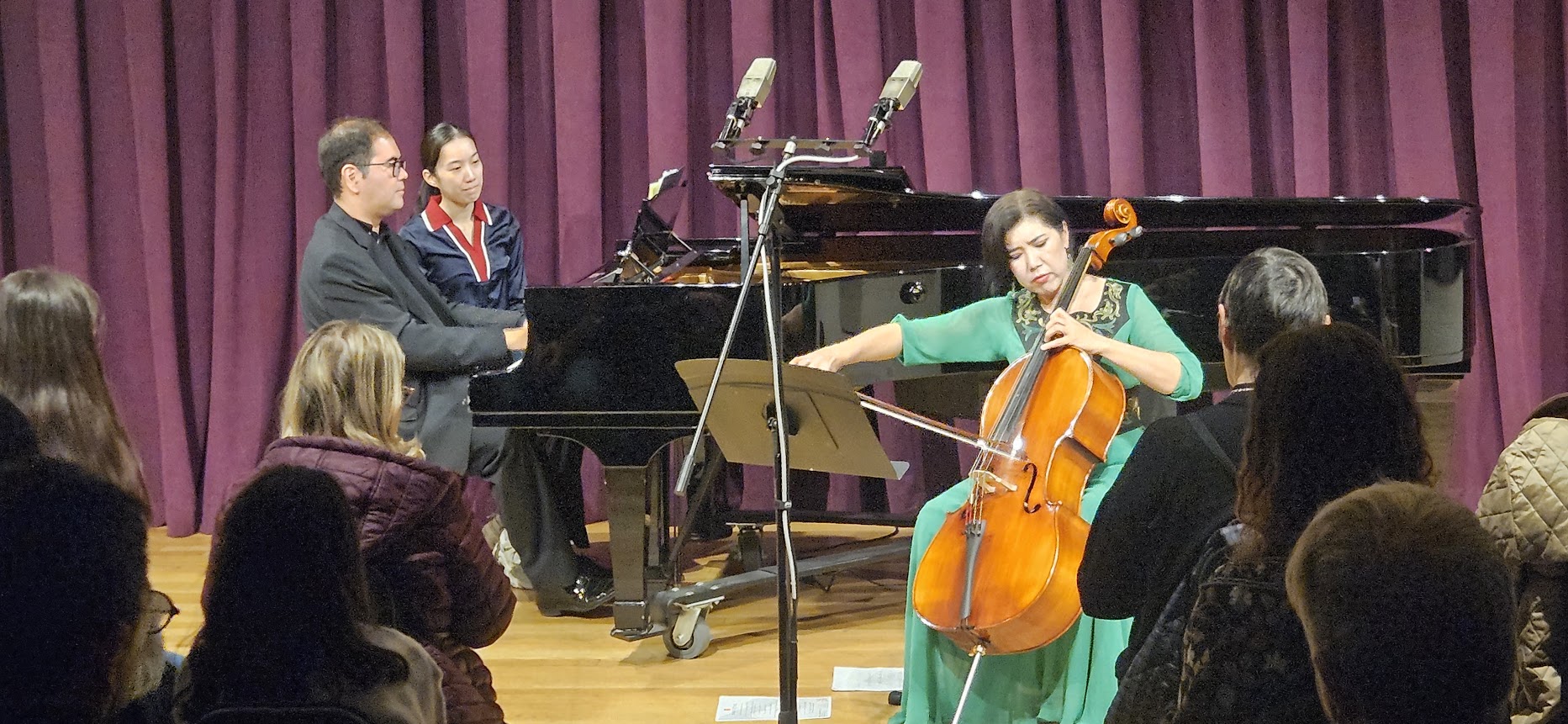
Image: K. Krombie; TCA
Introductions between pieces connected the sounds to experiences and traditions familiar in Kyrgyzstan, giving listeners a referential path into the music. The celebrated Kyrgyz composer Kalyi Moldobasanov, who co-wrote the music for the national anthem of Kyrgyzstan, featured prominently. Introducing Russian composer Vladimir Fere’s Dance, Sydykov argued that Soviet-era compositions deserved consideration on their artistic merits, rather than being reduced to their political context. “Music is music,” he said.
For Salimbaeva-Greenberg, learning the komuz had been a response to homesickness. During a visit to Kyrgyzstan, the cellist became a beginner again, sitting beside a teacher and copying hand movements. Strumming hand gestures with names such as “dolphin” and “figure eight” became part of her performance of the traditional Kyrgyz folk tune Koiron Kuu (The Boastful Piece). “I absolutely love this instrument,” she told the audience.
Introducing Kyrgyzstan to audiences abroad is a role both musicians know from childhood. In the early years of the country’s independence, they performed before heads of state and royalty on visits abroad with President Askar Akayev. Both participated in New Names, the Presidential Fund for Gifted Youth. Tours and performances in Russia and Türkiye followed. Sydykov credited the Meerim Foundation, established by first lady Mairam Akayeva, with supporting their group.
Onstage in New York, he laughed as he compared their travels aboard the presidential aircraft to flying on “Air Force One.” Kyrgyzstan gained independence in 1991, but few people they met abroad knew much about the country. For Sydykov, those journeys instilled “a sense of responsibility as cultural ambassadors for a young Central Asian republic with an ancient and remarkable heritage.”
Their education eventually took them in different directions. Salimbaeva-Greenberg studied at the Eastman School of Music in Rochester, New York. Sydykov trained at the Moscow State Tchaikovsky Conservatory before continuing at the Mannes School of Music in Manhattan. They reconnected in New York City in 2011 and began performing together again.
“Today, as musicians based in the United States, we see this work as a continuation of the mission we embraced in childhood,” he said of their collaboration.
Sydykov has sought to give younger Kyrgyz musicians opportunities of their own through the Kyrgyz American Foundation, which he co-founded in 2016 to promote musical and academic exchanges. The foundation has brought musicians selected through national competitions to perform in the U.S. He and Salimbaeva-Greenberg continue to visit Kyrgyzstan and maintain relationships with its musical community.
“We want this music to be a booster of pride,” Sydykov told The Times of Central Asia. “I think it’s very important that self-esteem is established. So we’re rebuilding these cultural ties. We want music to be this transnational language and bridge, and I think people like Kyrgyz and other Central Asians have a very ancient culture and presence in history. Our ancestors played a big role in the formation of this transnational economy,” he said, alluding to the expanding networks of the Silk Road. “Maintaining these connections is important to us because cultural exchange must be an ongoing relationship, not simply an occasional performance.”
The pair plan to revive their Eurasia Project, an ensemble effort that would introduce overlooked composers to listeners in Asia as well as the West. Sydykov’s commitment to Central Asian music is accompanied by a deep, almost anthropological curiosity about history and the evolution of cultures. He is fascinated by the movement of people and ideas across Eurasia and views historic exchanges along the Silk Road as a reason for musicians to work across national and linguistic boundaries today. Discussing colonialism and the influence of neighboring empires, he spoke of wanting people from smaller countries to feel confidence in their own musical inheritance. International recognition, in his view, can change how Central Asian audiences and diaspora communities see their cultures.
Sydykov finds encouragement in the response of fellow musicians in cities such as London and Paris. When he plays music for them that has its roots in Central Asia, they feel connected and want to perform it. “You know, there is no inferiority to this music.” The obstacle, he believes, is that many musicians have simply never heard it.
Sydykov and Salimbaeva-Greenberg share an infectious ambition to bring composers familiar in Central Asia into other musicians’ regular programs. Through those performances, Sydykov says, “they will have a chance to be known on the world stage.”