Kazakhstan is the only Central Asian economy included in a new U.S. tariff action covering 60 trading partners.
An additional tariff of 12.5% has been imposed on a range of Kazakh goods, excluding products listed in the annexes to the final decision. The rate applies to goods entered for consumption in the United States from July 24, 2026. Kazakhstan’s Ministry of Trade and Integration said about 95% of the country’s exports to the United States would remain outside the measure because of the exemptions. It also said the new tariff replaces an expired temporary 10% surcharge and will not be added to it.
Kazakhstan already prohibits forced labor in domestic employment under Article 7 of its Labor Code. The Office of the U.S. Trade Representative (USTR) did not allege that Kazakh exporters use forced labor. Its finding concerned a separate gap: Kazakhstan lacks a customs prohibition capable of excluding foreign goods produced wholly or partly with forced labor.
The investigation was launched in March under Section 301 of the Trade Act of 1974, a mechanism that allows Washington to respond to foreign practices it considers discriminatory or restrictive to U.S. commerce. In June, USTR concluded that the policies of all 60 economies under review warranted action. The final decision followed more than 1,600 written comments and testimony from over 100 witnesses. Most of the economies were divided into two rate groups, while the European Union, Taiwan, Japan, South Korea, and Switzerland received special treatment linked to existing most-favored-nation tariffs.
This was not a Kazakhstan-specific finding. USTR identified the same deficiency in 53 other economies, including Australia, Japan, Norway, Singapore, and South Korea. Together, the 60 economies under investigation accounted for 99.4% of U.S. imports.
A 10% tariff was imposed on countries that had introduced at least a partial ban on imports associated with forced labor or made corresponding commitments to Washington. Kazakhstan was placed in the 12.5% category alongside Australia, Israel, New Zealand, Norway, Singapore, the United Arab Emirates, and several other U.S. trading partners, as well as China and Russia.
The immediate cost to Kazakhstan will depend largely on the scope of the exemptions. Washington exempted raw materials where tariffs could leave the U.S. market without sufficient domestic supply, products whose higher cost could cause wider economic disruption, and goods that the United States cannot produce in sufficient quantities or obtain elsewhere. The 12.5% rate therefore does not mean that all Kazakh exports will become more expensive in the American market.
The structure of bilateral trade further limits the likely damage. Kazakhstan’s exports to the United States are concentrated in commodities, particularly oil, uranium, metals, and semi-processed materials. Many serve U.S. energy and industrial needs. The Kazakh government’s estimate that about 95% of exports remain exempt indicates that the largest trade flows should avoid the additional tariff, although the U.S. notice does not provide a Kazakhstan-specific calculation.
According to U.S. figures, goods trade between the two countries reached $5 billion in 2025. U.S. imports from Kazakhstan rose by 73% to $4.1 billion, while American exports to Kazakhstan fell to $985 million. The U.S. goods trade deficit with Kazakhstan consequently widened to $3.1 billion.
Even so, the decision creates a new political and legal problem for Astana. Legislation prohibiting imports linked to forced labor is no longer simply an issue of international reputation; it has become a condition for avoiding the additional tariff on non-exempt goods. The White House has authorized USTR to modify or terminate tariffs and exemptions for individual economies.
In that sense, the tariff is primarily a lever. Washington is extending its own product-origin requirements beyond the U.S. customs border and demanding that trading partners apply comparable restrictions in their domestic markets. A country may not use forced labor within its own economy and may still be penalized for failing to control imports from third countries.
The issue is particularly sensitive because China and Russia, Kazakhstan’s two largest individual trading partners, are also covered by the U.S. measures. Tighter controls would require scrutiny of finished products and of raw materials or components moving through complex Eurasian supply chains.
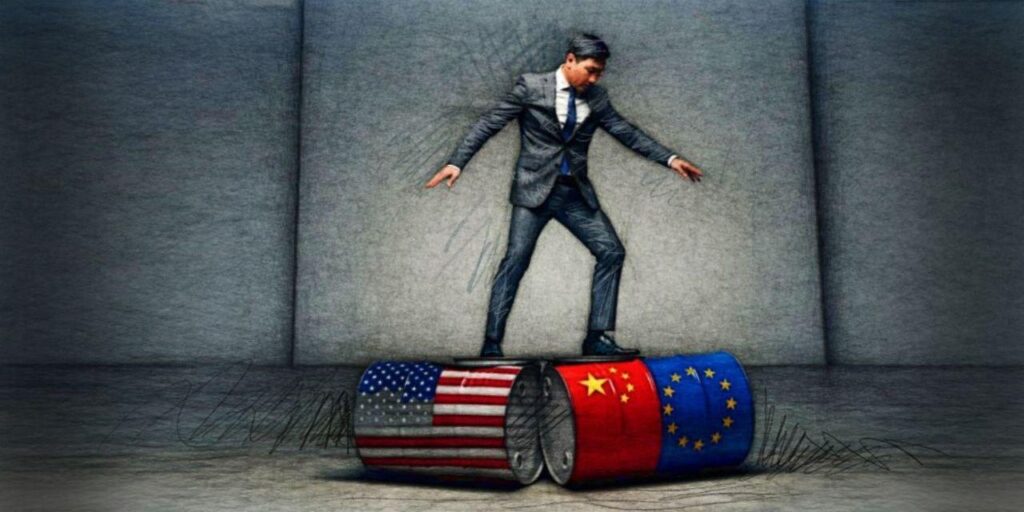
The tariff is unlikely on its own to reshape Kazakhstan’s foreign trade. The U.S. accounts for a smaller share of the country’s trade than the EU, China, or Russia, while most Kazakh exports to the American market remain exempt. The broader effect will be continued pressure on Astana to align its import controls more closely with the U.S. system while preserving trade with its two largest neighbors.
The new measure took effect as the temporary 10% U.S. import surcharge expired on July 24. That surcharge had been introduced in February under Section 122 of the Trade Act and was limited to 150 days. Its replacement with Section 301 duties marks a shift from a broadly applied levy toward targeted measures tied to the domestic policies of selected trading partners.
William Reinsch, a senior adviser at the Center for Strategic and International Studies, argued that the Section 301 investigation should not be viewed solely as a response to goods produced with forced labor. It also gave the Trump administration a new statutory basis for maintaining part of its tariff policy after the U.S. Supreme Court ruled that emergency economic powers did not authorize the president to impose tariffs.
The 95% estimate resembles one issued by Kazakhstan during a separate U.S. tariff dispute in July 2025. The ministry then said exemptions covered oil, uranium, silver, ferroalloys, tantalum, and titanium. That statement concerned the earlier tariff plan rather than the new Section 301 action, but it shows how Kazakhstan’s commodity-heavy export structure reduced its exposure to broad U.S. duties.
The latest measure therefore follows two distinct U.S. tariff episodes affecting Kazakhstan. A reciprocal tariff dispute began in 2025, followed by the temporary global surcharge introduced in February 2026. The new decision uses a more specific legal route and ties the treatment of non-exempt goods directly to whether trading partners prohibit imports associated with forced labor.
As previously reported by The Times of Central Asia, Washington has continued to expand cooperation with Kazakhstan in critical minerals and transport infrastructure despite introducing new tariffs. The contrast is sharpened by renewed efforts in Congress to remove Kazakhstan from the Cold War-era Jackson-Vanik amendment and grant it permanent normal trade relations. The amendment has little direct effect on current trade because Kazakhstan receives conditional normal trade treatment, but its continued application remains a political anomaly. Strategic engagement and tighter trade controls are developing in parallel. For Astana, the immediate economic effect may remain limited, but pressure to revise its import rules is likely to persist.