“Ornament Is a Language”: How a Tattoo Artist from Almaty Turns Culture into Art on Skin

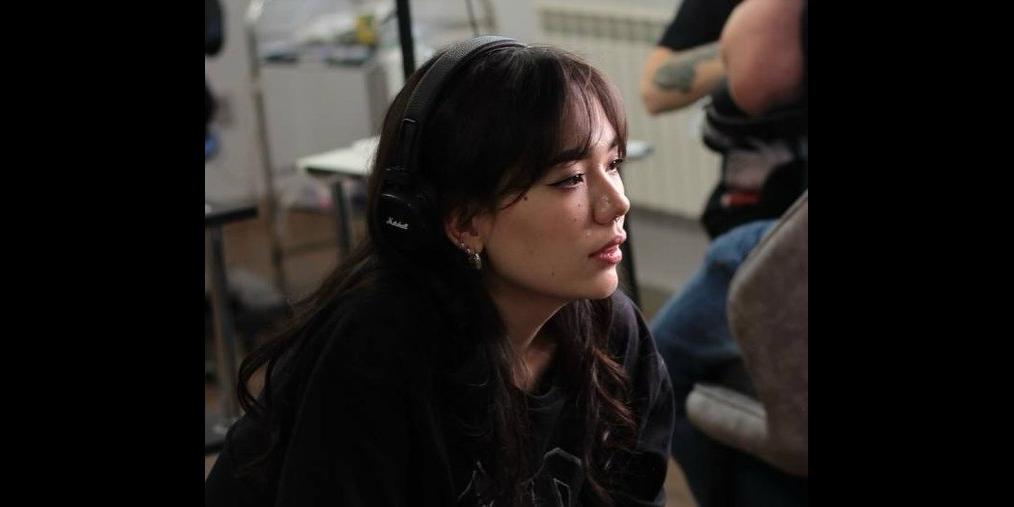
Almaty-based tattoo artist Saltanat Kuanova, known under the pseudonym tana.creator, is among those reinterpreting traditional culture through contemporary art. In her work, Kazakh ornaments become more than decorative elements, they form a complex system of symbols, personal stories, and cultural memory.
The Times of Central Asia spoke with her about why Kazakhstanis are increasingly choosing national motifs, how attitudes toward tattoos are changing, and whether tattooing can serve as a means of preserving identity.
Path into the Profession
TCA: When and why did you start practicing tattoo art?
Saltanat: I became interested in tattoos at around 14. Even then, I had a clear sense that it was “mine.” It wasn’t just curiosity, I immediately knew I wanted to become a professional in this field.
At 16, I began tattooing. By that time, I had already studied the theory, watched videos, and understood the process, so I was well prepared for formal training and quickly started working.
After completing my training, I was offered a position at a studio. That was important because it provided a steady flow of clients, and my work stood out. I worked there for about three years before moving into independent practice.
I have now been working independently for more than five years. I’ve gained experience in different studios, and today I have my own private workspace in Almaty and manage bookings through Instagram.
TCA: Do you remember your first work?
Saltanat: Of course. It was a small tattoo with Roman numerals that I did for a friend during my training. She came as a model to support me, and honestly, I was more nervous than she was.
My first paid piece left an even stronger impression it was a wolf with a dreamcatcher. That was the moment I first felt real responsibility toward a client. At the same time, I was surprised that I could actually earn money from this.
Even now, years later, I don’t feel like I’m “already a pro.” It’s an ongoing process; there is always room to grow.
@instagram.com/tana.creator
Working with Kazakh Ornaments
TCA: When did you start working with Kazakh ornaments?
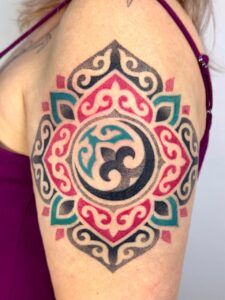
Saltanat: It happened gradually. At some point, I realized that ornament is not just a pattern, it’s a full-fledged language. It has structure, logic, even “grammar.” Everything matters: the shape, the number of elements, the color. Even a small detail can completely change the meaning of a piece.
TCA: Who usually comes for such tattoos locals or foreigners?
Saltanat: Primarily Kazakhstanis and, more broadly, representatives of Turkic peoples, Kyrgyz, Uzbeks, Tatars.
But there are also many foreigners, and their number is growing. I tend to group them into categories.
The first group includes people who come to Kazakhstan for work or travel and want a lasting memory of the country.
The second consists of those who have a partner from Kazakhstan. They come together and, through tattoos, connect with each other’s cultures.
The third and most touching category is people who were adopted abroad as children. They know they are originally from Kazakhstan and use tattoos as a way to reconnect with their roots. I have several such clients each year, and these are always very emotional stories.
Tattoo as a Personal Story
TCA: Which client stories have stayed with you the most?
Saltanat: Almost every piece is a story. Some people come after a serious illness and want to mark their recovery. Others come with requests related to love, relationships, or inner harmony.
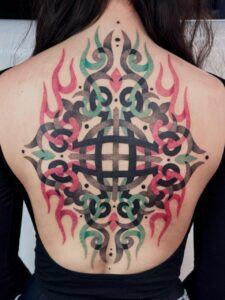
I always create designs from scratch, so I immerse myself deeply in each person’s story. My work often includes hidden meanings, encoded letters or individual combinations of ornaments.
Sometimes it may look like just a pattern, but in reality, it’s a very personal code. That’s why I dislike when my work is copied. People don’t realize they are carrying someone else’s story.
Why Interest in Ornaments Is Growing
TCA: Why do you think this is becoming popular now?
Saltanat: People are searching for identity. For a long time, cultural differences in the region were smoothed out, and some traditions were lost. Now there is a process of rediscovery. People want to understand who they are and where their roots come from. Ornaments have become one way to reconnect with that.
TCA: Can tattoos be considered a way of preserving culture?
Saltanat: Yes, absolutely. But it’s important not only to create tattoos, but also to talk about them through social media and visual content. I see that people often come to me because they are interested in culture first, and through that, they develop an interest in tattoos. It has become a kind of bridge between tradition and modernity.
TCA: Do you feel responsibility when working with national symbols?
Saltanat: A very strong one. On one hand, there isn’t much information available, and there’s a temptation to interpret things freely. But for me, it’s important not to distort meanings. On the other hand, simply copying tradition without adding anything new is also problematic. So I constantly balance respect for cultural heritage with my own artistic interpretation.
@instagram.com/tana.creator
On History and Cultural Representation
TCA: If you could create a comic telling the story of Kazakhstan, what would it be about?
Saltanat: That’s a very interesting question. I would like comics to popularize the real history of Kazakhstan, through Turkic culture and Tengrism.
But honestly, this is more a question for historians. For example, I deeply respect Irlan Pinbetov. He studies history seriously and responsibly, working with sources and presenting a more objective account of Kazakhstan’s past.
What we studied in schools often still reflects a Soviet-influenced narrative, with distortions and misplaced emphasis. He is essentially reconstructing this history in a more accurate way, and I’m currently studying with him myself.
I believe it would be valuable for Kazakhstan’s history to be developed through creative formats, books, comics, films, similar to practices in English-speaking cultures, where fictional stories are often grounded in real historical events. That is one reason their histories are widely known worldwide.
I would like to see more creative projects, engaging and artistic, but firmly grounded in factual accuracy.
The Future of Tattoo Culture in Kazakhstan
TCA: How do you see the development of the industry?
Saltanat: I try to contribute as much as I can to the development of tattoo culture in Kazakhstan. But I don’t see myself as the main driver, there are many others doing remarkable work.
For example, Dauren Ussenov from Astana is a well-known artist who is deeply committed to this field. He brings artists together, organizes events, and promotes tattoo culture.
I also contribute where I can. I’ve noticed that many people follow me because of their interest in ornaments and culture, even if they were not initially interested in tattoos. Through this, they develop an interest in tattooing as well, it creates a kind of funnel that brings new audiences into the industry.
In that sense, I see myself at the intersection of two fields: on one side, a tattoo artist, and on the other, a researcher of culture and ornaments.
I believe tattoo culture in Kazakhstan will continue to grow, but there are objective factors influencing it.
First, the economic factor. According to Maslow’s hierarchy of needs, tattoos are not a basic necessity. If people face financial difficulties, the industry naturally slows down.
Second, religion. In Islam, tattoos are considered haram, and this idea is widely promoted. Even those who are not strictly religious are influenced by their surroundings.
Third, cultural norms, particularly the concept of “uyat” (shame). Social pressure and fear of judgment still play a significant role and often discourage people from getting tattoos.
Despite these challenges, the industry continues to develop. Demand is growing, and, importantly, people’s tastes are evolving. They are increasingly seeking unique, thoughtful, and artistic work which is a positive sign.
TCA: If you could create a tattoo symbolizing Kazakhstan, what would it be like?
Saltanat: It would be a large, complex project, possibly a full-body composition. A system of ornaments built according to all compositional rules: levels, structure, meanings. Not just a single element, but a unified, harmonious system, layered and detailed. Just like the culture itself.