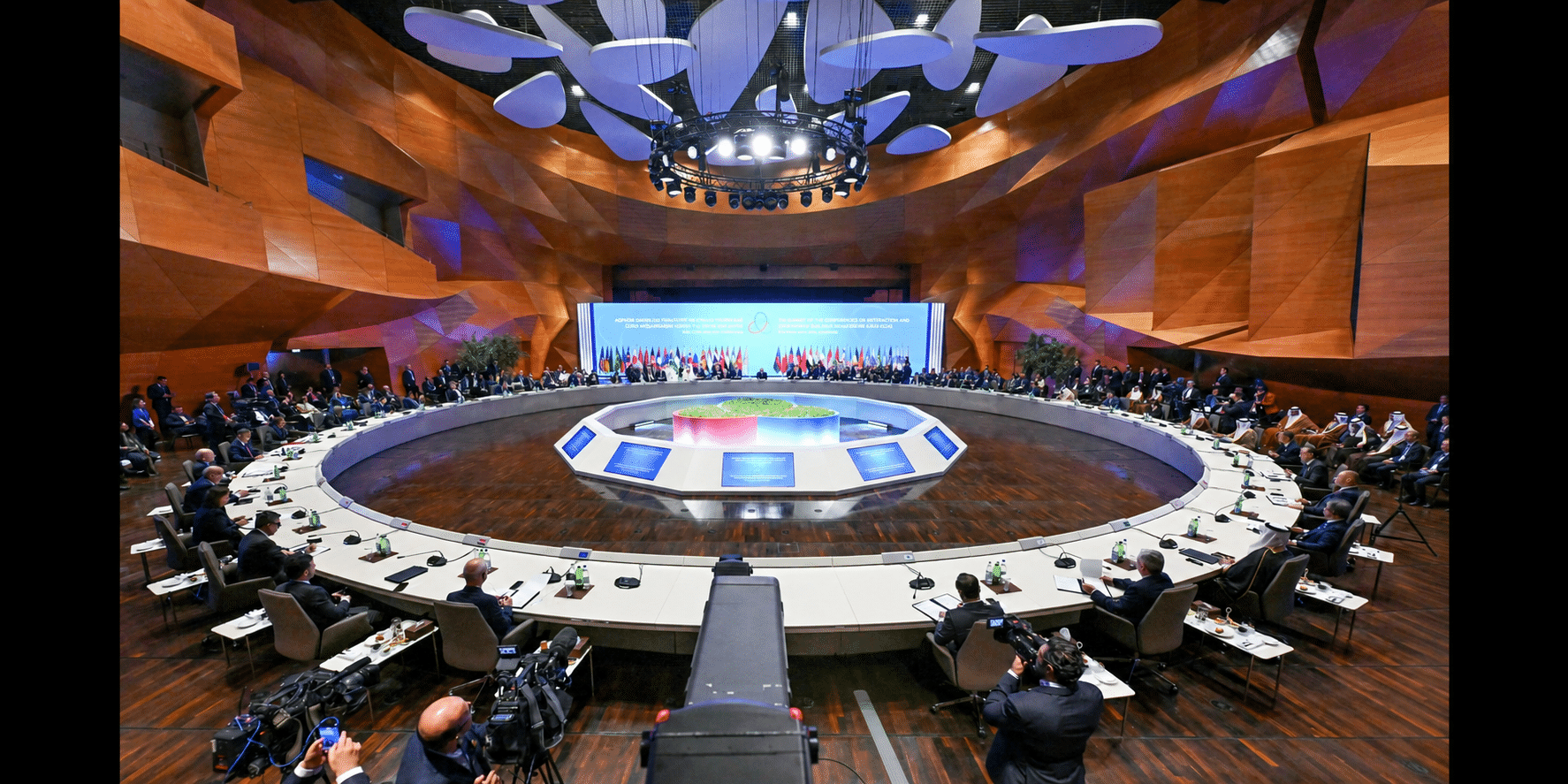
Central Asian leaders called for better transport links and joint action on water shortages at the Baku summit in Azerbaijan on October 15, arguing that practical cooperation could prevent political disputes from turning into conflict.
The seventh summit of the Conference on Interaction and Confidence Building Measures in Asia (CICA) adopted the Baku Declaration, admitted Laos as a new member, and approved Azerbaijan’s continued chairmanship through 2028.
Uzbekistan’s President Shavkat Mirziyoyev called for an “infrastructure of trust” based on transparent government actions and the fulfillment of commitments. His proposed concept would connect conflict prevention with joint transport and energy projects, trade, and digital links. He pointed to the damage that conflicts in Asia were causing to economies and security far from the fighting.
Mirziyoyev warned, “When dialogue weakens, the risk of misguided decisions increases.” He urged governments to prevent political disagreements from becoming armed confrontations.
Kazakhstan’s President Kassym-Jomart Tokayev proposed a preventive diplomacy mechanism within CICA, enabling members to contribute before a crisis develops. He told the summit, “Peace is best built before crises emerge.”
According to the Azerbaijani state news agency AZERTAC’s account, the Baku Declaration includes provisions on economic ties, transport and digital connections, and energy security. It addresses the opportunities and risks of artificial intelligence.
Trade Routes Across the Caspian Sea
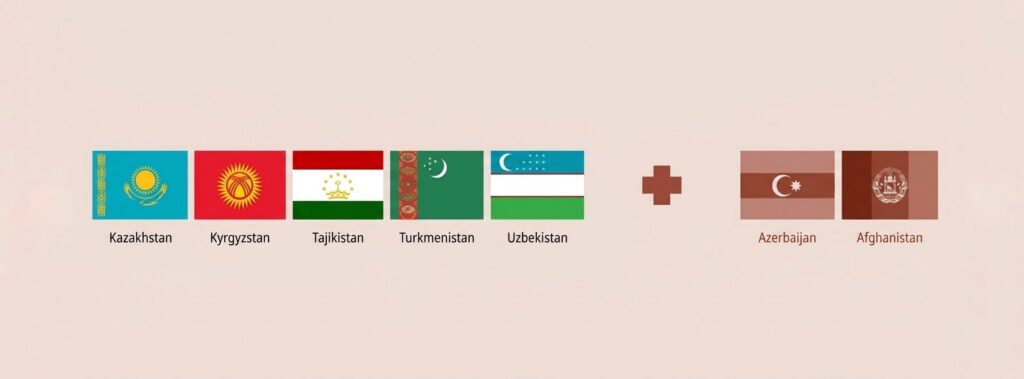
The meeting came one week after the Avaza summit, where Central Asian presidents and Azerbaijan’s Ilham Aliyev discussed east-west and north-south trade routes. In Baku, those regional priorities entered a wider Asian forum, alongside calls to make commercial relationships more dependable.
Tokayev proposed a CICA Transport Connectivity Strategy covering major routes, including the Middle Corridor across the Caspian Sea. He linked Azerbaijan’s rapprochement with Armenia to new opportunities for east-west transport.
Tajikistan’s President Emomali Rahmon called in his summit address for simpler customs and logistics procedures and better connections between different forms of transport. He presented economic cooperation as a foundation for lasting peace, alongside continued action against terrorism and its financing.
On the summit’s sidelines, the foreign ministers of Azerbaijan, Turkmenistan, and Uzbekistan discussed transport and transit cooperation. Their talks covered improvements to logistics infrastructure and international routes connecting Central Asia with the Caucasus, according to Turkmenistan’s government account.
During a separate bilateral meeting, Tokayev and Aliyev inaugurated the Trans-Caspian Fiber-Optic Cable Line remotely, opening an approximately 380-kilometer connection between Aktau in Kazakhstan and Sumgayit in Azerbaijan. The project forms part of the Digital Silk Way initiative, with onward connections intended to carry data between China, Central Asia, and Europe.
Kazakhstan’s Ministry of Artificial Intelligence and Digital Development gives the cable a design capacity exceeding 400 terabits per second. The ministry says the additional route will provide backup for existing international connections and allow operators to distribute traffic across more channels. It expects the connection to attract investment in data centers and cloud services as Kazakhstan seeks a larger role in carrying international data.
Kyrgyzstan’s President Sadyr Japarov similarly called for fiber-optic routes linking Asia and Europe. He invited technology companies to build data centers and computing facilities in Kyrgyzstan, citing its hydropower resources and climate. He said Kyrgyzstan’s trade with CICA members had more than doubled over four years to exceed $14 billion in 2025.
Calls for AI Safeguards and Water Conservation
The push for more digital infrastructure was accompanied by proposals to manage its risks. Mirziyoyev suggested an expert platform within CICA to develop shared recommendations on responsible artificial intelligence, under an Asian initiative on technological trust. Tokayev called for artificial intelligence to become a sixth dimension of CICA’s work, citing risks to interstate stability.
Kazakhstan advocated a CICA Water Partnership for joint research, technology exchange, and water-saving solutions. Uzbekistan suggested a Partnership for Climate Resilience that would combine water-saving technologies with green energy and continuous environmental monitoring.
Japarov proposed a joint trust fund under United Nations auspices to protect Issyk-Kul and offered an initial contribution of $10 million, according to a presidential statement carried by Kyrgyzstan’s state news agency Kabar. He presented the fund as a means of attracting technology, scientific expertise, and international financing to protect vulnerable mountain ecosystems.
Tokayev and Mirziyoyev called for continued work on CICA’s charter. Members agreed in Astana in 2022 to turn the conference into a full international organization, and both presidents presented the charter as a next step in that process.
The gap between proposals and implementation had already been raised at Avaza. In his October 8 address, Tokayev said more than 200 initiatives had been put forward in the regional consultative format since 2018, but only a small proportion had been implemented. He called on foreign ministries to review those initiatives and assess which remained relevant and achievable.