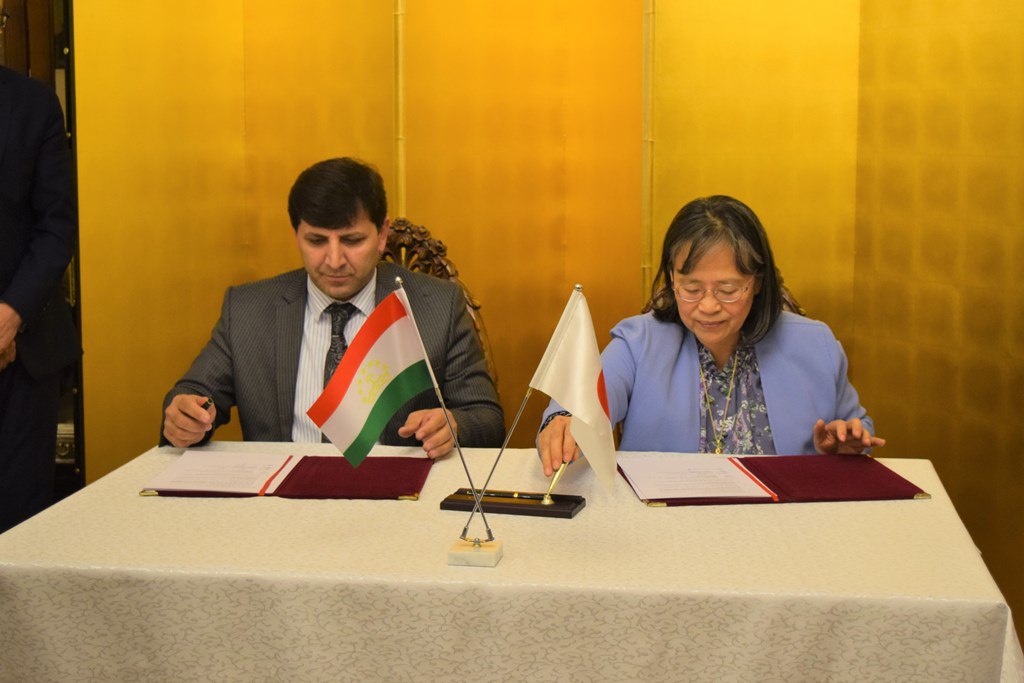
Japan is one of the countries that has been most active in recent years in terms of deepening political and economic relations with the republics of Central Asia. However, the geopolitical and ideological grounds for Tokyo’s activism have received less attention than those of other countries. In early August 2024, then Prime Minister Fumio Kishida was scheduled to visit the region, but the visit was cancelled at the last minute due to the risk of a major earthquake that could have struck Japan at that time. During his visit, Kishida was also expected to announce the launch of an economic aid package for the Central Asian republics.
As confirmed by the Ministry of Foreign Affairs in Tokyo, Japanese Foreign Minister Takeshi Iwaya is visiting the region over the coming days, landing in Kazakhstan on August 24, before moving on to Uzbekistan until August 28. In the two countries, he will meet with his Kazakh and Uzbek counterparts, Murat Nurtleu and Bakhtiyor Saidov, respectively, with the aim in both cases of strengthening bilateral relations.
Japan’s interest in Central Asia is long-standing: the Central Asia Plus Japan Dialogue format was launched back in 2004, a platform that has been emulated by several countries in the following years. From a political point of view, this is a very smooth relationship, as confirmed to The Times of Central Asia by Timur Dadabaev, Professor of International Relations at the University of Tsukuba.
“Japan’s engagement with Central Asia is driven less by immediate material gain and more by its pursuit of trust-building diplomacy,” Dadabaev told TCA. “It is a relationship rooted in Japan’s desire to be seen as a reliable, non-imperial partner that supports the sovereignty, stability, and regional agency of Central Asian states. Unlike other powers, Japan positions itself as a ‘distant neighbor without hidden agendas,’ which makes its initiatives particularly well-received. Over the years, this has translated into Japan being perceived not as a competing hegemon, but as a partner that invests in the region’s human capital, infrastructure, and governance in ways that reinforce independence rather than dependence.”
The relationship between Japan and the Central Asian republics is based on many concrete elements – cooperation on energy, migrant workers, and connectivity – which, as Tomohiko Uyama, Professor of Modern History and Politics of Central Asia at Slavic-Eurasian Research Center at the Hokkaido University pointed out to TCA, represent the basis for broader diplomatic engagement.
“The relationship between Japan and Central Asia is based on geopolitical factors. For Japan, Central Asia is a region that shares troublesome neighbors, Russia and China,” Uyama said. “Increasing Japan’s presence in this region is important for curbing the excessive expansion of China and Russia’s global influence. However, strengthening diplomatic relations requires fostering economic and human relations. Therefore, in addition to its traditional technical cooperation, Japan is seeking to promote decarbonization, transportation connectivity, and human resource development.”
Professor Dadabaev also stresses that the two dimensions – the one linked more to concrete elements and the one that has more to do with political elements – go hand in hand: “Economic ties such as energy cooperation and labor mobility are important, but they do not exhaust the relationship. What makes Japan’s approach unique is its political symbolism: it recognizes Central Asia as a region with its own voice and aspirations. Japan’s cooperation extends to governance reform, human resource development, and regional connectivity. This signals that the partnership is as much about political trust and identity as it is about trade”.
More than two decades ago, Japan was the first country to launch a formal “C5+1”–style framework that grouped all five Central Asian states together as a single partner. This forum for dialogue continues to form the basis of Tokyo’s commitment to the region, thanks in part to some of its unique characteristics. “Unlike transactional models, Japan’s ‘Central Asia plus Japan’ is dialogue-oriented, not dictate-oriented,” Dadabaev told TCA. “Its features are humility, long-term commitment, and the deliberate avoidance of zero-sum geopolitics. What stands out is that Japan’s approach is not about quick wins but about establishing predictable, rules-based relations with the region. This explains why the format, introduced by Japan, has since been emulated by other major powers, yet continues to carry credibility precisely because Japan does not tie it to coercive conditions or geopolitical pressure.”
Over the years, Japan’s approach, while retaining its distinctive characteristics, has changed in some respects in order to respond to China’s growing influence in Central Asia. The relationship between Tokyo and Beijing is characterized by a dual track: on the economic front, there is growing interdependence, while on the political front, a high degree of mutual distrust continues to persist.
Central Asia is a region where this competition is further represented. Professor Uyama notes that, “Japan’s policy toward non-Western countries emphasizes responding to the needs of each country’s development rather than imposing Japan’s interests and values, with a particular emphasis on grassroots cooperation with local communities. Furthermore, as Japan has stated from the outset of the ‘Central Asia + Japan’ dialogue that it aims to serve as a catalyst for regional integration, it hopes to provide support for cooperation among Central Asian countries. However, in recent years, as China’s influence in development cooperation has grown, Japan has been seeking to strengthen cooperation on global issues, such as environmental problems.”
Ultimately, Tokyo’s Central Asia play is a long-horizon bet on trust and delivery. By coupling diplomacy with concrete work on decarbonization, transport corridors, skills, and governance, Japan is proposing a rules-based partnership that prizes sovereignty and predictability over quick transactional wins. The near-term test is execution: converting dialogue into financed projects, expanding people-to-people programs and lawful labor pathways, and aligning standards so freight, finance, and data move more smoothly. If Japan sustains that approach – and Central Asian capitals keep using the format to cooperate with one another as well as with Tokyo – the relationship should outlast news cycles and great-power swings, giving the region a reliable external partner and Japan a durable role as the ‘distant neighbor’ that shows up.