• KGS/USD = 0.01144 0%
  • KZT/USD = 0.00213 0%
  • TJS/USD = 0.10836 0.28%
  • UZS/USD = 0.00008 0%
  • TMT/USD = 0.28490 -0.28%
  • KGS/USD = 0.01144 0%
  • KZT/USD = 0.00213 0%
  • TJS/USD = 0.10836 0.28%
  • UZS/USD = 0.00008 0%
  • TMT/USD = 0.28490 -0.28%
  • KGS/USD = 0.01144 0%
  • KZT/USD = 0.00213 0%
  • TJS/USD = 0.10836 0.28%
  • UZS/USD = 0.00008 0%
  • TMT/USD = 0.28490 -0.28%
  • KGS/USD = 0.01144 0%
  • KZT/USD = 0.00213 0%
  • TJS/USD = 0.10836 0.28%
  • UZS/USD = 0.00008 0%
  • TMT/USD = 0.28490 -0.28%
  • KGS/USD = 0.01144 0%
  • KZT/USD = 0.00213 0%
  • TJS/USD = 0.10836 0.28%
  • UZS/USD = 0.00008 0%
  • TMT/USD = 0.28490 -0.28%
  • KGS/USD = 0.01144 0%
  • KZT/USD = 0.00213 0%
  • TJS/USD = 0.10836 0.28%
  • UZS/USD = 0.00008 0%
  • TMT/USD = 0.28490 -0.28%
  • KGS/USD = 0.01144 0%
  • KZT/USD = 0.00213 0%
  • TJS/USD = 0.10836 0.28%
  • UZS/USD = 0.00008 0%
  • TMT/USD = 0.28490 -0.28%
  • KGS/USD = 0.01144 0%
  • KZT/USD = 0.00213 0%
  • TJS/USD = 0.10836 0.28%
  • UZS/USD = 0.00008 0%
  • TMT/USD = 0.28490 -0.28%

Our People > Andrei Matveev

Andrei Matveev's Avatar

Journalist

Andrei Matveev is a journalist from Kazakhstan.

Articles

Aliyev Sees Azerbaijan and Central Asia’s Interests Converging

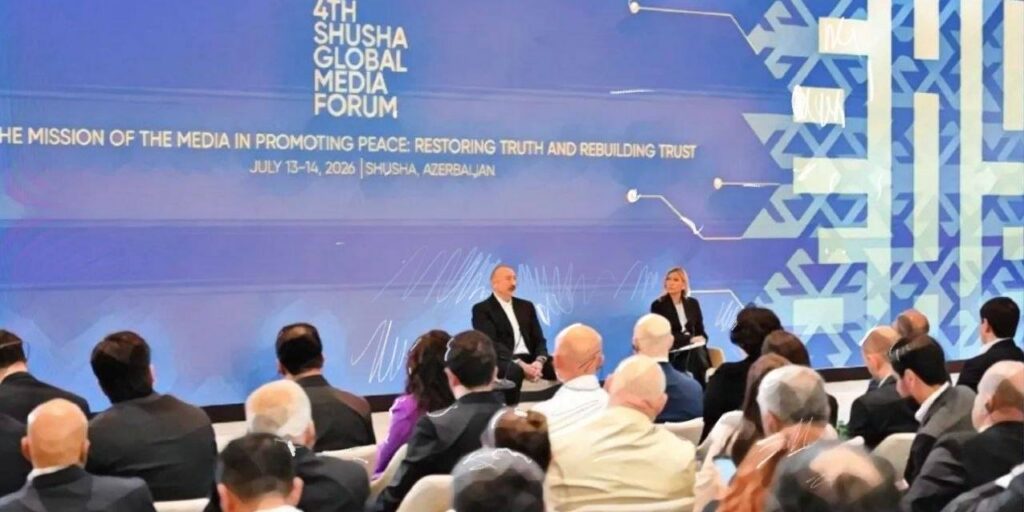
The Shusha Global Media Forum, an annual gathering held in Azerbaijan’s Karabakh region and conceived as a platform for journalists and media representatives from dozens of countries across Europe and beyond, including the United States, acquired broader regional significance last year because of its consequences for several Russian participants. Last year’s forum attracted widespread attention in Russia after two prominent Russian participants faced repercussions at home. Mikhail Gusman, then first deputy director general of the state news agency TASS, was dismissed shortly after attending the event and praising Azerbaijan, although no official reason was given. The following month, pro-Kremlin political analyst Sergei Markov was designated a “foreign agent” after facing criticism for his favorable comments about Azerbaijan. It was therefore unsurprising that this year’s forum attracted close attention from media outlets around the world. Beyond the forum’s Russia-related significance, Azerbaijan’s President Ilham Aliyev’s remarks pointed to a broader regional shift. Azerbaijan increasingly sees its political and economic interests converging with those of Central Asia, particularly through the Middle Corridor, cross-Caspian energy links, and infrastructure cooperation. According to official figures, approximately 160 journalists, experts, and public officials from 53 countries attended the event. The forum brought together representatives of around 30 international news agencies, more than 60 leading media organizations, and roughly 10 international organizations and companies. Former TASS executive Mikhail Gusman attended the fourth Shusha Global Media Forum and highlighted its growing international profile. “There are very few, if any, media platforms in the world that bring together representatives of media organizations from every region to exchange views and engage in dialogue. That is precisely why the importance of this forum cannot be overstated,” he said. As in previous years, President Aliyev opened the forum and spent nearly three hours answering questions from journalists representing a wide range of countries. Given the latest deterioration in relations between Baku and Moscow, many observers were watching to see whether questions would prompt unusually sharp comments about Russia. The organizers did not shy away from potentially sensitive questions. Ukrainian journalist Dmytro Gordon, who has been designated an extremist in Russia, was once again invited to the forum and made full use of the opportunity. Gordon noted Ukrainian drone and missile strikes deep inside Russia before asking Aliyev what counsel he would offer Ukraine and President Vladimir Putin. “What advice would you give Putin today, when, in my view, he no longer has any good options left?” Gordon asked. Aliyev avoided an overtly confrontational response, stating that Ukraine should “never agree to occupation” and that the war “must be stopped—and stopped immediately.” Aliyev’s exchange with journalists and analysts from Europe and the United States painted a clear picture of Azerbaijan’s worldview and the role it sees for itself internationally. That perspective remains heavily shaped by the three-decade conflict between Baku and Yerevan over Karabakh. According to Aliyev, the United States, France, and Russia all sought to preserve the status quo during that period. He described those decades as a “time of war,” arguing that...

4 hours ago

As Azerbaijan Pushes Back Against Moscow, Central Asia Watches

The recent diplomatic escalation between Azerbaijan and Russia appeared to have run its course in April, after Moscow agreed to pay compensation over the Azerbaijan Airlines crash in Kazakhstan. Instead, the dispute has entered a new phase, and its implications now reach beyond the South Caucasus. On July 6, Azerbaijan’s Ministry of Foreign Affairs summoned Russian Ambassador Mikhail Yevdokimov and handed him a formal note of protest over what Baku described as a Russian drone strike on a fuel station owned by Azerbaijan’s state energy company SOCAR in Ukraine’s Mykolaiv region on the evening of July 5. The Azerbaijani Foreign Ministry said the attack on SOCAR facilities in Ukraine was not an isolated incident. It cited previous strikes on the company’s gas distribution compressor station and oil depot in Odesa, which caused material damage and injured employees. Baku also pointed to earlier damage to the Azerbaijani embassy building in Kyiv and the honorary consulate in Kharkiv, calling on Moscow to investigate and comply with its obligations to protect civilian infrastructure and diplomatic missions. At the same time, Shusha — known to Armenians as Shushi, retaken by Azerbaijan during the 2020 Karabakh war, and still regarded by many Armenians as occupied — hosted an international conference devoted to what participants described as Russia’s “colonial policy,” the “Circassian genocide,” and the situation of non-Russian peoples within the Russian Federation. The conference declaration called on Moscow to “recognize its historical crimes, abandon its chauvinistic policies, and end the forced recruitment of ethnic minorities into the war against Ukraine.” Experts from Azerbaijan, the United States, France, Lithuania, Poland, the Czech Republic, Germany, Israel, Türkiye, and Georgia attended the conference. None of the Central Asian republics was represented. That absence was telling. Central Asian governments may be distancing themselves from Moscow in certain areas, but they remain reluctant to participate in openly anti-Russian political initiatives. For Astana, Tashkent, Bishkek, Dushanbe, and Ashgabat, the question is not whether Russia’s position has weakened, but how far they can move without provoking pressure from Moscow. For Central Asia, the dispute is not a distant quarrel in the South Caucasus. Azerbaijan is now a central link in the westward routes that Kazakhstan, Uzbekistan, Turkmenistan, and Kyrgyzstan are trying to strengthen as alternatives to Russian territory. The Middle Corridor runs from China through Central Asia, across the Caspian Sea, and onward through Azerbaijan, Georgia, and Türkiye to Europe. Any deterioration in Azerbaijan-Russia relations therefore has practical implications for Central Asian transit, energy, and diplomatic room for maneuver. The first major rupture in relations between Baku and Moscow came after Azerbaijan Airlines Flight J2-8243, traveling from Baku to Grozny, was damaged by Russian air-defense fire over Russian territory on December 25, 2024. The aircraft later crashed while attempting an emergency landing near Aktau, Kazakhstan, killing 38 people. Azerbaijan blamed Russia and demanded an apology, accountability, and compensation. Relations deteriorated further in June 2025 following the detention of ethnic Azerbaijanis in Yekaterinburg and reports of torture. The most prominent victims were the...

6 days ago

Kazakhstan Court Ruling Clears Legal Path for Tokayev to Seek Another Term

Kazakhstan’s Constitutional Court has ruled that President Kassym-Jomart Tokayev may seek another term under the country’s 2026 Constitution, effectively resetting the count created under the previous Basic Law while leaving the single seven-year presidential term formally in place. The ruling, issued on July 7 after Tokayev’s request, addressed whether people who held senior offices under the 1995 Constitution could be elected or appointed to those posts under the new Basic Law, adopted in a March 15 referendum and in force since July 1. The offices covered include the president, the chair and judges of the Constitutional Court, the chair of the Supreme Court, and the prosecutor general. The court said restrictions in the 2026 Constitution are linked only to elections and appointments made under the new constitutional order and laws adopted on its basis. It said the new Constitution contains no provision requiring terms, elections, or appointments under the 1995 Basic Law to be counted when the new limits are applied. The court’s official interpretation says people who held those offices under the 1995 Constitution “may be elected or appointed to the corresponding positions after the 2026 Constitution enters into force.” In practical terms, the ruling removes the main legal barrier that had been assumed to prevent Tokayev from appearing on the presidential ballot again. Tokayev was elected in November 2022 to what was presented as a single, non-renewable seven-year term ending in 2029. He has not announced another run, and the ruling does not set a timetable for a presidential election. Speculation has also continued over whether Tokayev could seek a future international role, including as UN secretary-general. According to political analyst Daniyar Ashimbayev, the Constitutional Court’s clarification resolves a strategic issue over the president’s term of office. He recalled that Tokayev’s 2022 election followed an earlier constitutional reform that introduced the single seven-year presidential term. A later dilemma emerged because the previous constitutional rules would have required elections to be held in December 2028, almost a year before the end of the seven-year mandate. “In the new Constitution, these formulations were changed, but a new question emerged: does the new Constitution require a review of terms in connection with the reset of political institutions? The text itself contained no relevant provisions. At a press briefing on voting day, Tokayev said the next elections would be held in 2029,” Ashimbayev said, adding that Tokayev’s appeal showed that the issue would be handled through constitutional procedure rather than political assumption. The court, he said, indicated that adoption of the new Constitution does not mean the automatic extension of norms contained in the old Constitution or decisions adopted on its basis. “Thus, the single seven-year term is confirmed, but it will be counted from the moment elections are held. The Constitution, however, prohibits holding presidential and parliamentary elections at the same time, which moves the presidential issue to the autumn,” Ashimbayev said. “It is clear that this is about the right, not the obligation, of the incumbent head of state to...

1 week ago

Kyrgyzstan’s Water Compensation Push Tests Central Asian Unity

Central Asia’s water diplomacy is entering a contentious phase. Kyrgyzstan, where much of the region’s runoff is formed, is reviving calls for economic compensation from downstream users. Kazakhstan and Uzbekistan have rejected the idea, saying current agreements do not provide for payments for transboundary river water. The dispute comes as the region tries to maintain annual water-allocation deals while adapting agriculture to worsening scarcity and climate pressure. Water has long tied together the region’s upstream and downstream states. The 2021 and 2022 clashes on the Kyrgyz-Tajik border showed how disputes over land, border infrastructure, roads, security posts, and water access can escalate when local tensions are not contained. Yet political will alone does not guarantee agreements between countries. The Central Asian republics cooperate on water issues through two interstate bodies. One is the International Fund for Saving the Aral Sea, established in 1993 by all five Central Asian republics. Kyrgyzstan suspended its participation in IFAS in 2016, and now attends the fund’s meetings as an observer. The second body is the Interstate Commission for Water Coordination, whose meetings are held once a quarter. At its 93rd meeting in Bukhara in early April, the commission confirmed limits for water withdrawal from transboundary rivers, following decisions approved at the 92nd meeting in Dushanbe. For the Amu Darya, the 2026 water allocations set the total withdrawal limit for the water-management year from October 2025 to October 2026 at about 55.4 billion cubic meters. Of this, 15.9 billion cubic meters is allocated for the cold period, from October to April. Tajikistan has been allocated 9.8 billion cubic meters per year, while Turkmenistan and Uzbekistan each receive 22 billion. A significant part of the flow, 44 billion cubic meters, must pass through the adjusted section of the Kerki hydrological post, helping secure the lower reaches of the river. For the Syr Darya, the total water withdrawal limit for the non-growing season is 4.219 billion cubic meters. Kazakhstan will receive 460 million cubic meters through the Dustlik Canal, Kyrgyzstan 47 million, and Tajikistan 365 million, while the largest share will go to Uzbekistan, 3.347 billion cubic meters. The inherited framework is also facing pressure from outside the five-state system. Afghanistan’s Qosh-Tepa Canal, which is being advanced outside the Soviet-era allocation structure, has added uncertainty on the Amu Darya. The Central Asian republics also cooperate in bilateral and trilateral formats. In January, Kazakhstan-Uzbekistan joint working groups met in Turkestan. The sides reaffirmed water cooperation, agreed to continue repairs on the Dostyk canal, and planned automated hydrological posts on the Syr Darya. In May, Kazakhstan, Uzbekistan, and Tajikistan agreed on the operating regime of the Bahri-Tojik Reservoir for the summer of 2026. From June to August, the reservoir is to operate in a coordinated mode to supply irrigation water to farmers in the Maktaaral and Zhetysai districts of southern Kazakhstan. These agreements show that regional mechanisms still work, but experts continue to warn that climate pressure, data gaps, and uneven national interests could overwhelm existing formats. “Forecasting the...

2 weeks ago

Kazakhstan’s Parliament Gives Way to New Kurultai Under Tokayev’s Constitutional Reset

Kazakhstan’s bicameral parliament held its final joint session in Astana on June 30, closing a 30-year legislative era before the new Constitution takes effect on July 1. The change will replace the Senate and Mazhilis with a single-chamber Kurultai. Elections to the new body are expected in August, with 145 deputies to be elected through party lists. No current deputy will transfer automatically into the new chamber, giving the coming vote direct importance for Kazakhstan’s parties and for President Kassym-Jomart Tokayev’s wider state overhaul. Addressing the final joint session, Tokayev framed the change as more than an administrative reform. He said Kazakhstan was entering “a new chapter in the development of independent Kazakhstan,” and beginning what he called a new historical era. The president also used his speech to summarize the work of the parliament created under the 1995 Constitution. Over three decades, the legislature adopted around 3,500 laws, which Tokayev said had helped strengthen the country’s statehood. “Today, we are completing an important parliamentary political cycle and opening a new chapter in the development of independent Kazakhstan,” Tokayev said. According to Tokayev, more than 300 major laws, including constitutional legislation, have been adopted over the past three years. He described them as “a reliable platform for our future achievements.” The transition also carries a succession dimension. The new Constitution creates a vice presidency and rewrites parts of the state architecture ahead of the scheduled end of Tokayev’s single seven-year presidential term in 2029. Tokayev has presented the changes as a modernization of governance, while the August Kurultai election will show how much room the new party-list system gives to political competition. Tokayev told deputies that the new legislature would need to move faster than the outgoing parliament. He said the Kurultai would be expected to remove bureaucratic obstacles, improve the speed and quality of law-making, and bring qualified experts and consultants into legislative work. “The Kurultai will have to eliminate all obstacles in the form of bureaucratic procedures, increase the speed and quality of law-making, and organize the effective work of qualified experts and consultants,” Tokayev said. He linked those goals to global instability and digital competition, saying Kazakhstan had to adapt legislation to a rapidly changing environment. “The Kurultai will have to work at an accelerated pace to promptly adapt national legislation to rapidly changing realities within the digital matrix,” Tokayev said. “This is a critically important task, as it will determine Kazakhstan’s readiness to participate in global competition.” Tokayev praised the outgoing deputies for their work on digital legislation. He said there had been no ready-made templates for regulating artificial intelligence, and credited the parliament with helping build a flexible legal system. Tokayev said Kazakhstan had become one of the first countries to adopt both a Digital Code and a specialized law on artificial intelligence. He also pointed to the new Constitution’s guarantees on the protection of personal data in cyberspace. The next phase, he said, would include a full e-Parliament system. Tokayev first raised that idea...

2 weeks ago

Kurultai Election Campaign Takes Shape in Parliament’s Final Budget Debate

Kazakhstan's outgoing parliament spent one of its final sessions debating the government's management of the 2025 budget, in what often resembled a dress rehearsal for the country's first Kurultai election campaign. On July 1, Kazakhstan’s new constitution will enter into force, replacing the current Senate and Mazhilis with a single-chamber Kurultai. The new legislature will have 145 deputies elected through party lists, and elections are expected in August. No current deputy will transfer automatically into the new chamber. Those who want to remain in national politics will need a place on a party list and a fresh mandate. That gave the June 26 session an unusual political significance: would any outgoing deputies use the budget debate to make a final public break with the government? Some did put pointed questions to Prime Minister Olzhas Bektenov and Finance Minister Madi Takiyev as parliament reviewed and approved the reports of the government and the Supreme Audit Chamber on the execution of the republican budget for 2025. Finance Minister Madi Takiyev presented the figures in optimistic terms. According to him, Kazakhstan’s economy grew by 6.5% in 2025, while GDP increased by $14.7 billion in dollar terms. Meanwhile, public debt remains low at around 22.8% of GDP, or approximately $74.5 billion.  Deputies asked Prime Minister Olzhas Bektenov why, despite GDP growth of 6.5%, Kazakh citizens’ incomes had declined.  Bektenov referred to high inflation, which has been eating into household incomes. “Last year, inflation peaked in September at 12.9%. Now, as a result of measures taken by the government, the National Bank and other interested agencies, inflation over the first five months of this year has declined to 10.4%,” the prime minister said. He recalled that the government had adopted a separate plan to raise household incomes. According to the government, the average monthly wage reached 442,000 tenge, about $910. He said there were already sectors, such as agriculture and transport, where real incomes had increased. Mazhilis deputy Azat Peruashev, who recently stepped down after 15 years as chairman of the Ak Zhol party but still heads its parliamentary faction, focused on the National Fund. He said the government had failed to keep an earlier promise to reduce withdrawals. “When approving the draft budget for 2024-2026, the government announced a plan to reduce withdrawals from the National Fund starting in 2025. In fact, the volume of funds received from the National Fund in 2025 remained high, at approximately $10.8 billion,” he said. The National Fund is one of the most politically sensitive parts of Kazakhstan’s public finances. Built largely from oil and gas revenue and managed through the National Bank, it is meant to serve two functions: to help stabilize the budget when commodity revenue falls, and to preserve part of the country’s resource wealth for future generations. Heavy withdrawals therefore carry a political cost. They can help cover current spending, but they also reduce the savings Kazakhstan has accumulated from its oil wealth, making the size of annual transfers a perennial political argument. Peruashev...

3 weeks ago

The Fragile U.S.–Iran Truce: What Central Asia Stands to Gain and Lose

The preliminary memorandum signed in mid-June between the United States and Iran, followed by renewed talks between Washington and Tehran, has extended a U.S.–Iran truce and opened a 60-day window for negotiations on a final agreement. The nuclear terms remain unresolved, while Israel’s continued military presence in southern Lebanon, despite U.S. pressure for a withdrawal, underscores how fragile the broader regional de-escalation remains. At the end of this period, the parties may sign a final agreement, return to hostilities, or mutually agree to extend the interim arrangement. Kazakhstan, Uzbekistan, Kyrgyzstan, and Tajikistan, along with neighboring Azerbaijan, have welcomed efforts to de-escalate the conflict between the United States and Iran. The fighting briefly boosted demand for alternative routes through Central Asia, but prolonged instability would disrupt trade, raise transport and insurance costs, and increase security risks. The question now is what the region could gain if the pause holds. Those effects would vary across the region. Turkmenistan and Uzbekistan stand to benefit most directly from safer southern rail access through Iran to the Persian Gulf and Türkiye. Kyrgyzstan and Tajikistan, which are less directly connected to these corridors and less exposed to oil price swings, would feel the consequences mainly through freight costs, fuel prices, and wider regional trade. For Azerbaijan, a sustained pause would reinforce its role as the Caspian link between Central Asia, the South Caucasus, and Türkiye, while renewed instability would push more freight toward Trans-Caspian alternatives. That interest is not merely theoretical. Tajik-Iranian trade reached $119.6 million in the first quarter of 2026, while Tajikistan and Kyrgyzstan are developing access to Iranian maritime infrastructure through Uzbekistan and Turkmenistan. The opportunity, however, is conditional. A truce can reduce military risk, but it does not by itself remove the banking, insurance, and compliance problems that have long complicated trade through Iran. For Central Asian exporters and logistics companies, the question is not only whether routes are physically open, but whether carriers, lenders, insurers, and buyers are prepared to use them during a temporary 60-day window. Analysts interviewed by Deutsche Welle said the framework leaves several important provisions unresolved, making a final agreement uncertain. For Central Asia, the most immediate economic variable is the Strait of Hormuz. Kazakh historian and political analyst Sultan Akimbekov identifies its reopening as the key to easing global supply fears. A durable reopening, combined with the temporary U.S. waiver allowing Iranian oil sales through August 21, could put downward pressure on global energy prices. The effects would vary across Central Asia: weaker prices could strain hydrocarbon revenues, while lower fuel, fertilizer, and freight costs could ease imported inflation in Uzbekistan, Kyrgyzstan, and Tajikistan. For Kazakhstan, lower global oil prices would have significant implications. National Bank Governor Timur Suleimenov has said oil generates more than 50% of the country’s export revenues and over 30% of the state budget and National Fund revenues. That would reverse one of the conflict’s few short-term economic benefits for Kazakhstan. Higher crude prices had briefly improved the outlook for export revenues,...

3 weeks ago

Amanat Adilet Merger as Kazakhstan Prepares for New Parliament

Kazakhstan’s long-dominant Amanat party has voted to merge into the newly formed pro-presidential Adilet party, transferring the machinery of the country’s ruling political force into a new vehicle more closely associated with President Kassym-Jomart Tokayev. The move gives Adilet the campaign infrastructure and nationwide network of officials and activists that it lacked as a newly registered party. For Amanat, it offers a way to move beyond a political brand still closely associated with former President Nursultan Nazarbayev. Amanat held a congress in Astana on June 12 that is likely to be remembered as the final meeting of a political organization whose history spans a quarter of a century. For most of that period, the party was known as Nur Otan, the ruling party built around Nazarbayev and chaired by him for much of its existence. The rebrand followed the chaos of January 2022, officially referred to in Kazakhstan as the January Events, when protests triggered by fuel price rises grew into the most serious political crisis in the country’s post-Soviet history. The violence weakened Nazarbayev’s remaining influence and accelerated Tokayev’s effort to distance the political system from the Nazarbayev era. It also made Nur Otan’s association with the former president a political liability. Tokayev took over Nur Otan from Nazarbayev in January 2022. Two months later, the party was renamed Amanat. Tokayev stepped down from the party leadership in April, after Kazakhstan amended its legislation to prohibit the president from being a member of any political party. Since then, Amanat has been led by Yerlan Koshanov, an experienced official and Tokayev ally. At the congress, Koshanov acknowledged that the 2022 name change had failed to remove the party’s association with the previous political era. “Let us be frank,” he said. “Certain associations and assessments related to the party’s past still remain in public consciousness.” Amanat remains politically useful: it has the organization needed to contest elections. But its connection to Nazarbayev’s era sits uneasily with Tokayev’s attempts to present his presidency as a break with the old system. Koshanov told delegates that the country needed “new points of unity” rather than new divisions, and said Amanat should combine its resources with Adilet as part of a single pro-presidential force. Delegates unanimously approved the decision to join Adilet. New Kid On The Block Adilet, meaning “justice,” is a very new party. As previously reported by The Times of Central Asia, it held its founding congress on May 7 and was officially registered by Kazakhstan’s Ministry of Justice on June 1. Its chairman is Aibek Dadebay, a former head of Tokayev’s presidential administration. The party presents itself as a pro-presidential force built around the language of responsibility and reform. On June 14, Adilet held its second congress. Party leader Aibek Dadebay, addressing participants, proposed voting in favor of Amanat joining Adilet, describing it as a decision based on national responsibility and broader state interests rather than narrow party calculations. Delegates approved the merger, confirming that Adilet is less the creation of an...

4 weeks ago

Kazakhstan’s Party Landscape Enters a Decisive Week

Kazakhstan’s party system may be approaching one of its most consequential turning points in years. With Amanat scheduled to hold a party congress on June 12 and the newly registered Adilet party planning its own gathering on June 14, speculation is growing that the country’s dominant political organization could be reshaped, merged, or rebranded ahead of elections to the new unicameral Kurultai. The immediate question is whether Amanat, the successor to the party originally created around Kazakhstan’s first president, Nursultan Nazarbayev, will remain the major pro-presidential force or whether its extensive organizational resources will be drawn into Adilet, a new party aligned with President Kassym-Jomart Tokayev’s political agenda and reform program. For now, no merger has been officially announced, but the timing of the two congresses has made the possibility central to Kazakhstan’s political debate. Adilet held its founding congress on May 7, and was officially registered by the Ministry of Justice on June 1. It is led by Aibek Dadebay, the former head of Tokayev’s administration, and presents itself as a pro-presidential force built around the language of justice, responsibility, and reform. Its emergence adds an eighth officially registered party to Kazakhstan’s system, but its political importance lies less in the number of parties than in the possibility that it could become the new vehicle for the president’s loyalist coalition. That makes Adilet’s appearance significant in a regional context. For many years, Kyrgyzstan was often regarded as Central Asia’s most advanced state in terms of party development and political pluralism. Today, however, Kazakhstan has become a more influential reference point for party-building, one that is attracting attention in Tashkent and Dushanbe, while Kyrgyzstan has largely moved away from party-centered politics. Kazakhstan has developed a multi-party model in which several major political organizations are represented in parliament. The system seeks to balance the interests of the state with those of various social groups and constituencies. Individual elements of this model can be adjusted or transformed as political demands evolve. For example, as public nostalgia for communism began to fade, the Communist People’s Party of Kazakhstan quietly dropped the word “Communist” from its public identity. Ironically, when the party was originally established, the word “People’s” had been added to distinguish it from the Communist Party of Kazakhstan, from which many of its founders had emerged. Through such splits, mergers, and rebrandings, Kazakhstan has gradually constructed a party system that encompasses organizations representing a broad spectrum of society, from state officials and business interests to rural communities. In both Uzbekistan and Tajikistan, five political parties are officially registered. Their political spectrum broadly mirrors that of Kazakhstan: a dominant ruling party, a socialist or communist party, and organizations positioning themselves as democratic, people’s, agrarian, or environmental movements. Kyrgyzstan, by contrast, has taken a markedly different path. In 2025, the country completed its transition from a party-centered political system to one in which parties play a secondary role. Elections to the Jogorku Kenesh are now conducted primarily through a majoritarian model that emphasizes individual...

1 month ago

Kazakhstan’s August Elections: Who Will Enter the New Parliament?

On July 1, Kazakhstan’s new Constitution will come into force, triggering the dissolution of the current bicameral parliament. According to political observers, President Kassym-Jomart Tokayev is expected to sign a decree in early July calling elections to a new unicameral legislature, to be known as the Kurultai. No date has yet been formally announced, but analysts expect the vote to take place in the second half of August, most likely on either August 16 or August 23. On June 1, Kazakhstan officially registered a new political party, Adilet, meaning “Justice,” led by Aybek Dadebay, the former head of Tokayev’s presidential administration. As a result, eight political parties are now officially registered ahead of the election campaign, six of which are currently represented in the lower house of parliament. So far, however, none of the parties has shown significant signs of gearing up for the campaign. “Kazakhstan’s political parties know perfectly well that parliamentary elections will take place in the second half of August, that they will be conducted under a proportional representation system, and that skipping the election is not advisable because it could affect party financing,” political analyst Gaziz Abishev wrote on his Telegram channel. “They could already be actively working to revive their party brands and promote the public figures who will become the faces of the campaign. Yet the passivity is obvious.” In his view, internal party, inter-party, and broader elite-level processes are currently underway, suggesting that some form of political transformation is taking place behind the scenes. The emergence of Adilet appears to have influenced the calculations of Kazakhstan’s political class. The arrival of a second openly pro-presidential party introduces a significant element of uncertainty into a system long dominated by Amanat. Amanat traces its roots to former President Nursultan Nazarbayev’s political machine. Originally known as Otan, or “Fatherland,” it became Nur Otan in 2006 before being rebranded as Amanat following the January 2022 unrest. Former presidential candidate Amirzhan Kosanov believes the creation of Adilet reflects Tokayev’s desire to create political competition within the ruling elite while presenting it internationally as evidence of political pluralism. “Given the executive branch’s influence over election commissions and the largely artificial nature of the party system, the campaign beginning in July will most likely resemble a controlled competition between two principal actors: the ruling Amanat party and the new Adilet party,” Kosanov argued. For critics of the system, the upcoming elections increasingly resemble a contest between two pro-presidential forces. Organizationally, Amanat remains a formidable political machine. It inherited from the Nur Otan era an extensive nationwide network of regional branches and primary organizations embedded in large workplaces and institutions. Adilet, meanwhile, has already secured backing from a wide range of business associations, professional groups, technology organizations, creative-industry bodies, and civic initiatives. Its political council also includes senior executives from some of Kazakhstan’s largest companies, including Qarmet, Kazakhtelecom, and Allur Auto. Despite this, few analysts believe Kazakhstan is moving toward an American-style two-party system. Amanat and Adilet share broadly similar political...

1 month ago