• KGS/USD = 0.01144 0%
  • KZT/USD = 0.00214 0%
  • TJS/USD = 0.10508 0.48%
  • UZS/USD = 0.00008 0%
  • TMT/USD = 0.28571 0%
  • KGS/USD = 0.01144 0%
  • KZT/USD = 0.00214 0%
  • TJS/USD = 0.10508 0.48%
  • UZS/USD = 0.00008 0%
  • TMT/USD = 0.28571 0%
  • KGS/USD = 0.01144 0%
  • KZT/USD = 0.00214 0%
  • TJS/USD = 0.10508 0.48%
  • UZS/USD = 0.00008 0%
  • TMT/USD = 0.28571 0%
  • KGS/USD = 0.01144 0%
  • KZT/USD = 0.00214 0%
  • TJS/USD = 0.10508 0.48%
  • UZS/USD = 0.00008 0%
  • TMT/USD = 0.28571 0%
  • KGS/USD = 0.01144 0%
  • KZT/USD = 0.00214 0%
  • TJS/USD = 0.10508 0.48%
  • UZS/USD = 0.00008 0%
  • TMT/USD = 0.28571 0%
  • KGS/USD = 0.01144 0%
  • KZT/USD = 0.00214 0%
  • TJS/USD = 0.10508 0.48%
  • UZS/USD = 0.00008 0%
  • TMT/USD = 0.28571 0%
  • KGS/USD = 0.01144 0%
  • KZT/USD = 0.00214 0%
  • TJS/USD = 0.10508 0.48%
  • UZS/USD = 0.00008 0%
  • TMT/USD = 0.28571 0%
  • KGS/USD = 0.01144 0%
  • KZT/USD = 0.00214 0%
  • TJS/USD = 0.10508 0.48%
  • UZS/USD = 0.00008 0%
  • TMT/USD = 0.28571 0%

Kazakhstan’s Bibisara Assaubayeva Wins Third World Blitz Chess Championship

Kazakh chess star Bibisara Assaubayeva has claimed her third women’s world blitz title, emerging victorious at the 2025 World Blitz Championship in Doha. The win secures her a direct place in the 2026 Candidates Tournament, set to take place in Cyprus in April.

Assaubayeva reaffirmed her dominance in women’s chess by defeating Ukraine’s Anna Muzychuk 2.5-1.5 in the final. After three consecutive draws, she clinched the title in the decisive fourth game by capitalizing on a strategic advantage.

The 21-year-old first rose to prominence in 2021, when she won the blitz title in Warsaw at just 17, becoming the youngest champion in the tournament’s history. She defended her crown in 2022 at the home championship in Almaty, solidifying her position among the elite in women’s chess.

Her 2025 win in Doha marked the culmination of a strong performance throughout the 2024-2025 FIDE Women’s Tournament Cycle.

“It’s an amazing feeling, as if all my New Year’s wishes have come true,” Assaubayeva told the tournament’s press service. She described this third title as the most emotional of her career due to the pressure and workload tied to the Candidates’ qualification.

Assaubayeva is the first Kazakhstani player to qualify for the Women’s Candidates Tournament, where she will face top contenders including India’s Divya Deshmukh, Humpy Koneru, and Vaishali Rameshbabu; China’s Zhu Jiner and Tan Zhongyi; and Russia’s Kateryna Lagno and Alexandra Goryachkina.

The tournament will follow a double round-robin format in classical time control. The winner will earn the right to challenge China’s Ju Wenjun, who has held the women’s world championship title since 2018.

In Kazakhstan, Assaubayeva’s achievement received high praise. President Kassym-Jomart Tokayev awarded her the Order of Barys, 2nd degree. In his official message, he noted that Assaubayeva “has gone down in the history of world chess as an outstanding master and the first representative of Kazakhstan to become a three-time world blitz champion.”

As previously reported by The Times of Central Asia, Assaubayeva was awarded the title of International Grandmaster (GM FIDE) in July 2025, becoming one of the most decorated chess players in Kazakhstan’s post-independence history.

Astana Plans to Launch Driverless Taxis in 2026

Kazakhstan plans to launch pilot projects for autonomous taxi services in Astana as early as 2026. Memorandums of cooperation have been signed between the Ministry of Artificial Intelligence and Digital Development, the Ministry of Transport, the capital’s akimat, and private companies inDrive and Yandex Qazaqstan.

According to the Ministry of Artificial Intelligence and Digital Development, Astana will be among the first cities in Kazakhstan to test driverless urban transport in real-world conditions. The initiative is part of the country’s broader “smart city” strategy and includes a phased rollout from the creation of a testing ground and a “regulatory sandbox” to limited on-road operation.

The inDrive pilot project is expected to begin in early 2026. A preliminary route has already been mapped in coordination with the capital’s local government (akimat), running from Astana International Airport to the Abu Dhabi Plaza business center on the left bank of the Ishim River. Before deployment, all autonomous vehicles will undergo rigorous safety testing, including assessments related to passenger, pedestrian, and road user safety. Operators and manufacturers will oversee vehicle performance, and road risk evaluations will be mandatory.

InDrive stated that the Astana project draws on the company’s previous experience with autonomous transport in Saudi Arabia. The driverless taxi service will be accessible through a mobile app, with designated boarding areas planned at Astana Airport. Full-scale deployment will proceed only after testing is complete and regulatory approvals are in place.

A parallel pilot project is also planned with Yandex Qazaqstan. The company intends to gradually introduce autonomous taxis on a limited number of routes, beginning with trial operations. The service will feature 24/7 dispatch support, passenger insurance, and AI-based systems for real-time monitoring of road conditions. Expansion will follow once operational experience has been gained.

The ministry highlighted that countries already using driverless taxis have reported reductions in serious traffic accidents. Authorities in Kazakhstan expect similar benefits, alongside a broader transformation in the ride-hailing industry and urban transportation.

As previously reported by The Times of Central Asia, Kazakhstan is also preparing the infrastructure and regulatory frameworks for autonomous trucking on intercity highways.

Deadly Clashes and Gold Mines Fuel Tensions on the Tajik-Afghan Border

Along a short strip of the Tajik-Afghan border, there has been a lot of activity in recent months, including the most serious incidents of cross-border violence in decades. Most of this activity has involved Tajikistan’s Shamsiddin Shohin district, a sparsely inhabited area where the population ekes out a living farming and herding in the foothills of the Pamir Mountains. Why the situation changed so suddenly is not entirely clear, but it is clear that the district is now the hot spot along the Tajik-Afghan frontier.

A Dubious Post-Independence Reputation

The Shamsiddin Shohin district is in Tajikistan’s southwestern Khatlon region. The district is located near the place where Afghan territory starts to make its northern-most protrusion. The elevation across most of the district is between 1,500-2,000 meters.

The district is about 2,300 square kilometers and has a population of some 60,000. Shuroobad, population roughly 11,000, is the district capital, and the entire district was once called Shuroobad. It was renamed Shamsiddin Shohin in 2016 to honor the Tajik poet and satirist of the late 19th century, who was born in the area.

Tajikistan and Afghanistan are divided by the Pyanj River, which further downstream merges with other rivers to become the Amu Darya, known to the Greeks as the Oxus, one of Central Asia’s two great rivers.
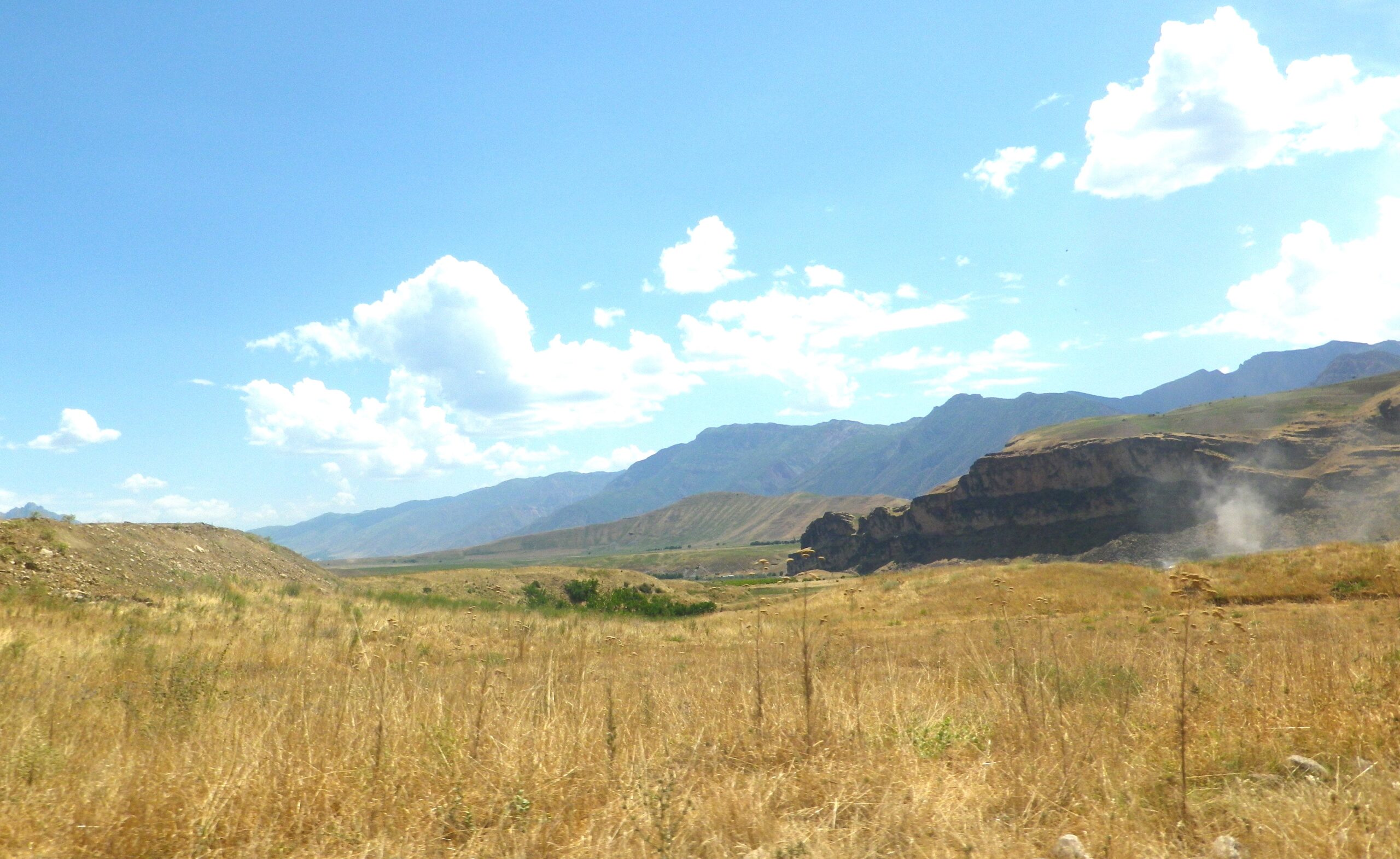
The road to Shuroobad; image: TCA, Stephen M. Bland

The Tajik-Afghan frontier is about 1,360 kilometers. Some 70 kilometers is the southern border of the Shamsiddin Shohin district, but it is the first area, traveling downstream, where the current of the Pyanj River slows significantly.

In the first years after the Bolshevik Revolution broke out, many Tajiks fled through what is now the Shamsiddin Shohin district into Afghanistan. Some seventy years later, thousands of Tajiks again fled through the district into Afghanistan when the newly independent state of Tajikistan was engulfed by civil war.

The United Tajik Opposition (UTO), the group fighting against the Tajik government during the 1992-1997 civil war, made frequent use of the Shamsiddin Shohin area to bring weapons from Afghanistan. UTO fighters had safe havens in Afghanistan, and they often made their way through this district, retreating south of the border and returning via the district once they were rested and resupplied.

There are only a few roads in the Shamsiddin Shohi district. The European Union funded the construction of the Friendship Bridge, which was completed in 2017, and connects the district to Afghanistan. It has often been closed by the Tajik authorities due to security concerns emanating from the Afghan side of the border.

Anyone crossing illegally from Afghanistan into the Shamsiddin Shohin district could easily hide in the rugged hills and abundance of caves in the area, making it ideal for smugglers and other intruders. Aside from a few small villages along the banks, there are no settlements for 20 to 30 kilometers north of the river.

Border posts were built during the time Tajikistan was a Soviet republic. Russian border guards remained in Tajikistan after the collapse of the USSR, and fortified these outposts as they increasingly came under attack from smugglers and UTO fighters crossing from Afghanistan.

Foreign governments funded the construction of new border guard posts along the Afghan frontier after the last Russian border guards departed in 2005. China, for example, financed the construction of the Gulhan border guard post in the Shamsiddin Shohin district in 2016.
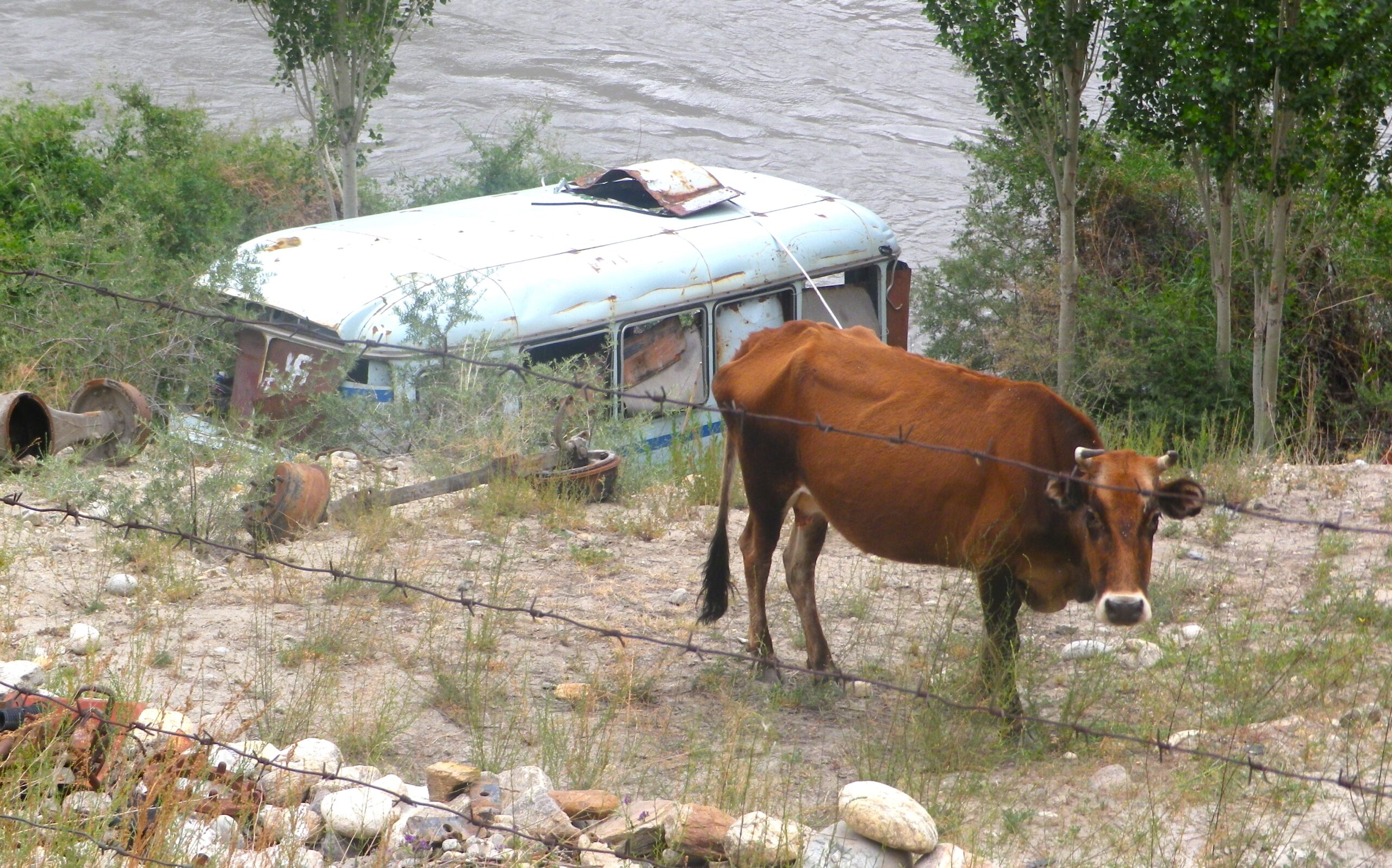
A burnt-out bus in the Pyanj River between Tajikistan and Afghanistan; image: TCA, Stephen M. Bland

New People, New Business

Illegal narcotics, weapons, precious and semi-precious stones, and a variety of contraband goods have been regularly smuggled from Afghanistan through Tajikistan since not long after Tajikistan became independent. It didn’t matter who the government in Afghanistan was. The Shamsiddin Shohin district is one of the more popular places along the Tajik-Afghan border for smugglers.

However, almost all of the recent violence along the Tajik-Afghan frontier is happening in the Shamsiddin Shohin district and Afghan territory on the other side of the river, and smuggling does not seem to be the main reason.

Not long after the Taliban returned to power in August 2021, agreements were signed with Chinese companies to develop Afghan gas and oil fields, and mineral deposits, notably gold. About three years ago, Chinese and Afghans started working at several sites in Afghanistan’s northern Badakhshan Province that borders Tajikistan.

In February 2023, the Tajik-Chinese company Zarafshan announced the discovery of new gold deposits, one of the most promising of which was in the Shamsiddin Shohin district. Zarafshan subsidiary Shohin SM started work shortly after that announcement.

In November 2024, armed men from Afghanistan crossed into Tajikistan and attacked the Shohin SM gold-mining camp, killing one Chinese worker and wounding at least four other workers, three of whom were also Chinese (the fourth was Tajik). The Tajik authorities blamed the attack on drug smugglers who wandered too close to the gold-mining camp and were seen by camp security guards.

In May 2025, the Tajik authorities apprehended a group of Chinese and Afghans who had crossed from Afghanistan on excavators into the Shamsiddin Shohin district. Tajik officials alleged the group intended to launder money, though the head of the district, Zafar Gulzoda, said the group was searching for gold scrap on the Tajik side of the Pyanj River.

Then in August 2025, Tajik border guards stationed in Shamsiddin Shohin exchanged fire with Taliban fighters on the other side of the river.  The Tajik border guards did not suffer any casualties, but one Taliban fighter was killed and four others wounded. The head of the local Tajik border guards led a small detachment of troops across the border into Afghanistan for talks with local Taliban officials and the head of the local mining operation.

In late October, there were reports that Tajik border guards and the Taliban were again involved in a firefight in the same area as the shooting in August. A report from an Afghan media outlet said there were casualties on both sides, but Tajik and Taliban officials never commented on the incident.

The reason for the second exchange of fire was reportedly construction work at a Chinese-Afghan gold mining site that had altered the course of the Pyanj River and sent more water to the Tajik bank, sparking concerns about flooding in the Shamsiddin Shohin district. The Tajik authorities have complained about this several times.

Then, on November 26, three Chinese workers at the Shohin SM gold mining camp were killed and two wounded in an attack that combined gunfire and the use of a drone armed with a grenade. On the last day of November, two Chinese roadworkers were shot dead and three wounded in Tajikistan’s Darvaz district, the next district east of Shamsiddin Shohin. The shots came from the Afghan side of the river.

On December 24, Tajik border guards in Shamsiddin Shohin were again involved in a shootout, this time with an armed group that came across the river from Afghanistan. Two Tajik border guards and three of the attackers were killed in the clash. The Tajik authorities said the armed group were terrorists who attacked the Tajik border guard post in the area.

No other place along the Tajik-Afghan border has seen the sort of violence that is becoming routine in the Shamsiddin Shohin district. The alleged “smuggler” attack on the gold mining camp in November 2024, and then a series of attacks and exchanges of fire since late August 2025.

Chinese gold mining, smuggling, and terrorists are combining to make the Shamsiddin Shohin district the hot spot of Tajikistan’s border with Afghanistan.

Tajikistan Plans $6.5 Billion Investment in Energy Sector

Tajikistan will require approximately $6.5 billion to implement its 2026-2030 Energy Sector Development Program, with funding expected from a combination of external and internal sources, including international partners and the state budget.

Planned funding sources include:

  • Development partners: $3.94 billion
  • Private investment: $2.56 billion
  • The state budget, primarily to finance the ongoing construction of the Rogun Hydropower Plant (HPP), which is supported annually through a dedicated budget line.

In 2025 alone, more than $970 million was allocated from the state budget to the Rogun project, accounting for roughly 20% of all approved treasury expenditures.

Support for Tajikistan’s fuel and energy complex remains one of the top budgetary priorities. The draft state budget for 2026 earmarks $1.61 billion for the sector, equivalent to 22.4% of total planned expenditures.

The program will primarily focus on large-scale hydropower development. In parallel, the government aims to expand renewable energy capacity. Solar power plants with a combined capacity of 1.5 GW are planned for construction in the Sughd and Khatlon regions. Authorities also plan to explore the potential for wind energy.

Another key objective is increasing electricity exports and contributing to frequency regulation within Central Asia’s regional power networks. Achieving this will require infrastructure upgrades, including construction of the Rogun-Saihun 500 kV transmission line and the modernization of existing substations.

Domestically, the program calls for the replacement of outdated equipment, renovation of distribution networks, and the installation of smart meters to enhance energy reliability and efficiency.

Kazakhstan Accelerates Shift Away from Cash Payments

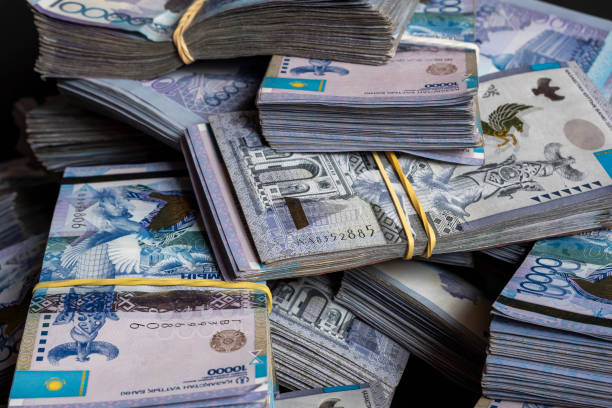
Kazakhstan is rapidly embracing cashless payments, with the share of cash withdrawals in card transactions continuing to decline each year, according to data from the National Bank. While the country has not yet reached the levels seen in leading digital economies, recent trends suggest Kazakhstan is closing the gap.

A recent study by analysts at Finprom.kz compares Kazakhstan’s transition to cashless payments with global trends. It highlights the persistent divide between countries where cash is nearly obsolete and those where it remains dominant.

The global variation is illustrated by the Cash Index, compiled by FOREX.se, which ranks 122 countries based on the share of daily transactions made with cash. Using data from Statista, Numbeo, central banks, and other global sources, the index offers an average estimate of cash usage across the world.

According to the Cash Index, countries with the lowest rates of cash use, just 10%, include South Korea, Norway, China, Iceland, and Australia. Similarly low figures are reported for Scotland, England, and Denmark (12% each). Analysts attribute this to strong fintech ecosystems, widespread broadband internet, high smartphone penetration, and robust consumer protection frameworks.

In contrast, cash remains dominant in countries where poverty, limited banking access, and weak infrastructure prevail. In Myanmar, daily cash transactions account for 98% of all payments, followed by Ethiopia and Gambia at 95%. Other high-cash-use countries include Albania, Cambodia, Laos, Lebanon, Nepal, and Pakistan, all averaging around 90%.

While Kazakhstan is not included in the Cash Index due to its tourism orientation, National Bank statistics provide insight into local trends. From January to October 2025, cash withdrawals via Kazakhstani and foreign payment cards totaled $44.37 billion, an 8.6% increase compared to the same period in 2024.

Yet the overall trend favors non-cash transactions. The share of cash withdrawals in total card turnover fell from 13.5% to 12.9% over the year, comparable to figures seen in developed economies. By contrast, in 2019, cash accounted for more than half of card-based transactions. This dropped to 34.1% in 2020 and has continued its steady decline.

Regional data reveal that the shift to cashless payments is uneven across the country. In January-October 2025, the share of cash withdrawals in total card transactions ranged from 8.3% to 27.4%, depending on the region.

The lowest shares were recorded in the Almaty region (8.3%), Almaty city (9%), and the Turkestan region (9.4%). Astana and the Atyrau region followed with 14.4% and 14.8%, respectively. The North Kazakhstan region reported the highest share of cash withdrawals.

Alcohol and Tobacco Lead Kyrgyzstan’s Excise Tax Revenues

Alcohol and tobacco products continue to be the primary sources of excise tax revenue for Kyrgyzstan’s state budget, according to the Ministry of Finance’s final report on budget revenues for the first 11 months of 2025.

The report highlights excise taxes as one of the most stable and predictable sources of state income. From January through November 2025, total excise tax revenues exceeded $222 million.

Alcohol producers remain the top contributors. During the reporting period, they transferred $38 million to the budget. Vodka producers accounted for the largest share at $25.5 million, while breweries contributed approximately $9.4 million. Producers of brandy, wine, and other alcoholic beverages paid significantly less. As a result, the alcohol sector continues to lead all industries in excise tax contributions.

Despite reduced domestic production, tobacco companies dominate excise revenues from imports. In the same period, excise taxes on tobacco products imported from Eurasian Economic Union (EAEU) countries brought in $101 million, with an additional $4.4 million from imports originating outside the EAEU.

Revenue is no longer limited to traditional cigarettes. The report notes contributions from heated tobacco products and electronic cigarettes. While their current share remains modest, steady annual growth in excise payments for these categories points to shifting consumer habits.

Kyrgyz authorities consider excise taxes on alcohol and tobacco not only a fiscal mechanism, but also a tool of social policy. Gradual increases in tax rates are intended to simultaneously boost revenue and, according to government projections, reduce consumption of harmful products.

The state’s role in the alcohol sector warrants particular attention. In early 2023, the country’s largest alcohol producer, Ayu, along with its distilleries and vodka factories, was voluntarily transferred to state ownership. Since then, smaller industry players have voiced concern that the government may incrementally tighten its grip on the sector and effectively establish a monopoly.

Overall, the data confirm that so-called “harmful” goods, alcohol and tobacco, remain the most lucrative sources of excise tax revenue for the Kyrgyz budget.