• KGS/USD = 0.01144 0%
  • KZT/USD = 0.00194 -0%
  • TJS/USD = 0.10822 -0.18%
  • UZS/USD = 0.00008 0%
  • TMT/USD = 0.28571 0%
  • KGS/USD = 0.01144 0%
  • KZT/USD = 0.00194 -0%
  • TJS/USD = 0.10822 -0.18%
  • UZS/USD = 0.00008 0%
  • TMT/USD = 0.28571 0%
  • KGS/USD = 0.01144 0%
  • KZT/USD = 0.00194 -0%
  • TJS/USD = 0.10822 -0.18%
  • UZS/USD = 0.00008 0%
  • TMT/USD = 0.28571 0%
  • KGS/USD = 0.01144 0%
  • KZT/USD = 0.00194 -0%
  • TJS/USD = 0.10822 -0.18%
  • UZS/USD = 0.00008 0%
  • TMT/USD = 0.28571 0%
  • KGS/USD = 0.01144 0%
  • KZT/USD = 0.00194 -0%
  • TJS/USD = 0.10822 -0.18%
  • UZS/USD = 0.00008 0%
  • TMT/USD = 0.28571 0%
  • KGS/USD = 0.01144 0%
  • KZT/USD = 0.00194 -0%
  • TJS/USD = 0.10822 -0.18%
  • UZS/USD = 0.00008 0%
  • TMT/USD = 0.28571 0%
  • KGS/USD = 0.01144 0%
  • KZT/USD = 0.00194 -0%
  • TJS/USD = 0.10822 -0.18%
  • UZS/USD = 0.00008 0%
  • TMT/USD = 0.28571 0%
  • KGS/USD = 0.01144 0%
  • KZT/USD = 0.00194 -0%
  • TJS/USD = 0.10822 -0.18%
  • UZS/USD = 0.00008 0%
  • TMT/USD = 0.28571 0%
18 December 2025

Building a Bridge of Tongues: One Uzbek Linguist’s Pursuit of Turkic Unity

For nearly five decades, Uzbek linguist Dr. Bakhtiyor Karimov has worked quietly on an ambitious vision: the creation of a shared, auxiliary language for Turkic-speaking nations. What began as a spark of inspiration on a trolleybus in 1974 became a lifelong intellectual project shaped by history, hardship, and support from prominent regional figures.

Karimov’s idea, what he calls the “Averaged Turkic Language”, was born not from political ideology but from a desire to preserve and connect cultures. “If our children cannot access the world’s knowledge in their own tongue, how can they innovate?” he once asked.

A Lifelong Vision Conceived in Silence

The concept took shape in the shadows of the Soviet Union, where Pan-Turkic ideas were taboo. Karimov and his colleague Shoahmad Mutalov developed their theories discreetly, using mathematical models to explore linguistic convergence. They coined the term “Eesopic” to mask their proposals, likening it to Aesop’s allegories.

In 1980, Karimov presented his formulas at a Turkology conference in Tashkent, illustrating affinities among Turkic languages. The room, initially confused by the mathematical display, fell silent when the implications became clear: this was about regional unity through language. The session was cut short.

Still, in 1982, their paper was quietly published under the title Language Policy Solutions for Developing Countries, disguised as a study on African and Asian contexts. This allowed Karimov’s ideas to survive Soviet censorship and enter academic circulation.

From Perestroika to Independence

The late 1980s gave Karimov space to speak more openly. He published theoretical sketches under allegorical titles and refined his proposals, ranging from grammar convergence to script reform. After Uzbekistan’s independence in 1991, he carried his vision to Kazakhstan, where he helped establish a Turkology Center and spoke of reviving Chagatai, the classical literary language once shared across Central Asia.

Despite early support, funding dried up. At one point, he suffered heart trouble during a meeting and was left unattended in a hospital corridor until a local cultural leader intervened. “I owe my heart to the Averaged Turkic Language,” he later said, reflecting on how the project had shaped every corner of his life.

Digital Revival and Regional Interest

In recent years, interest in Karimov’s ideas has quietly revived. In 2022, a Kazakh team led by Dr. Miriyev launched OzTurk, a simplified digital prototype that uses linguistic inputs from various Turkic languages to create a common vocabulary. Though limited in scope, the program demonstrated the feasibility of Karimov’s concept.

The idea has even reached Turkish media, with headlines celebrating “A Bridge of Tongues for a New Era.” Yet formal institutional backing has remained elusive.

Karimov estimates that establishing an Averaged Turkic Language Institute would require just $3 million, $500,000 from each of six Turkic states. “That’s a small price to pay for preserving our languages,” he argues.

A Broader Vision

Karimov’s ambitions extend beyond the Turkic world. In 1992, he presented a similar proposal for an Averaged Iranian Language, drawing on shared roots among Persian, Dari, Tajik, Pashto, Kurdish, and other languages. His papers were later published in a respected philological journal, gaining attention from regional linguists.

He sees both projects as part of a greater vision: a “third Renaissance” in Eurasia, where auxiliary languages rooted in local traditions can unite people without erasing their cultural identities.

A Gift to Aitmatov

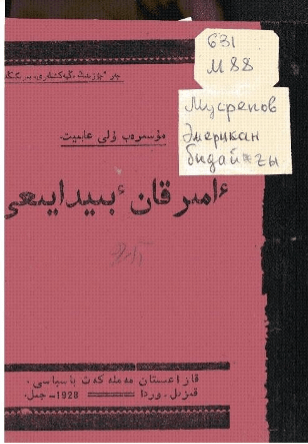
In 2004, Karimov was invited to the Ala-Archa presidential residence in Bishkek, where he met the late Kyrgyz writer and diplomat Chingiz Aitmatov. Presenting the last remaining copy of his 1992 book O‘rtaturk Tili, Karimov received public praise. “You have found a way to honor both our diversity and our unity,” Aitmatov said.

Looking Ahead

Now in his later years, Karimov hopes to see the Organization of Turkic States formally adopt the project and fund an international institute. He envisions a digital platform where scholars from Bukhara, Istanbul, and Osh can contribute to a shared linguistic future.

From a scribbled formula on a Tashkent trolleybus window to pilot programs in Kazakhstan, Dr. Bakhtiyor Karimov’s idea has endured. His work reminds Central Asia that cultural unity need not come at the expense of diversity and that even the most ambitious dreams can begin with a simple idea, carried quietly for years until the world is ready to listen.

By 2022, Dr. Miriyev and a team in Kazakhstan had developed OzTurk, a pilot model based on Karimov’s ideas. It allowed users, from Bashkir economists to Tatar geographers, to input word lists and grammatical rules. The program computed a shared vocabulary and grammatical core. Though preliminary, OzTurk showed that Karimov’s model could be implemented with limited resources.

Karimov’s ambitions later expanded to include Iranian languages. In 1992, he submitted a paper on an “Averaged Iranian Language” to the annual conference at Tashkent’s Oriental Studies Institute. Initially excluded from the program, he spoke during the discussion period. “You call Persian the language of Iran,” he told colleagues, “but what of Dari, Tajik, Kurdish, Pashto, Balochi, Ossetian, Luri?” His data stunned the room. The next year, he was invited to publish two papers in Contemporary Problems in Iranian-Afghan Philology, over thirty pages articulating the theory’s ideological and mathematical underpinnings.

In 1992, Karimov brought the project to Ankara, where TIKA’s president, Ümit Arık, praised the idea and approved a Turkish-language edition. Yet the local grant officer dismissed it. “Why build an Averaged Turkic Language?” he asked. “Let everyone learn Turkish in two months.” The grant was blocked.

Karimov proposed a modest plan: a $3 million, two-year budget, $500,000 from each of six Turkic states, to fund linguists and developers. “That’s nothing compared to the cost of losing our languages,” he argued. “If a merchant wants his name enshrined in history, let him fund it.”

By 2019, Karimov’s personal copy was worn and taped at the spine. He had overseen two expanded editions, one in 2008, featuring new chapters on script reform, and a revised volume in 2019. Turkish newspapers had begun reporting on OzTurk, praising it as a “Bridge of Tongues for a New Era.”

From a spark on a trolleybus window to a comprehensive linguistic theory, Dr. Bakhtiyor Karimov’s vision remains a testament to resilience, imagination, and the enduring hope of unity through language. With political will, institutional backing, and shared commitment, Central Asia may yet witness its third Renaissance, one built on friendship, mathematics, and the belief that no culture should ever stand alone.

Biopesticide Trials in Kyrgyzstan Pave Way for Greener Locust Control

Between June 10 and 13, Kyrgyzstan conducted a national trial of biological pesticides in the northern Chuy region, marking a step forward in the country’s push toward environmentally responsible locust management. The trial was led by the Ministry of Water Resources, Agriculture and Processing Industry with support from the Food and Agriculture Organization of the United Nations (FAO), and funded by the Japan International Cooperation Agency (JICA) and FAO’s own resources.

The initiative is part of the broader “Programme to Improve National and Regional Locust Management in the Caucasus and Central Asia (CCA),” which aims to shift countries away from reliance on chemical pesticides.

According to the FAO, biopesticides, particularly those using the Metarhizium acridum fungus, are emerging as an effective, selective alternative to chemical treatments. These biological agents target locusts and grasshoppers without harming humans or non-target species such as pollinators, birds, and aquatic life.

Kyrgyzstan regularly faces locust threats from two species: the Moroccan locust and the Italian locust. Both are capable of rapid reproduction and forming large swarms that can severely damage crops and pastures.

“Biological pesticides offer a safer alternative for controlling locusts before they reach crisis levels,” said Oleg Guchgeldiyev, FAO Representative in Kyrgyzstan. “They are especially useful for fragile ecosystems. Continued testing will enhance scientific and technical capacity, paving the way for a more resilient agricultural sector.”

Field trials are a critical step toward integrating biopesticides into national locust control strategies.

The urgency of the initiative is underscored by recent government data. As previously reported by The Times of Central Asia, the Ministry of Agriculture surveyed 114,000 hectares earlier this month and found locusts present on nearly two-thirds of the land. More than 74,000 hectares have already been treated with pesticides. The infestation has been particularly severe in southern regions, where early harvest cycles and warm temperatures create ideal conditions for locust breeding.

By embracing biopesticides, Kyrgyzstan hopes to reduce environmental risks while maintaining effective pest control, balancing agricultural productivity with ecological responsibility.

Uzbekistan Allows Name Changes Following Official Gender Correction

Uzbekistan has updated its civil status regulations to allow individuals who have officially changed their gender to also change their first name, last name, and patronymic. The change follows a June 12 Cabinet of Ministers decision that amends the country’s procedures for registering personal status documents.

According to the Ministry of Justice, the update is part of broader efforts to streamline legal documentation related to marriage, family, and civil status. Under the new rules, citizens aged 18 and older, who do not have minor children, may apply to change their names via the Unified Interactive Services Portal.

The ministry clarified that the changes have been misinterpreted online as introducing broad legal provisions for gender transition. In fact, officials stressed, the amendment only affects the process of updating civil records after a gender change has already been made and recognized through medical documentation.

Previously, individuals who had changed their gender could correct key documents such as birth, death, and marriage certificates. However, name changes were restricted and typically permitted only under cultural or national naming exceptions. Under the new rules, a recognized gender transition now constitutes sufficient legal grounds for a name change, provided that a medical statement confirming the change is submitted.

The Justice Ministry also noted that each year, approximately five to six children in Uzbekistan are born with indeterminate gender characteristics. In many such cases, gender is assigned based on early medical assessments, though the child’s actual gender identity may only become clear years later, sometimes not until adolescence.

Officials cited one example involving a child born in 2008 who was initially registered as male. At age 16, medical evaluation confirmed the child was female. While her gender record was corrected in civil documents, existing laws at the time did not allow her to change her name and patronymic accordingly.

To address such legal gaps, the government passed Decision No. 362. It ensures that once a medical institution verifies a gender correction, the individual may also update their full name to reflect their gender identity. The regulation is intended to improve consistency across civil documents and prevent identity mismatches for individuals who have undergone gender transition.

Personal Data of 16 Million Kazakh Citizens Leaked

Kazakhstan has experienced one of the most extensive personal data breaches in its history. According to Olzhas Satiev, President of the Center for Analysis and Investigation of Cyber Attacks (CARKA), over 16.3 million records, representing nearly the entire population, have been made publicly accessible.

Scope of the Breach

The compromised data includes surnames, first names, patronymics, gender, date of birth, individual identification numbers (IIN), addresses, phone numbers, citizenship, ethnicity, and other sensitive details.

The source of the leak has not been identified. Experts suggest it may be a compilation of previously hacked databases redistributed via closed Telegram channels. Alternatively, it could stem from a new, as yet undetected breach.

“This is one of the largest leaks. An investigation is currently underway. We are awaiting information from the technical service of the National Security Committee (KNB),” said Satiev.

Government Response and Ongoing Investigation

The Ministry of Digital Development, Innovation and Aerospace Industry (MCIA) stated that it is closely monitoring the incident.

The ministry’s Information Security Committee, in cooperation with law enforcement and intelligence agencies, is analyzing the leaked data and verifying its relevance. Initial assessments suggest the breach likely originated from private information systems. The MCIA emphasized that no cyberattacks on government databases have been detected.

“It is premature to draw final conclusions or confirm the accuracy of the leaked information until the investigation concludes,” the ministry said.

Individuals affected by the leak will be notified through the e-government portal. The ministry also noted that previous leaks involved outdated information sourced from microfinance organizations and other commercial entities.

Combating the Shadow Data Market

Separately, the Ministry of Internal Affairs recently dismantled an organized group involved in the illegal sale of personal data.

Authorities say the group accessed state databases and distributed information through Telegram channels, often in cooperation with debt collection agencies. More than 140 individuals, including channel administrators and company executives, were detained. Five suspects remain in custody. Investigators seized over 400 pieces of computer and electronic equipment.

“The information was obtained from state databases and distributed through Telegram channels. Work is ongoing to identify all parties involved,” said Zhandos Suinbay, head of the Interior Ministry’s cybercrime division.

Criminal proceedings have been launched under Articles 205 (unlawful access to information), 147 (violation of privacy), and 211 (distribution of restricted data) of the Criminal Code of Kazakhstan.

The Interior Ministry vowed to intensify efforts to prevent further data breaches and urged citizens to be cautious, particularly when sharing personal information or using unsecured digital platforms.

China to Invest $500M in Corn Processing in Kazakhstan

Chinese biopharmaceutical company Yili Chuanning Biological Co. will invest $500 million in a large-scale corn processing project in Kazakhstan’s Almaty region.

The announcement came during the China-Central Asia Industrial and Investment Cooperation Forum held in Astana, where a memorandum of cooperation was signed between the Almaty region’s Akimat (local government) and Yili Chuanning, one of China’s leading biopharmaceutical firms. The agreement outlines the construction of a major processing facility in the Yenbekshikazakh district’s Shelek industrial zone.

The project will incorporate advanced biotechnology for the production of amino acids, probiotics, and biodegradable materials, including packaging and medical products. The investment, valued at approximately $500 million, is expected to create up to 1,000 new jobs. The plant is projected to process hundreds of thousands of tons of corn annually.

Chinese specialists are currently conducting a comprehensive assessment of the site, examining infrastructure, logistics, and economic factors, and preparing a phased implementation strategy. During the forum, additional agreements were signed regarding Chinese investments in Kazakhstan’s agricultural processing sector, several of which also target corn processing.

One such initiative is an $800 million project by the Fufeng Group in the Zhambyl region. This facility will process up to one million tons of corn per year to produce high-value-added goods such as lysine and amino acids. It is expected to generate around 1,500 jobs and provide stable demand for regional farmers. Offtake contracts have already been signed for the supply of 300,000 tons of corn in 2025.

In the Turkestan region, Xinjiang Lihua Group Co., Ltd. is developing a $420 million integrated cotton cluster. The project encompasses the entire production chain, from cotton cultivation to the manufacture of finished textile goods.

Separately, the Investment Committee of Kazakhstan’s Ministry of Foreign Affairs signed a contract with Qingdao Wanlin Food Corporation for an $89 million facility dedicated to onion dehydration and deep vegetable processing. The plant will primarily export to China, the United States, and Europe.

Kazakhstan is intensifying its efforts to advance deep agricultural processing, driven in part by challenges in exporting raw commodities.

Kazakh Nomads and Authentic Tourism: Interview with Mongolia’s Cultural Envoy Dr. Gantemur Damba at CAMCA

This week The Times of Central Asia will be attending the CAMCA Regional Forum, which this year is being held in Ulaanbaatar, Mongolia. 

The CAMCA network is a collection of professionals and policymakers dedicated to sharing ideas, knowledge and inspiration to develop the Eurasia region; its name stands for Central Asia, Mongolia, the Caucasus and Afghanistan.

Ahead of the Forum, The Times of Central Asia spoke with Mongolia’s Cultural Envoy, and the Vice Chair of the Asian Ecotourism Network, Dr. Gantumur Damba, about the country’s Kazakh nomads, and what the CAMCA program means for Mongolian culture and tourism.

TCA: Central Asia is geographically quite close to Mongolia, but Mongolia’s culture is distinct. What parts of Mongolian life do you think make journeys here unique for visitors?

GD: Indeed. While Mongolia has some cultural similarities with Central Asia due to historical links, it has developed its own distinct identity. We are a unique culture with influences from Buddhism, shamanism and animism in our pastoralist herder’s way of life.

Eastern Mongolia is rich in historical sites, including Deluun Boldog, where Genghis Khan was born, and the historical ruins of 13th and 14th-century towns.

Central Mongolia is centered on the ancient town of Kharkhorum – with UNESCO-inscribed intangible cultural events – and the beautiful Orkhon Valley. 

This region is also enriched by Mongolian Buddhist traditions and architectural sites.  

North Mongolia is the home of nomadic reindeer herders, who have strong shamanistic beliefs. They are one of the last groups in the world to still herd reindeer as their primary way of life.

Mongolia’s largest ethnic minority are Kazakhs, who live in the country’s western regions. What opportunities do visitors to Mongolia have to discover the Mongolian Kazakh way of life?

The Kazakhs of Mongolia have distinct cultural practices, and live mainly in western Mongolia, particularly in Bayan-Ölgii province. 

While they share a common heritage with Kazakhs in Kazakhstan and other Central Asian nations, their experience in Mongolia is shaped by their minority status and the influence of Mongolian culture and Buddhism, alongside their own Turkic language and Islamic traditions. 

Activities like eagle hunting demonstration events, trekking in the Altai Mountains, and exploring authentic nomadic life offer unique travel experiences. 

Travelers can experience authentic nomad Kazakh culture through homestays, participating in festivals, and witnessing traditional crafts, traditional music, epic storytelling and vibrant dances like the eagle dance.

What places and activities in Mongolia do you most recommend to foreign visitors? Are you working on any new destinations?

Mongolia offers a high degree of freedom and flexibility for travelers, especially when it comes to camping and exploring the vast landscapes. There are relatively few restrictions on where you can go and camp, and you can often choose your own route and pace. 

However, choosing the right travel partner is vital. I categorize our destinations according to three “Ms”. The first M stands for modified places – basically those that are spoiled. That includes Terelj, Kharkhorum and West Khuvsgul Lake, where you will find many resorts, ger (yurt) camps and scheduled mass tourism activities. 

In the second category are places which require more professional land use planning. These are places like some Gobi destinations or the Altai mountains. 

The third M is for the authentic, untouched Mongolia, which is what visitors want to see. We need a clear picture of what Mongolia really is, of what it has to offer, of its competitive advantages, and of the expectations of potential tourists. 

Mongolia is not Bali or Brazil. Ours is a specific niche market, high-end, specialized tourism for which we need improvements down the whole value chain. Quality rather than quantity! 

Tourism offers not only economic but also cultural and social opportunities. That is all about sustainable and inclusive tourism development, so this is why we need to collaborate more together with the Central Asian destinations, where we do have common issues in tourism – unique and vulnerable resources.

How do you think the CAMCA Forum will bring together businesses from all of its member regions and countries?

Tourism is a fragmented sector, necessitating It arises from the diverse range of businesses and sectors involved, each with its own specific needs and objectives. 

To achieve sustainable and successful tourism development,  collaboration and discussion among stakeholders is important. I strongly believe that the CAMCA Forum significantly contributes to economic, political and socio-cultural results in regional tourism development, on both a national and regional basis. 

I highly appreciate the chance to be part of this  CAMCA dialogue. I sincerely welcome all the participants to Mongolia.