• KGS/USD = 0.01144 0%
  • KZT/USD = 0.00216 0%
  • TJS/USD = 0.10456 0%
  • UZS/USD = 0.00008 0%
  • TMT/USD = 0.28490 0%
  • KGS/USD = 0.01144 0%
  • KZT/USD = 0.00216 0%
  • TJS/USD = 0.10456 0%
  • UZS/USD = 0.00008 0%
  • TMT/USD = 0.28490 0%
  • KGS/USD = 0.01144 0%
  • KZT/USD = 0.00216 0%
  • TJS/USD = 0.10456 0%
  • UZS/USD = 0.00008 0%
  • TMT/USD = 0.28490 0%
  • KGS/USD = 0.01144 0%
  • KZT/USD = 0.00216 0%
  • TJS/USD = 0.10456 0%
  • UZS/USD = 0.00008 0%
  • TMT/USD = 0.28490 0%
  • KGS/USD = 0.01144 0%
  • KZT/USD = 0.00216 0%
  • TJS/USD = 0.10456 0%
  • UZS/USD = 0.00008 0%
  • TMT/USD = 0.28490 0%
  • KGS/USD = 0.01144 0%
  • KZT/USD = 0.00216 0%
  • TJS/USD = 0.10456 0%
  • UZS/USD = 0.00008 0%
  • TMT/USD = 0.28490 0%
  • KGS/USD = 0.01144 0%
  • KZT/USD = 0.00216 0%
  • TJS/USD = 0.10456 0%
  • UZS/USD = 0.00008 0%
  • TMT/USD = 0.28490 0%
  • KGS/USD = 0.01144 0%
  • KZT/USD = 0.00216 0%
  • TJS/USD = 0.10456 0%
  • UZS/USD = 0.00008 0%
  • TMT/USD = 0.28490 0%

ArtSkin: Prosthetics with a Sense of Touch from Kyrgyzstan

The Kyrgyz startup ecosystem is still in its nascent stages and can’t boast an endless number of founders pursuing their dreams. But those focused on building hardware startups, which is generally significantly more challenging, are even a rarer breed. Despite all of that, there is an ambitious attempt to build artificial skin for prosthetics. Meet ArtSkin.


Not like a human hand

“Since childhood, I was mad about science and tech, and the first big thing that I made was a prototype of the first airplane by the Wright brothers. I dropped it from the second floor, and it was crushed after flying four meters. Later, when I was twelve, I saw a TV program about robot battles, and it was crazy! Since then, I have wanted to be able to make any kind of robots, and my dream has come true,” says Iliias Dzheentaev’s biography on LinkedIn. Dzheentaev is the CEO and Founder of ArtSkin. 
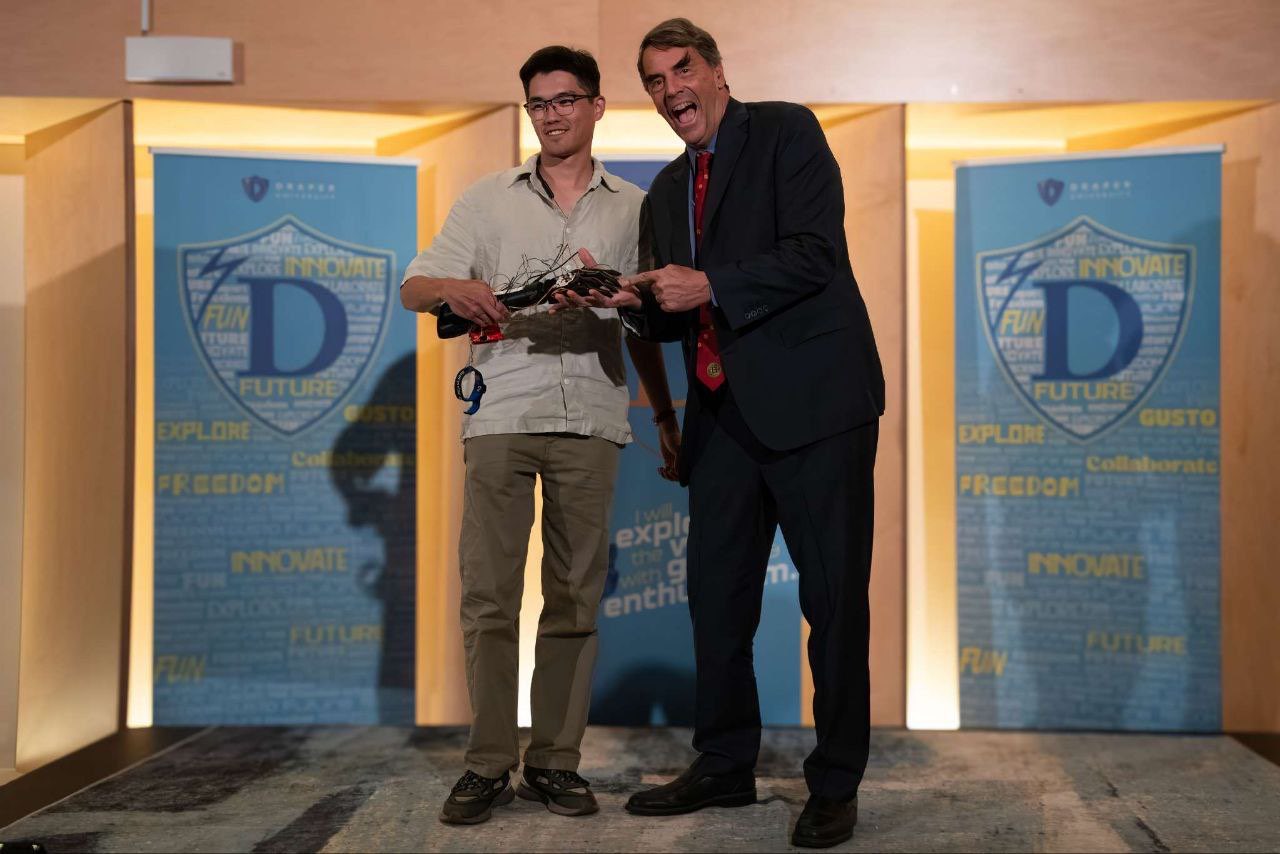
ArtSkin is a hardware startup from Kyrgyzstan that develops artificial skin for prosthetic limbs. It was launched by Dzheentaev in 2024. Before that, he spent three years studying how human skin, the nervous system, and receptors work to understand how to design a device allowing proper touch sensations. The process was time-consuming and challenging due to the lack of relevant information.

“My initial prototype was a robotic arm manipulator. I encountered a challenge with grasping flexible objects – figuring out how to make the robot recognize when its claw had squeezed tightly enough to hold the object securely. To solve this, I developed a mechanism that overcomes the resistance of different materials, enabling the robot to firmly grasp objects of various shapes, textures, and densities. Although the mechanism was simple, it made me realize how important this problem is for robotics. This insight then led me to thinking about people who use prosthetics and whether they actually feel anything when wearing them”, Dzheentaev tells The Times of Central Asia.

He was not happy with the contemporary prosthetic solutions – basic body-powered mechanical prosthetics rely on physical motions, and more advanced bionic prosthetics translate electrical signals generated by muscle activity into movements, both of which lack feedback. And without the latter, control is incomplete, while with a human hand, one can easily understand its position as well as feel touch and pressure. With this in mind, Dzheentaev built his prototype with a single sensor to test the device on himself.


First steps

Things got serious when Dzheentaev visited the High Technology Park of the Kyrgyz Republic (HTP), where he was inspired by other founders pitching and raising funds for their startups. At the time, unfamiliar with this environment, Dzheentaev was using his salary to buy electronic components, order materials, and do designs.

Not long after, Dzheentaev took part in HTP’s two programs: Dive into Silicon Valley and Unicorn from KG. The finalists for the first one were selected in February 2024. Dive into Silicon Valley in an entry-level incubation program, which sends founders to spend two weeks in Silicon Valley during which they meet founders, venture capitalists, prospective customers, take part in hackathons and pitch sessions, and visit the headquarters of leading tech companies and top universities. Dhzeentaev had quality networking during this visit, meeting Stanford professors and fellow founders from the region, like Doszhan Zhussupov, CEO of the leading Kazakh AI-medtech startup, which creates AI solutions that are essential in emergency medicine.

Later the same year, Dzheentaev was admitted to a more advanced program, Unicorn from KG, which runs in partnership with Draper University’s Hero Training Program. The program is an intensive five-week pre-accelerator based in Silicon Valley. In April 2025, Dzheentaev won a $10,000 equity-free cash prize at the largest local tech conference, Central Asia Startup Cup.

Apart from taking part in various programs, Dzheentaev found himself a Co-Founder. Sultan Tukeshov, the President of the Association of Surgeons of the Kyrgyz Republic, with 20 years of experience in surgery, joined Dzheentaev on his journey to build ArtSkin. The partner was a good fit as he and his team were the first in the country to start fitting patients with bionic prostheses.


Global ambitions

In March 2025, Dzheentaev was admitted to Stanford’s Summer Session. Last month, ArtSkin was selected for the MIT DeepTech Program, a joint program of the High Technology Park and Kuo-Sharper Center for Prosperity and Entrepreneurship at Massachusetts Institute of Technology. Last week, ArtSkin was named fourth out of 400 startups in the Road to Battlefield Regional Final regional pitching round of the TechCrunch Disrupt 2025 selection by Silkroad Innovation Hub. Now he will pitch in the global lineup during TechCrunch Disrupt 2025, where he plans to present the prototype – a unified solution that can be adapted to different types of prostheses and integrated with VR – to show how the same technology can be applied in different areas. TechCrunch Disrupt is one of the largest global tech conferences and is held annually in Silicon Valley.

Dzheentaev has also received a grant of $50,000 from the High Technology Park to build a technical laboratory for developing an advanced version, testing, and preparing for clinical trials. By January 2026, Dzheentaev plans to develop a flexible prototype, which will have 16 sensors and operate similarly to human skin, including object temperature transmission, with a target to obtain a patent in the summer of 2026. Dzheentaev also plans to take part in accelerators and raise investments to cover the operating expenses since the team is working on enthusiasm alone.

“The biggest goal for us is to give people with prosthetic limbs back their natural touch sensations, because through them we feel the world around us. We also plan to integrate with virtual reality technologies, where people can not only see digital objects, but also feel and interact with them. I see great potential in our project, and who knows where this journey will take us?” Dzheentaev told The Times of Central Asia.

‘Orange Angels’: Aviators of Eastern Kazakhstan Fly Daily Rescue Missions

When there is no help left on the ground, they take to the skies: orange fuselages, the roar of propellers, and salvation descending from above. The Aviation Division of the East Kazakhstan Region – the ‘Orange Angels’ – is more than a state enterprise; it is a vital lifeline, operating when every minute counts.

No Margin For Error

Since its founding in 2003, the division has become an indispensable part of the region’s emergency response system. Its 114 full-time specialists conduct medical flights, firefighting operations, evacuations, and rescues.

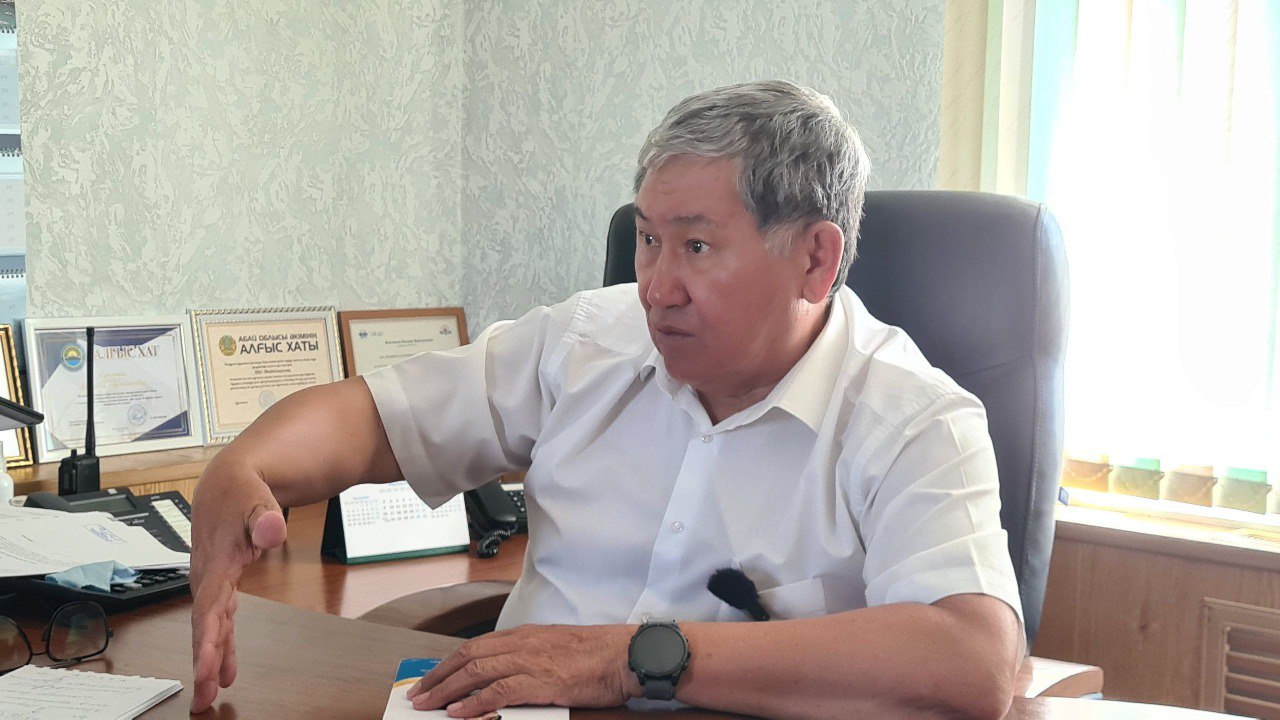
Yet staffing remains a challenge. “We are short 12-13 personnel. Ideally, we should have around 120,” Kalikan Baigonusov, Director of the East Kazakhstan Aviation Division, told The Times of Central Asia. “Young people prefer big airlines, foreign skies, and big paychecks. Our salaries are decent, between $1,300 and $2,900, but the profession lacks visibility and appeal. It’s a calling, not just a job.”

Image: TCA

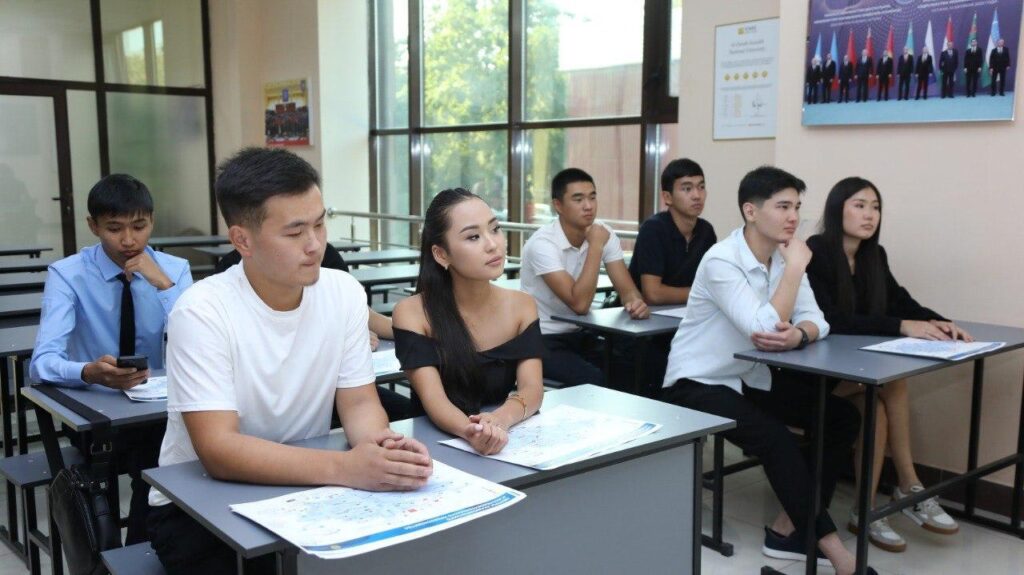
Baigonusov hopes more young people will be drawn to aviation through education. His division is now organizing practical MI-2 helicopter training for students from the Civil Aviation Academy JSC. There is also close cooperation with the East Kazakhstan Multidisciplinary College, which, with support from the regional governor, launched new specialties in aviation engineering and mechanics on September 1, 2024. Therein, students undergo practical training with the air squadron, learning directly from experienced pilots and engineers.

Still, Baigonusov believes Kazakhstan’s personnel training system needs urgent reform. “I’ve knocked on every door, the academy, the rector, the department head,” he told TCA. “We need to train our people locally. Sending a student to Russia costs $47,000. That’s simply out of reach. We need to promote dual education here, so people can study and work at home.”

Many of the division’s specialists are graduates of now-diminished Soviet-era aviation schools in Kachinsk, Omsk, Kyiv, and Riga. Each year, their ranks grow thinner.

Engineering, Maintenance, and a Race Against Time

Despite operating from aging facilities built in the 1970s and 1980s, the team is working to modernize and extend the lifespan of its equipment. The aircraft fleet, averaging 35 years in age, has undergone extensive inspections and upgrades. Standardization tests have been passed, and all certifications are in place.

Thanks to the expertise of the engineering team, the division recently secured certification for maintaining YAK-40 and YAK-42 aircraft and Mi-8 and Mi-2 helicopters.

Image: TCA

“Before, we relied on outside companies for repairs. Now we do everything ourselves,” says Baigonusov. “That saves time and money and makes us more self-reliant.”

Deputy for the Engineering and Aviation Service (IAS) Lobanov leads a team dedicated to his work, although he, like many in the unit, is already over 55. Baigonusov is determined to attract the younger generation.

“We need to show how important and beautiful this profession is. It’s demanding, but it’s also deeply meaningful.”

Rescuing the Stranded in Kalbatau

Chief pilot Denis Grunsky recalled one of the most dramatic missions of his career to TCA.

“Over 100 people were stuck in a snowdrift near Kalbatau in Kokpekty district. Rescuers couldn’t get through. It was snowing hard, freezing cold… We made three Mi-8 flights to evacuate women and children. Winds were strong, fuel was running low, and the sun was setting; you can’t fly in the mountains at night. But we did it.”

For this team, days off are rare. Technically, they can’t work more than seven days in a row. But as Grunsky puts it: “If we’re not flying, it doesn’t mean we’re not working.”

They also genuinely love their equipment.

Image: TCA

“Our Machine”: The Mi-8 Helicopter

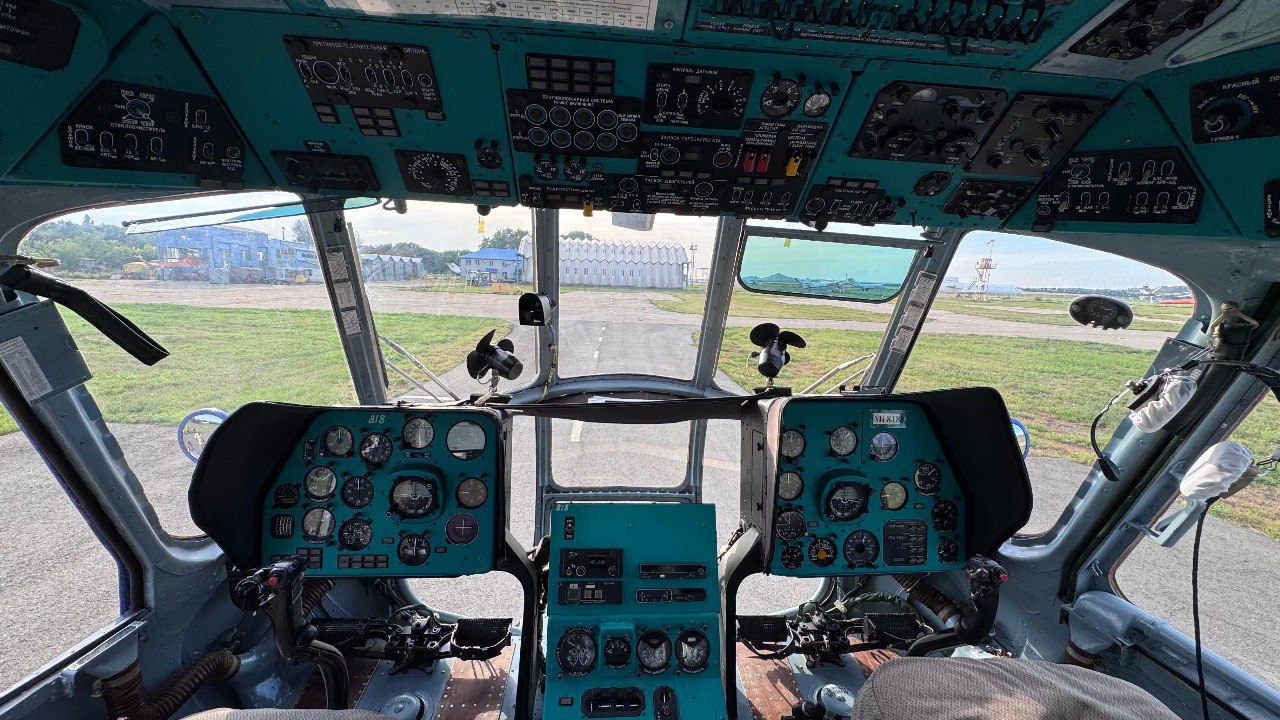
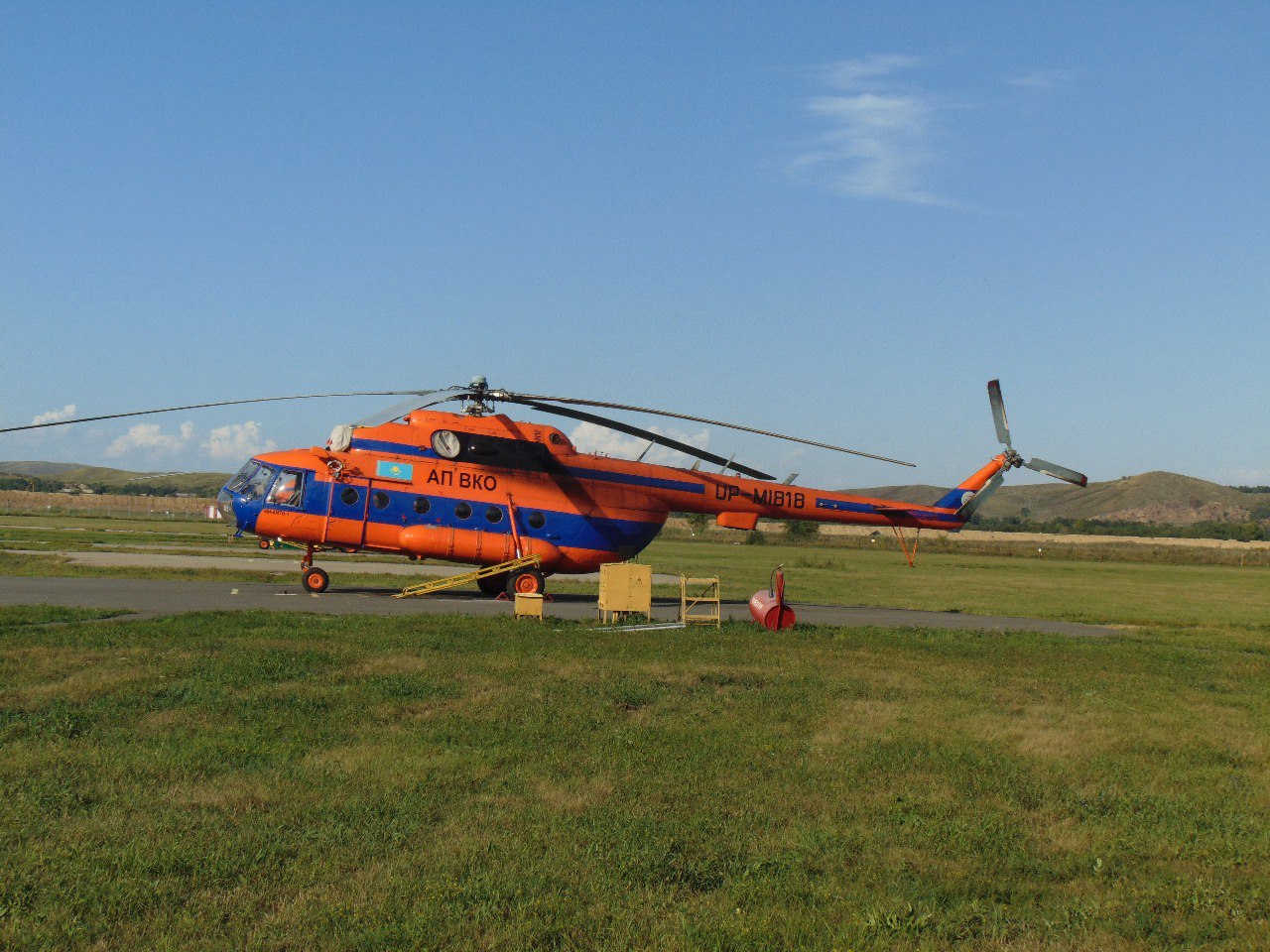
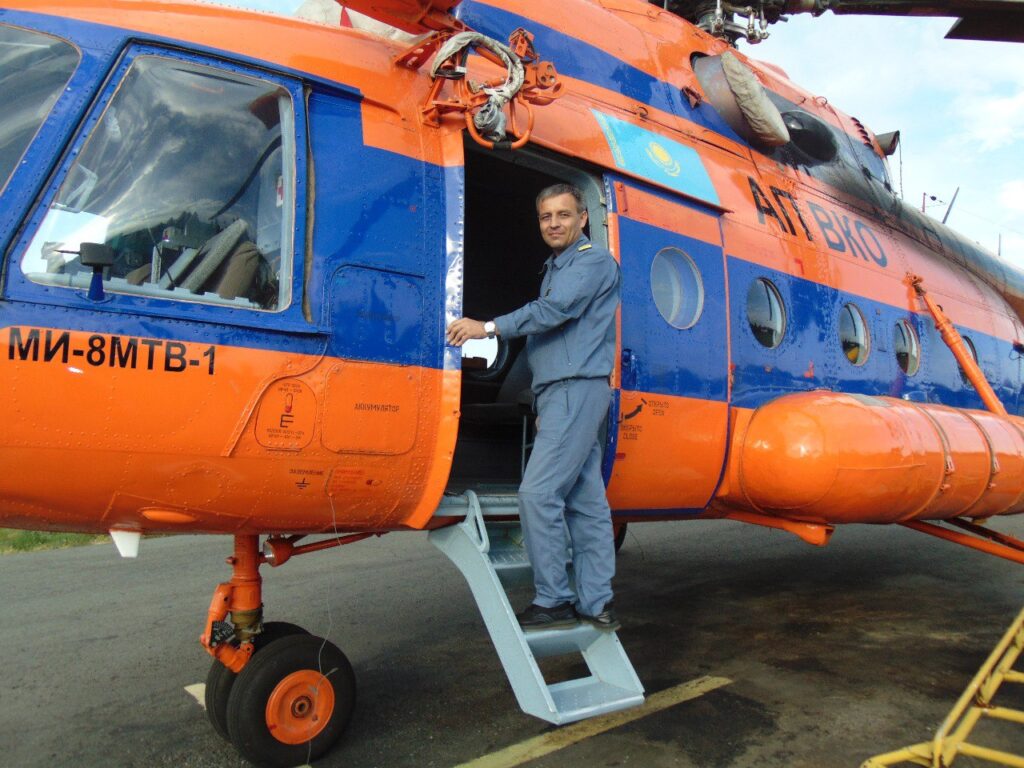
“The Mi-8 is our legendary machine – the team’s workhorse,” Grunsky told TCA. “It handles temperatures from -50°C to +50°C. You can start it even in the freezing cold with little preheating. It doesn’t need hangars and can carry 22 passengers, plus animals, if needed. It’s not just a tool, it’s our partner.”

While Western helicopters may be sleek, the Mi-8 and Mi-2 remain ideally suited for Kazakhstan’s harsh environments.

“The Mi-2 even has an anti-icing system, which many newer models lack,” Grunsky adds.

The People Behind the Missions

A typical crew includes a captain, co-pilot, and flight engineer, with the co-pilot training to become a future captain. The flight engineer acts as the captain’s eyes, managing water discharge for firefighting and checking the helicopter’s condition.

Grunsky, a father of three, acknowledges the demands of the job: “It looks romantic, but it’s intense: constant medical checks, a strict regime, and physical limits due to pressure changes. It’s not just a job, it’s a lifestyle. I won’t push my kids into this, but if one of them chooses this path, I won’t stop them.”

Director of the Aviation Division of the EKR Kalikan Baigonusov; image: TCA

Dispelling Rumors, Building Legacy

Despite their life-saving work, the team faces damaging rumors, such as claims that their helicopters are used by regional officials.

“It’s simply not true,” says Baigonusov. “We operate under strict regulations; every flight is documented with reports and protocols. We’re public servants, not a private airline.”

Private aviation companies with far larger budgets may covet their niche, but Baigonusov remains focused on preserving the division’s mission and legacy: “If there’s no one to pass on the knowledge, everything will be lost. Continuity is what matters most.”

Kazakhstan Boosts Air Transport Sector with New Fleet and Airport Revamps

Kazakhstan is set to double its civil aircraft fleet over the next five years, increasing the number of aircraft from 103 to 216 by 2030.

According to the Ministry of Transport, in 2025 the country’s fleet will add six new Airbus A320s and one Boeing 737 MAX 8. In January 2025, FlyArystan and Air Astana received new aircraft as part of this expansion. The government’s long-term plan aims to boost the number of aircraft operated by Kazakh airlines to 216 by the end of the decade.

“This year, 36 new international routes have been launched, and eight foreign airlines have entered the market. There are currently 61 domestic routes with 850 flights per week,” said Deputy Minister of Transport Maksat Kaliakparov.

As part of domestic connectivity efforts, 21 subsidized routes are now operating across nine regions, with approximately $12 million allocated for these services in 2025. The government’s priority is to improve air access to tourist destinations such as Usharal, Urdar, Kokshetau, and Turkestan.

Airport Infrastructure Development

Major investments are also being channeled into the country’s largest airports in Astana, Almaty, Shymkent, and Aktobe, all of which are being developed into multimodal transport hubs.

In Astana, a $1.1 billion modernization project for Nursultan Nazarbayev International Airport began in 2025. Plans include the construction of a second runway, a third passenger and cargo terminal, and a multifunctional complex known as the Aerotropolis. The new facility will feature an industrial and logistics zone, business centers, hotels, and retail space.

In Almaty, the airport is undergoing modernization in line with a General Development Plan extending to 2050. The initial phase includes reconstructing the domestic terminal, building a taxiway, upgrading the runway and fueling infrastructure, and establishing a cargo apron and maintenance hangar. Future phases envision a hotel and a multi-level parking facility. During the construction phase, more than 1,800 jobs are expected to be created, with an additional 550 jobs during operations.

Shymkent opened a new 40,000 square-meter terminal in December 2024, boosting its annual passenger capacity from 800,000 to 6 million. Plans are underway to construct a new 3,500-meter runway and develop a multimodal hub connecting the airport with the Ontustik Special Economic Zone.

In Aktobe, a multifunctional logistics center is being implemented at the airport. As part of this effort, the fuel filling complex is being upgraded, and storage capacity will more than double, facilitating an increase in flight operations. Authorities are also considering the construction of a second runway, which would allow the existing runway to undergo major repairs without disrupting service.

“In addition, the government has decided to expand the boundaries of special economic zones at the country’s largest airports. This will attract investors, develop industry and logistics, and turn Kazakhstan’s air hubs into growth points for the national economy,” the government said in a statement.

Foreign Investment and Regional Expansion

As previously reported by The Times of Central Asia, the German company Skyhansa intends to construct a new cargo and passenger airport in Kazakhstan’s Zhetysu region. The project is slated for the Khorgos-Eastern Gate Special Economic Zone, located along the border with China.

Aliyev: SOCAR Begins Oil Project in Uzbekistan, Results Expected Soon

Azerbaijani President Ilham Aliyev has announced that the State Oil Company of Azerbaijan (SOCAR) has officially launched operations at an oil field in Uzbekistan. “SOCAR has already started work on an oil field in Uzbekistan, and the contract has been signed. We hope to hear good news within one to two years, and we all look forward to the announcement of a major oil discovery in Uzbekistan,” Aliyev said, as reported by Report.

Aliyev also highlighted Azerbaijan’s longstanding energy partnership with Turkmenistan, noting that expanding cooperation to include Uzbekistan presents new strategic opportunities for regional development.

Energy cooperation in Central Asia continues to deepen. In March 2025, Kazakhstan’s national oil company KazMunayGas and SOCAR agreed to increase oil transit volumes via the Aktau-Baku-Ceyhan route, reinforcing Azerbaijan’s growing role as a transit hub for Central Asian energy exports.

Kazakhstan’s Gumilyov Eurasian National University Opens Branch in Kyrgyzstan’s Osh

Kazakhstan’s L.N. Gumilyov Eurasian National University (ENU) has opened a new branch at Osh State University in Kyrgyzstan’s second-largest city, Osh.

The new branch will offer training in ecology, information and communications technology (ICT), and the service sector. Students will also study Russian language and literature, translation, foreign languages, journalism, and physics, earning dual diplomas from both ENU and Osh State University.

ENU Rector Yerlan Sydykov said that the new branch would help strengthen regional human capital and “create a strong intellectual foundation for the sustainable development of Central Asia.”

ENU currently collaborates with 16 Kyrgyz universities through academic mobility initiatives and dual-degree programs.

Uzbek Migrants Send Home $4.8 Billion in Q2 2025

Uzbekistan’s Central Bank has reported that migrant workers sent home $4.8 billion in remittances during the second quarter of 2025. This marks a 21.4% increase compared to the same period last year, although it represents a slowdown from the 38.6% recorded in 2024.

The Central Bank attributed the increase to stable exchange rates in host countries, higher wages, and continued economic activity. However, the report also noted varied growth by region. Remittances from the Baltic states saw the sharpest rise, up 65.6% year-on-year, while transfers from the United States, Russia, and Europe increased more modestly by 10.3%, 23.7%, and 26.9%, respectively. Inflows from Asia remained relatively unchanged.

At the start of the year, Uzbekistan’s Embassy in Russia urged its citizens working abroad to consider returning home to participate in the construction of New Tashkent, an ambitious capital expansion project, according to Podrobno.uz.

The embassy noted that companies involved in the project could offer jobs to approximately 10,000 workers across 38 professions. Demand is especially high for concrete workers, plasterers, plumbers, electricians, and bricklayers. Officials emphasized that the project provides an opportunity to earn decent wages while contributing to national development.

Since the collapse of the Soviet Union in 1991, Russia has remained the primary destination for labor migrants from Central Asia. Official Russian data suggests nearly four million citizens from Kazakhstan, Kyrgyzstan, Uzbekistan, Tajikistan, and Turkmenistan currently reside in Russia, alongside an estimated 670,000 undocumented migrants.

Anti-migrant sentiment has intensified in Russia following the terrorist attack at Moscow’s Crocus City Hall on March 22, 2024. In response, the Russian authorities have tightened migration regulations and increased enforcement.