
• KGS/USD = 0.01144 0%
  • KZT/USD = 0.00215 0%
  • TJS/USD = 0.10640 0.76%
  • UZS/USD = 0.00008 0%
  • TMT/USD = 0.28530 0%
  • KGS/USD = 0.01144 0%
  • KZT/USD = 0.00215 0%
  • TJS/USD = 0.10640 0.76%
  • UZS/USD = 0.00008 0%
  • TMT/USD = 0.28530 0%
  • KGS/USD = 0.01144 0%
  • KZT/USD = 0.00215 0%
  • TJS/USD = 0.10640 0.76%
  • UZS/USD = 0.00008 0%
  • TMT/USD = 0.28530 0%
  • KGS/USD = 0.01144 0%
  • KZT/USD = 0.00215 0%
  • TJS/USD = 0.10640 0.76%
  • UZS/USD = 0.00008 0%
  • TMT/USD = 0.28530 0%
  • KGS/USD = 0.01144 0%
  • KZT/USD = 0.00215 0%
  • TJS/USD = 0.10640 0.76%
  • UZS/USD = 0.00008 0%
  • TMT/USD = 0.28530 0%
  • KGS/USD = 0.01144 0%
  • KZT/USD = 0.00215 0%
  • TJS/USD = 0.10640 0.76%
  • UZS/USD = 0.00008 0%
  • TMT/USD = 0.28530 0%
  • KGS/USD = 0.01144 0%
  • KZT/USD = 0.00215 0%
  • TJS/USD = 0.10640 0.76%
  • UZS/USD = 0.00008 0%
  • TMT/USD = 0.28530 0%
  • KGS/USD = 0.01144 0%
  • KZT/USD = 0.00215 0%
  • TJS/USD = 0.10640 0.76%
  • UZS/USD = 0.00008 0%
  • TMT/USD = 0.28530 0%

How Did Kazakh Poet Abai Qunanbaiuly`s Name Reach the U.S.?

Kazakh literature is filled with towering figures who have shaped the nation’s cultural and spiritual identity. Among them, Abai Qunanbaiuly (1845–1904) remains the most iconic. A poet, philosopher, and intellectual of global stature, Abai left behind a legacy that continues to resonate within world literature. As Kazakhstan celebrates the 180th anniversary of his birth, it is a fitting moment to explore how his influence extended far beyond the steppe, reaching as far as the United States.

George Kennan: The American Who Introduced Abai to the World

In 1885, American journalist George Kennan visited Semey (then Semipalatinsk) and was deeply impressed by the city’s public library. To his surprise, local Kazakhs actively borrowed and read books, a rare sight for that time and region. In his influential work Siberia and the Exile System, Kennan specifically mentioned Abai, marking one of the earliest references to the Kazakh thinker in Western literature.

Kennan’s account stands out for its authenticity. It is based not on secondhand stories but on direct observation. His writings confirm Abai’s presence in Semey’s intellectual life and suggest that the poet had begun to attract attention well beyond the Kazakh steppe.
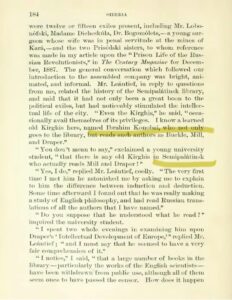
Credit «Siberia and the Exile System», by George Kennan

From Kennan’s descriptions, we gain insight into what Abai read, who his associates were, and how his worldview aligned with major thinkers of the time.

Abai’s intellectual growth was greatly influenced by E. P. Mikhaelis, a Russian political exile and lifelong friend. Under Mikhaelis’s guidance, Abai refined his reading habits and began a new phase of self-education. Through Mikhaelis, he was introduced to other exiled Russian intellectuals such as S. S. Gross, A. A. Leontiev, and N. I. Dolgopolov.

These thinkers were struck by Abai’s intellectual depth, civic engagement, and dedication to the betterment of his people. In return, Abai introduced them to Kazakh culture, history, and oral traditions, becoming a cultural bridge between East and West.
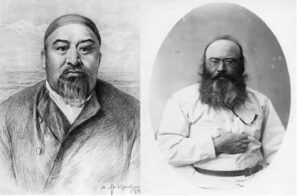
Аbai and E.P. Mikhaelis

Kennan also described the library in Semey, where Abai was a frequent visitor and reader. Since the original excerpt is in English, it is often shared as an image in historical archives rather than a transcription.

Credit «Siberia and the Exile System», by George Kennan
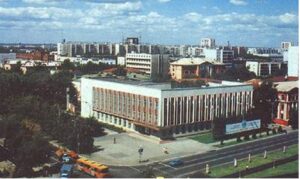
The exterior appearance of the library in Semey where Abai was a reader

Abai’s Songs and Wesleyan University

Abai’s influence extended not only through literature but also through music. In 1970, Wesleyan University Press in Connecticut published Music of Central Asia: Essays on the History of Music of the Peoples of the USSR, a groundbreaking volume by V. Belyaev and other scholars. The book includes a chapter titled Kazakh Music: From the 15th Century to the Mid-18th Century, which devotes special attention to Abai’s musical legacy.
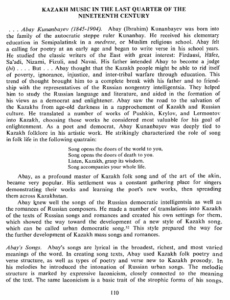
Belyaev describes Abai as a progressive thinker and a voice for enlightenment, quoting one of his famous verses:

“Song opens the doors of the world to you,
Song opens the death to you.
Listen, Kazakh, grasp its wisdom.
Song accompanies you your whole life.”

In the section Abai’s Songs, Belyaev explores the emotional range and poetic craftsmanship of Abai’s music. The poet merged Kazakh folk forms with Russian melodic influences, creating a distinctive style that aligned lyrical meaning with melodic structure.

One example is the song “Ayttim Salem, Qalamkas,” whose heartfelt lyrics convey themes of love, longing, and human connection. Another is the renowned “Kózimnіń qarasy” (“The Black of My Eye”), notable for its traditional aaba verse form and expressive melody.

Abai’s poem Segiz Ayaq (“The Eight-Liner”) is also discussed for its moral and ethical themes. Written in an innovative eight-line stanza with a unique metrical structure (558+558+88) and a rhyme pattern (aab ccb dd), it exemplifies Abai’s command of both form and content.

While his music is now receiving long-overdue recognition, much of Abai’s poetry and philosophy remains underexplored in international circles.

Abai’s commitment to education, self-awareness, and moral integrity defines him as more than a national poet. He is a universal thinker. As Professor Tursyn Zhurtbay puts it:

“We participate in global intellectual culture through Abai. He is the moral compass of our people. Every Kazakh should hold their own image of Abai in their heart.”


The only lifetime portrait of Abаi. Painter Lobanovsky P.D. 1887 y. Pencil

Abai with family members – wife Erkezhan, sons Turagul and Magauiya, grandsons – Pakizat, Abubakir and his wife Kamaliya. Semey city,1903
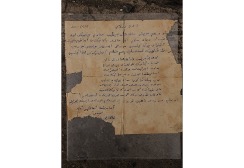
The original letter of Abai to his son Magauiya.
Arabic script. 1896 y.
From the personal fund of Musakhan Baltakaiuly.
Museum of Abai in Semey

To truly honor Abai is to engage deeply with his ideas. His vision of harmony between heart, will, and reason remains deeply relevant. As the world becomes increasingly interconnected, his wisdom continues to echo, urging us to look inward while building bridges outward.

Abai’s words are not relics of the past. They are living guides for the future. The responsibility now falls to us to read, reflect, and carry forward the message of one of Kazakhstan’s greatest minds.


Uzbekistan Joins Asian Cricket Council as Sport Gains Momentum

Uzbekistan has taken another major step in its cricket journey, as the Cricket Federation of Uzbekistan (CFU) was officially welcomed into the Asian Cricket Council (ACC) during its conference in Dhaka, Bangladesh on July 30. 

In 2022 Uzbekistan became an Associate Member of the sport’s governing body, the International Cricket Council (ICC).

Cricket has grown swiftly in Uzbekistan, with more than 4,000 players now participating in schools, universities, and community clubs across the country. The CFU has introduced cricket to 253 sports schools, using ICC training materials translated into Uzbek to engage young players. Facilities have been set up in Tashkent, Chirchiq, and Samarkand, laying the groundwork for Uzbekistan’s first national cricket team.

“Becoming part of the Asian Cricket Council is a historic step for Uzbekistan,” CFU Chairman Aziz Mihliev said. “It connects us with the wider Asian cricket community and strengthens our ability to grow the sport locally. With the support of the ICC and ACC, we are committed to developing grassroots cricket, training local coaches, and providing more opportunities for young Uzbeks to experience this global sport.”

This membership places Uzbekistan among Asia’s recognised cricket nations, including India, Pakistan, Sri Lanka, Bangladesh and Nepal.

Last year, the Times of Central Asia reported that Uzbekistan’s cricket team was preparing to play its first international matches, possibly against Mongolia.

Kazakhstan Mourns Talgat Musabayev – Cosmonaut, Space Agency Chief and Senator

Talgat Musabayev, a pilot and cosmonaut from Kazakhstan who flew on several space missions and conducted multiple spacewalks before becoming the head of his country’s space agency and a member of parliament, has died at the age of 74.  

Musabayev traveled on Russian Soyuz spacecraft in 1994, 1998 and 2001, logging nearly a year in orbit. He stayed on the Soviet-built Mir space station on the first two voyages and spent a week on the International Space Station for a week on the third trip. Dennis Tito, the first paying space tourist, was on that third expedition with Musabayev, an event that set the stage for the nascent space tourism industry involving companies such as SpaceX and Blue Origin. 

President Kassym-Jomart Tokayev expressed his condolences to Musabayev’s family on Monday. 

Musabayev “is a hero who conquered space three times and performed spacewalks, glorifying our country with his feats,” Tokayev said in a statement. “He dedicated his entire working life to the progress of domestic cosmonautics. As a Senator and public figure, he initiated many good undertakings.”

Among Musabayev’s highlights in space was, as commander, welcoming American astronauts aboard the Mir station in 1998, three years before the station was abandoned and made a controlled reentry into Earth’s atmosphere, mostly burning up in the process. Video shows Musabayev smiling broadly and embracing the Americans as they float through the hatch from the Discovery space shuttle into the Mir station. Musabayev gave a wrench to shuttle commander Charlie Precourt, saying it was a gift from Mir for the construction of the International Space Station. 

After his career as a cosmonaut ended in 2003, Musabayev was appointed head of KazCosmos, Kazakhstan’s space agency, in 2007 and then served as a senator in Kazakhstan’s parliament from 2017 to 2023. He received numerous awards for his contribution to space flight, not just from Kazakhstan but also Russia and NASA, the U.S. space agency. A commemorative stamp with his image was released in Kazakhstan a decade ago. 

In the mid-2000s, Musabayev became director of the joint Russian-Kazakh venture known as Baiterek, which aimed to build a new launch pad for the Soyuz-5 rocket at the Russia-operated Baikonur Cosmodrome in Kazakhstan. The goal was to replace deteriorating Soviet-era infrastructure and expand Kazakhstan’s own space ambitions, though the project ran into delays and funding problems.  

Dmitry Bakanov, head of Russian space agency Roscosmos, said last month that, as part of the Baiterek venture, the Soyuz-5 rocket will launch from Baikonur at the end of 2025, Russia’s Interfax news agency reported

Roscosmos also expressed condolences on learning of Musabayev’s death on Monday. 

Musabayev, who was born in the Almaty area, graduated with a degree in radio electronic equipment from the Riga Civil Aviation Engineers Institute in Latvia, then under Soviet control, in 1974. The engineering school, renamed the Transport and Telecommunication Institute, said in a tribute that the alumnus from Kazakhstan as “a person whose humility, intellect, and dedication left a lasting impression on everyone who had the privilege of meeting him.”

The cosmonaut, who was photographed playing the guitar on missions, maintained his passion for pushing the limits of space exploration. In 2014, he praised the mission of the European Space Agency’s Rosetta spacecraft after its lander touched down on a comet, according to Tengrinews, a news outlet based in Kazakhstan. 

“This suggests that humanity has moved another few meters forward in the study of the outer space, of the deep cosmos,” Musabayev said. “And it shows that we are not focused only on orbital flights around the Earth. It is time to explore deep space.”

Uzbekistan Approves Controversial ‘Sea Breeze Project’ at Charvak Reservoir

The Uzbek government has approved the contentious “Sea Breeze Uzbekistan” project at the Charvak reservoir in Tashkent region, despite vocal opposition from environmental activists and mounting public concern.

Prime Minister Abdulla Aripov signed Cabinet of Ministers Resolution No. 490, granting “Sea Breeze Uzbekistan” LLC a 25-year direct lease on 577 hectares of land to develop a $5 billion all-season resort complex.

Amid widespread protests, the Ministry of Ecology and the Ministry of Water Resources released back-to-back statements pledging strict government oversight throughout the project’s implementation.

The Ministry of Ecology stated that it will supervise adherence to environmental legislation, including the monitoring of air quality, resource efficiency, and public health safeguards. The ministry reiterated its commitment to transparency and public engagement, stating: “Environmental protection remains an absolute priority for the state.”

“The Ministry of Ecology will conduct continuous monitoring to identify any risks related to pollution, misuse of resources, or potential threats to citizens’ health,” the statement added.

The Ministry of Water Resources affirmed that the Charvak reservoir will remain under full state control. It assured the public that all wastewater generated by the project will be diverted to a centralized treatment facility, with no discharge permitted into the reservoir. The ministry stated that construction will take place outside protected water zones and comply fully with sanitary and hydraulic engineering standards.

Officials also noted that an inter-agency task force will conduct ongoing monitoring, with immediate responses promised in the event of any violations. Safeguarding drinking water and maintaining the reservoir’s water quality are described as “absolute priorities.”

Despite assurances, the project continues to provoke heated debate under the viral hashtag #SaveChorvoq. Government officials have pledged strict oversight, but environmental groups remain skeptical as construction proceeds.

Uzbek National in U.S. Faces Deportation Following Voter Fraud Conviction

An Uzbek citizen, Sanjar Djamilov, is facing deportation from the United States after pleading guilty to conspiracy to commit voter registration fraud, according to a U.S. court ruling reported by Florida Politics.

Djamilov, 33, who resides in St. Petersburg, Florida, was sentenced to time served and placed under supervised release pending deportation. He has been remanded to the custody of U.S. Marshals and is awaiting processing by the Bureau of Customs and Immigration. If deported, he will be barred from re-entering the U.S. without explicit government authorization.

The court imposed a $100 assessment on Djamilov, but waived restitution and other fees.

According to investigators, Djamilov and a Russian national, Dmitry Shushlebin, submitted 132 fraudulent voter registration applications to the Pinellas County Supervisor of Elections between February and March 2023. The applications were flagged for identical formatting, repeated typographical errors, sequential Social Security numbers, and recurring birth dates, raising immediate suspicion.

Authorities say the pair also submitted change-of-address forms to the U.S. Postal Service to redirect official mail to three addresses under their control. The case was jointly investigated by the FBI, the U.S. Postal Inspection Service, and the Florida Department of Law Enforcement, following a referral from the Florida Department of State’s Office of Election Crimes and Security.

In an April 2025 plea agreement, Djamilov admitted that Shushlebin had hired him and others to submit more than 100 fraudulent applications. While Djamilov has now been sentenced, Shushlebin has also pleaded guilty but is still awaiting sentencing. Djamilov had faced up to five years in prison for his involvement.

As previously reported by The Times of Central Asia, 131 citizens from Uzbekistan, Kazakhstan, and Kyrgyzstan were repatriated from the U.S. on a special charter flight in May 2025. Funded by the Uzbek government, the operation reflected growing cooperation between Washington and Tashkent on migration and security issues.

Kazakhstan Proposes Stricter Measures for Convicted Pedophiles, Including Pre-Release Chemical Castration

Kazakhstan’s Ministry of Health has proposed tightening the application of chemical castration for individuals convicted of sexual crimes against minors. Draft amendments published on the Open NPA platform outline a new mechanism mandating the procedure six months prior to a convict’s release from prison.

Ministry of Health Proposal

Under the proposed changes, prisoners would undergo a compulsory forensic psychiatric evaluation one year before their scheduled release to assess the risk of recidivism. If deemed necessary, chemical castration would follow six months later.

“An amendment is being introduced on the use of chemical castration six months before release and the referral of materials by the administration of the institution no later than twelve months before the expiry of the sentence to the court for the appointment of a forensic psychiatric examination,” the explanatory note states.

Legal Basis and Procedure

Chemical castration is regulated under Article 91 of Kazakhstan’s Criminal Code. It is currently applied to individuals over the age of 18 convicted of crimes against the sexual integrity of minors, provided they have been diagnosed with a disorder of sexual preference.

The procedure involves the administration of antiandrogenic medication to suppress testosterone levels and reduce sexual drive. Presently, the measure can only be imposed by court order.

The Ministry of Health argues that conducting the procedure shortly before release would minimize the risk of reoffending during the immediate post-release period, which is considered particularly high-risk.

Lifelong Supervision Also Under Consideration

In a parallel initiative, the Ministry of Internal Affairs has proposed introducing lifetime administrative supervision for convicted pedophiles. Currently, such supervision is limited to eight years.

“We can also restrict leaving the house at night,” said Deputy Minister of Internal Affairs Igor Lepekha. “Previously, supervision lasted eight years. Now, it is planned to be significantly extended.”

Under the proposal, courts would reassess each case every six months based on the likelihood of recidivism. Additional measures may include restrictions on visiting educational institutions, curfews, and more. Violations would carry administrative or criminal penalties.

A Push for Surgical Castration

A more extreme measure was proposed in 2024 by parliament deputy Yelnur Beisenbayev, who advocated for the surgical castration of pedophiles, calling it a powerful deterrent.

“I spoke in favor of surgical castration. We included this provision in the draft law, but the government did not support it, citing concerns about violating privacy,” Beisenbayev said.

He criticized the government’s stance as “spineless,” asserting that physical castration could serve as both a preventive measure and a means to protect children from violent sexual crimes.


