• KGS/USD = 0.01144 0%
  • KZT/USD = 0.00192 -0%
  • TJS/USD = 0.10849 0.37%
  • UZS/USD = 0.00008 0%
  • TMT/USD = 0.28571 0.28%
  • KGS/USD = 0.01144 0%
  • KZT/USD = 0.00192 -0%
  • TJS/USD = 0.10849 0.37%
  • UZS/USD = 0.00008 0%
  • TMT/USD = 0.28571 0.28%
  • KGS/USD = 0.01144 0%
  • KZT/USD = 0.00192 -0%
  • TJS/USD = 0.10849 0.37%
  • UZS/USD = 0.00008 0%
  • TMT/USD = 0.28571 0.28%
  • KGS/USD = 0.01144 0%
  • KZT/USD = 0.00192 -0%
  • TJS/USD = 0.10849 0.37%
  • UZS/USD = 0.00008 0%
  • TMT/USD = 0.28571 0.28%
  • KGS/USD = 0.01144 0%
  • KZT/USD = 0.00192 -0%
  • TJS/USD = 0.10849 0.37%
  • UZS/USD = 0.00008 0%
  • TMT/USD = 0.28571 0.28%
  • KGS/USD = 0.01144 0%
  • KZT/USD = 0.00192 -0%
  • TJS/USD = 0.10849 0.37%
  • UZS/USD = 0.00008 0%
  • TMT/USD = 0.28571 0.28%
  • KGS/USD = 0.01144 0%
  • KZT/USD = 0.00192 -0%
  • TJS/USD = 0.10849 0.37%
  • UZS/USD = 0.00008 0%
  • TMT/USD = 0.28571 0.28%
  • KGS/USD = 0.01144 0%
  • KZT/USD = 0.00192 -0%
  • TJS/USD = 0.10849 0.37%
  • UZS/USD = 0.00008 0%
  • TMT/USD = 0.28571 0.28%
11 December 2025

Kyrgyzstan Moves Toward Fully Digital Justice System

On November 17, Kyrgyz President Sadyr Japarov signed new legislation aimed at modernizing the country’s judicial system and expanding citizens’ access to justice through advanced digital technologies.

The new law introduces a fully digital framework for legal proceedings, intended to accelerate litigation and increase transparency. Beginning January 1, 2026, administrative, civil, and economic cases will be processed entirely within a digital environment.

Under this system, court rulings, protocols, and other legal documents will be deemed legally valid if signed with a digital signature. All filings, including lawsuits, appeals, cassation complaints, and petitions for case review, must be submitted electronically through a unified digital platform, with each document requiring a digital signature and completion of an electronic form.

Participants in legal proceedings will be able to access and download court decisions online. The legislation significantly reduces and eventually aims to eliminate the need for individuals to appear in court in person as plaintiffs, defendants, witnesses, or experts. Remote participation and the mandatory audio and video recording of all court sessions will be central features of the new system.

According to government officials, the reform marks a systemic shift from paper-based litigation toward a digital, streamlined model designed to improve judicial efficiency and accountability.

In parallel, President Japarov also signed the Law “On Mediation,” which introduces mandatory pre-trial and extra-judicial mediation for certain categories of civil and criminal disputes. The goal is to ease the burden on courts and promote a culture of peaceful conflict resolution.

While these reforms represent a step toward modernization, Kyrgyzstan’s judiciary continues to face significant structural challenges. The Global Organized Crime Index identifies the judicial system as among the most corrupt institutions in the country, citing persistent issues of bribery, political pressure, and influence from organized crime networks.

The presumption of innocence is frequently disregarded, and courts are often criticized for operating under a de facto presumption of guilt. A 2023 nationwide survey by the International Republican Institute found that 49% of respondents identified the courts as the most corrupt institution in Kyrgyzstan.

Energy-Saving Measures Introduced in Kyrgyzstan: Who Will Be Affected?

Kyrgyzstan’s Cabinet of Ministers has implemented a series of measures aimed at improving energy efficiency and ensuring the rational use of electricity. The move comes amid an electricity shortage caused by persistently low water levels in the country’s main reservoirs.

What’s Happening?

Officials have reported a record surge in electricity consumption this year, coupled with a continuing regional drought. In response, the government has ordered a restriction on indoor and outdoor lighting between 6p.m. and 6a.m.

However, the Cabinet emphasized that the new measures will not apply to strategic facilities, 24-hour operations, or institutions responsible for defense, security, health care, social services, or other critical public functions.

“These measures do not affect processes essential to the technological operation of buildings,” stated the government’s press service.

According to official estimates, the restrictions could save approximately 40 million kilowatt-hours of electricity per month.

This year, Kyrgyzstan has already recorded electricity consumption that exceeds last year’s figures by 1 billion kilowatt-hours.

The government attributes the increased demand to the launch of new industrial enterprises, the expansion of social and educational institutions, and ongoing residential construction.

The situation is further worsened by declining water inflow to the Naryn River, which feeds the Toktogul Reservoir and its namesake hydroelectric plant. The reservoir’s water level is currently 2 billion cubic meters lower than it was during the same period last year.

“The Cabinet’s primary objective is to ensure rational water use in the Toktogul Reservoir and reduce the load on the energy system,” the government said. The goal is to prevent the reservoir from reaching a critical low.

Who Will Be Responsible?

The Ministry of Energy has mandated that all government agencies and state-owned entities switch off power in the evenings and at night once staff have left their workplaces. Heads of municipal bodies and public institutions will bear personal responsibility for any violations of the new regulations.

How Are Residents Responding?

For now, residents in the private sector report that little has changed. However, there are growing concerns that household power limits may soon be tightened.

“They say our electricity consumption will be restricted. It used to be capped at 5 kilowatts at a time, but now they’re talking about reducing it to 3. That would make things much harder, especially if it’s a cold winter,” said Alexander Verkholantsev, a resident of central Bishkek, who spoke with The Times of Central Asia.

Authorities have already announced that electricity restrictions for residential consumers during peak hours will be in place from October 2025 through March 2026. Despite this, many households still exceed the 3-kilowatt threshold.

TCA Interview: Kazakh Director Venera Kairzhanova on the Bravery of Children with Special Needs

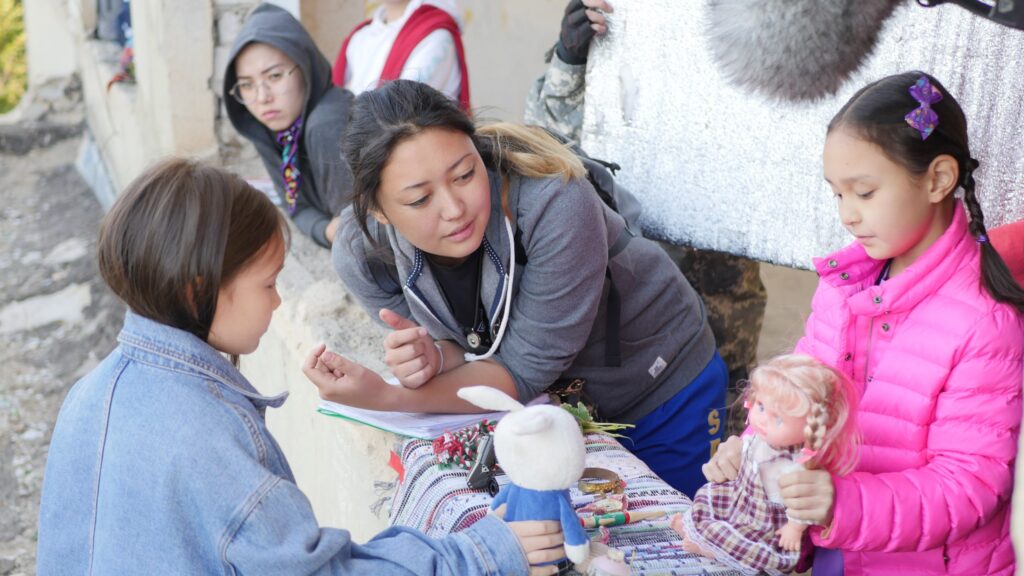
November saw the premiere of Venera Kairzhanova’s debut feature film, Second Mother. The documentary centers on the Meyirim rehabilitation center for children with developmental disabilities. But the film is more than a social chronicle; it’s a warm and luminous portrait of people who help children explore the world every day. Step by step, movement by movement.

Kairzhanova spoke with The Times of Central Asia about the making of the film.

TCA: Venera, congratulations on the premiere. How did you feel seeing your work on the big screen?

Kairzhanova: It was very exciting, but everything went smoothly in a warm, friendly atmosphere. The film was well received, and the theater was full. The audience included employees of the Meyirim center, parents, media representatives, and industry colleagues. The first private screening was back in September, but it was in a small theater with limited guests. This time, it was a huge hall with lots of people, a completely different experience.

What’s interesting is that when the project is finished and you watch it with the audience, you see it not just as a director, but also as a viewer.

TCA: The audience cried. Did you?

Kairzhanova: Yes. At the first screening, very much so. At the second, the emotions were a bit less intense, but the material still moves me: stories about the children, their teachers, their victories. After the screening, people came up to me to share their impressions and that was incredibly valuable. It’s important when a film is not just watched but really touches people’s hearts.

@Galiya Baizhanova

TCA: Working with children is always a special process. How did you prepare?

Kairzhanova: Honestly, I didn’t prepare specifically. I arrived early, observed the classes and that was it. I was nervous, of course, because I didn’t know how the children would react to the cameras, lights, and equipment. But everything went surprisingly well.

The children turned out to be incredibly open and sociable. They weren’t shy about the cameras; on the contrary, they played around and looked straight into the lens. Everything was so natural that we hardly interfered. We didn’t ask them to repeat anything or stage any shots. We just captured moments: in the dining room, during classes, and in their interactions.

This project made me fall even more in love with documentary filmmaking, even though this is already my fifth documentary.

TCA: Which episode was the most emotional for you?

Kairzhanova: The film mainly focuses on the rehabilitation center’s educators. We filmed their daily routines: classes, meetings, celebrations. By the third day, everyone had gotten used to each other, and the atmosphere became very warm.

One day, we filmed an individual session between instructor Anna Kosenko and a girl named Aisha. She was learning to walk with the help of an exoskeleton. Aisha, fragile, small, beautiful, was taking steps, and Anna was helping her. At one point, Anna asked, “Are you okay?” Aisha smiled and said, “Yes, I’m fine.”

TCA: And you couldn’t hold back…

Kairzhanova: I just started crying. I looked at the monitor and cried.

I’d been working for three days, just recording what was happening. And then suddenly, something clicked. I realized this wasn’t just a shot. This was real life, the children’s efforts, their inner strength. I turned away so no one would see me and sat behind the monitor, crying.

Our cameraman, the wonderful Azamat Zhanabekov, came over and said he’d also barely held it together. It was a very moving moment.

@Galiya Baizhanova

TCA: What touched you so deeply, her joy at taking her first steps?

Kairzhanova: It was her inner strength and the joy with which she accepts life. We often get upset over nonsense. But these children work every day to learn to walk, talk, hold a spoon, things that come naturally to us. And they smile while doing it.

They look at you with such warmth, such gratitude for life, that it turns everything inside you upside down. Even now, talking about it, my voice trembles. That moment will stay with me forever.

TCA: You were the screenwriter for the film Paralympian. Did you choose inclusive cinema consciously, or was it a coincidence?

Kairzhanova: It started back when I was a student. Aldiyar and I have been working together for a long time. One of our first inclusive projects was the short film Hop-Top. It was successful, got a lot of feedback, and then we were invited to make a social video about a girl with Down syndrome. Then Aldiyar came up with the idea for Paralympian.

That film probably led to Second Mother. The author of the idea, Bakhyt Saparov, suggested making a film about teachers at rehabilitation centers, to show their work and the atmosphere from the inside.

You could say this topic found us. We weren’t looking for it.

TCA: “Khlop-Top” is the one where Santa Claus visits a rehabilitation center?

Kairzhanova: Exactly. An actor is sent without being told the details. He walks in and sees most of the children in wheelchairs. He panics and leaves. The teacher runs after him and says, “Please don’t leave. The children were waiting for you.”

He returns, and the children experience a real miracle.

That’s how we got drawn into the topic of inclusion. We didn’t have any personal experience with it; it just found us.

TCA: In Paralympian, you don’t push for pity but use humor. Why?

Kairzhanova: Because we listened and observed a lot. We realized that people overcome difficulties through humor.

The characters joked about their situations but in a kind, good-natured way. And it’s not just about people with disabilities. Everyone lives like that. Life is hard, and humor helps you get through it without staying stuck in pain.

@Galiya Baizhanova

TCA: Is your new film also uplifting?

Kairzhanova: Yes. Many expected a heavy film, but they smiled throughout. And I loved that.

We didn’t focus on how hard things are for the children. We showed how they live, how they’re supported, how they grow.

The centers create an atmosphere of complete safety and acceptance. No one is judged. There, children are just children.

TCA: Second Mother is your feature film debut. What were your earlier works about?

Kairzhanova: My first documentary was about our friend Sofia Tormysheva, who passed away. It was a very personal story.

Then in 2021 came a turning point. After the pandemic, I had two offers: to work as an assistant on a TV series, a feature film, my comfort zone or to direct a documentary project. It was scary, but I chose documentary. I have no regrets – it was a turning point.

After that came projects: a film about cattle breeding for the Meat Union of Kazakhstan, one about Turkestan, and a project for the 30th anniversary of a mineral water plant.

And Second Mother is already a social film and a special one.

TCA: Will the film be released?

Kairzhanova: The producers are considering it, but it’ll most likely go to festivals and streaming platforms.

Theatrical release is harder. As far as I know, the only documentary to make it to theaters was Kanat Beysekeev’s Winter in Rehab. He’s a media personality with his own audience. It’s much more difficult for other filmmakers.

TCA: Social films are increasingly being made in Kazakhstan now. Can such films become part of theatrical distribution?

Kairzhanova: I think so. When major players like Tiger Films focus on social issues, it’s important. Inclusive stories need to be seen they shouldn’t stay hidden in festival niches.

The potential for such films is huge. Look at the global success of 1+1, that’s a social film too. Our film Paralympian was also very well received.

Audiences are changing, opening up to new topics, and that’s wonderful. I’m glad there are directors and producers taking on such bold stories.

Lifting Off: Kazakhstan’s Push Into Next-Gen Aviation Technologies

Kazakhstan’s plans to create an air taxi system based on electric eVTOLs in the city of Alatau have drawn attention to the country’s readiness to take the lead in implementing advanced unmanned technologies. The project would require large-scale changes in regulation and technological infrastructure, as well as personnel training and risk assessment.

The Times of Central Asia discussed these futuristic developments with Aslan Satzhanov, acting CEO of the Aviation Administration of Kazakhstan JSC.

Goals and Expected Results

TCA: What is the Concept for the Development of Civil Unmanned Aviation in Kazakhstan, and what does it provide for? What are the key goals set out in the document?

Satzhanov: In accordance with the government decree, the main goals for the development of civil unmanned aviation are to increase the volume of work using unmanned aerial systems (UAS), de-bureaucratize, digitize, and transform existing requirements, procedures, and processes. The principal aim is to simplify the formalities for performing UAS flights in designated airspace as much as possible.

The development of the industry is based on the principles of safety, minimization of risks to people and objects, and the creation of the most favorable conditions for technological growth. Key approaches include establishing a scientific foundation, improving the training system, and expanding the scope of UAS applications.

By 2031, it is planned that at least 80% of secondary and vocational education institutions will teach the basics of unmanned aviation. The share of enterprises in the agro-industrial complex (AIC), industry, and energy that use UAVs will grow by at least 30%. The localization of production of key UAS components in Kazakhstan will increase to 10%. In addition, Kazakhstani companies will be able to enter promising segments of the global market for unmanned aerial vehicles and software.

Regulation and Legislative Framework

TCA: How is the regulation of UAV flights and production structured today? To what extent does the regulatory framework meet modern requirements?

Satzhanov: The fundamental document is the Rules for the Use of Unmanned Aircraft Systems, adopted back in 2020. Kazakhstan became the first country in the post-Soviet space to approve comprehensive rules for the use of UAS in its airspace.

Later, amendments were made to the Law on the Use of Airspace. Based on these amendments, the rules for the use of airspace for UAS operations were updated in 2023.

Thus, the regulatory framework has been fully established. It is in line with global trends from urban air mobility to unmanned taxis and strikes a balance between technological development and flight safety.

The transition to eVTOL and urban air mobility will create a new transport ecosystem: it increases population mobility, reduces the load on ground infrastructure, improves the environmental situation, and promotes innovation.

Training

TCA: What measures are planned for training UAV operators and introducing unmanned technologies into educational programs?

Satzhanov: The concept provides for the creation of a multi-level training and professional development system. Modules on civil unmanned aviation will be introduced into secondary and vocational education programs, covering at least 80% of educational institutions by 2031. The number of certified operators and external UAS pilots will increase to 5,000.

Interdisciplinary programs at the intersection of aviation, engineering, and IT will be developed. Subsurface resource users will be able to train personnel as part of their contractual obligations.

A special role will be assigned to the Civil Aviation Academy, which will become a key center of expertise. The educational institution will provide methodological support, operator certification, and training for public sector specialists on a “one-stop shop” basis. All programs will comply with ICAO, EASA, and JARUS standards.

Test Sites, Research Centers, Test Bases

TCA: What is the current state of unmanned aviation infrastructure? Are there any test sites and laboratories?

Satzhanov: The infrastructure is currently being developed. Test sites are already in operation at the Civil Aviation Academy, numerous technical colleges and universities, and as part of private sector pilot projects.

The concept envisages the creation of a national network of test centers for static, dynamic, and certification tests, as well as research and engineering centers at leading technical universities. Regional test sites will be created for different types of UAVs, including agricultural, logistics, search and rescue, and urban eVTOL.

At the same time, research centers will be developed with the involvement of universities and the private sector, which will allow for the creation of proprietary technologies and the expansion of the scientific base.

Areas of Application

TCA: Which sectors of the economy will be the main users of UAVs?

Satzhanov: UAVs are most in demand in agriculture, geological exploration, energy, transport, ecology, construction, and security.

In the agro-industrial complex, UAVs are used for crop monitoring, fertilization, irrigation control, and aerial chemical work. In geological exploration, they are used for aerial photography, mapping, and geophysics. In energy, they are used to inspect power lines, main pipelines, power plants, and renewable energy facilities.

In transportation, they are used to deliver cargo to hard-to-reach areas and develop air mobility. In ecology, for monitoring the environment, water bodies, forests, and identifying illegal dumps. In construction, for engineering surveys and 3D modeling. In the field of emergencies, for aerial reconnaissance and search and rescue operations.

The UAS market also has a multiplier effect on IT, instrument engineering, telecommunications, and component manufacturing.

International Integration: ICAO and JARUS

TCA: Is Kazakhstan working to integrate into international unmanned aviation regulatory structures?

Satzhanov: Yes, Kazakhstan is actively cooperating with ICAO and JARUS. We are not a direct participant in the UAS Advisory Group or RPAS Panel, but we use the recommendations, SARPs standards, and the Manual on RPAS (Doc 10019), gradually harmonizing our standards with global requirements.

In July 2023, Kazakhstan officially joined JARUS. We became the first Central Asian country to join the organization. This provides access to an international expert platform, best regulatory practices, and uniform methodologies that are integrated into ICAO standards.

Thus, national standards and certification procedures are gradually being brought into line with international ones.

Domestic Production

TCA: Is the creation of domestic production of UAVs and components in Kazakhstan being considered?

Satzhanov: Yes. The concept and action plan explicitly provide for support for domestic manufacturers, localization of key components, development of engineering competencies, and creation of conditions for serial production of UAS. At the same time, R&D aimed at developing our own solutions will be supported.

TCA: How is the safety of UAV flights ensured, and how are incidents and cyber threats prevented?

Satzhanov: These areas are priorities. We are implementing a set of measures: coordination and monitoring systems, remote identification, geo-zones, interagency cooperation, and ensuring cyber resilience.

We plan to introduce an integrated airspace coordination system. In the future, UAS flight applications will be submitted electronically, which will minimize violations.

The flight monitoring system will operate in specially designated areas. A model of state or public-private management is being considered.

From 2023, all UAV flights within the administrative boundaries of cities of republican and regional significance must be performed using a Remote ID, which allows flights to be tracked quickly and unauthorized activity to be prevented.

A mechanism of geo-zones is envisaged, software restrictions on flights near aerodromes, critical infrastructure, and strategic facilities.

The effective operation of all systems requires the combined efforts of ministries and the Aviation Administration. The creation of a single center for the coordination and monitoring of UAV flights is currently being considered.

Meet Nurxat Nuraje, One of Kazakhstan’s Most Impressive Scientists

Nurxat Nuraje is a Kazakh scientist who is now well known in the global scientific community. He has spent more than two decades studying and conducting research in the United States.

Drawn to science from an early age, he earned his PhD in chemistry from the City University of New York in 2008, successfully launching his research career.

His main field of research is nanotechnology and its applications. At a time when nanoscience was still emerging, his bold approach to the subject quickly gained recognition. His first major publication was in the Journal of the American Chemical Society – one of the world’s leading chemistry journals.

The paper introduced innovative ideas about nanocircuit fabrication, methods and challenges in their development, computational power, and potential applications. This paper was considered a major contribution to the field at the time.

Soon after, he joined the Massachusetts Institute of Technology (MIT), one of the world’s foremost technology universities, as a postdoctoral researcher. There, he succeeded in finding ways to increase computer storage capacity, which is a crucial question for modern computing. His research on the development and application of specific nanoparticles was published in Advanced Materials, once again establishing his name in global science.

His work was later awarded a silver medal at the International Materials Research Society conference in San Francisco.
“Science doesn’t deliver results overnight. It evolves gradually,” says Nuraje. “The true mission of a scientist is to reshape the world’s thinking through discovery. In the future, we must move from oil to hydrogen energy. That is the energy of tomorrow.”

Since 2013, Nuraje has worked as a research scientist at MIT. He is also credited with developing conductive polymer nanoparticles, which are now widely used.

Together with his students, he continues to design and create practical, everyday-use technologies. In 2015 he received the Joseph Award for his outstanding contribution to nanotechnology. He became the first Kazakh scientist to win this American honor.

Why did MIT invite him to join their team? The answer lies in his PhD dissertation, which was recognized by experts as one of the best in the field. Harvard University, the University of California, and MIT each offered him postdoctoral positions.

One of Nuraje’s remarkable achievements was the development of anti-fogging materials – the kind used on smartphone screens today. Working with MIT professor Angela Belcher, he co-created a new type of photocatalytic material through genetic engineering of the M13 virus. This groundbreaking work was published in Advanced Materials in 2012 and resulted in five international patents. This is a true testament to the Kazakh proverb: “Knowledge conquers all.”

In 2015, he joined Texas Tech University as a professor of chemical engineering, where he established his own research laboratory, The Nurxat Nuraje Lab. There, his team developed solar-powered water-splitting technology to produce hydrogen. His breakthroughs in conductive polymers earned him the American Chemical Society’s Petroleum Research Award in 2016.

In the following years, he was named “Most Distinguished Scientist” at Texas Tech University, and in 2018, the Journal of Materials Chemistry A listed him among the world’s top researchers.

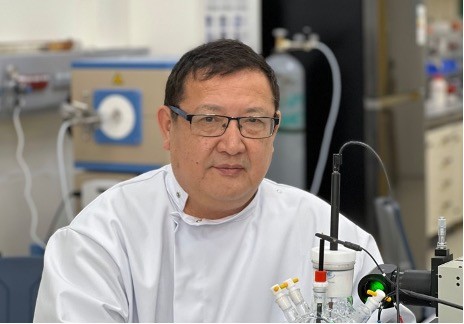
Nurxat Nuraje with his students

In 2019, he returned to Kazakhstan to continue his scientific work at Nazarbayev University. Within three years, he founded four major research laboratories focusing on membranes, conductive plastics, solar hydrogen production, and biomass. These labs now employ over forty young Kazakh researchers.

When we asked Nuraje about the innovations that his team has achieved, he replied: “We’ve developed flexible, conductive rubber materials that can stretch and conduct electricity without breaking, unlike metal. They can be used for sensors, bacterial testing, even TV screens. That’s a major success, and our findings have been published in a high-impact scientific journal.”

Nuraje believes that science must be trusted and valued before it can truly flourish. Together with his students, he continues to promote Kazakhstan’s scientific achievements globally. Recently, his team developed a hydrogen detection sensor. This is a clear example of how passion and dedication to science can yield tangible progress.

Uzbekistan Emerges as Key Market for China’s Real Estate Giants

Since 2021, China’s property sector has been navigating one of the most severe downturns in its history. A combination of mounting developer debt, strict government lending rules, and a large stock of unsold housing has pushed the country’s real estate giants into prolonged distress.

As speculative construction slows at home, Chinese companies are increasingly turning outward. Similar to firms in renewable energy, waste-to-energy, and electric vehicle industries, real estate developers now see foreign markets as essential for restoring balance and sustaining growth.

In this broader search for new opportunities, Uzbekistan has emerged as a highly compelling destination for Chinese investment. The country offers a rare mix of rapid demographic growth and urgent housing needs that few markets can match. Uzbekistan’s population is expanding at a fast pace, and more than 60,000 new households form every year. This demographic surge is placing enormous strain on the country’s already limited housing stock.

Official data shows that around 85,000 families are waiting for housing, yet annual construction increases the existing stock by only one to two percent. The result is a persistent shortage that cannot be resolved without sustained and large-scale capital investment. If this deficit remains unaddressed, it risks creating long-term social frustration.

Against this backdrop, the interests of Chinese real estate developers and Uzbekistan’s housing priorities are beginning to align. Chinese firms looking for stable and high-demand markets increasingly view Uzbekistan as an attractive place to expand. Tashkent, in particular, has become a center of growing cooperation with Chinese partners.

Several recent agreements illustrate this momentum. The Chinese firm TSC HK Investment is preparing a $340 million project for a residential complex and business center in the Chilanzar district of Tashkent. The city authorities have also signed agreements worth about $1 billion with CSCEC, including a major housing development valued at $440 million. Beyond the capital, another Chinese investor plans to allocate $250 million to build a modern complex covering 55 hectares in the city of Babur in the Andijan region.

For Chinese companies, Uzbekistan offers a large and expanding market that helps absorb China’s massive overcapacity in construction services, heavy machinery, and industrial materials such as steel and cement. Investing in Uzbekistan not only eases domestic economic pressure but also allows Chinese firms to demonstrate their capabilities in shaping the daily lives of Uzbek families.

Large residential projects provide opportunities to familiarize local communities with Chinese standards, technologies, and urban design practices. When these projects are executed successfully, they can contribute to a positive image of China and strengthen its soft power presence in the country.

For Uzbekistan, China’s growing involvement brings several advantages. Chinese investment can help meet the country’s rapidly rising demand for housing and reduce the likelihood of long-term social frustration linked to shortages. Chinese developers often work with integrated models that go beyond simple residential blocks. They build high-density and multi-functional complexes combining housing, business centers, educational facilities, and public services.

This approach aligns closely with Uzbekistan’s strategy to encourage sustainable urbanization, improve living conditions, and move away from unplanned urban sprawl. Most importantly, these investments generate employment. The TSC HK Investment project alone is expected to create 1,000 new jobs.

Alongside these benefits, there are legitimate concerns that require attention. The entry of large Chinese construction companies can put Uzbek firms at a disadvantage. Chinese developers typically operate through highly efficient global supply chains and may rely heavily on imported materials and sometimes labor.

Their ability to control everything from raw materials to the final construction creates a fully integrated ecosystem that local firms often cannot compete with. If Chinese companies consistently bypass Uzbek contractors, local businesses may face declining revenues and lose opportunities to develop their own industrial capacities.

The overall picture shows that the growing presence of Chinese real estate companies in Uzbekistan brings significant opportunities, but also risks. To maximize the benefits, Uzbekistan would gain from encouraging structured cooperation between Chinese and local firms. Policies that require the partial use of local contractors, materials, and labor can strengthen the domestic construction sector.

At the same time, Uzbek companies can learn from the international experience of their Chinese counterparts, which would raise local standards and capacities in the long term. A balanced and well-managed partnership can therefore support Uzbekistan’s development goals while offering Chinese companies a valuable external market, creating a mutually beneficial outcome for both sides.