• KGS/USD = 0.01144 0%
  • KZT/USD = 0.00197 -0%
  • TJS/USD = 0.10904 0%
  • UZS/USD = 0.00008 0%
  • TMT/USD = 0.28490 0%
  • KGS/USD = 0.01144 0%
  • KZT/USD = 0.00197 -0%
  • TJS/USD = 0.10904 0%
  • UZS/USD = 0.00008 0%
  • TMT/USD = 0.28490 0%
  • KGS/USD = 0.01144 0%
  • KZT/USD = 0.00197 -0%
  • TJS/USD = 0.10904 0%
  • UZS/USD = 0.00008 0%
  • TMT/USD = 0.28490 0%
  • KGS/USD = 0.01144 0%
  • KZT/USD = 0.00197 -0%
  • TJS/USD = 0.10904 0%
  • UZS/USD = 0.00008 0%
  • TMT/USD = 0.28490 0%
  • KGS/USD = 0.01144 0%
  • KZT/USD = 0.00197 -0%
  • TJS/USD = 0.10904 0%
  • UZS/USD = 0.00008 0%
  • TMT/USD = 0.28490 0%
  • KGS/USD = 0.01144 0%
  • KZT/USD = 0.00197 -0%
  • TJS/USD = 0.10904 0%
  • UZS/USD = 0.00008 0%
  • TMT/USD = 0.28490 0%
  • KGS/USD = 0.01144 0%
  • KZT/USD = 0.00197 -0%
  • TJS/USD = 0.10904 0%
  • UZS/USD = 0.00008 0%
  • TMT/USD = 0.28490 0%
  • KGS/USD = 0.01144 0%
  • KZT/USD = 0.00197 -0%
  • TJS/USD = 0.10904 0%
  • UZS/USD = 0.00008 0%
  • TMT/USD = 0.28490 0%
08 December 2025

Kazakhstan Attracts Over $150 Million in Geological Exploration Investment in 2025

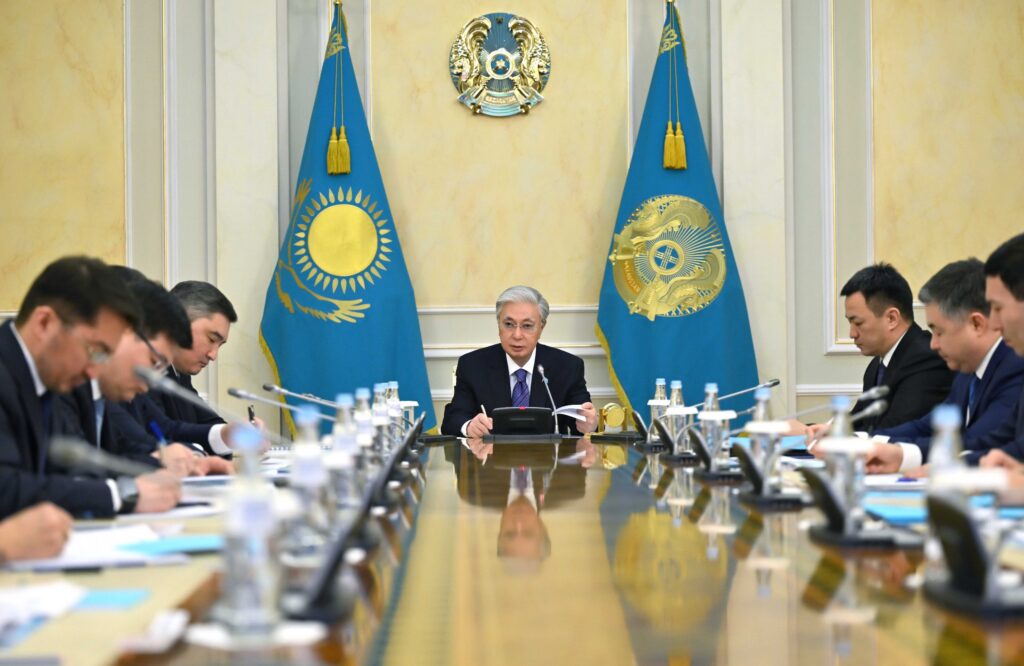
Investments in geological exploration in Kazakhstan surpassed $150 million during the first nine months of 2025, Deputy Minister of Energy Kayirkhan Tutkyshbaev announced at a recent government meeting. The exploration efforts led to the registration of five new deposits, boosting the country’s proven reserves of gold, copper, manganese, and phosphorites.

Tutkyshbaev noted that geological exploration projects attracted approximately $285 million in 2023 and $304 million in 2024. “By the end of this year, the volume of investment is expected to be no less than in previous years,” he stated.

According to the Ministry of Energy, Kazakhstan currently has 324 active hydrocarbon subsoil use contracts: 15 for exploration, 170 for combined exploration and production, 131 for production, and 8 production sharing agreements (PSAs).

Deputy Minister of Industry and Construction Iran Sharhan reported that five deposits, Kok-Zhon, Altyn-Shoko, Samombet, Student, and Takyr-Kaljir, have been newly registered. These discoveries have added an estimated 98 tons of gold, 36,000 tons of copper, 11 million tons of manganese, and 1.3 million tons of phosphorites to the country’s reserves.

“To date, 2.1 million square kilometers have been explored, and by the end of the year, this figure will reach 2.3 million,” Sharhan said. He added that the next phase involves more detailed studies to identify promising areas earlier in the exploration process.

From 2026 to 2028, the government plans to explore an additional 100,000 square kilometers, followed by 30,000 square kilometers annually. Next year, 44.4 billion tenge (approximately $84 million) is allocated for comprehensive geological and geophysical research, seismic exploration, and the development of industry infrastructure.

Prime Minister Olzhas Bektenov has directed the construction of a modern geo-laboratory in Astana, scheduled to begin in 2026, to support mineral-geochemical and analytical research. He also ordered the establishment of a National Digital Geological Information Fund, which will consolidate more than 5 million pieces of primary geological data collected over the past 80 years.

Currently, 83% of this archive, around 3.8 million records, has been digitized. The digitization rate is expected to reach 97.5% by the end of 2025, with full digital transition projected by the end of 2026.

Separately, The Times of Central Asia recently reported that new geological surveys at Kuirektykol, the country’s largest, rare earth metal deposit located in the Karaganda region, have revealed significantly higher reserves than previously estimated.

Kazakhstan Parliament Advances Bill to Ban ‘LGBT Propaganda’

Activists and human rights defenders in Almaty have condemned proposed legislative amendments aimed at banning so-called “LGBT propaganda” in Kazakhstan. Critics argue the initiative fosters an atmosphere of fear and hatred, undermines fundamental human rights, and risks isolating the country internationally. According to them, the issue is not about “propaganda” but about the right to visibility, safety, and dignity.

Penalties for Media, Posts, and Books

The public statements from rights groups follow a renewed effort to introduce such a ban. On October 29, a working group within the Mazhilis (the lower house of parliament) met to review amendments proposed by 15 deputies. The group approved the amendments, which stipulate that dissemination of content deemed as “LGBT propaganda,” if not qualifying as a criminal offense, would be punishable under the Code of Administrative Offenses.

Violations, including the distribution of content on social networks, could incur heavy fines or up to ten days of administrative arrest. Mazhilis deputy Yelnur Beisenbayev explained that “propaganda of non-traditional sexual orientation” includes disseminating information that promotes such orientations publicly or via mass media, telecommunications, or online platforms, especially if intended to shape public opinion positively.

Fellow deputy Irina Smirnova cited library books and cartoons featuring same-sex relationships as examples, stating that she “saw books in the library that promote LGBT, where a prince falls in love with a prince, two boys. There are cartoons that allow this to be shown, there are magazines and comics where all this is promoted.” Deputy Natalya Dementyeva, meanwhile, emphasized that the ban would extend to social media, films, and advertising.

The LGBT clauses form part of a broader bill on “protecting children from harmful information,” which amends several existing laws, including those on children’s rights, advertising, education, cinema, and media. Rights advocates say this packaging blurs the true scope of the restrictions.

On November 12, the Mazhilis passed the bill in its second reading and forwarded it to the Senate for consideration. The legislation prohibits the dissemination of information promoting pedophilia and non-traditional sexual orientation in public spaces. It will only take effect if approved by the Senate and signed by President Kassym-Jomart Tokayev.

Activists Warn Against Repressive Precedents

Human rights advocates stress that Kazakhstan must avoid replicating repressive measures seen in Russia, where similar laws have led to broad crackdowns following the invasion of Ukraine.

“We live in an independent and sovereign republic. Or are we already a colony of the Russian Federation?” asked Zhanar Sekerbayeva, co-founder of the feminist initiative, Feminita. She noted that the LGBT community and activists in Kazakhstan have faced harassment for years.

“Because of these amendments, people can be punished for anything – jokes, drawings, hugs,” said Arj Tursynkan, an activist with the NGO Education Community. He argued that the legislation is not just a legal text, but a test of Kazakhstan’s commitment to international norms of dignity and freedom.

Independent human rights expert Tatyana Chernobyl added, “There is absolutely no reason to protect children from so-called LGBT propaganda at this time. The LGBTQI+ community in Kazakhstan is not protected either by law or in practice.” She described the amendments as inciting discrimination and violence.

Human Rights Watch and Amnesty International have urged parliament to withdraw the bill, warning that its vague definition of ‘propaganda’ invites arbitrary enforcement and contravenes Kazakhstan’s international commitments under the ICCPR.

A Recurring Initiative

This is not the first legislative attempt to criminalize LGBT expression. In April 2024, deputies proposed criminal penalties for LGBT propaganda through changes to the media law, though the provision was later removed from the final bill.

Proponents of the ban often cite public opinion. An online petition titled “We are against open and covert LGBT propaganda in Kazakhstan” gathered 50,000 signatures in June of that year, enough for consideration at the government level. However, no comprehensive public opinion poll has been conducted. Some supporters have attempted to equate “LGBT propaganda” with incitement to social or religious hatred, which carries serious legal penalties in Kazakhstan.

Kazakhstan has positioned itself as a country open to international dialogue and investment, particularly in fields such as artificial intelligence and digital technology. Activists warn that such prohibitive laws risk undermining that image and hampering economic development.

A Conservative Response

Political analyst Gaziz Abishev advocates a conservative stance, asserting that LGBT individuals should follow the same moral standards as heterosexuals.

“I am completely neutral towards representatives of various groups,” Abishev wrote on Telegram. “But they should be treated like ordinary people and behave accordingly. If heterosexuals are criticized for excessive public displays of sexuality, the same should apply to LGBT individuals.”

Abishev also rejected both anti-LGBT rhetoric from ultra-conservatives and what he called “hybrid incitement of hatred” by LGBT groups toward traditional values. “Not everyone is obliged to live in ultra-liberal families with the mandatory early disclosure of gender identity,” he stated.

Deputy Nikita Shatalov criticized international human rights organizations for opposing the legislation. “It is nonsense for someone to impose their point of view on us through informational pressure,” he said. “This is unacceptable.”

Shatalov emphasized that Kazakhstan does not and cannot engage in persecution based on identity, asserting that the bill focuses solely on public discourse and the protection of minors.

Kazakhstan and Israel Strengthen Cooperation on Water Resource Management

On November 11, Kazakhstan’s Minister of Water Resources and Irrigation Nurzhan Nurzhigitov and Israel’s Minister of Regional Cooperation David Amsalem signed a memorandum of cooperation to deepen bilateral ties in the field of water resource management.

The agreement outlines joint efforts in modernizing Kazakhstan’s water management infrastructure, improving water use efficiency, implementing water-saving and reuse technologies, and exchanging expertise in innovation and technology, particularly in the collection, management, and processing of remote sensing data.

The memorandum also covers cooperation in the digitalization of water resource monitoring, flood and drought risk management, scientific and technical collaboration, and specialist training programs.

As part of the visit, the ministers held talks with representatives of leading Israeli companies to explore partnerships on introducing water-saving technologies in Kazakh agriculture and training Kazakh specialists at Israeli enterprises.

“Israel has extensive experience in water resource management under challenging climatic conditions and offers advanced technologies,” said Minister Nurzhigitov. “We are interested in long-term, mutually beneficial cooperation to modernize Kazakhstan’s water sector across the board, including the digitalization of water metering and distribution, deployment of cutting-edge water-saving systems, use of modern data collection methods, and professional development of our specialists.”

Israeli firms have previously expressed interest in participating in the construction and reconstruction of reservoirs in Kazakhstan, and in supplying the country with modern flood forecasting and protection systems.

Kazakhstan’s Ministry of Water Resources and Irrigation plans to build 20 new reservoirs by 2030, with a combined capacity of 2.5 billion cubic meters. The project is expected to reduce the country’s reliance on upstream water sources from Kyrgyzstan and China by 25%, mitigate drought in southern regions, and lower flood risks for 70 rural settlements with a combined population of nearly 140,000. Additionally, irrigation will be expanded to cover another 250,000 hectares of farmland.

The ministry also plans to reconstruct 15 existing reservoirs, adding another 1.9 billion cubic meters in water storage capacity.

Universities Join Kazakhstan’s Global Education Vision: An Interview with Minister of Education Sayasat Nurbek

At the invitation of President Trump, on November 5-6, the Presidents of the five Central Asia Republics arrived in Washington, D.C. to celebrate and sign deals on the 10th anniversary of C5+1. They were accompanied by cabinet ministers and business leaders.

The Times of Central Asia presents a wide-ranging interview with Kazakhstan’s Minister of Education, Sayasat Nurbek. Minister Nurbek sat down with our Washington Correspondent, Javier M. Piedra, to discuss Kazakhstan’s education strategy.

The interview offers U.S. academic and technical institutions a glimpse into Minister Nurbek’s educational philosophy and his plans to advance Kazakhstan’s higher education through new partnerships with U.S. universities, AI platforms, and private sector innovators—positioning Kazakhstan as a regional educational hub.

Nurbek shared his insights on his understanding of traditional values, the human person, AI’s potential and risks, critical thinking, and building mutually beneficial partnerships in the context of education. (His responses have been edited for length and flow.)


TCA: The tenth anniversary of C5+1 was a landmark event, bringing together the Presidents of all five Central Asian nations at the White House. Kazakhstan President Tokayev has tasked you with transforming Kazakhstan into a fully digital nation within three years. In the last two days, you secured six key partnerships with U.S. universities and tech firms across education, testing, mining, and engineering. Minister, with that in mind, how is Central Asia important to the United States?

Nurbek: My message to American academic institutions is straightforward. Kazakhstan has a lot to offer, and we are keen on deeper engagement with the outside world. Also, the timing to deepen U.S.-Kazakhstan relations is perfect given that the world is changing. Avenues are open for new relationships and business opportunities. America and Kazakhstan can have a great future as long as we work together to achieve that future. America should not miss this moment in history; the importance of Eurasia and of Central Asia in particular.

Besides the education aspects – most important to me – academic and technical partnerships can serve as platforms to maintain U.S. influence, share values, and promote ideas, benefiting both the United States and Kazakhstan as friends in a non-geopolitical sense.

TCA: In our earlier conversation, you referenced Sir Halford Mackinder, the early 20th-century British academic who emphasized geography’s role in geopolitics. Can you comment on the sensitivity of mixing education and geopolitics?

Nurbek: In The Geographical Pivot of History in 1904, Halford Mackinder argued that control of Eurasia’s central “Heartland,” particularly Eastern Europe and Central Asia, could secure global influence. Mackinder’s theory stressed land power’s dominance over naval power in an increasingly rail-connected world in the early 20th century. Central Asia mattered then and still does today—but why do I mention Mackinder in the context of education?

President Tokayev has been clear, especially in the sphere of education, that Kazakhstan seeks great gain, not a “Great Game” – the rivalry between Great Powers for influence and control in Central Asia. In other words, the main way to produce great gains in Kazakhstan and across the region is through the development of education and training, both academic and skilled labor, with a focus on science, engineering, and AI, without politicizing education. In this sense, we want to focus on partnerships that yield benefits without the need to take sides in the geopolitical ambitions of others. That’s why I brought up Mackinder.

TCA:  How do you envision integrating computer processing and machine learning into the educational system without destroying critical thinking?

Nurbek: That is a very challenging question. Let me first define what I mean by critical thinking. Critical thinking is the essential human aptitude for questioning, contextualizing, and conscientiously applying data or conclusions that AI provides, preventing us from becoming dumb passive consumers or regurgitators of automated conclusions. We want partners who understand that.

My focus is to connect education to the digital ecosystem while maintaining independent thinking in our students. Towards this end, we want to work with the United States – not on an exclusive basis, incidentally – to achieve our win-win objectives and respective national goals.

TCA:  Is there not a “brain drain” underway in Kazakhstan? How do you hope to keep young people in Kazakhstan?

Nurbek: We are aware of this issue. It was certainly a problem in the 1990s, but since then, the situation has changed. We must keep working to ensure that students and graduates remain in Kazakhstan. It’s the same story across Central Asia.

One of my key initiatives as minister has been to roll out a strategy to attract foreign university branch campuses to Kazakhstan, including over fourteen top-tier research institutions. By building a first-rate educational system, we’ll stop the brain drain. I am committed to expanding this effort by inviting more U.S. universities and trade schools.

TCA:  Please provide American educators with some examples of the agreements you signed on this trip. What do you expect down the road?

Nurbek: We have so much going on that I’d point those interested to our website. But to get a sense, Kazakhstan’s Ulytau Technical University, for example, partnered with Colorado School of Mines and Kazakhmys, a Kazakhstan mining company. They will forge a mining/metallurgy innovation hub. It offers dual degrees, industry R&D, and tech transfer, boosting Kazakhstan’s academic leadership and U.S. economic ties. Arizona State University will be opening two big branch campuses in Kazakhstan. That is only the tip of the iceberg.

Kazakhstan is poised to become a draw for students across the region. This is already happening. I expect Kazakhstan’s educational system to continue to improve and meet the needs of our growing population in a highly competitive world where young families need to find stability and predictability. What’s more, we need to teach ethics and traditional values – a focus of President Tokayev.

TCA: What drives buy-in for your strategy, and how do you define ethics?

Nurbek: Education – technical and intellectual – is deeply valued in our culture. Households devote one of the region’s highest shares of income to it. To support families, Kazakhstan provides direct financial aid and other incentives when needed. But hope in the future is paramount. And for our overseas partners, we offer great incentives, like free land, tax breaks, and streamlined customs. Scholarships further ensure education remains financially sustainable.

You should know that, in Kazakhstan, we are adopting the Digital Code, a comprehensive regulatory framework addressing AI use and ethics. Our understanding of value ethics provides a context for navigating difficult moral challenges about modern technology in light of human dignity. What’s more, our strategy takes into account a growing population.

TCA: Yes, Central Asia’s population is expanding rapidly compared to the demographic collapse across much of East Asia and Europe. Pessimists see population growth as bad; optimists see it as good. Which camp do you fall into?

Nurbek: For starters, we believe in a “culture of life” – by which I mean that the human person possesses an inherent dignity – as is written in the preamble to the United States Declaration of Independence: “We hold these truths to be self-evident, that all men are created equal, that they are endowed by their Creator with certain unalienable Rights, that among these are Life, Liberty and the pursuit of Happiness.” Kazakhstan agrees with that worldview.

This region is undergoing one of the fastest population booms in the world, which requires strategic planning. While East Asia and Europe age, and North America relies on immigration for growth, Central and South Asia are surging demographically. Kazakhstan adds about half a million newborns each year, Uzbekistan nearly a million. By 2050, Central Asia is projected to be one of the world’s youngest and fastest-growing regions, with a population nearing 500 million. We see this increase as a strategic opportunity, one that demands responsible stewardship as we carry on building our nation.

TCA: It seems that you approach the population question with confidence and a sense of responsibility. Having said that, education and AI are tools, not ends in themselves – what is your goal?

Nurbek: Ultimately, Kazakhstan views people – the multiplicity of races and cultures within our borders – not as resources to exploit, but as the foundation of our nation’s future. Education is central to our strategy, ensuring prosperity is shared rather than concentrated in the hands of a few, whether that wealth is here or overseas. As President Tokayev emphasizes, the private sector must help build the nation—especially through advancing education and preparing our people for the era of AI, digital communications, and data processing. We want to help people to be creative, to be inspired to contribute to society.  Educators should know that I do not believe in Thomas Hobbes’ description of human nature as “solitary, poor, nasty, brutish and short.” There are many good people who are not fundamentally self-centered and inclined toward aggression. It is the task of educators to form responsible and entrepreneurial people with a sense that there are limits to human behavior. So, I’m not just interested in technical training, but in the formation of the person in a holistic sense.

TCA: What do you see as the role of the private sector in developing the education system in Kazakhstan?

Nurbek: Benjamin Franklin had it right when he said, “An investment in knowledge pays the best interest” or “Tell me and I forget, teach me and I may remember, involve me and I learn.”

Our message to the private sector is that investing in education pays. To facilitate this partnership, we have drafted a law creating tax and other incentives for contributors to endowment funds. In this sense, the U.S. has much to show us.

Kazakhstan is leading Central Asia in computing, with two national supercomputers and others at top universities—Al Farabi, Eurasian National, and Nazarbayev. While we have critical computing power, my goal is to develop first-rate human capital with the help of AI – that must be clear.

TCA: In this sense, what are you asking U.S. universities to keep in mind as they roll out their expertise in Kazakhstan?

Nurbek: AI and science expertise should augment not just value (in a material sense) but meaning (in a philosophical sense) to everyday existence. Youth ask: “How does AI improve life?” True progress goes beyond material gain—it must enrich people and the nation, fostering unity, creativity, and entrepreneurship, giving them a sense of identity, dignity, and optimism in the future. Otherwise, AI risks serving only efficiency, divorced from human and societal needs. My job is to balance these factors. Our partners – foreign and domestic – must understand our strategic objectives.

TCA: Do you have a message to the U.S. State Department and to U.S. Universities, research institutions, and trade schools?

Nurbek: To illustrate my message, I’ll tell you an anecdote. Our two-year journey to secure U.S. approvals for a supercomputer was challenging. While we understand the need for caution, a two-year process highlights a critical issue. When procedures become too complex and time-consuming, they force us to consider more efficient partners, despite our strong preference to work with the U.S. We believe streamlining protocols on security and IP would benefit both sides and strengthen our collaboration.

Retired Kazakhstani, 66, Finds Calling as Long-Distance Swimmer

Askar Ospanov, a retired police major general in Kazakhstan, decided to become a serious swimmer relatively late in life, around the age of 60. Inspiration came when he was cheering from the sidelines at the 2018 Bosphorus Cross-Continental Swimming Race, an annual event in which about 2,500 people swim 6.5 kilometers from the Asian shore to the European side of Istanbul. 

Ospanov’s eldest son, Galym, himself an accomplished athlete, had completed the crossing in one hour and 18 minutes. A favorable current means many swimmers log fast times across the Bosphorus.

“Then, about 30–40 minutes later, everyone on the shore suddenly started buzzing. I thought maybe someone had drowned… or perhaps Erdoğan (the president of Turkey) had arrived. I told my kids, ‘Find out what’s going on, quickly!’” 66-year-old Ospanov said. 

It turned out that beloved Turkish swimmer Levent Aksüt, then in his late 80s, had just finished. 

“Everyone stood and applauded his achievement,” said Ospanov, who saw Aksüt as a role model for his new passion. 

In September, the Kazakhstani swam about 15 kilometers across the Strait of Bonifacio, from the French island of Corsica to the Italian island of Sardinia, in seven hours and 50 minutes. He has competed in international open-water swimming competitions, including OCEANMAN and X-WATERS events, in numerous places at various distances. He has won prizes in the 60+ category in Dubai, Thailand, at Issyk-Kul Lake in Kyrgyzstan and in Kazakhstan, a landlocked country with big lakes and reservoirs. 

“If someone wants to start swimming after 60, it’s absolutely necessary to do stretching exercises. The arms and legs will gradually loosen up!” Ospanov said. 

“Since childhood, I played volleyball,” the Almaty resident said. “Then my knees started hurting, and I couldn’t play volleyball at full strength anymore. Doctors said that for the knee joints, you need movement without load… That meant either cycling or swimming. I didn’t feel like buying a bike, so I chose swimming. With each passing year, swimming gave me more and more strength. Gradually, the results started coming.”

Swimming coach Evgeny Alexandrov, who has been awarded the prestigious Master of Sport of International Class title by Kazakhstan’s government, has worked with Ospanov for several years. 

The coach described his student as tough, punctual, and responsible. However, Alexandrov said, “turning him into an ideal swimmer quickly isn’t possible due to age-related limitations and some acquired health issues,” including knee pain and a right arm weakened by years of playing volleyball, which meant he only breathed on his left side in the pool.

“When he was learning to swim, he couldn’t breathe every three strokes — he only inhaled on his left side, resulting in an asymmetrical freestyle stroke with excessive body roll. In open water, if the sun and waves are on the left, it becomes difficult for Askar,” the 44-year-old coach said.  

Ospanov had that problem to some extent in the Strait of Bonifacio, where proper alignment in the water can offset the challenges of wind, waves and current. 

“At his age, it’s difficult to increase speed through physical load and sprint work, so we decided to focus on improving his technique instead,” including breathing on both sides, Alexandrov said 

“I hope that through various exercises, we’ll be able to even out his arm and leg work, emphasize a long pull in a two-beat distance freestyle stroke, and as a result, improve his body position in the water. This will give him proper balance, better glide, and ultimately help us increase his speed,” said the coach. Alexandrov used to swim two kilometers on the Kapchagay Reservoir north of Almaty when he was a teenager – “in our competitions the distance was only 200 meters, but even back then I was drawn to long-distance, open-water swims.”

Ospanov trains at the Altyn-Kargaly Hotel-Sanatorium in Almaty, averaging 10 kilometers in the pool over three sessions a week. He also takes three weekly yoga classes to improve flexibility. His three sons – Galym, Aslan and Imangali – are faster, long-distance swimmers, and some grandchildren are now competing in races.  

Grandfather Ospanov’s other role models include Australian Cyril Baldock, who was 70 when he swam across the English Channel in 2014; Astana resident Salatanat Tuitebayev, who came second in the 80-89 age category at this year’s New York City marathon, finishing in four hours and 45 minutes; and Japan’s Mieko Nagaoka, who completed a 1,500-meter freestyle swim at the age of 100 in 2015.

Ospanov worked for Kazakhstan’s government for 40 years, 30 of those with the Ministry of Internal Affairs. Last week, in full uniform and accompanied by his son, Galym, he visited the recently renovated high school where he graduated with honors in Zhansugurovo, a village in the Almaty area that is named after an early 20th-century Kazakhstani poet. 

Some students, perhaps seeing a role model, asked Ospanov about his swimming feats.

Kazakhstan Develops Technology to “Revive” Worn Asphalt

Scientists at the Kazakh Road Research Institute (KazdorNII) are developing a technology that restores worn asphalt for reuse in highway repair and construction.

According to the institute, the project involves the creation of an innovative restorative compound. Experts say that the regeneration process could significantly reduce construction waste, lower energy consumption, and cut CO₂ emissions during asphalt production. This model supports more sustainable road construction by giving materials a “second life.”

“We are developing solutions that allow existing resources to be restored instead of consuming new ones. This will not only reduce the burden on the environment but also make the road industry more efficient and technologically advanced,” said Saltanat Ashimova, head of the department of road construction materials and new technologies at the institute.

The initiative is part of a grant awarded through a competition for scientific and technical projects for 2025-2027. The research is focused on integrating green technologies into road construction. The institute expects the new compound to be environmentally friendly, produced domestically, and adapted to Kazakhstan’s climate and road conditions. Its use is expected to improve road surface durability and quality, while supporting the country’s shift toward a sustainable economy.

As previously reported by The Times of Central Asia, severe road surface deformations were recorded across inter-city highways in Kazakhstan this summer amid extreme heat.