• KGS/USD = 0.01144 0%
  • KZT/USD = 0.00194 0%
  • TJS/USD = 0.10879 -0.18%
  • UZS/USD = 0.00008 0%
  • TMT/USD = 0.28490 0%
  • KGS/USD = 0.01144 0%
  • KZT/USD = 0.00194 0%
  • TJS/USD = 0.10879 -0.18%
  • UZS/USD = 0.00008 0%
  • TMT/USD = 0.28490 0%
  • KGS/USD = 0.01144 0%
  • KZT/USD = 0.00194 0%
  • TJS/USD = 0.10879 -0.18%
  • UZS/USD = 0.00008 0%
  • TMT/USD = 0.28490 0%
  • KGS/USD = 0.01144 0%
  • KZT/USD = 0.00194 0%
  • TJS/USD = 0.10879 -0.18%
  • UZS/USD = 0.00008 0%
  • TMT/USD = 0.28490 0%
  • KGS/USD = 0.01144 0%
  • KZT/USD = 0.00194 0%
  • TJS/USD = 0.10879 -0.18%
  • UZS/USD = 0.00008 0%
  • TMT/USD = 0.28490 0%
  • KGS/USD = 0.01144 0%
  • KZT/USD = 0.00194 0%
  • TJS/USD = 0.10879 -0.18%
  • UZS/USD = 0.00008 0%
  • TMT/USD = 0.28490 0%
  • KGS/USD = 0.01144 0%
  • KZT/USD = 0.00194 0%
  • TJS/USD = 0.10879 -0.18%
  • UZS/USD = 0.00008 0%
  • TMT/USD = 0.28490 0%
  • KGS/USD = 0.01144 0%
  • KZT/USD = 0.00194 0%
  • TJS/USD = 0.10879 -0.18%
  • UZS/USD = 0.00008 0%
  • TMT/USD = 0.28490 0%
15 December 2025

Changing Volumes of Gold Mined in Kazakhstan and Uzbekistan

According to data  issued by the U.S. Geological Service, in 2023, 130 tons of gold were mined in Kazakhstan and 100 tons in Uzbekistan.

Kazakhstan’s volume increased by 15 tons compared to 2022, whilst Uzbekistan’s decreased by 4 tons. Russia produced 310 tons of gold, equivalent to that mined the previous year. Worldwide, 3,600 tons of gold were produced in 2023, 60 tons less than in 2022. The U.S. Geological Survey has yet to release the latest estimate of gold production in Kyrgyzstan but according to data, the country mined  25.3 tons in 2022.

As of September 1, Uzbekistan’s international reserves reached $39.15 billion; a record indicator since data disclosure began in 2018. The National Bank of Kazakhstan counts the country’s gold and foreign exchange reserves in February 2024 at $36.1 billion. In 2014, this indicator was at $26.05 billion, meaning that over the past ten years, the volume of gross international reserves has increased by $10 billion (+38.6%).

Kazakhstan Seeks Co-Production Venture with Italy

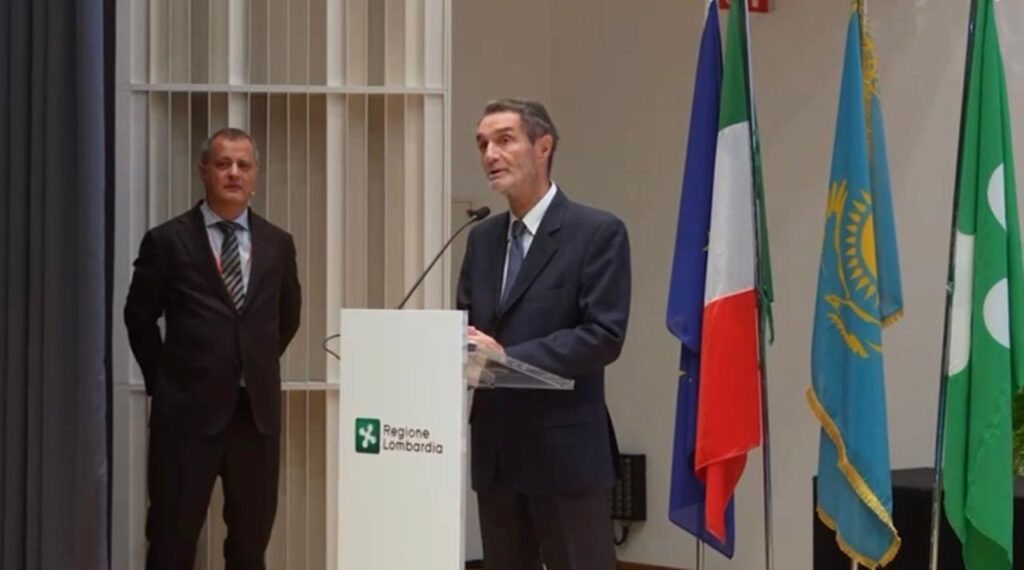
Following the Kazakh-Italian forum, “Kazakhstan–Italy: Trade and Investment Opportunities on the Way to Kazakhstan,” on October 8 in Milan, the Kazakh Ministry of Trade and Integration reported that discussions had focused on renewable energy, the agro-industrial sector, tourism, pharmaceuticals, and technological innovations, with an emphasis on Kazakhstan’s strategic importance in economic cooperation between Europe and Central Asia.

The event came in the wake of Kazakhstan’s President Kassym-Jomart Tokayev official visit to Italy in January 2024, which marked a significant step in strengthening Kazakh-Italian relations.

The Minister of Trade and Integration of Kazakhstan Arman Shakkaliyev noted that Italy is one of Kazakhstan’s key trading partners in the European Union with one of the three largest trade turnovers, and  proposed the introduction of  “Made with Italy”; a concept aimed to promote products created in collaboration with Italian companies.

Valentino Valentini, Deputy Minister at the Italian Ministry of Enterprise and Made in Italy supported the notion and stressed that joint projects would stimulate the development of small and medium-sized businesses in both countries.

Essential to the initiative, would be the creation of centers of excellence for the transition to European quality standards in Kazakhstan. To ensure the rapid entry of Kazakh products into the EU and Italian markets, such centers would issue certificates of equivalence of manufactured products to EU regulations.

The forum also discussed prospects in the tourism sector, with Italian Minister of Tourism Daniela Santanke noting the significant potential for the growth of tourist exchange, facilitated by the launch of direct flights between Astana and Milan.

The forum launched Kazakh companies’ first trade and economic mission to Italy, involving over 50 enterprises representing agriculture, oilfield services, textile industry, tourism, and IT sectors.

According to Kazakh statistics, in 2023, the trade turnover between Kazakhstan and Italy amounted to $16.1 billion, an increase of 7.8% since the previous year, with exports from Kazakhstan reaching $14.8 billion. In January-August 2024, bilateral trade increased by 33% to $13.8 billion, with Kazakh exports rising by 36% to $12.9 billion. Kazakhstan’s main exports to Italy comprise crude oil (+38.1%), coal (309-fold increase), flax seeds ($4.1 million increase), and propylene polymers (71-fold increase).

Kyrgyzstan Encourages German Investment in Raw Materials Extraction and Logistics

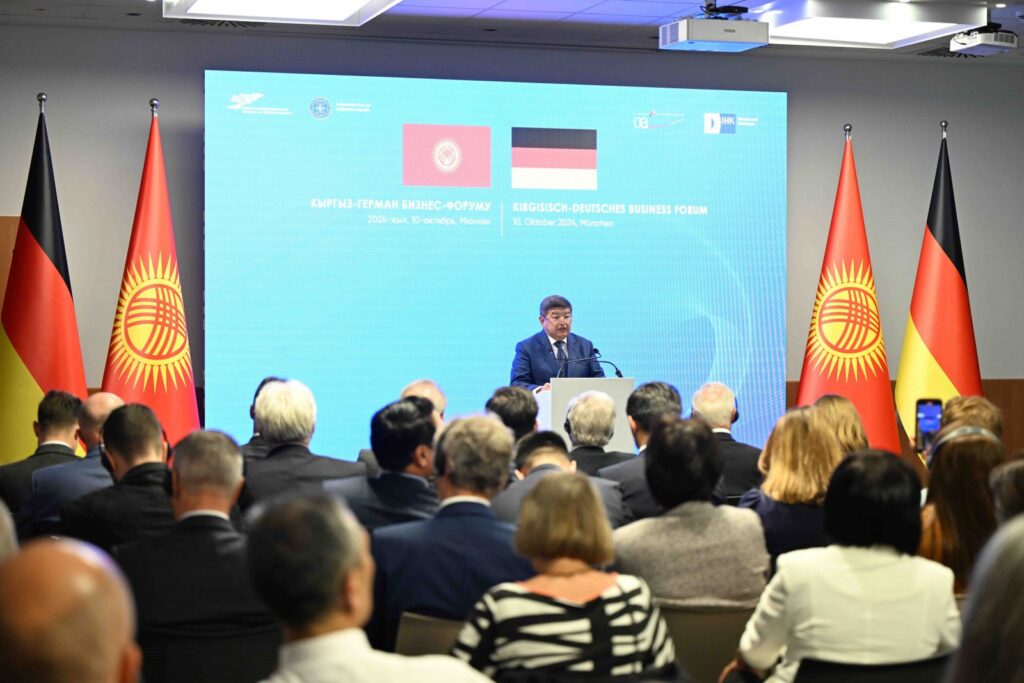
During a Kyrgyz-German Business Forum in Munich on October 10, Kyrgyzstan’s Chairman of the Cabinet of Ministers, Akylbek Japarov, stated that  following the first Kyrgyz-German Business Forum in Hamburg over a year ago, bilateral relations between the two countries had strengthened alongside a mutual interest in deepening cooperation.

Japarov cited the fact that 180 joint Kyrgyz-German enterprises are currently engaged in Kyrgyzstan’s trade, industry, agriculture, tourism, energy, education, and services sectors, and to encourage further  German investment and  participation in implementing the government’s ambitious economic development plans, invited businesses to attend the ‘Day of German Economy in Kyrgyzstan.’ Scheduled for summer 2025, the event follows three ‘Days of Kyrgyz Economy’ in Hamburg, Frankfurt am Main, and Munich.

Addressing the forum, Kyrgyz Minister of Economy and Commerce Daniyar Amangeldiev spoke of Kyrgyzstan’s interest in developing cooperation with Germany on raw materials, with reference to the presence of  100 raw material deposits in Kyrgyzstan. In addition, he proposed that German investors participate in auctions to gain the right to use the subsoil in Kyrgyzstan and develop deposits using modern technologies that comply with environmental standards.

The minister also touched upon the development of transport and logistics infrastructure and invited German companies to collaborate in the development of Kyrgyzstan’s logistics system, stating: “Kyrgyzstan, located in the heart of Central Asia, is  ‘landlocked’. At the same time, the Great Silk Road — a trade route between West and East, North and South — has been passing through our country since ancient times. Therefore, our country should rightfully be called ‘land connecting,’”

Scientists Attempt to Unlock the Secrets of Turkic Runes in Altai

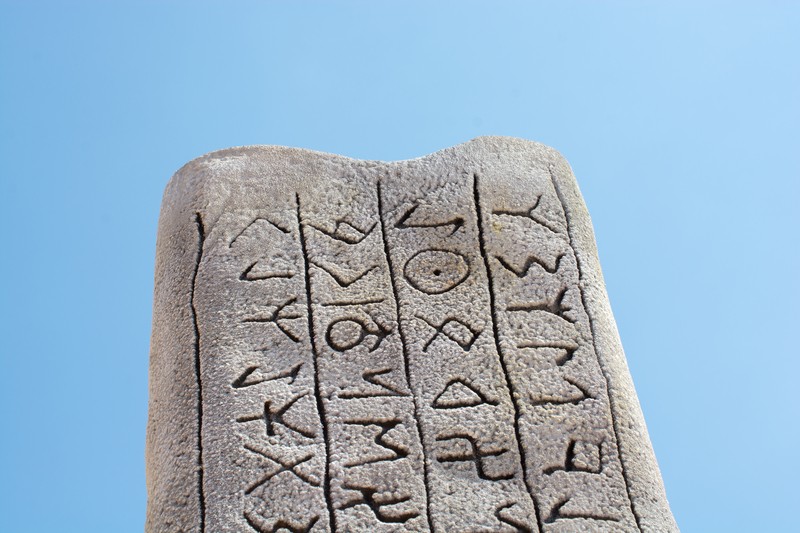
Russian scientists have started deciphering unique Turkic runic inscriptions in Altai, dating back to the VI-X centuries AD.

Speaking at the International Conference “Mountain Altai – the ancestral home of the Turks,” Alexander Vasiliev, head of the Oriental History Department of the Institute of Oriental Studies of the Russian Academy of Sciences, reported that whilst some 120 such texts have been identified, a significant number has yet to be deciphered due to a lack of “keys”.

According to Vasilyev, problems in evaluating inscriptions arise as a result of the different graphic systems used by Turkic peoples in various historical periods. Hence, researchers face a difficult task in making these texts accessible and determining the exact nature of the archaeological objects found. Historians also note that with the emergence of Mongolian vertical writing, the influence of the Turkic writing system began to weaken.

Previous attempts to decipher these texts using Iranian and Finno-Ugric languages, proved unsuccessful. Assuming that the key to understanding the inscriptions lies in one of the ancient Turkic languages, scientists are now focusing on the Chuvash language, which retains ancient features, or the Kypchak language group.

The decipherment of Turkic runic inscriptions began with the discovery of the famous Orkhon-Yenisei texts in Mongolia in the 19th century. In 1893, Danish scholar Wilhelm Thomsen was the first to successfully decipher these ancient texts using analogies to ancient Turkic words such as “tengri” (sky). These inscriptions, dating from the 7th to 10th centuries, recount the lives of the Turkic kagans and their victories. In addition to the Orkhon texts, significant inscriptions have been found in the Yenisei Valley and the Altai Mountains.

An international conference in Manzherok, in the Altai Republic, brought together scholars to discuss not only the problems of deciphering the Turkic script but also the formation of the Turkic civilization and the history of cultural interaction between the Turks and other peoples, including Slavic cultures.

Employees in Uzbekistan to be Rewarded with Company Shares

Uzbekistan is to introduce an initiative to reward employees with shares in companies, under a  regulation  developed by The National Agency for Perspective Projects (NAPP).

According to the NAPP, the transfer of shares to employees, as part of additional incentive programs, including bonuses, will help increase employee interest in the company’s sustainable development and improve labor relations.

The main goal of the initiative, modelled on ESOP (Employee Stock Ownership Plan) successfully applied in other countries, is to improve the population’s welfare and develop the domestic capital market.
Although joining in the Stock Ownership Plan will be voluntary, its development will be mandatory for joint stock companies with more than 50% state participation.

The presidential decree on capital market development, issued in September 2023, envisioned the implementation of ESOP. Funds of up to one month’s salary used to purchase shares will not be subject to personal income tax.

Kazakhstan-Tajikistan Trade Turnover Rises 6%

According to the State Revenue Committee of Kazakhstan’s Ministry of Finance, the trade turnover between Kazakhstan and Tajikistan has reached $780.7 million so far this year, 6% higher than for the same period last year.

From January to August 2024, Kazakhstan exported over 1.6 million tons of goods worth $613.2 million to Tajikistan, an increase of 15.5% compared to last year. The main export product was wheat, with 629,100 tons valued at $154.5 million.

Tajikistan also produces more sunflower, safflower, and soybean oil – 44,800 tons (+8.2%), pasta – 5,300 tons (+20.7%), and sweet drinks – 12.5 million liters (+5.8 times).

The export of aluminum oxide also increased by 40.5% to 105,400 tons; iron and steel rods increased 1.5 times, up to 36,800 tons; plastic windows and frames increased ten times, up to 12,400 tons; and smartphones and media stations increased 1.8 times, up to 148,100 units.
However, the supply of liquefied gas decreased by 4% (211,300 tons).

At the same time, imports from this country continued to decrease. In January-August, 220,800 tons (-19.4%) of products worth $167.5 million were imported from there.

This decrease affected the sales volume of ores and concentrates (lead, copper, zinc) by 12.3%, up to 106,500 tons, and children’s scooters and skateboards by 32.6%, up to 46,00 units.

In addition, Kazakhstan has begun to buy fewer fresh fruits and vegetables. For example, the supply of apricots, peaches, and grapes immediately decreased by 2.1 times, to 6,900 tons, and onions by 3.3 times, to 17,600 tons.

However, the volume of imported dried fruits increased by 23.3% and amounted to 36,800 tons.