• KGS/USD = 0.01144 0%
  • KZT/USD = 0.00193 -0%
  • TJS/USD = 0.10811 -0.28%
  • UZS/USD = 0.00008 0%
  • TMT/USD = 0.28490 0%
  • KGS/USD = 0.01144 0%
  • KZT/USD = 0.00193 -0%
  • TJS/USD = 0.10811 -0.28%
  • UZS/USD = 0.00008 0%
  • TMT/USD = 0.28490 0%
  • KGS/USD = 0.01144 0%
  • KZT/USD = 0.00193 -0%
  • TJS/USD = 0.10811 -0.28%
  • UZS/USD = 0.00008 0%
  • TMT/USD = 0.28490 0%
  • KGS/USD = 0.01144 0%
  • KZT/USD = 0.00193 -0%
  • TJS/USD = 0.10811 -0.28%
  • UZS/USD = 0.00008 0%
  • TMT/USD = 0.28490 0%
  • KGS/USD = 0.01144 0%
  • KZT/USD = 0.00193 -0%
  • TJS/USD = 0.10811 -0.28%
  • UZS/USD = 0.00008 0%
  • TMT/USD = 0.28490 0%
  • KGS/USD = 0.01144 0%
  • KZT/USD = 0.00193 -0%
  • TJS/USD = 0.10811 -0.28%
  • UZS/USD = 0.00008 0%
  • TMT/USD = 0.28490 0%
  • KGS/USD = 0.01144 0%
  • KZT/USD = 0.00193 -0%
  • TJS/USD = 0.10811 -0.28%
  • UZS/USD = 0.00008 0%
  • TMT/USD = 0.28490 0%
  • KGS/USD = 0.01144 0%
  • KZT/USD = 0.00193 -0%
  • TJS/USD = 0.10811 -0.28%
  • UZS/USD = 0.00008 0%
  • TMT/USD = 0.28490 0%
10 December 2025

The Rules of the Steppe: Countdown to the 2024 World Nomad Games

The countdown to the 2024 World Nomad Games (WNG) in Astana, Kazakhstan, which will take place between September 8-13, has begun. Now in its fifth incarnation, the upcoming WNG will host an estimated 3,000 athletes – including nomadic and non-nomadic participants (such as American cowboys) – from over 100 nations. The event will showcase sports, science, and culture at venues comprising the Alau Ice Palace, the Astana Arena, the Ushkempirov Martial Arts Palace (named after the Kazakhstani Greco-Roman Olympian wrestler Zhaksylyk Ushkempirov), the Qazaqstan Athletic Sports Complex, the Duman Complex, and the Kazanat Hippodrome. Beside the hippodrome’s equestrian sports complex, the Ethno-aul, or the “Nomadic Universe,” is where visitors can immerse themselves in the many nomadic yurt traditions through classes, entertainment, and cultural programs.

The first official WNG began in the resort town of Cholpon-Ata in the Kyrgyz Republic in 2012. At that time, almost 600 athletes from 19 countries took part in ten sporting categories. Since then – with the second and third WNG also in Cholpon-Ata in 2016 and 2018 – and the fourth in the town of İznik in northwestern Turkey in 2022, the number of games and participants has grown exponentially. In 2016, 1,200 athletes from 62 countries took part in 26 sporting categories. In 2018, the numbers increased to 2,000 athletes from 82 countries in 37 sports. In 2022, 3,000 athletes from 102 countries took part in a limited number of games (13) held over a shorter timeframe due to restrictions enforced by the COVID-19 pandemic.

September is a significant calendar month for the WNG due to the traditional nomadic migration between seasonal camps in preparation for winter. To the uninitiated, and in particular, newcomer spectators from the West, the WNG is an action-packed alternative to more conventional and established international sports. Earlier this year, UK package tours for the 2024 WNG sold out. There is a Game of Thrones fantasy element to some of the scheduled events. The venerable warrior allure of selected games that include birds of prey, dogs, horses, wrestling, archery, and agility contests, are rooted in the uncompromising landscape from which the games were born. The WNG is fairly new to the international stage, but the games themselves are not. Abiding by the rules set by the Eurasian Steppe, athletic events are often vigorous and compellingly rugged. The vast, grassy plains with their minimal natural resources are where the nomadic inhabitants learned to sustain their way of life in work and play. Thus, the WNG has been extracted, maintained, and perfected by the ancient rituals of age-old battles and challenging recreation.

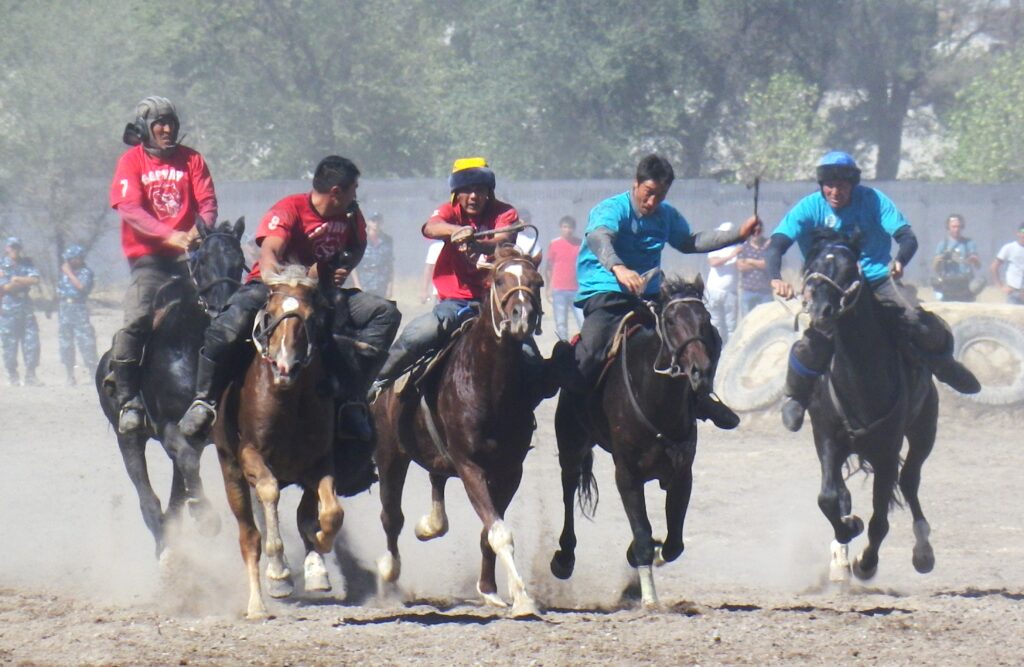
Kok-Boru, 2018 World Nomad Games Image Source: Helen Owl

Horses are a vital extension of Central Asian human resourcefulness. Among the sporting category highlights, the popular Kok-Boru (also known as Buzkashi and Ulak Tyrtysh in Kyrgyz) procured from a battle training custom, will take center stage. Mere balls fade in comparison to the headless goat carcass that the equestrian participants must capture and then fling into the opponent’s goal to win the game. The breadth of horse riding and wrestling take on various forms in several definitive sporting divisions. Er Enish, a tough physical challenge for both humans and horses, entails bare-chested athletes on horseback, wrestling each other off of said horses. Elsewhere, nomadic children are in a different category, both literally and figuratively, when compared to most other cultures. Baige is a horseracing event in which child competitors, aged 8 and up, race one another across distances between 11 and 25 kilometers in different categories.

Other animals, featured in the Salburun hunting games, including bait-chasing falcons and Taigans (an old hunting dog breed from Kyrgyzstan), denote the historic trained allies of codependent nomadic survival. The Powerful Strongman competition is another highlight in which the distance of 10 meters features prominently. Contestants must lift a 100 kg stone and carry it, perform squats with a 100 kg bag, pull a 200 kg trolley, and throw a 10 kg javelin at a target, all at a distance of 10 meters. For good measure, the strong men must also carry a 130 kg log on their shoulders. Amidst the traditional physical sports, female athletes will partake in the designated categories of wrestling (including Mas-wrestling, a stick tug-of-war), martial arts, and archery.

Mind games are another feature of the WNG in which animal leftovers don’t go to waste. Originating in strategic mind-over-matter warrior training, Ordo (meaning Khan’s palace) is a type of board game played on a flat surface representing the khanate. Players must bring down the khan by tossing alchiks, small bones from a ram’s knee joint, toward the opponent’s alchik row to knock the pieces out of the circle. Similarly, in Assyk Atu, a traditional Kazakh game, players make use of sheep leftovers by using the assyk, made from sheep knuckle bones, to hit lines of multiple assyks.
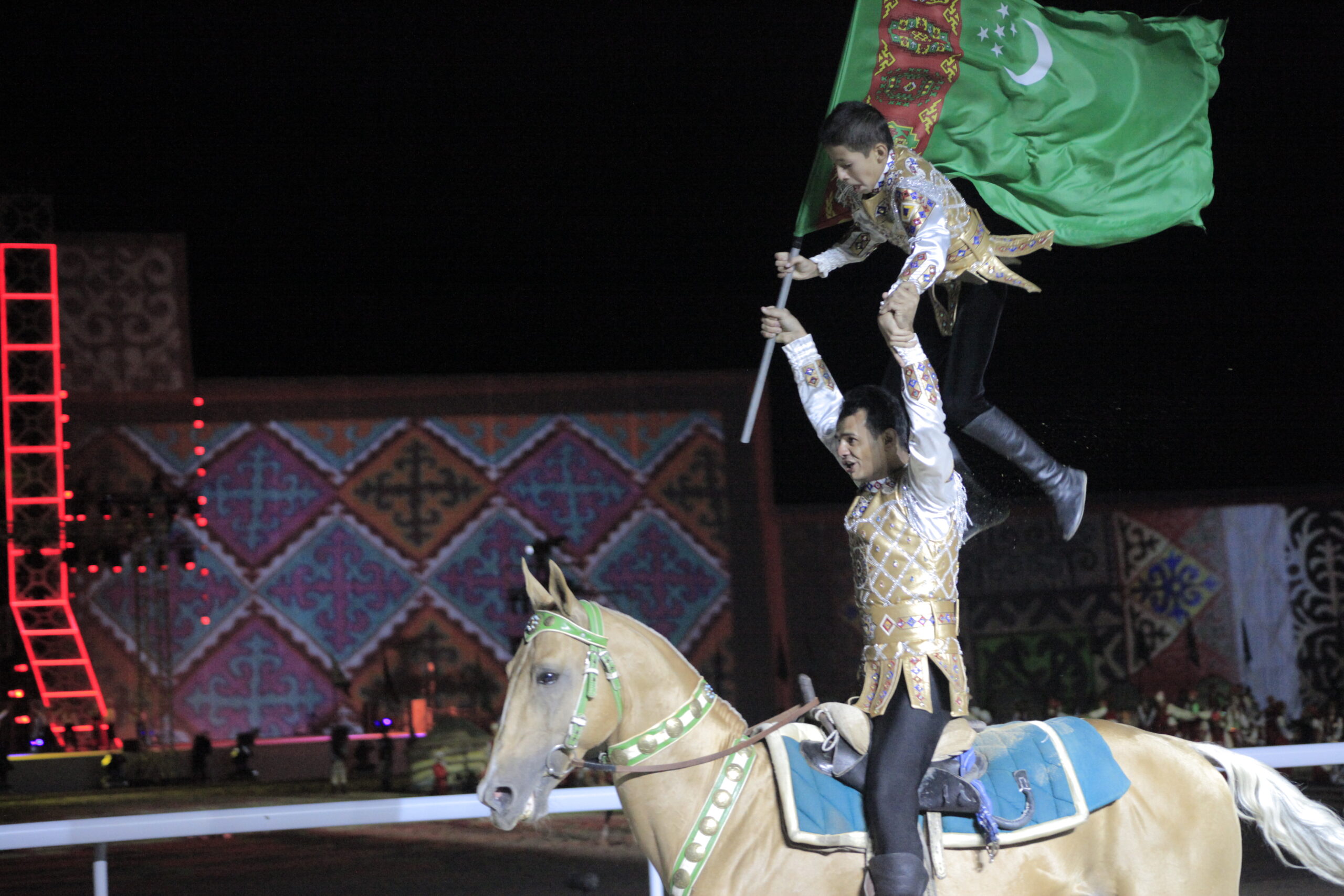
Turkmenistan athletes at the World Nomad Games opening ceremony Image Source: Save the Dream

Organized by the Republic of Kazakhstan, the opening ceremony will be attended by the President of Kazakhstan, Kassym-Jomart Tokayev, who will announce the official start of the 2024 WNG. Between then and the closing ceremony, the WNG winners will receive 97 sets of medals. The Kazakhstan capital of Astana, a commercial hub of Central Asia, represents a significantly more metropolitan setting when compared with the previous WNG locations. In the post-Soviet era, the manifestation of national ambition is perceptible in the architecturally competitive domes, cones, and geometric conundrums. As Astana’s touristic pull continues to expand, the nomadic presence of Kazakhstan is pervasive. The yurt dwellings of Almaty, the largest city in Kazakhstan, and the Altai regions in the east of the country, have incorporated glamping opportunities for the curious traveler. Meanwhile, global awareness of the WNG has been assisted in no small part by its inclusion on the UNESCO Intangible Cultural Heritage list. The ancient nomad games, revived since the end of the Soviet Union in 1991, amount to an exhilarating spectacle of mental and physical disciplines.

Come back soon for new updates.

Trading Volume of Ruble-Tenge Pair on Kazakh Exchange Tripled in June

The trading volume of the ruble-tenge currency pair on the Kazakhstan Stock Exchange (KASE) in June amounted to 366 billion KZT ($770 million). This is a nearly threefold increase compared to May’s trading volume, and the highest trading volume since December 2023.

The most significant growth in daily trading volume occurred after June 12, when U.S. sanctions were imposed on the Moscow Exchange (which holds a 13.1% stake in KASE).

In the first five months, the average trading volume of the ruble-tenge pair was 191 billion KZT ($400 million). According to the head of the exchange, Alina Aldambergen, the surge last month could be due to seasonal factors.

Some participants in the Russian stock market have suspended input and output of Kazakhstani tenge to clients’ brokerage accounts since July 15. These measures are connected with the complications of settlements between participants in exchange trades in the Kazakhstani tenge and the increase in time for input/withdrawal of currency and settlements on deals with it.

Belgian Company Expands Turkmenistan Operations to Support Growth of Middle Corridor

Jan De Nul, a Belgian group of companies known for its offshore construction and environmental projects, is expanding its activities in Turkmenistan.

The company’s expansion is a response to the expected increase in cargo traffic along the Trans-Caspian International Transport Route (TITR), also known as the Middle Corridor.

A spokesperson from the company said: “We recognize the need to deepen maritime access channels to port infrastructure and operating bases as Caspian Sea levels drop and cargo traffic increases. Our company has the expertise and resources needed to address these challenges quickly and efficiently, given the growing role of the TITR in the region.”

Jan De Nul’s expansion in Turkmenistan confirms the region’s importance and potential for transportation infrastructure development.

Uzbekistan Sends Aid to Kyrgyzstan After Osh Region Floods

Following heavy flooding in Kyrgyzstan’s Osh region on July 14, people in Uzbekistan’s nearby Andijan region have sent 200 tons humanitarian aid to the people affected.

The aid received in Osh includes household goods, construction materials, clothes and food. The flood resulted from torrential rains in the surrounding mountains and hills.

Kyrgyzstan has suffered more than usual from extreme weather this summer. Last month nine people were killed by another flood in the Osh region.

Tigers to Return to Kazakhstan

The Ministry of Ecology of Kazakhstan and the World Wide Fund for Nature (WWF International) are set to reintroduce tigers to the republic by settling the animals in a new reserve.

Following an agreement signed by the two parties in mid-July, the Ministry of Ecology stated: “This memorandum is a continuation of successful and fruitful cooperation, which has already led to significant achievements in the restoration of biodiversity and infrastructure of the Ile-Balkhash Nature Reserve. The tiger’s return to Kazakhstan is an ecologically important project and a symbol of our efforts to restore the natural heritage.”

The project has been many years in the making. In 2021, President Kassym-Jomart Tokayev discussed reintroducing tigers to Kazakhstan with Russian President Vladimir Putin. Referencing the fact that the last Turanian tigers were spotted in Kazakhstan in the 1930s, he explained: “These are steppe tigers. In ancient times, they were sabre-toothed, so now we are developing an international project to restore the population of these tigers.”

The long-awaited tigers will arrive this autumn and as reported by the Ministry of Ecology, two tigers, a male and a female, will be delivered from the Netherlands at the expense of the Dutch side in September.

In addition to these animals, in 2023, environmentalists announced plans to release a group of Amur tigers from Russia within five years, following an agreement signed by Russia and Kazakhstan at the Eastern Economic Forum (EEF) in 2022. It was assumed that the first generation of the population would consist of Amur tigers, including those from Primorye. Turanian, otherwise known as Transcaucasian tigers, which used to live in Central Asia, northern Iran, and the Caucasus, are genetically close to Amur tigers but slightly smaller.

The intention to recreate the tiger population in the country was first declared at an international forum dedicated to preserving tigers in 2010.  Kazakhstan announced its readiness to embrace the initiative and since then, has been rigorous in its preparations. In September 2017, a memorandum was signed between the World Wildlife Fund (WWF) and the government of Kazakhstan on implementing the program  and in 2018, the Ile-Balkhash State Nature Reserve was established, where work to restore the ecosystem is in full swing.

The tiger reintroduction program is planned to span over 35 years and comprises three phases: habitat preparation, predator release, and monitoring the growth of the tiger population. In the Ile-Balkhash reserve, boundaries have been established, communication systems have been set up, and comprehensive territory protection measures have been implemented.

“The reserve territory is a natural complex that includes a variety of natural ecosystems from semi-desert, floodplain, and saxaul forests to wetlands. Such a favorable geographical location and rich forage create favorable conditions for the breeding of wild animals and a large number of birds. Biodiversity of the reserve includes about 40 species of mammals, 284 species of birds, and more than 420 species of plants, many of which are included in the Red Book of Kazakhstan,” the Ministry of Ecology explained.

Since 2019, the reintroduction of the Bukhara deer, a species that disappeared over a century ago, has proved highly successful and today, the reserve has over 100 deer. The number of wild boars and gazelles has also significantly increased.

Careful consideration has been paid to the impact of the project on villagers of Southern Pribalkhash, as outlined by Grigory Mazmanyants, Director of the World Wildlife Fund office in Kazakhstan: “Undoubtedly, the support of residents is one of the most important stages of the tiger reintroduction program. Without their assistance, realizing such an ambitious project is simply impossible. A separate area is being worked on for the economic development of these villages. Cattle breeding and agriculture cannot fully meet the needs of families, which is why one of the program’s directions is to support residents and provide opportunities to develop other sources of income that do not harm the environment. Over the past four years, the WWF has provided more than 40 small grants, established a community development fund, and supported the cultivation of melons for low-income families. Training in working with ecotourists is underway. In particular, attention is focused on the creation of guest houses, the art of being a guide, production of souvenirs, etc.”

According to ecologists, the presence of big wild cats will benefit rural residents. No compensation is available for livestock taken by wolves but since the tigers will replace these predators  in the food chain, their numbers will decline. Given that livestock may fall prey to tigers, the reintroduction program plans to reimburse residents for any losses, and drawing on the experience of the Russian Far East and India, will implement measures to track the animals’ movements to minimize the risk of collision with humans.

English Courses for Labor Migrants Open in Kyrgyzstan

Free English language courses have been opened in Bishkek and Osh for citizens wishing to work seasonal jobs in the UK.

According to the Center for Employment of Citizens Abroad, free English language training will be provided to citizens who have previously worked in the UK and plan to return as seasonal workers. The classes will start on August 1 and last two and a half months.

“The purpose of the course is to improve your level of English so you can have a more comfortable stay in the UK. If you enroll in the course, you are committing to take (the course) from start to finish,” the Center’s website says.

Students will learn grammar, vocabulary, and pronunciation. However, these courses are not prerequisites for selection into the seasonal worker program.

On the organization’s website, migrants can fill out a form that requires their data and information about their previous work experience.
Earlier this year, the Ministry of Labor, Social Security, and Migration of Kyrgyzstan opened online registration for Kyrgyz citizens seeking seasonal work in the UK. In one day, over 26,000 people registered on the migrant.kg portal. This year’s quota for seasonal work in England is at most 10,000 people.