• KGS/USD = 0.01144 0%
  • KZT/USD = 0.00212 0%
  • TJS/USD = 0.10432 -0.29%
  • UZS/USD = 0.00008 0%
  • TMT/USD = 0.28571 0.28%
  • KGS/USD = 0.01144 0%
  • KZT/USD = 0.00212 0%
  • TJS/USD = 0.10432 -0.29%
  • UZS/USD = 0.00008 0%
  • TMT/USD = 0.28571 0.28%
  • KGS/USD = 0.01144 0%
  • KZT/USD = 0.00212 0%
  • TJS/USD = 0.10432 -0.29%
  • UZS/USD = 0.00008 0%
  • TMT/USD = 0.28571 0.28%
  • KGS/USD = 0.01144 0%
  • KZT/USD = 0.00212 0%
  • TJS/USD = 0.10432 -0.29%
  • UZS/USD = 0.00008 0%
  • TMT/USD = 0.28571 0.28%
  • KGS/USD = 0.01144 0%
  • KZT/USD = 0.00212 0%
  • TJS/USD = 0.10432 -0.29%
  • UZS/USD = 0.00008 0%
  • TMT/USD = 0.28571 0.28%
  • KGS/USD = 0.01144 0%
  • KZT/USD = 0.00212 0%
  • TJS/USD = 0.10432 -0.29%
  • UZS/USD = 0.00008 0%
  • TMT/USD = 0.28571 0.28%
  • KGS/USD = 0.01144 0%
  • KZT/USD = 0.00212 0%
  • TJS/USD = 0.10432 -0.29%
  • UZS/USD = 0.00008 0%
  • TMT/USD = 0.28571 0.28%
  • KGS/USD = 0.01144 0%
  • KZT/USD = 0.00212 0%
  • TJS/USD = 0.10432 -0.29%
  • UZS/USD = 0.00008 0%
  • TMT/USD = 0.28571 0.28%

Five Hundred Uzbek Orphans Will Be Provided With New Homes in 2024

Officials in Uzbekistan held an online meeting under the direction of President Shavkat Mirziyoyev on February 20th to discuss the top priorities in the realm of social services. One topic raised at the meeting was that the work of juvenile legal and social-assistance centers needs to be improved.

It was stated that these centers ought to be transformed into facilities that deal with childhood issues inherent to those who have challenging upbringings, and that the center should offer complex social services to help children adjust to society.

The President directed that institutions like the School of Life be reorganized. It was also underlined how important it is to give orphans land for farming, and also provide training in entrepreneurship and professions in order to help them fulfill their potential.

The Cabinet of Ministers was set the task of establishing a system to enable orphans and young people who lack parental guidance and affection to find work in state organizations. To help complete this task, a list of young people in dire need of housing will be compiled by the Inson (People) social-service centers. The value of the housing provided to them is set by region and is based on fair market value. The amount of money set aside for these projects this year will total 140 billion som (~$11.2 million). Officials were instructed to provide housing for 500 orphans who are on the waiting list before June 1st.

Spanish Company Ready to Explore for Groundwater in Kazakhstan

Cooperation in groundwater exploration was discussed during a February 21st meeting of Kazakhstan’s minister for water resources and irrigation, Nurzhan Nurzhigitov, with the Spanish ambassador Jorge Urbiola López de Montenegro, and representatives of the Spanish company Xcalibur Smart Mapping, the global leader in natural resource mapping. 

Xcalibur, whose technologies are widely used in Australia, Canada, the USA, and Europe, said that it was ready to help attract grants and funding for joint projects in groundwater exploration in Kazakhstan. 

According to the Ministry of Water Resources and Irrigation, 4,540 groundwater deposits have so far been explored in Kazakhstan. Today the water reserves of Kazakhstan total 102.3km³ and the operational reserves of groundwater in the country amount to 15.7km³. Slightly more than 1% of the total volume of water is used to provide the population with drinking water. 

Kazakhstan to Report to UN on Events of January 2022 Unrest

Kazakhstan will report to the United Nations (UN) Committee against Torture on measures taken after the events of bloody January (Qantar) 2022. This is according to the Deputy Chairwoman of the International Bureau for Human Rights, Roza Akylbekova, who added that information on urgent recommendations, which primarily concern Qantar, should be provided no later than May 12th, 2024

“This is information about what happened, how many people were affected, and, of course, about deaths in closed institutions and how Kazakhstan is investigating them,” Akylbekova said at a news conference at the office of the Kazakhstan International Bureau for Human Rights and the Rule of Law. In addition, according to the human rights activist, the Ministry of Defense of Kazakhstan will have to prepare information on the deaths of conscripts.

It has been 25 years since Kazakhstan joined the UN Convention against Torture, since which time the Coalition of NGOs of Kazakhstan against Torture and the National Preventive Mechanism for the Prevention of Torture have been established created. Furthermore, Kazakhstan added an article on torture to the criminal code and opened up a path for individual appeals regarding torture directly to the UN Committee. At the same time, however, torture remains a pressing problem in the country.

According to the Kazakhstan International Bureau for Human Rights and the Rule of Law, 200-250 people apply to the Coalition of NGOs against Torture every year. In 2022, 190 appeals were received in connection with the January events, and another 88 episodes that had no connection to the mass riots of that year. Since Qantar, the number of complaints has not fallen, with 283 appeals in 2023, during which year over 20 systemic recommendations were issued to Kazakhstan.

Earlier this year, the European Union (EU) funded a three-year project by Kazakhstani human rights defenders that aims to eradicate torture. As part of this project, the Kazakhstan NGO Coalition against Torture and the Prison Reform International (PRI) office will analyze individual cases of criminal prosecution for torture which do not reach trial. However, these cases are difficult to identify and prosecute.

“In Kazakhstan such crime as torture is adjacent to other articles of the Criminal Code: in addition to ‘torture,’ the concepts of ‘ill-treatment’ and ‘abuse of power’ are used. Therefore, the official statistics on those prosecuted for ‘torture’ (Article 146) do not give an understanding of how many cases are actually hidden behind the lighter articles. At the same time, Article 146 itself has been divided into two parts: ‘torture,’ which will be investigated by the prosecutor’s office, and ‘cruel and inhuman treatment,’ which is left to the Interior Ministry, whose employees are most often the beneficiaries of torture,” the press service of the Kazakhstan International Bureau for Human Rights and Rule of Law reported.

The UN Committee against Torture was established in January 1987. It consists of 10 independent experts, who currently represent the United States, Turkey, China, Japan, Russia, France, Morocco, Moldova, Latvia, and Mexico. They monitor the implementation of the Convention against Torture and Other Cruel, Inhuman or Degrading Treatment or Punishment by state parties. The document was signed in February 1985 in New York, and came into force two years later, on June 26th, 1987. All those who have acceded to the Convention must report regularly to the Committee on the fulfillment of their obligations.

Bodies of Kazakh Rescue Workers Swallowed by Sinkhole Still Missing After Seven Weeks

The search for rescuers who fell into a sinkhole at a mine owned by JSC Maikainzoloto may resume in ten to fourteen days, it has been announced by Deputy Chairman of the Committee of Industrial Safety of the Ministry of Emergency Situations, Musa Tanabaev. “Work on expansion and deepening” must be completed, Tanabaev said, and only then can a “direct search for the missing begin.”

The wife of Aidos Shaimerden, one of the missing rescue workers, has repeatedly asked local authorities to involve foreign specialists in the search. The Ministry of Emergency Situations has responded that this is not required yet.

In the early hours of January 4th, near the Maikainsky mine in the Pavlodar Region, a bus carrying three rescue workers and a driver fell into a sinkhole. Shortly before the incident, they had received an emergency call about smoke in the area of the mine and proceeded to the site. Preliminary measurements of the sinkhole put the width of the collapse at 500 meters, with a depth of 150 meters.

At noon of the same day, the bodies of two rescue workers who fell into the breach were found in the debris at a depth equal to that of a 25-story building. They were 53-year-old Oleg Tyshkevich, and 24-year-old Berdikan Sarkyt. The rescue operation was, however, complicated by the fact there could be more collapses at the edge of the newly formed pit.

On January 5th, the police began an investigation into the tragedy. According to details of the special investigation, dust at the site of the sinkhole was mistaken for smoke, and at 01:14 a bus with first responders went to the location of a possible fire. The director of the mine followed them by car. When he saw the bus fall, he managed to slow down and report what had happened – thus preventing the death of four firefighters who were following.

During the ensuing search, a tracking device showed that the bus was buried at a depth of about five meters from the bottom of the funnel. Two days later, rescuers with a surveyor descended to the bottom of the breach and examined it for the first time.

On January 18th, heavy equipment completed the laying of a side ramp and lowered a small excavator down to the center of the sinkhole on a safety cable. During the initial excavation, parts of the bus, an oxygen cylinder, breathing apparatus and a rescue worker’s bag were located. Later, a helmet, parts of the interior of the bus, and a first responder’s hand-held radio were discovered.

On January 26th, a special commission found that the collapse of rock mass into the abandoned mine was caused by unsatisfactory production management, there having been no proper oversight of the breaches formed as a result of the company’s activities.

An investigation was launched for “violation of safety rules during mining or construction works,” and more than 40 employees and the management of the LLP were questioned, whilst documents and video surveillance footage were seized.

On February 3rd, search efforts at Maikainzoloto were suspended after the appearance of another funnel at the bottom of the sinkhole. “Voids were observed at the bottom of the funnel,” the press service of the Emergency Situations Department of Pavlodar Region reported, and the “excavator and specialists were urgently raised to the surface.” Rescue attempts were further hindered by sub-zero temperatures and a powerful storm.

The families of the deceased rescuers have received financial assistance in the amount of 4.5 million tenge (about $10,000). Similar payments will be made to the other families upon completion of the search for the missing first responders in the event that the bodies are found or legally declared dead. The families will also be assigned a state social benefit for the loss of the breadwinner – this is a monthly stipend for each member of the family under the age of 18.

Peace Following Kyrgyz-Tajik Clashes Allows Hydro Engineers to Visit Tajikistan

For the first time since the start of armed clashes on the Kyrgyz-Tajik border, business cooperation between the two countries has begun to return. Kyrgyz Energy Minister Taalaibek Ibrayev and his delegation recently visited a pair of Tajikistan’s energy facilities, the Rogun and Nurek hydroelectric power plants (HPP), according to the press service of the Kyrgyz Ministry of Energy.

Tajikistan’s Deputy Minister for Energy Halmukhamadzoda Sobron showed Kyrgyz colleagues how the Rogun HPP is being built, as well as some special underground facilities and tunnels under the plant. Sobron described problems faced by Tajik hydro construction workers when using construction equipment at the site, and detailed the integrated stage-by-stage approach to building the main structures of the hydropower plant.

“More than 15,000 hydro construction workers are involved in the construction of the Rogun HPP, more than 300,000 machines and equipment are operated, and skillful planning allows dozens of contracting companies to work simultaneously,” Tajik power engineers emphasized.

The Kyrgyz side noted that the exchange of experience in the construction of such grandiose facilities will be useful in the construction of Kambar-Ata HPP-1 in Kyrgyzstan.

During the three-day visit, Kyrgyz power engineers also visited plants responsible for the production of hydromechanical equipment and for  the production of electrical equipment. During the meetings it was emphasized that after the border issue is resolved, the sides are ready to cooperate with each other again on all issues.

Kyrgyzstan and Tajikistan are usually connected by high-voltage power lines, which play an important role in the regular supply of electricity to local residents living in the border areas. However, these lines are now out of operation.

The problem with the border between the two countries arose after the collapse of the USSR. Essentially both parties claimed land that’s rich in water resources, as the issue of agricultural irrigation is very relevant in the arid region. More than 30 years have passed since then, and the parties still cannot agree on the disputed territories. Because of this, conflicts periodically arise between citizens of border villages — as well as residents of enclaves and border guards of Kyrgyzstan and Tajikistan — including with the use of heavy weaponry. The last such conflict took place in the Batken region of Kyrgyzstan and Sughd region of Tajikistan in September 2022 — at which time there were hundreds of deaths on both sides and civilian infrastructure was destroyed. Since May 2021, transportation by land or air between the countries remains closed. Trade and all business contacts have been suspended.

To date, the two countries have agreed to demarcate about 90% of the disputed territories.

Rogun HPP is a hydroelectric power plant under construction on the Vakhsh River. It is the largest HPP in Central Asia. Construction of Rogun HPP began in the 1970s, but in the 1990s work was stopped due to the collapse of the Soviet Union and the outbreak of civil war in Tajikistan. Construction resumed only in 2010 with the support of the World Bank. The first of six units planned for Rogun was commissioned in 2018. When all infrastructure is complete, the average annual electricity generation at the plant will be more than 17 billion kWh per year. The dam under construction, as Tajik power engineers note, will be the highest rock-fill type dam in the world.

Record Numbers of Pink Flamingos Are Wintering in Turkmenistan

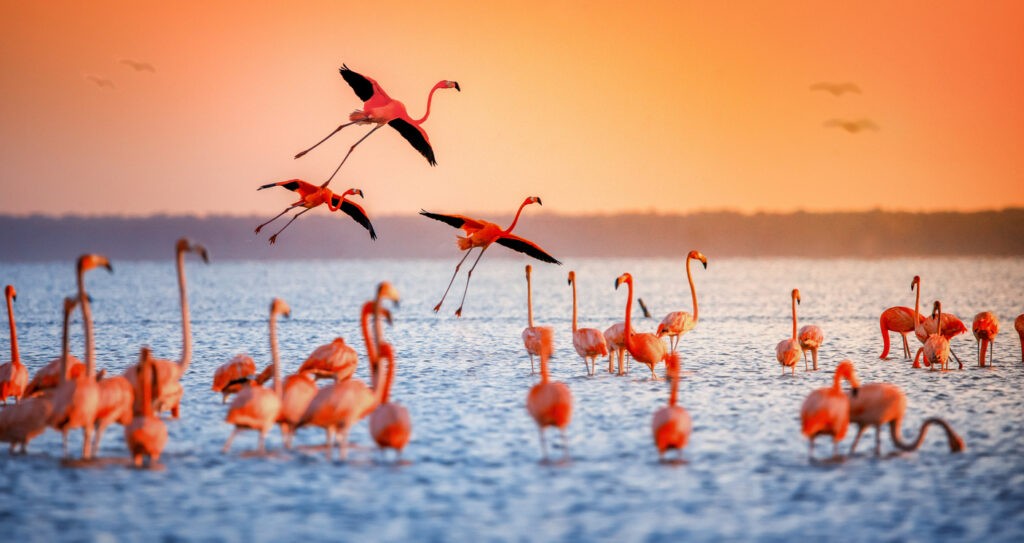
This year the Turkmen coastline of the Caspian Sea has hosted a record number of wintering birds. According to the international ornithological expedition, more than 207,000 birds have flown there since the fall.

Pink flamingos, listed in the so-called Red Book of endangered species, are the emblem of Turkmenistan’s Khazar State Nature Reserve. Scientists at the reserve counted 30,392 of these migratory birds in total. Turkmen ornithologist A.A. Shcherbina commented that “this is an official record, both according to recorded data and observations in our sector of the sea, which I have been engaged in since 1971.”

In Latin flamingo means fire or flame. This species is most commonly found in Africa, Southeast and Central Asia, the Caucasus, Central and South America, and the Mediterranean. In Central Asia there is a red-winged species of flamingo, which is usually called ‘pink’. Nomadic peoples across Asia believe that seeing one will make them happy.

Scientists carefully study, photograph and keep records of all coastal animal species of the Turkmen sector of the Caspian Sea. Specialists have noted that in the past years, endangered flamingos preferred to spend their winters in Iran. The current relocation of the birds, it seems, is caused by favorable changes in the water of the Caspian Sea and its coastline.

Thanks to the efforts of staff from the Khazar reserve, natural conditions for nesting are improving on the Turkmen coast — and the food base for protected birds is growing. According to their calculations, there are 50,000 more migratory birds this season than last season.

The reserve, founded in 1934, took its name from the ancient name of the Caspian Sea — Khazar. Most of the reserve’s 270,000 hectares fall on the shores of the Caspian Sea.