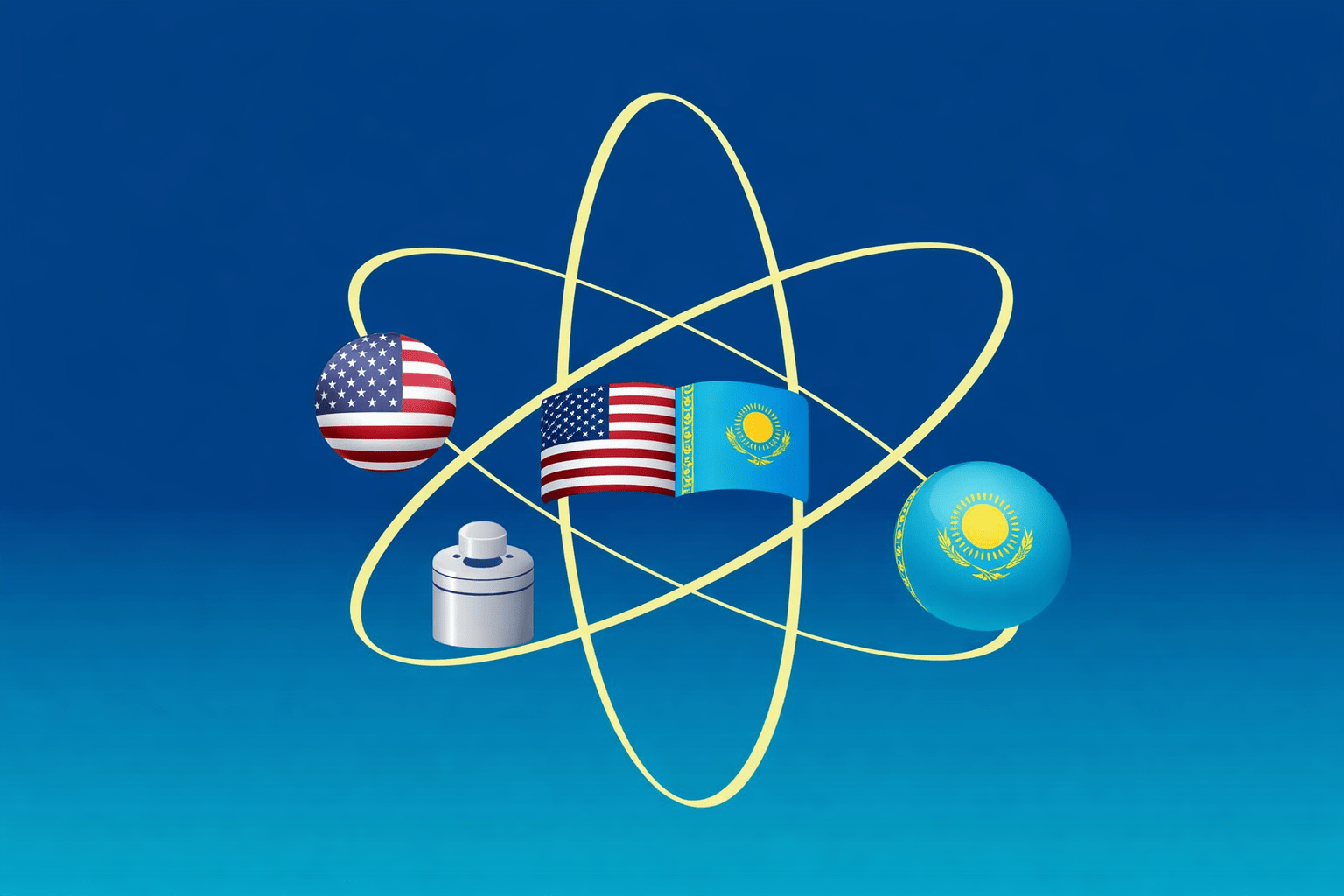
The United States and Kazakhstan have expanded cooperation on civil nuclear energy, placing small modular reactors at the center of a new phase in bilateral engagement. In late December 2025, the U.S. Embassy in Kazakhstan announced two initiatives under the U.S. State Department’s Foundational Infrastructure for Responsible Use of Small Modular Reactor Technology program, known as FIRST. The measures focus on workforce training and technical evaluation as Kazakhstan prepares to reintroduce nuclear power generation.
Kazakhstan is the first country in Central Asia to participate in the FIRST program, which was launched by the U.S. State Department in 2021 to help partner countries prepare regulatory frameworks, workforce capacity, and infrastructure for advanced nuclear technologies.
The first initiative provides for the installation of a classroom-based SMR (small modular reactor) simulator at the Kazakhstan Institute of Nuclear Physics in Almaty. The simulator is intended to train specialists in reactor operations, safety systems, and emergency response. On January 6, 2026, the American Nuclear Society reported that the simulator will be supplied by U.S. companies Holtec International and WSC Inc., a simulation technology company that operates as part of the Curtiss-Wright group. The project is designed to build domestic technical capacity prior to licensing or construction decisions. The International Science and Technology Center is supporting implementation in Kazakhstan.
The second initiative is a feasibility study examining which U.S.-designed SMRs could be technically and economically suitable for Kazakhstan. According to the American Nuclear Society, the study is being conducted under FIRST, with U.S. engineering firm Sargent & Lundy. The assessment is expected to cover grid integration, siting considerations, cooling requirements, and indicative deployment timelines. The study does not authorize construction or commit Kazakhstan to a specific reactor technology; rather, the feasibility study is intended to produce a shortlist of U.S. SMR designs that could be compatible with Kazakhstan’s grid, geography, and projected electricity demand.
These initiatives follow Kazakhstan’s decision to return to nuclear power. On October 6, 2024, voters approved the construction of nuclear power plants in a national referendum. Official results published by the Central Referendum Commission showed 71.12% voting in favor, with turnout at 63.66%. Kazakhstan has not generated nuclear electricity since the BN-350 fast reactor at Aktau was shut down in 1999. Government energy planners have warned that Kazakhstan faces growing electricity shortfalls as early as the mid-2020s, driven by aging coal plants and rising consumption.
Kazakhstan’s interest in nuclear energy reflects structural pressures in the power sector. Coal-fired plants still supply most electricity, particularly in northern regions, but much of that capacity is aging. Electricity demand continues to rise alongside industrial output and urban growth, while the government has set targets to reduce emissions intensity. Nuclear power is being positioned as a source of stable, low-carbon baseload generation that can complement renewable energy.
Kazakhstan also occupies a central position in the global nuclear fuel market. The country accounts for about 40% of global uranium mine production and holds roughly 14% of identified recoverable uranium resources. Despite that role, the country has relied on fossil fuels for domestic electricity generation for more than two decades, a situation characterized by President Kassym-Jomart Tokayev in a January 5 interview as a “historical absurdity”. Tokayev has repeatedly argued that Kazakhstan’s status as the world’s leading uranium producer strengthens the economic and strategic case for domestic nuclear power generation.
Large-scale reactors remain the core of Kazakhstan’s near-term nuclear plans. In 2025, Kazakhstan selected Russia’s Rosatom to build its first nuclear power plant at Ulken, near Lake Balkhash, using two VVER-1200 reactors. Kazakhstan has also moved forward with plans for a second nuclear power plant to be built by China’s China National Nuclear Corporation, reflecting a broader multi-vector nuclear diplomacy strategy. Officials have presented SMRs as a complementary option that could serve industrial sites or regions not immediately connected to large new nuclear plants.
The U.S.-supported SMR initiatives operate on a different timeline. SMRs are generally defined as reactors producing up to 300 megawatts of electricity per unit and are promoted for their modular construction and potential flexibility in deployment. No U.S. SMR has yet entered commercial operation, but several designs are advancing through licensing and demonstration. The FIRST program focuses on regulatory readiness, workforce development, and early technical planning rather than financing or construction.
For Kazakhstan, participation in FIRST adds a U.S. component to its nuclear strategy. The simulator and feasibility study expand technical expertise and provide comparative data that could inform future decisions on reactor scale and deployment. The initiatives broaden the range of technologies under consideration as nuclear power returns to a central place in Kazakhstan’s long-term energy strategy.