Kazakhstan wants to connect its rail and logistics network with the China-Laos Railway, opening a possible route for Lao goods to Central Asia and Europe and for Kazakh exports into Southeast Asia.
Much of the infrastructure already exists: both countries’ networks connect through China. What is missing are the agreements needed to make regular freight traffic between them practical.
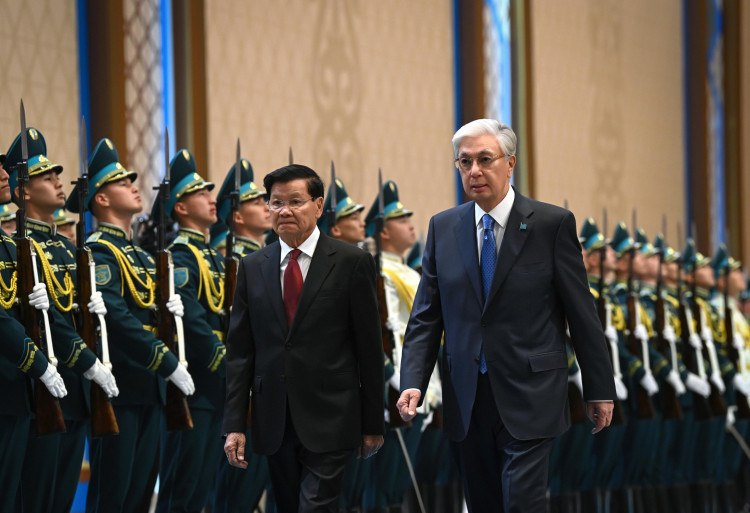
The idea was one of the main topics during Lao President Thongloun Sisoulith’s first official visit to Kazakhstan on September 3. During talks with President Kassym-Jomart Tokayev, trade, transport and logistics were high on the agenda.
Tokayev specifically offered Lao freight carriers access to Kazakhstan’s logistics hub in Xi’an. From there, cargo can move through Kazakhstan to the Caspian Sea and then onward toward Europe.
Astana sees the China-Laos Railway as a potential gateway to Southeast Asian markets. Opened in December 2021, the 414-kilometer section inside Laos connects the capital Vientiane with Boten on the Chinese border, linking the Lao network onward to Kunming through China’s rail system.
It has become a central element of Laos’ strategy to transform itself from a landlocked country into a regional land-linked transport hub.
Before the railway opened, the World Bank estimated that, with better logistics and simpler border procedures, it could substantially reduce transport costs and integrate Laos more closely into regional production and supply chains.
The route is already being used for freight between China and Southeast Asian countries, including Thailand, Vietnam, Malaysia, and Singapore. Kazakhstan is looking at this infrastructure as a possible southern extension of its own overland trade routes.
Between the two countries lies China’s vast railway system, meaning much of the physical infrastructure needed for such a connection already exists.
There is, however, no regular Kazakhstan-Laos freight corridor yet. Regular freight services would require agreements covering transit, tariffs, and customs procedures. The route’s commercial viability would depend on transport costs and delivery times, as well as the ability to generate sufficient cargo volumes.
The first potential goods have already been identified. Laos is interested in Kazakh grain, oilseeds, animal feed, and meat products. Coffee and rubber are among the possible Lao exports to Kazakhstan.
The search for new trade routes is linked to Astana’s broader plans to expand the geography of its exports. Kazakhstan aims to increase non-commodity exports to $52 billion by 2030.
Kazakhstan’s interest in Laos is largely explained by the country’s changing position on Asia’s transport map. The railway connection to China has given Laos direct access to the Chinese network and brought it closer to major regional markets. Kazakhstan’s infrastructure could extend that chain westward through Central Asia and across the Caspian toward Europe.