The 46th FIDE Chess Olympiad in Samarkand, Uzbekistan, brings national teams together from September 15 to 27. Alongside the competition, delegates will elect the next leadership of FIDE, the International Chess Federation.
Three presidential tickets have been approved for the September 26 election. Entrepreneur Jan Henric Buettner, co-founder of Freestyle Chess with Magnus Carlsen, is running with Malcolm Pein for deputy president. WR Chess founder and WR Group chairman Wadim Rosenstein is standing with Gordon Tang. Freedom Holding Corp. founder and CEO Timur Turlov, who also heads the Kazakhstan Chess Federation, is running with Viswanathan Anand.
The Times of Central Asia spoke with Turlov about his experience of chess within his family and his proposals for managing the international federation.
TCA: Before we talk about professional chess and FIDE, let’s start at the beginning. What is your personal history with chess?
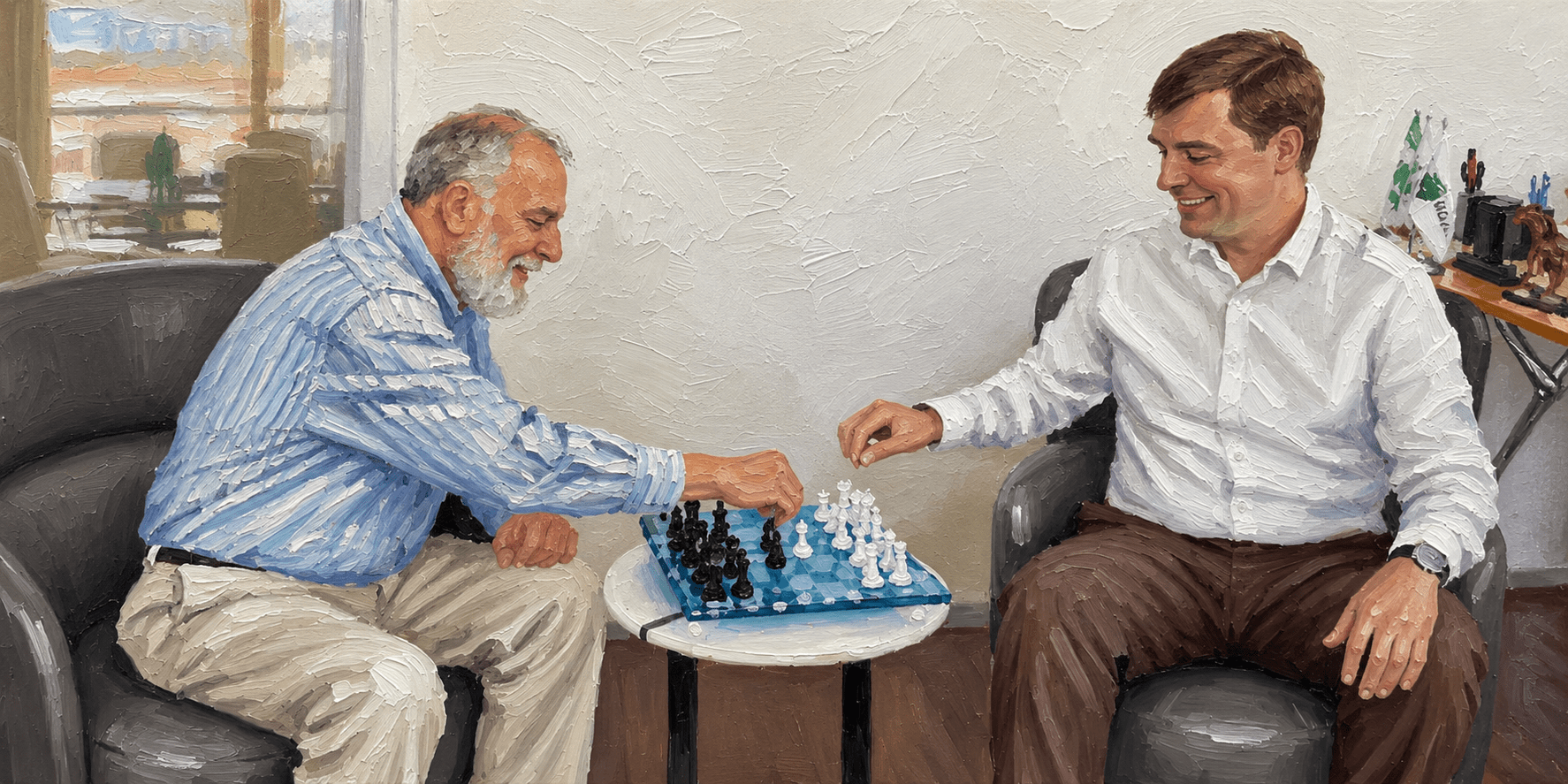
Turlov: I learned to play chess as a kid; my grandfather taught me. He saw it as a parenting tool, and it just became part of the family. Over time I drifted away from the game, but I eventually came back. What brought me back wasn’t nostalgia or any urge to win; it was my kids, and the sense that real relationships are built on substance, on actually connecting with and sharing with people. Having six children has been one of the great blessings of my life, and when they started playing and asked me to join them, I had good reason to pick the game back up, this time as a parent, and not as a student. It’s a small thing, but it reminded me how much family life keeps you grounded, thinking about someone other than yourself. Chess is one way for people to develop relationships and grow in virtue.
TCA: You describe chess as a parenting tool as much as a sport. How does that work in practice?
Turlov: With six children, finding one consistent way to connect with all of them isn’t easy. They’re each unique, of different ages, and with different personalities. Chess turned out to be that common ground for us that could be cultivated year after year. Sitting across the board from your child is different from a conversation at dinner. It’s slower, calmer, and it opens the door to talking about things that usually don’t come up otherwise. Honestly, some of my favorite moments as a parent have happened over a chessboard, not in spite of the game but because of it.
TCA: Can you give an example of what a chess game actually teaches a child that a normal conversation can’t?
Turlov: Beyond strategic thinking- call it looking ahead- there’s something in chess that matters even more: learning how to win, and especially how to lose. Chess is one of the few structured experiences where a child loses clearly, sees exactly why, and has to sit with that calmly, without a tantrum, without blaming anyone else. As a parent, that’s also a moment for reflection. You can talk through the loss with them, help them understand it wasn’t random, that it came from specific decisions. Learning that ideas and choices have consequences and learning to hold your emotions steady when things don’t go your way are lessons that stay with a child long after the game ends. And that’s a much easier conversation to have over a chessboard than in the abstract.
TCA: Can you elaborate on how chess can be a tool for building critical thinking? How does that connect to a child’s broader development?
Turlov: Every move in chess has a consequence, and you have to think several moves ahead before you commit to one. That habit- pause, weigh the options, consider how the other side will respond, taking a defensive or offensive posture- doesn’t stay on the board. Children who play seriously start applying that same discipline to how they approach problems generally, including how they treat the people around them, because they’ve practiced thinking about consequences before acting. It builds a quiet kind of responsibility and self-control that I think every child benefits from, whether or not they ever become a serious player.
TCA: You lead the Kazakhstan Chess Federation. What drew you into sports management specifically?
Turlov: Notwithstanding chess’ educational side, the managerial side of the professional game can always use some new ideas and approaches. A lot of sports federations are run with real athletic expertise but with less focus on the business discipline that lets an organization actually grow, plan budgets, build partnerships, and professionalize operations. I came in to help build an even better organization. Together with our Executive Director Gulmira Dauletova and Darmen Sadvakassov, First Vice President of the Kazakhstan Chess Federation, we’ve tried to run the Federation the way you’d run a serious business, and the results have followed: record medal counts and a strong pipeline of youth world champions across age categories.
Chess means something different to everyone, yet it brings us all together. From amateurs to professionals, organizers to officials, it connects people of every age, background, and region. I want to see chess become a truly global phenomenon.
TCA: You mentioned the education side. What does the Federation’s relationship with Kazakhstan’s Ministry of Education actually look like? Can your experience be exported?
Turlov: It’s an ongoing dialogue, not a one-off project. We regularly discuss with the Ministry how chess can fit into the broader curriculum and how to expand access in schools. We have already shown results in this area: chess has been introduced as an academic subject in 1,500 schools across Kazakhstan this year; the plan for next year is 2,500 schools. Our experience could be applied globally. There is strong evidence that chess supports educational outcomes, particularly by developing mathematical reasoning, pattern recognition and problem-solving, while also strengthening reading and analytical skills that support subjects such as literature. We can point to real results. Importantly, AI should be used only as an educational tool before and after matches.
Regarding your question about exporting our experience with the Ministry of Education: yes, it can be replicated. The key is clearly demonstrating its benefits.
TCA: The Federation has also pushed chess into some unconventional social spaces, tournaments for teachers, doctors, even prisoners. Why prioritize that?
Turlov: Because chess doesn’t have to be a niche competitive sport. It teaches patience, self-discipline, and a habit of thinking about consequences that can genuinely change how a person approaches their life. Our [Kazakhstan] “Senate Open Championship” alone brought in more than 5,000 participants across diverse levels of government. When you widen who plays, you widen who supports the game, which has also meant more engagement from government officials and sponsors, for example, in mining, real estate, and IT.
TCA: Let’s turn to FIDE. Why run for the presidency now?
Turlov: First of all, I’m passionate about chess and its global relevance in an AI era, one that’s challenging the age-old need for critical thinking, personal responsibility, and the skills we need to deal with others. At a more down-to-earth but equally important level, I think the same professionalization that worked for our national federation in Kazakhstan can work globally. An organization like FIDE can improve its financial predictability, the kind that lets you plan two-year calendars in advance instead of reacting year to year. I want to bring in the corporate governance tools that made a difference here: a CRM through Salesforce, a digital FIDE ID, and a proper learning management system for players and coaches worldwide.
Moreover, I want to push our media presence forward as well. Investing in media outreach requires confidence in the future. Broadcasters and sponsors commit resources when they know an event will happen reliably, be well organized and follow a predictable calendar.
If FIDE operates with the governance discipline and calendar stability seen in established sports such as tennis—with events like the US Open and Roland-Garros—it reduces the risk attached to investing in chess. Stability itself becomes a media strategy: it enables sustained coverage, stronger sponsorship and growing viewership. This can help chess reach new audiences across continents, particularly from Africa to Latin America, while developing greater interest among children and women.
[Editor’s note: FIDE has already announced a partnership with Salesforce that includes customer relationship management and fan engagement tools. The agreement also covers title sponsorship of world championship matches and the world rankings.]
TCA: Tell us about your experience in the business world?
Turlov: I hope my experience in corporate governance will help. I know how to work with independent directors, how to manage a large group of people, and how to maintain a high standard of governance. I’ve managed different sports federations, and at the same time managed a corporation with more than 10,000 employees, including international operations. I hope that experience helps bring real additional value to FIDE.
TCA: How do you plan to balance business management with the sport’s technical, competitive side, and how does your network of relationships with major global companies factor into your vision for FIDE and chess, generally?
Turlov: I’m not trying to run the show alone or swap out chess expertise for a corporate process. A balance is needed. I have teamed up with respected figures from the professional chess world, Viswanathan Anand among them, so the leadership pairs real sporting authority with the business and governance side. Neither one really works without the other.
On top of that, I plan to use my business network to open doors to sponsorships that chess, frankly, hasn’t fully tapped yet. By way of example only, I hope to bring in more sponsorship for chess from major companies like Alibaba and Citibank to large Chinese conglomerates like Tencent. Commercial expansion isn’t a side goal; it’s what makes the rest of the vision- digitalization, stability, growing the game worldwide- financially possible. All of this must be brought to harmonize with the beauty of chess as a sport.
TCA: You plan to spend two weeks in Samarkand during the Olympiad. What will you be doing there?
Turlov: Learning, sharing, meeting people. It’s a big couple of weeks; the 46th Chess Olympiad is taking place there, and the election for FIDE President is happening alongside it, so there’s a lot going on at once. But beyond the election itself, I’m looking forward to spending real time in Uzbekistan, a country with such a rich chess culture, as well as meeting people from all over the world; professionals and fans alike. My approach to all of this comes from different places: my education, my family, my business background, my ability to get things done and, of course, my love for the game. Six kids will teach you a lot about patience and listening. So will years of building relationships across very different cultures and industries. I’ll be talking with players, organizers, and fans, trying to get a real sense of what the community needs and hopes for. It’s a chance to listen as much as to speak.
The Olympiad runs until September 27, with 11 rounds of classical chess scheduled from September 16 to 27. The presidential election takes place at the FIDE General Assembly on September 26. Each member federation represented at the assembly is entitled to one vote.