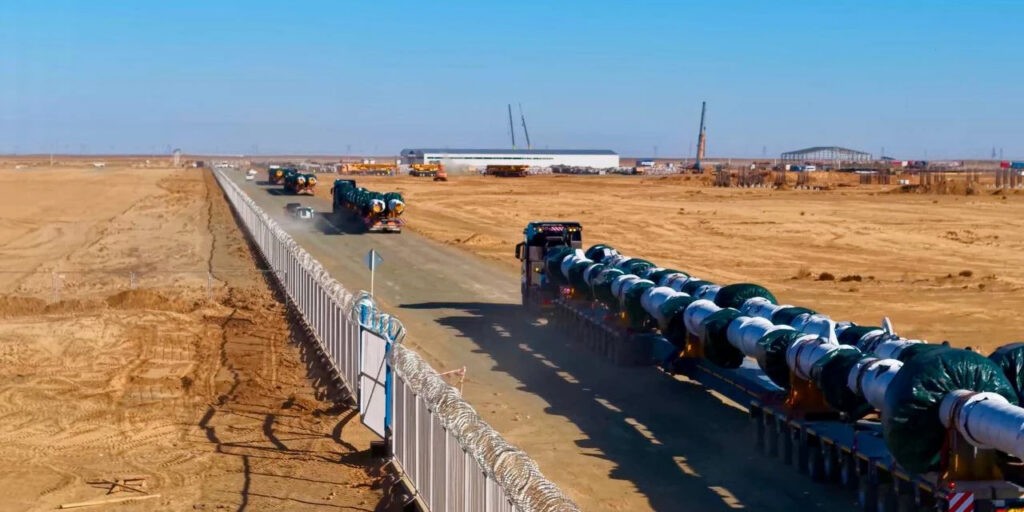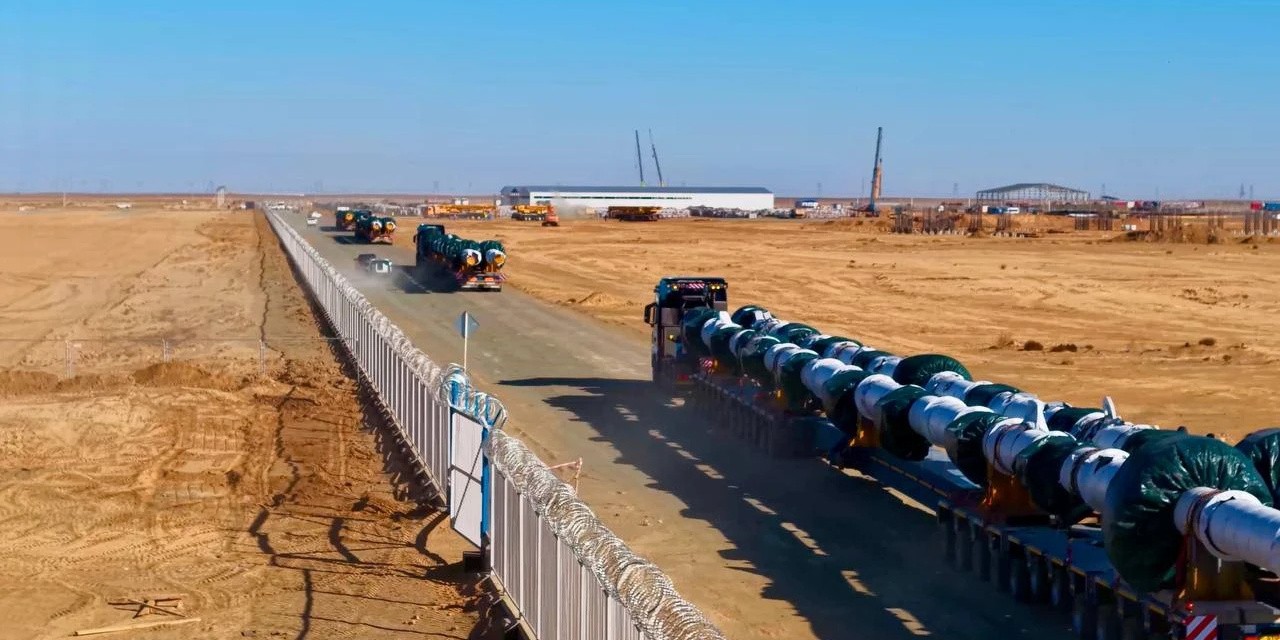
Two days before the UK sanctioned Russia’s SIBUR, Kazakhstan’s national oil company announced a major delivery to its Silleno petrochemical project. Eight reactor sections, weighing more than 600 tons, had reached the construction site in Atyrau region. The equipment marked progress toward a plant intended to turn Kazakh gas into higher-value industrial exports.
The November 10 delivery preceded a decision that could complicate the international partnerships supporting that ambition. SIBUR owns 30% of Silleno, a $7.4 billion polyethylene complex, and 40% of Kazakhstan Petrochemical Industries (KPI), which operates a nearby polypropylene plant.
The UK’s November 12 designation imposed an asset freeze alongside restrictions on trust services, company directorships and transport. The British authorities cited SIBUR’s business in Russia’s strategically important energy sector as grounds for the measures.
SIBUR rejected the decision on November 13. The company called the sanctions “neither legitimate nor justified” and reserved its right to challenge them, Reuters reported.
For Kazakhstan, the central issue is whether the two ventures can maintain financing and commercial relationships involving a sanctioned shareholder. Neither plant automatically falls under UK asset freezes merely because SIBUR holds a minority stake. Nevertheless, KazMunayGas’s experience with another Russian partner shows how insurance and lending difficulties can threaten projects beyond Russia’s borders.
Financing at a Critical Stage
Silleno is particularly exposed to uncertainty because it remains under construction. KazMunayGas’s 2025 annual report says the venture attracted $2 billion in bridge financing that year. Key long-term project investments were expected in 2026–2027, placing the sanctions decision within an important funding period.
The report lists KazMunayGas’s stake at 40%, alongside 30% each for SIBUR and China’s Sinopec. The plant’s planned annual capacity is 1.25 million metric tons, with production scheduled for 2029.
KazMunayGas has said shareholder equity and international bank loans would finance the development. It expects the plant to replace imported polyethylene and expand exports of manufactured goods. Polyethylene is used in products ranging from pipes and packaging to automotive components and medical equipment.
Those ambitions depend on an industrial chain extending well beyond the factory. Silleno’s project outline shows gas from the Tengiz field passing through a separation complex operated by KMG PetroChem. Pipelines will carry ethane to Karabatan, where it will be converted into ethylene and then polyethylene.
The annual report separately estimates investment of about $2.1 billion in the gas separation unit and $470 million in ethane and propane pipelines.
The technology is international, too. Silleno identifies U.S. company Lummus as the supplier of its steam-cracking technology. Its polymerization and associated processes involve Chevron Phillips Chemical and Univation Technologies of the U.S., and France’s Axens.
Oil and gas analyst Oleg Chervinsky has warned that SIBUR’s designation could complicate dealings with banks, insurers and equipment licensors. According to Kursiv, he described additional compliance and payment difficulties rather than an automatic shutdown of the Kazakh ventures.
Keeping Exports Moving
KPI has a business to protect. The plant exported 326,000 of the 377,000 tons of polypropylene it produced in 2025. Its ability to sell abroad and receive payments is therefore central to its operations.
KazMunayGas owns 49.5% of KPI and SIBUR holds 40%. Another 9.5% belongs to Samruk-Kazyna Ondeu, the sovereign wealth fund’s chemical-industry subsidiary, while private investor Almex Plus holds 1%.
Sanctions against SIBUR do not automatically extend to KPI and Silleno. Under UK rules, however, either venture could face restrictions if SIBUR controls its decisions. Its minority shareholdings alone do not settle that question.
UK sanctions apply within British jurisdiction and to UK persons and companies overseas, meaning the designation does not itself impose equivalent U.S. or EU restrictions on the Kazakh ventures. Banks and suppliers may nevertheless hesitate to handle their business. For KPI, that could mean trouble collecting payment or arranging supplies if commercial partners decide the business is no longer worth the compliance burden.
The Warning from Another Russian Partnership
KazMunayGas has faced similar problems at Kalamkas-Khazar Operating, its offshore joint venture with LUKOIL. Its corporate risk assessment says reinsurers have refused coverage because of LUKOIL’s involvement. Without insurance, KazMunayGas cannot obtain external financing for the project.
The two cases differ, however. LUKOIL owns a larger stake in its venture and faces different sanctions. KazMunayGas reports exemptions for Tengiz, Karachaganak and the Caspian Pipeline Consortium, but none for Kalamkas-Khazar Operating.
Silleno still needs long-term financing and further equipment deliveries, while KPI needs to keep selling abroad and receiving payments. Neither project has to stop simply because SIBUR is sanctioned, but both depend on banks and suppliers willing to continue doing business with them.
Kazakhstan has built its petrochemical plans around Russian investment, Chinese participation, and Western technology. Whether those partners can keep working together will help determine whether the country can turn more of its gas into manufactured exports.