In the age of AI, capital and code travel fast. Trust does not. That is why the most valuable infrastructure our region can build right now is human: entrepreneurs who know each other across borders.
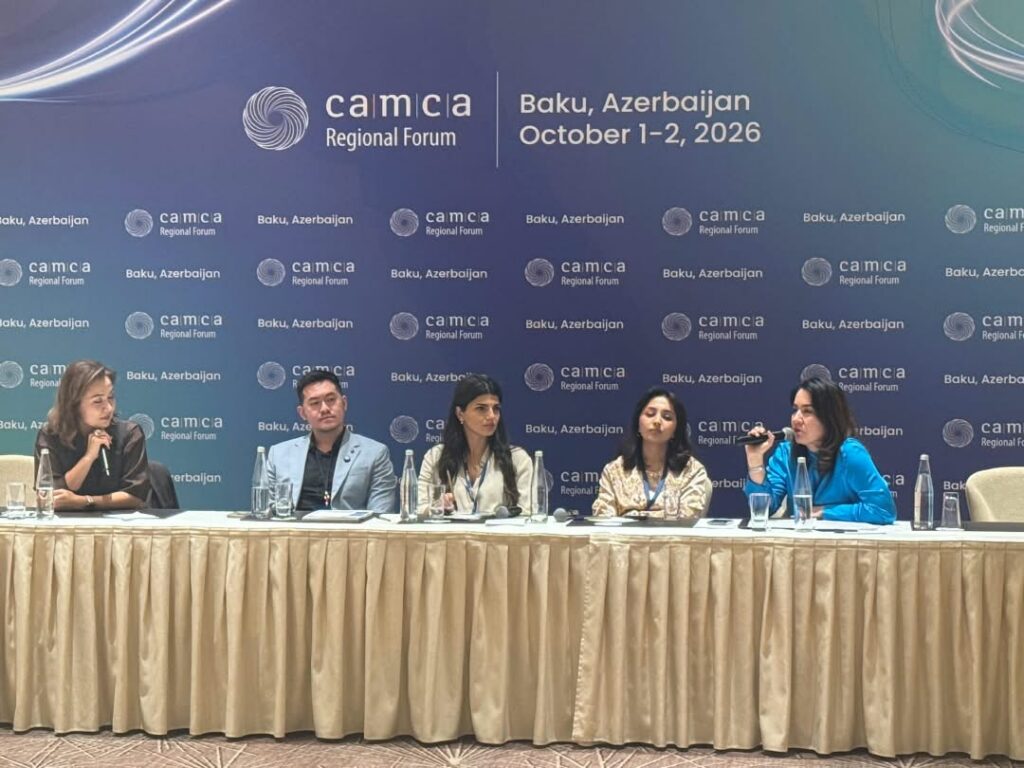
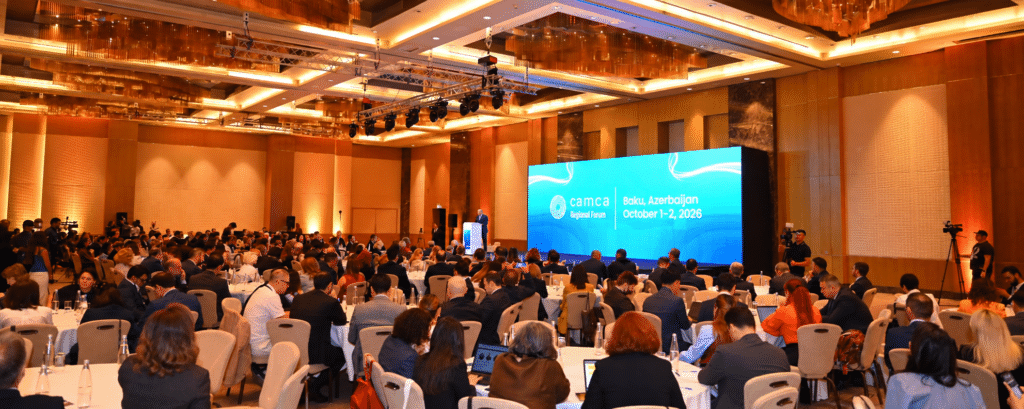
This week in Baku, at the CAMCA Forum 2026, two moments stayed with me. The first was a conversation on stage with investor Lucy Chow about what it means to back the future when artificial intelligence is rewriting the rules of business. The second happened a day earlier, quietly, at a signing table.
The CAMCA network signed a Memorandum of Understanding with YEGAP, the Young Entrepreneurs Group of Asia Pacific. Mr. Hiromi Aoki travelled from Japan to be with us. The purpose is simple to state and hard to do: build a lasting bridge between the founders of Central Asia, Mongolia, the Caucasus and Afghanistan and their peers across Asia-Pacific.
Those two moments are connected. The more powerful technology becomes, the more the advantage shifts to people who are connected to other people.
What “backing the future” means now
I opened our session by asking Lucy what “backing the future” means to her. We spent the next hour testing that phrase against the realities of AI: what is truly different about this wave, where the signal ends and the hype begins, and where entrepreneurs still have room when so much capital flows to a handful of AI giants.
The answer that emerged was reassuring. AI changes the tools, the speed and the cost of building a company. It does not change what makes a company worth backing: a visionary founder, a real problem, a great solution, a customer who will pay to solve it, and a team that can execute and adapt.
What AI does change is the bar. When anyone can build a prototype in a weekend, a prototype is no longer proof. The proof is distribution, domain knowledge and trust with customers. Those are exactly the things the world’s largest AI labs cannot buy in Almaty, Tashkent, Ulaanbaatar or Baku.
That is where the space for our entrepreneurs lies. Not in competing to build the biggest foundation models, but in applying AI to the industries we know better than anyone: agriculture and herding, logistics along new trade corridors, remittances and financial inclusion, energy, health, education and natural resources. The main focus should be to really focus on our uniqueness and take that to the world and showcase our local identity.
Investors back people, and people are shaped by their networks
When technology moves this fast, how do you judge a founder? The qualities we discussed are not new: resilience, curiosity, honesty about what is not working, and the speed to learn and change course. What is new is how quickly those qualities are tested. A founder today may need to rebuild a product three times in the time it once took to build it once.
One quality matters more than it used to: the ability to learn from others. No founder can track every model, regulation and market alone. The ones who move fastest are surrounded by peers a few steps ahead of them, who will pick up the phone and say, “we tried that, here is what happened.”
This is why networks are not a soft extra for entrepreneurs. They are a competitive advantage. An introduction can save a year. A peer who has already entered a market can save a fortune. A mentor who has failed before can save a company.
A bridge between CAMCA and Asia-Pacific
The CAMCA region sits at the crossroads of Eurasia, yet our founders are often better connected to Moscow, Istanbul or Dubai than to Seoul, Tokyo, Singapore or Jakarta. Meanwhile, Asia-Pacific holds much of the world’s manufacturing, consumer demand and technology talent. The two regions have a great deal to offer each other and too few direct relationships.
The MoU between CAMCA and YEGAP is designed to change that. Together we intend to:
- Connect young entrepreneurs across both regions through exchanges, delegations and joint events
- Open doors to markets, distributors and partners that are hard to reach from a distance
- Share know-how on scaling, fundraising and adopting AI responsibly
- Create introductions to investors who understand both regions
Mr. Aoki’s journey from Japan to Baku was itself a signal. Bridges are not built by documents. They are built by people who show up, again and again, until strangers become partners.
Per Mr Aoki : “Trust comes before any kind of transaction, especially in business. And when it comes to international business, friendship truly matters, because strong partnerships can only be built on a foundation of trust.
I strongly believe that the MOU between CAMCA and YEGAP will become an important bridge connecting Central Asia and the Asia-Pacific region for many years to come. I would also like to express my sincere gratitude to the invaluable member, Ms Khulan, who brought us together and made this partnership possible”
What I have learned building across borders from Mongolia
I write this as a founder, not only as a forum organiser. With Lhamour, I built a natural skincare brand rooted in Mongolia’s nomadic traditions and landscape. Taking it beyond Mongolia has taught me that a good product is only the beginning. You need people on the ground who understand the customer, the channels and the unwritten rules.
Through Advance Credit, which works in the remittance corridor between Australia and Mongolia, I have seen the same truth from another angle. Behind every cross-border transfer is a family, and behind every working corridor are relationships between regulators, partners and communities in two countries.
In both businesses, the breakthroughs rarely came from a cold email. They came from a conversation at a forum, an introduction from a fellow founder, or a peer who shared a contract template and saved me months. Our region is small in population but large in geography. Connection is how we make up the distance.
No founder left behind
One of the most important questions we discussed was how to make sure women and underrepresented founders are not left further behind. Globally, women-led startups still receive a small fraction of venture capital. AI could widen that gap, because capital and talent tend to follow existing networks, and those networks were not built with everyone in mind.
The answer is to build new networks deliberately. That means women investing in women, and men opening their own networks to founders who do not look like them. It means mentorship that leads to real introductions, not only advice. It means designing events, programmes and funds so that a mother running a business from Ulaanbaatar, or a young founder from a rural district, can participate as fully as someone in a capital city.
AI can help here too. It lowers the cost of building, translating, marketing and accessing knowledge. Used well, it can give a solo founder the capacity of a small team. But tools alone do not open doors. People do.
What entrepreneurs in our region should do now
We closed our session by asking what people in Baku, and across the region, should be paying attention to. Here is my own answer, shaped by that conversation and by the week:
- Solve local problems with global tools. Use AI to serve the industries and customers you understand best. Local knowledge is your moat.
- Think regional from day one. The market of one country is small. A market across CAMCA, connected to Asia-Pacific, is not.
- Invest in relationships before you need them. Go to the forum. Follow up after it. Introduce two people who should know each other.
- Give back as you grow. Mentor, angel invest, share what you learned. Every founder who helps another makes the whole ecosystem stronger.
- Open the circle wider. Make room for women, young founders and those outside the capitals. The next great company may come from where we least expect it.
AI will reshape many things, but it will not replace the moment when one entrepreneur trusts another enough to say, “let’s build this together.” The CAMCA–YEGAP bridge is our invitation to have more of those moments. I hope founders across both regions will walk across it with us.
The views expressed in this article are those of the author and do not necessarily reflect the official policy or position of the publication, its affiliates, or any other organizations mentioned.