Tajikistan has added two groups of archaeological sites to UNESCO’s World Heritage Tentative List: Paleolithic sites in southern Tajikistan documenting early human occupation, and petroglyph complexes in the high-altitude Pamirs. Tajik authorities announced the additions on September 21, although both entries were submitted to UNESCO on June 19, 2026.
The first group comprises Kuldara, Lohuti, Obi Mazor, and Khonakho in the Khovaling district of southern Tajikistan’s Khatlon region. UNESCO describes the archaeological complex as one of the most significant Paleolithic heritage areas in Central Asia. The sites provide evidence of early human occupation and adaptation to mountainous and semi-arid environments and help researchers study the dispersal of early human populations across Eurasia.
Kuldara is particularly significant. According to UNESCO, the site preserves cultural layers dating to the Lower and Middle Paleolithic periods and has yielded numerous stone tools. Together with the neighboring sites, the complex documents different stages of early human history and changes in stone-tool technology.
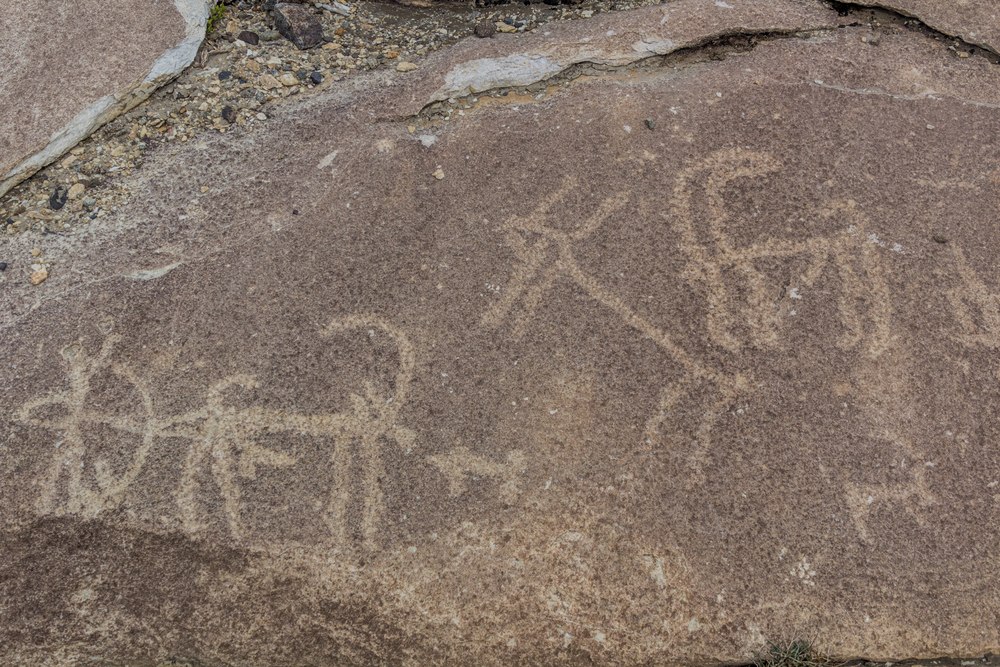
The second group lies nearly at the opposite end of the country, in the Gorno-Badakhshan Autonomous Region (GBAO), which covers much of eastern Tajikistan and the Pamirs. The nomination includes five petroglyph complexes: Langar, Darshair, Shakhta, Nayzatash, and Bakhmaljilga.
The rock carvings were created over thousands of years, from the Mesolithic and Neolithic periods through the Bronze and Iron Ages and into the medieval period. They depict ibex, argali sheep, deer and predators, as well as human figures, hunting scenes, symbolic compositions, and geometric motifs.
The hunting scenes and other images give archaeologists a record of life in high-mountain communities. They also document cultural contacts in the Pamirs, a region that has long stood at a crossroads between Central, South, and East Asia and the Iranian cultural sphere.
UNESCO’s Tentative List is an inventory of properties a country intends to consider for future nomination. A property must first appear on that list before the country can formally nominate it for World Heritage status.
With the two additions, Tajikistan now has 18 properties on its Tentative List. Five properties in the country are already inscribed on UNESCO’s World Heritage List. They include Sarazm, a settlement dating from the fourth to the third millennium BCE near Panjakent; the Cultural Heritage Sites of Ancient Khuttal in southern Tajikistan; and Tajik National Park, which encompasses a vast area of the Pamir Mountains.
Archaeological finds in southern Tajikistan include a royal seal from the Kushan period. Around two millennia ago, the Kushan Empire extended across parts of present-day Central Asia, Afghanistan, Pakistan, and northern India.