Governments in Central Asia have not made any public comment, so far, on the U.S. military operation that captured Venezuelan President Nicolás Maduro, at a time when relations between Central Asian countries and the administration of President Donald Trump are growing closer.
The operation on Saturday involved more than 150 American aircraft and extracted Maduro and his wife, Cilia Flores, from their compound in Caracas, prompting celebrations from many Venezuelan expatriates who viewed Maduro as a dictator, criticism from countries including Russia and China, and concerns that the complex attack violated international law.
Additional questions about Venezuela’s sovereignty emerged after Trump said the United States will “run” the country ahead of a transition and that American oil companies will help to rebuild its oil infrastructure. The U.S. has argued that Maduro himself effectively hijacked Venezuelan sovereignty through electoral fraud, repression and by allegedly funneling illegal drugs to the U.S. Maduro, who has been indicted on narco-terrorism and other charges, denies the allegations.
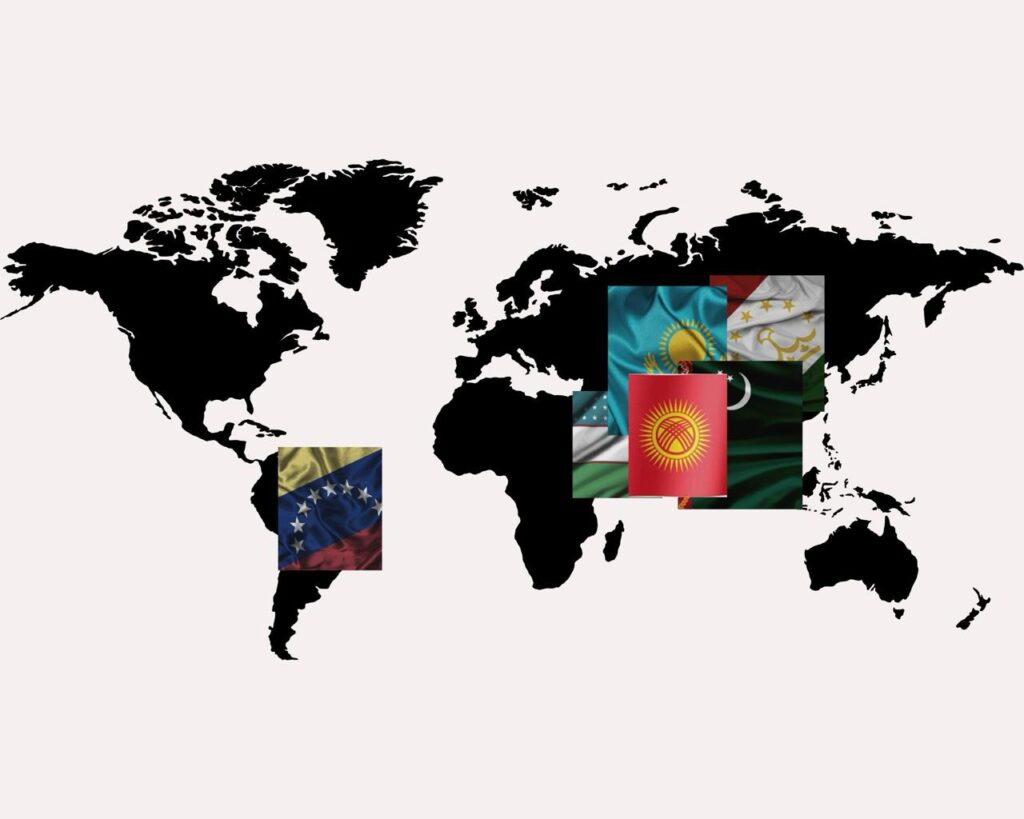
Countries in Central Asia are more than 10,000 kilometers away from Venezuela and their trade with the Latin American country is minimal, suggesting the uncertain and evolving situation there lies far outside their immediate area of interest. In May, Tokayev met Maduro in Moscow and invited him to visit Kazakhstan after describing Venezuela as an important partner.
“However, he acknowledged that, due to objective reasons, significant achievements in bilateral cooperation have yet to be realized,” Tokayev’s office said at the time.
Still, Tokayev and other Central Asian leaders have spoken in general terms of their adherence to United Nations principles of sovereignty, an issue that is being vigorously debated in some international circles after the U.S. military operation. U.N. Secretary-General António Guterres, who visited Central Asia in 2024 and 2025, has said that the U.S. military operation that extracted Maduro to New York constitutes a “dangerous precedent” and that he was concerned that the rules of international law had not been respected.
The U.S. capture of the leader of oil-rich Venezuela has not had a major impact for now on global oil prices, indicating that Central Asia’s oil and natural gas producers will not see any big fallout. Even so, at a time of ongoing geopolitical tension, a major shock or event in one region could influence distant regions in ways that are difficult to discern.
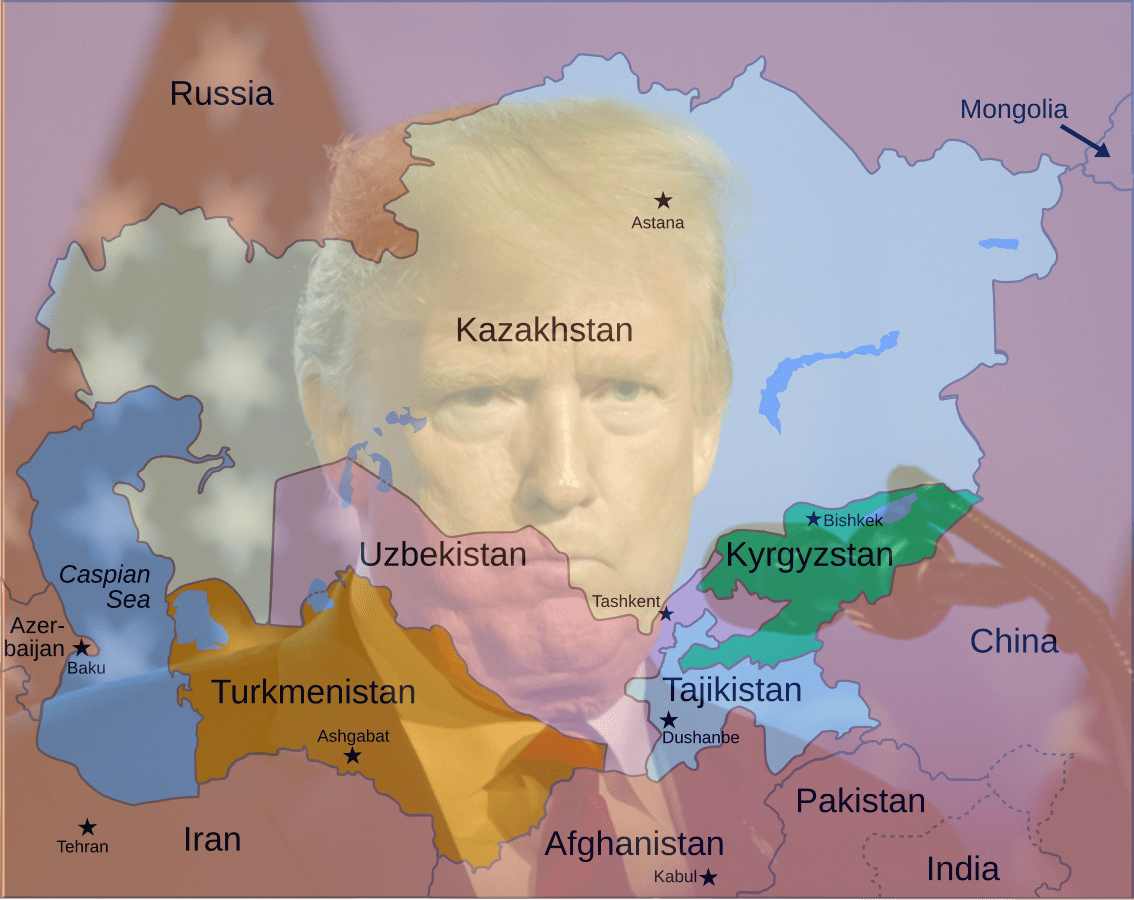
Russia and China, which are close trading partners with Central Asia and nurtured trade and political ties with Maduro’s government, condemned the U.S. military operation in Venezuela. But the Central Asian countries – Kazakhstan, Uzbekistan, Kyrgyzstan, Tajikistan and Turkmenistan – have not joined in the criticism, much as they have refrained from publicly supporting any side over Russia’s invasion of Ukraine.
Central Asia’s balancing act reflects efforts to maintain good ties with major powers even when they are in conflict, and comes during a period of increasing trade collaboration with the United States. The five leaders from Central Asia traveled to Washington in November for a summit with Trump, who later invited Tokayev and President Shavkat Mirziyoyev of Uzbekistan to the G20 summit, which the U.S. plans to hold in Miami in 2026.
Central Asian media are reporting Maduro’s capture, and regional governments could still comment once circumstances surrounding U.S. intentions in Venezuela become clearer.