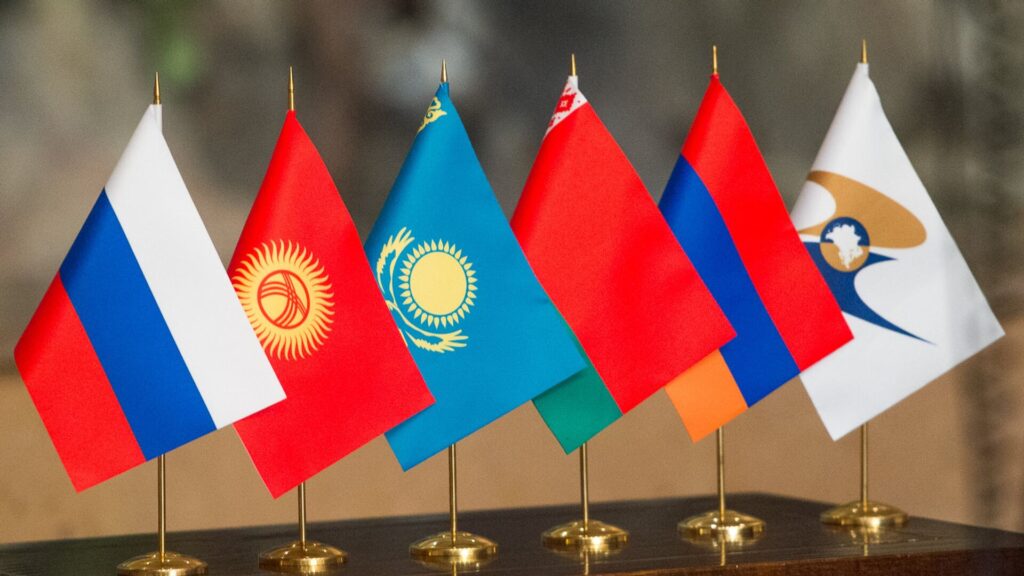
The leaders of the Eurasian Economic Union (EAEU) gathered on December 21 at the Yeltsin Presidential Library in St. Petersburg, Russia, to assess the bloc’s progress and outline future integration priorities. The summit was attended by the leaders of EAEU member states, President of Russia, Vladimir Putin, President of Belarus, Aleksandr Lukashenko, Prime Minister of Armenia, Nikol Pashinyan, President of Kazakhstan, Kassym-Jomart Tokayev, President of Kyrgyzstan, Sadyr Zhaparov, and Chairman of the Board of the Eurasian Economic Commission, Bakytzhan Sagintayev. In an expanded format, representatives of Uzbekistan, Indonesia, Iran, and Cuba also participated.
The meeting took place against the backdrop of continued global economic fragmentation, as the EAEU looks to position itself as a stable integration platform within an increasingly multipolar economic order.

Image: Akorda
Opening the meeting, Vladimir Putin proposed a year-end review and highlighted key decisions aimed at deepening cooperation. He stated that the EAEU has solidified its position as an independent and self-sufficient center within the evolving multipolar world. Putin pointed to rising combined GDP figures and noted that EAEU membership has contributed to economic stability and improved living standards across member states. These assessments framed the EAEU not only as a regional trade bloc but as a long-term economic center adapting to shifting global alignments.

Image: Akorda
Putin also cited progress in building the union’s payment infrastructure, removing trade barriers, and enhancing transport connectivity. Among individual economies, Kyrgyzstan stood out with a GDP growth rate of around 10%. Much of the focus, however, remained on translating macroeconomic gains into deeper market integration across energy, finance, and logistics.
Belarusian President Alexander Lukashenko, addressing the summit as chair of the EAEU, called for renewed approaches to economic engagement with third countries over the next five years. He endorsed deeper ties with what he termed the “global majority,” while acknowledging existing challenges, such as delays in establishing unified energy markets and hesitancy among member states to form a common financial market. Nonetheless, he described the Union State of Russia and Belarus as the “locomotive of integration” in the post-Soviet region. The discussion highlighted a recurring tension for the bloc: expanding external partnerships while still completing core internal market harmonization.

Image: Akorda
Kazakh President Kassym-Jomart Tokayev emphasized the EAEU’s milestone year as it entered its second decade. He projected a 2% increase in the union’s combined GDP in 2025 and noted that intra-union direct investment had surpassed $20 billion. Kazakhstan alone saw a nearly sevenfold increase in EAEU-related investment from $600 million in 2015 to $4 billion in 2024.

Image: Akorda
Tokayev also proposed the systematic integration of artificial intelligence technologies into EAEU operations, from trade forecasting to customs duties assessment. He highlighted the union’s potential as a global transport and logistics hub and advocated for the swift implementation of the Caspian Sea shipping agreement.
Uzbek President Shavkat Mirziyoyev noted that Uzbekistan’s trade with EAEU countries had nearly doubled to $20 billion over its four years of observer status. He called for the phased removal of trade barriers and suggested creating a joint Uzbekistan-EAEU coordination group to address tariff and non-tariff restrictions.
Uzbekistan’s engagement, alongside other observer states and partners, underscored the EAEU’s effort to broaden its reach beyond its original framework. Officials emphasized practical cooperation as a pathway toward gradual market alignment.

Image: Akorda
Kyrgyz President Sadyr Japarov reported that intra-EAEU trade had approached $100 billion in 2025, describing this as a reflection of “trust and genuine interest” among member states. He highlighted a GDP growth rate of 10.2% for Kyrgyzstan over the first eleven months of the year and reaffirmed the country’s focus on food and energy security.

Image: Akorda
The leaders agreed that the pace at which agreed measures are implemented will be critical to maintaining momentum in the Union’s second decade. As the EAEU moves from agenda-setting to execution, the credibility of the bloc will increasingly be judged not by the scale of its ambitions, but by the speed and consistency with which agreed mechanisms are translated into functioning common markets. Kazakhstan will assume the EAEU chairmanship in 2026. The next summit of the Supreme Eurasian Economic Council is scheduled for May 28-29 in Astana.