Kazakhstan and Kyrgyzstan have given differing accounts of what triggered the August 14 blackout that cut electricity across swathes of Central Asia. Three days later, the initiating event remains unresolved, and the times released by the two sides do not fit neatly into the same sequence.
Kazakhstan’s national grid operator KEGOC says two hydrogenerators at Kyrgyzstan’s Toktogul Hydropower Plant, with a combined capacity of 600 MW, disconnected at 2:37 p.m. Kazakhstan time. KEGOC said the sudden loss of generation overloaded the North-East-South transit corridor, separating southern Kazakhstan from the rest of the national grid and the interconnected systems of Kyrgyzstan, Uzbekistan, and Tajikistan. A special commission is investigating the causes.
Meanwhile, Kyrgyzstan’s National Electric Grid has given a different chronology. It said that at 3:34 p.m. Kyrgyzstan time, an external disconnection occurred on a high-voltage line linking the northern and southern parts of Kazakhstan’s power system. The Central Asian network then split into an isolated section, and Kyrgyzstan temporarily operated separately while automatic protection systems worked to protect equipment.
The one-hour difference between the countries’ clocks makes the discrepancy clearer. Kazakhstan has used UTC+5 nationwide since 2024, while Kyrgyzstan uses UTC+6. That puts Kyrgyzstan’s reported line disconnection at 2:34 p.m. Kazakhstan time, three minutes before KEGOC’s stated 2:37 p.m. Toktogul shutdown. The two times may describe different stages of a fast-moving cascade, but they do not establish the same starting point.
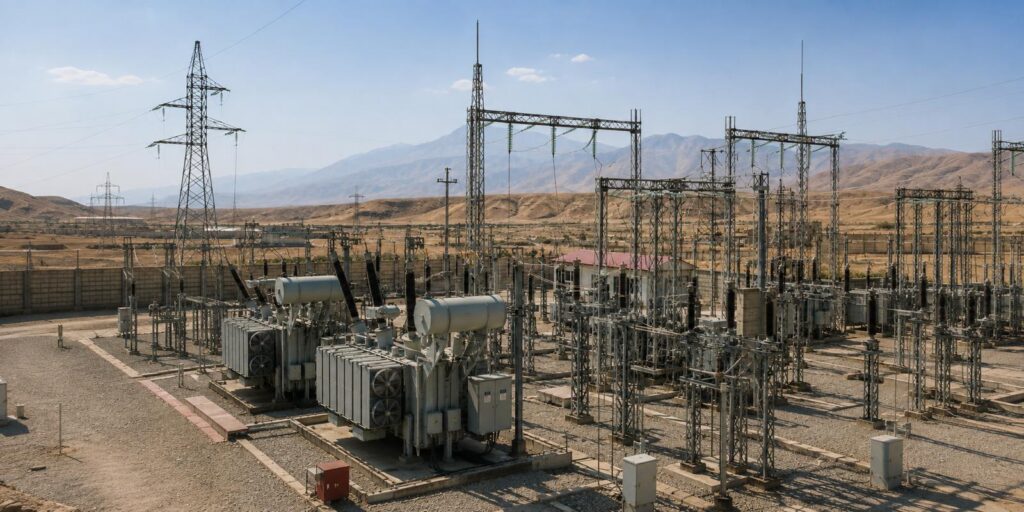
A third timestamp complicates the sequence. Alatau Zharyq Company said three 500 kV KEGOC transmission lines shut down at 2:38 p.m., and that those lines triggered automatic load-shedding and frequency protection in Almaty and the surrounding region. Taken together, the public statements leave a sequence of 2:34 p.m., 2:37 p.m., and 2:38 p.m. that investigators will need to reconcile.
TCA reporters in Almaty and Bishkek experienced power cuts, while local media reported outages in Dushanbe, Khujand, and southern parts of Uzbekistan.
In Kazakhstan, the disturbance affected consumers in the Zhambyl, Turkistan, Kyzylorda, Zhetysu, and Almaty regions, with further restrictions in Karaganda, Ulytau, and Abai. KEGOC said supplies were restored across the affected regions later that afternoon.
The four-country impact reflects how tightly the systems are connected. Kazakhstan, Kyrgyzstan, Tajikistan, and Uzbekistan operate in parallel through the Central Asian power system. Cross-border links allow operators to share electricity and reserve capacity, but also mean that a sudden loss of generation or a major transmission line can be felt beyond one national grid before protection systems isolate the disturbance.
Central Asia has been here before. In January 2022, a major blackout hit southern Kazakhstan, Kyrgyzstan, and Uzbekistan. The event also involved a sharp imbalance on the regional network and the separation of Kazakhstan’s northern and southern grids. Its precise starting point was disputed in the immediate aftermath.
The regional grid dates to the Soviet period. Uzbekistan later withdrew from the old electricity ring, leaving Tajikistan largely isolated for years. Regional links have since been rebuilt; Tajikistan began reconnecting to the unified system in 2024. An Asian Development Bank project is adding a 22-kilometer, 500 kV line between the Sughd substation in northern Tajikistan and New Syrdarya in Uzbekistan to strengthen cross-border capacity.
The push for integration is now much stronger. In January, the World Bank approved the ten-year Regional Electricity Market Interconnectivity and Trade program, or REMIT, intended to create Central Asia’s first formal regional electricity market. The World Bank puts total indicative financing at $1.018 billion over three phases. Cross-border electricity trade currently amounts to about 3% of regional demand. By the end of the program, the bank wants annual trade to reach at least 15,000 GWh and transmission capacity to more than triple to 16 GW.
That expansion is being planned while electricity use is rising sharply. A recent Times of Central Asia analysis of summer demand found that Uzbekistan’s system reached a record load of 14.2 GW on July 20, while Kyrgyzstan recorded an 18% year-on-year rise in consumption on July 19. Almaty also experienced local network faults during extreme heat.
No operator has linked the August 14 failure directly to heat or record demand, but it came during a summer of sharply rising electricity use, as governments also prepare to move more power across national borders.
Investigators now have to establish which piece of equipment failed first, how the disturbance spread through the interconnected system, and whether protection systems worked as intended.
Central Asia plans to move far more electricity across these borders in the coming decade. The August 14 blackout illustrates how much will depend on coordination between national grid operators as those cross-border flows increase. For now, Astana’s account begins at Toktogul, while Bishkek’s begins on the Kazakh transmission network.