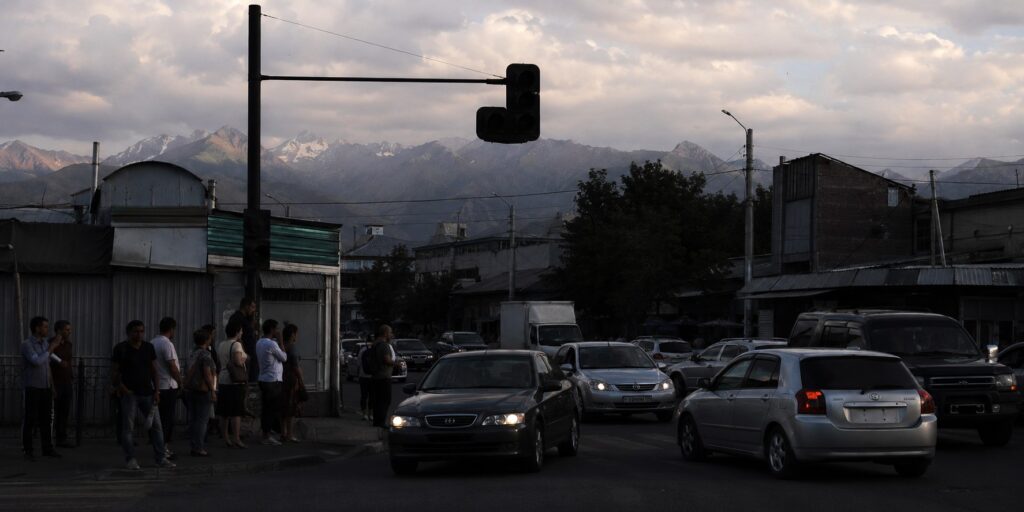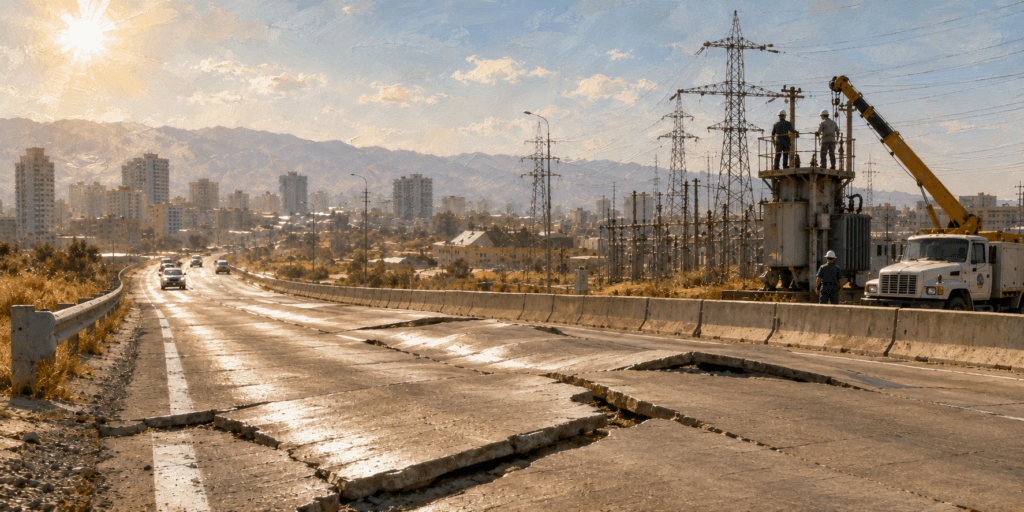
The blame game over Central Asia’s August 14 blackout continues.
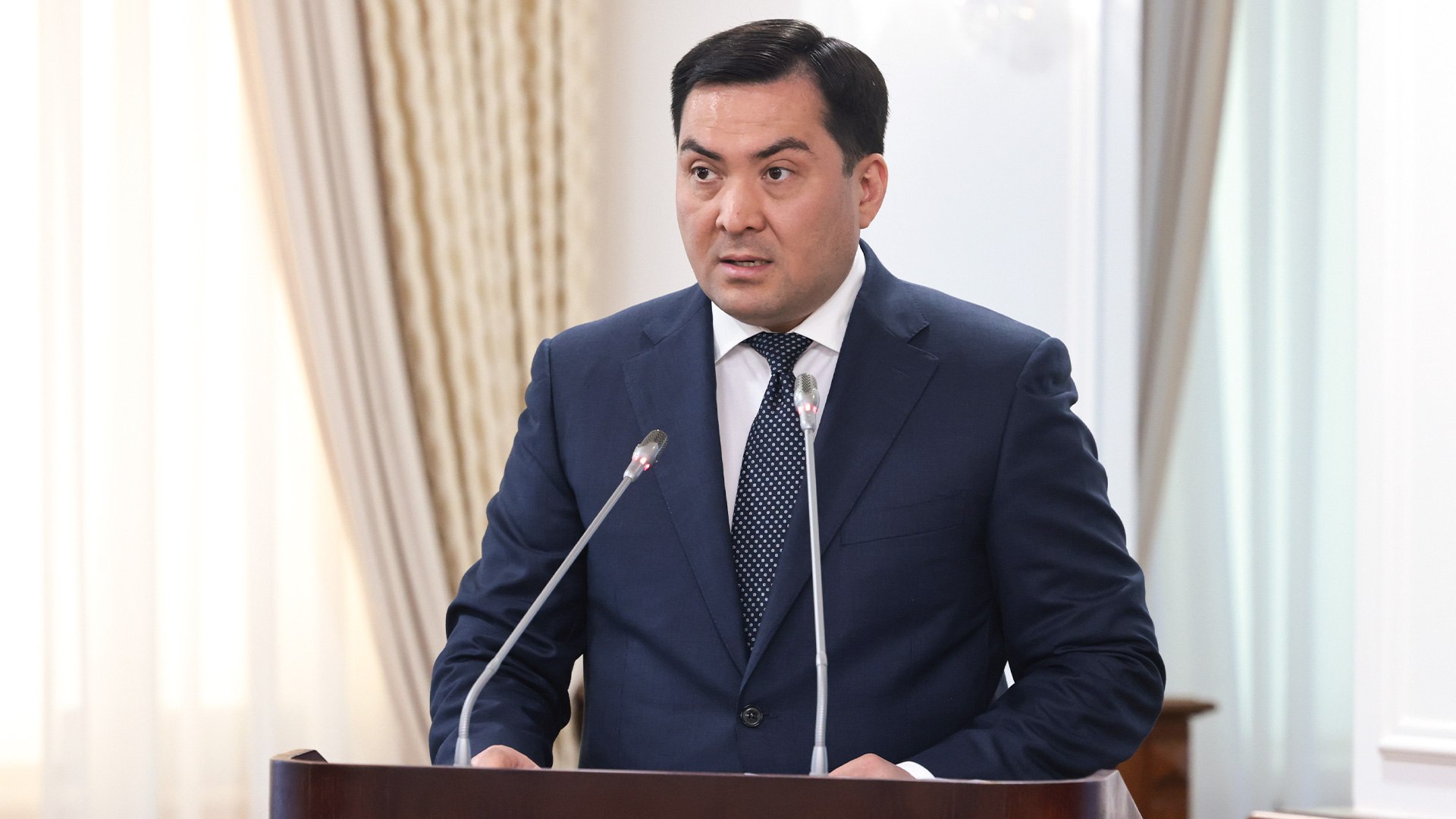
Kazakhstan’s Energy Minister Yerlan Akkenzhenov says the large-scale blackout began with the shutdown of two generating units at the Toktogul Hydroelectric Power Plant (HPP) in Kyrgyzstan. Bishkek does not dispute that the failure occurred but rejects the claim that it was the direct cause of the subsequent outages across several countries.
Akkenzhenov identified the events in Kyrgyzstan as the starting point of the emergency. According to him, the initial disturbance occurred on August 14 at 2:37 p.m. Kazakhstan time, or 3:37 p.m. in Kyrgyzstan, when generating units No. 1 and No. 2 at the Toktogul HPP went offline. The loss of generation altered operating conditions in Central Asia’s interconnected power system and led to a redistribution of power flows in southern Kazakhstan. A government commission in Kazakhstan is expected to make the final determination.
Kazakhstan’s grid operator KEGOC had earlier provided a more detailed chronology. At 2:37 p.m., three 500 kV transmission lines tripped, separating southern Kazakhstan and the Central Asian grid from the rest of Kazakhstan’s power system. About 2,810 MW of consumer load was temporarily cut off.
KEGOC later said that immediately beforehand, two generating units at the Toktogul HPP, with a combined capacity of about 600 MW, had gone offline. The resulting changes in power flows overloaded Kazakhstan’s North–East–South transmission corridor, triggering emergency protection systems.
Akkenzhenov said the protection systems had worked effectively and praised KEGOC’s response. Kazakhstan’s power system was restored in approximately 2.5 hours.
Kyrgyzstan acknowledges that the two units went offline. The country’s Energy Ministry described the incident as the “initial disturbance” in the interconnected power system, but stressed that the first event in an emergency sequence cannot automatically be considered the cause of all subsequent outages.
According to its account, by 3:55 p.m. Kyrgyzstan time — 2:55 p.m. in Kazakhstan — the frequency in the interconnected power system had returned to the normal 50 Hz. At that point, Kyrgyzstan was also supplying neighboring power systems with about 250 MW.
Bishkek maintains that the outage affecting the Almaty power hub occurred after normal frequency had already been restored. Kyrgyz energy officials therefore consider it premature to directly attribute all subsequent events to the failure at the Toktogul HPP.
The disagreement, therefore, is less about what happened first than about the causal link between the initial failure and the chain of outages that followed.
Why the Regional Grid Is Vulnerable
The vulnerability is rooted in the architecture of the region’s power system itself. During the Soviet period, its power plants and high-voltage transmission lines were designed to operate as a single interconnected system rather than around today’s national borders. Energy ties weakened after the collapse of the Soviet Union, but in recent years the countries have again expanded parallel operation of their power systems.
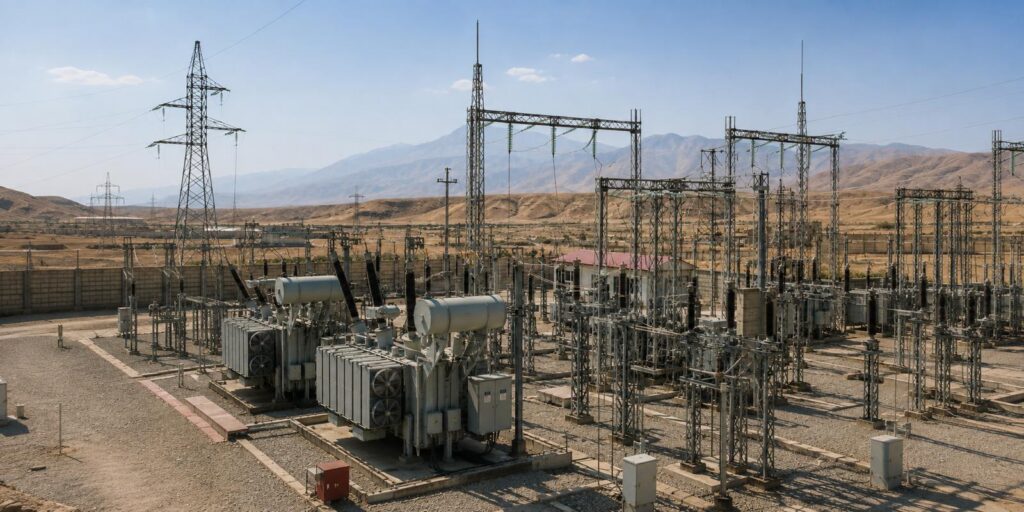
Kazakhstan, Kyrgyzstan, Uzbekistan, and Tajikistan are connected through the Integrated Power System of Central Asia. Cross-border power flows are coordinated by the Energia Coordinating Dispatch Center in Tashkent. Hydropower in Kyrgyzstan and Tajikistan complements the predominantly thermal generation of Kazakhstan and Uzbekistan, allowing the countries to exchange electricity depending on seasonal conditions and demand.
The arrangement has an obvious advantage: a power shortage in one part of the system can be offset by resources elsewhere. But the reverse is also true. A sudden loss of a major source of generation changes power flows throughout the synchronized grid. The events of August 14 provided a practical demonstration of precisely this mechanism.
For Kazakhstan, the geography of its power system adds another complication. The country’s largest coal-fired power plants are concentrated mainly in the north, while the southern zone has substantially less generation than it needs to meet demand.
Electricity therefore has to be transmitted over long distances through several major transmission corridors. One of them, the North–East–South corridor, was at the center of the August 14 disturbance.
Strengthening the Grid
KEGOC is already expanding the southern grid. The company is building the approximately 475-kilometer, 500 kV Shu–Zhambyl–Shymkent transmission line and modernizing three substations. Once the project is completed, transmission capacity on the Almaty–Zhambyl section is expected to increase from about 1,100 MW to 1,500 MW. Completion is scheduled for mid-2027.
Uzbekistan, meanwhile, has rapidly expanded its power sector in recent years, adding solar and wind capacity alongside new thermal generation. In June, it began construction of the first unit at the country’s first nuclear power plant. However, much of its distribution infrastructure predates this expansion.
More than half of the country’s distribution network assets have been in operation for over 30 years, while technical electricity losses stood at around 13% in 2024. The World Bank is financing a program to modernize this infrastructure.
Pressure on the regional system is only expected to increase. Electricity demand in Central Asia could triple by 2050. Cross-border electricity trade currently amounts to only about 3% of regional demand, while solar and wind account for roughly 4% of electricity generation.