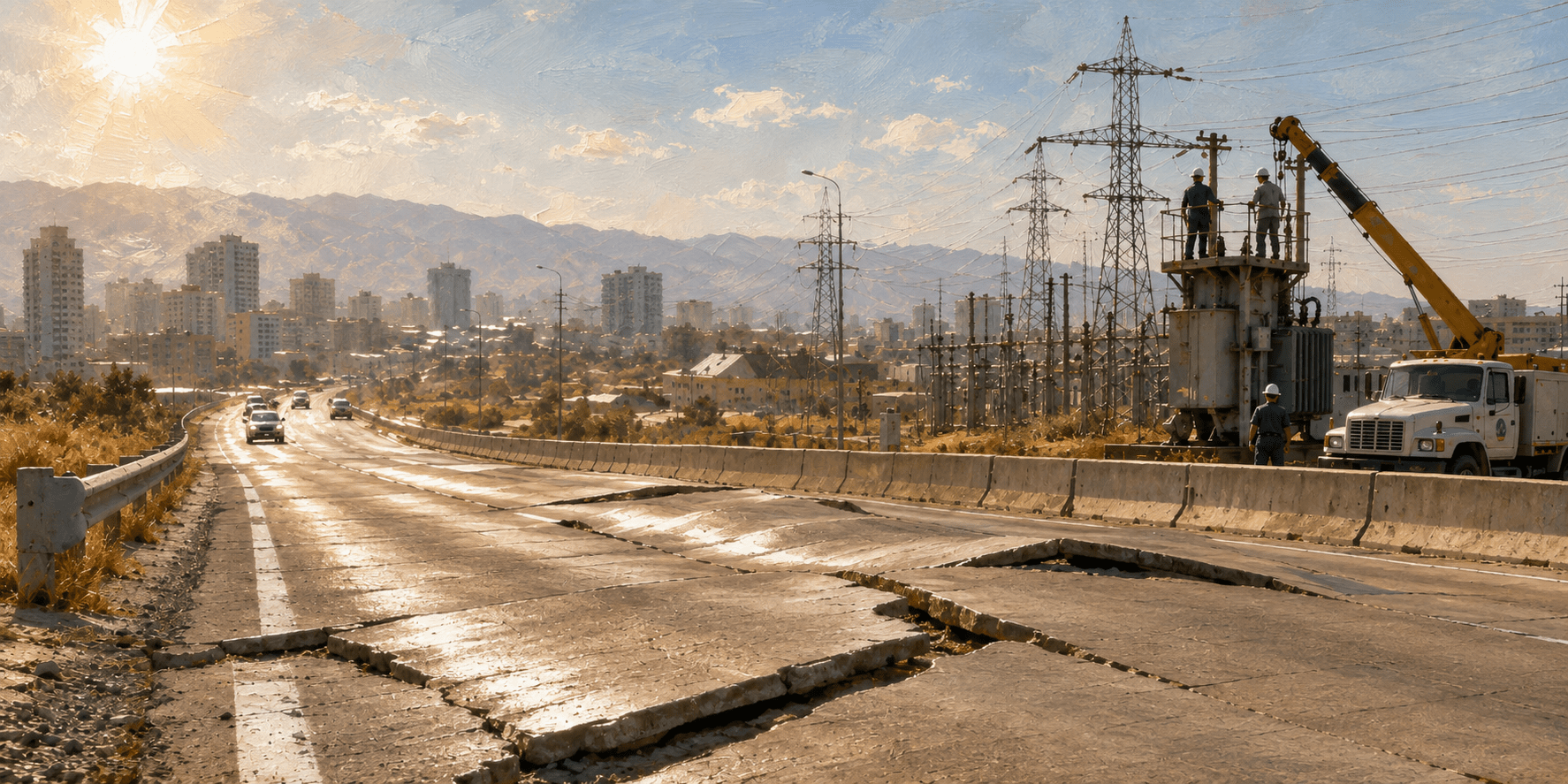
Extreme heat across Central Asia in mid-July has buckled concrete highways, pushed electricity demand to record levels, and increased pressure on power grids and ambulance services. Kazakhstan reported road deformation and repeated failures in Almaty, Uzbekistan set consumption and generation records, Kyrgyzstan introduced temporary cuts to protect equipment, and residents in Tajikistan reported local disruptions.
Temperatures above 40°C are common in parts of the region, but prolonged heat can strain several systems at once. Demand for cooling rises, road surfaces reach damaging temperatures, and health risks increase. The World Bank says much of Central Asia’s infrastructure was built in the mid-20th century and is overdue for renewal.
Kazakhstan’s Roads and Power Networks Struggle
Almaty recorded daily temperature highs on three consecutive days. The temperature reached 38°C on July 16, 39.2°C on July 17, and 40°C on July 18. The city’s July record remains 43.4°C, set in 1983.
The heat also damaged Kazakhstan’s road network. KazAvtoZhol found temperature-related deformation on six highway sections in the Zhambyl, Pavlodar, and Turkestan regions.
The national road operator said concrete surfaces can reach 60 to 70°C, and sometimes higher, during extreme weather. The resulting internal stress can deform concrete slabs. More than 50 workers repaired the affected sections, and traffic continued without restrictions. Road crews were monitoring more than 1,600 kilometers of concrete highway.
Almaty’s ambulance service received more than 33,600 calls during the first two weeks of July. Medical officials said many involved sudden spikes in blood pressure and cardiovascular conditions, including coronary heart disease and acute heart attacks. Stroke patients were taken to hospital.
Officials advised residents to avoid direct sunlight between 11 a.m. and 5 p.m., drink sufficient fluids, and seek medical help if their condition deteriorated.
The city’s electricity network has faced record electricity demand between July 17 and 20 as residents increased their use of air conditioners and other appliances. The Alatau Zharyk Company said technical failures occurred in several districts, sometimes followed by faults on neighboring sections of the network. Thirty-five repair crews were deployed around the clock.
The pressure extended beyond Almaty. Kazakhstan consumed 338.66 million kilowatt-hours of electricity on July 14, while domestic generation totaled 314.27 million kilowatt-hours, according to KOREM electricity data.
Consumption also exceeded generation on each of the previous three days. Kazakhstan has historically covered such shortfalls through electricity imports, principally from Russia.
Record Electricity Demand in Uzbekistan
Uzbekistan’s Ministry of Energy warned on July 13 that daily electricity consumption could reach a summer record of 280 million kilowatt-hours, with peak demand rising to between 13 and 13.3 gigawatts.
Demand subsequently exceeded that forecast. On July 18, consumption reached 294.4 million kilowatt-hours, 8% above the previous summer record. Peak evening demand rose to 13.7 gigawatts.
Power plants produced a record 297.1 million kilowatt-hours on the same day. Despite the increase in production, technical faults caused temporary outages in several districts of Tashkent. At different times, the disruptions affected between several hundred and 2,700 consumers, according to the Ministry of Energy. Supplies were later restored.
Kyrgyzstan Introduces Temporary Outages
Kyrgyzstan also recorded a sharp rise in electricity use. Daily consumption reached approximately 50.1 million kilowatt-hours on July 19, 18% more than on the same date a year earlier, according to the National Electric Grid of Kyrgyzstan.
Temporary outages lasting up to two hours were introduced in parts of Bishkek and the Chuy Region. The grid operator said the restrictions were needed to prevent overloaded equipment from failing and causing more extensive accidents.
Separately, a July 17 power failure affected Bishkek and several regions after two 220-kilovolt transmission lines shut down. An automatic load-shedding system was activated, cutting supplies while engineers worked to restore the network.
The ministry said the cause remained under investigation, so the blackout cannot yet be linked to the heat.
Local Disruptions Reported in Tajikistan
Some of the region’s highest temperatures were recorded in Tajikistan. The temperature reached 46°C in the Shahritus district of the Khatlon Region. Forecasts indicated that temperatures could reach 48°C in Bokhtar and Kulob, while Dushanbe recorded highs of around 43°C on July 17 and 18.
Residents of Dushanbe and other parts of the country reported unannounced local power disruptions. No comprehensive official information was available about their scale or the cause of each incident, and the authorities announced no nationwide restrictions or centralized rolling blackouts. Available reports therefore indicate localized failures rather than a national supply emergency.
Adapting to More Frequent Heat
The mid-July events do not by themselves show that climate change caused this particular heatwave. That conclusion would require a scientific attribution study. They do show how prolonged high temperatures can magnify weaknesses in electricity networks, roads, public services, and urban infrastructure.
The World Bank estimates that the number of hot days in major cities across Europe and Central Asia could more than triple by 2050. Without sufficient adaptation, extreme heat could reduce annual GDP in the region’s cities by an estimated 2.5%.
As The Times of Central Asia previously reported, the risks are particularly serious for Central Asian cities, where extreme heat is already affecting public health, economic output, and infrastructure. The World Bank recommends urban greening, early-warning systems, cooling centers, building retrofits, and heat-tolerant materials.
The July failures cannot be addressed by adding electricity generation alone. Governments also need to modernize transmission and distribution networks, strengthen road standards, protect outdoor workers, and prepare hospitals and emergency services for longer and more intense periods of heat.