The world is once again in a phase of systemic uncertainty. As conflicts proliferate and global governance splits, small and medium states must grapple with the consequences. For Central Asia, these external crises are not distant events; they are transmitted through trade, remittances, energy prices, and diplomatic pressure. But while exposure is unavoidable, dependence is not. The region’s future lies not in aligning with competing hegemons, but in constructing durable institutions of regional cooperation and self-governance.
Over the last two decades, Central Asian countries have existed in a delicate balance. Security guarantees from Russia, infrastructure finance from China, and development assistance from the West provided a measure of stability, but they also bred institutional inertia. Today, that equilibrium is breaking down. Russia is preoccupied and sanctioned. China’s external ambitions are increasingly self-serving. The West is distracted. The resulting vacuum could leave Central Asia either exposed or, more optimistically, empowered to shape its own destiny.
Uzbekistan’s Institutional Recalibration
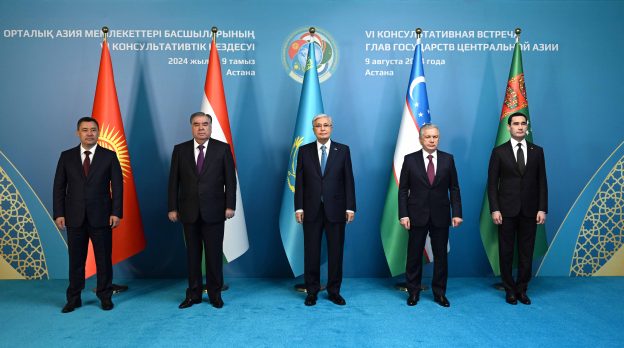
Uzbekistan’s pivot after 2016 was more than a diplomatic rebranding. It marked a nascent effort to build regional institutional trust, which was long absent in Central Asia. For the first time since independence, disputes over borders, transit, and trade were addressed not through coercion or isolation, but negotiation. The Khujand Declaration, signed by Uzbekistan, Kyrgyzstan, and Tajikistan, offered a blueprint for how local capacity, rather than external mediation, can resolve long-standing frictions.
This was a decisive shift from extractive bilateralism to inclusive multilateralism. But diplomatic normalization is only a prelude. The deeper question remains: Can Central Asia institutionalize integration? Can it create shared rules and enforcement mechanisms strong enough to withstand both internal and external shocks?
If Central Asian countries want to succeed, they should invest in four areas of regional institution-building, which will bring collective autonomy to the region.
- Mobility without bureaucracy
Mobility is not just about tourism or convenience; it is about labor markets, political identity, and state capacity. Central Asia must move toward the full elimination of intra-regional visa and registration requirements. A legally binding regional agreement should guarantee the right of all citizens to live, work, and invest across borders without administrative friction.
- Strategic alignment through membership discipline
Membership in multilateral organizations is not costless. It binds countries to external norms and power hierarchies. Uzbekistan’s exit from the CSTO and its calibrated WTO accession strategy demonstrate the value of selectively aligning with institutions that advance national and regional interests. Central Asian countries should have the political will to reconsider all memberships that harm their prosperity. Instead, a coordinated foreign policy doctrine between countries could increase their authority and bargaining power on the global stage.
- Energy security through joint investment and governance
Energy independence is the main concern in Central Asia. Therefore, a Central Asian Energy Association should be established to coordinate grid connectivity, renewable development, and strategic reserves. Collective energy governance would reduce dependency on Russian and Chinese systems, while enabling scale economies in transition technologies.
- Investment in Afghanistan as a regional stability mechanism
The marginalization of Afghanistan has always undermined regional stability. What Central Asia lacks is not capacity, but coordination. A Central Asian Infrastructure and Development Fund should be established to jointly finance roads, electricity, and higher education in Afghanistan, buffering spillovers while building cross-border institutions.
The question is no longer whether Central Asia can integrate; it is whether it can do so before external volatility overwhelms internal capacity. The foundations have been laid. Uzbekistan opened the doors for the unity of Central Asia. Now it is time to act accordingly.
The views expressed in this article are those of the author and do not necessarily reflect the official policy or position of the publication, its affiliates, or any other organizations mentioned.