• KGS/USD = 0.01144 0%
  • KZT/USD = 0.00193 -0%
  • TJS/USD = 0.10811 -0.28%
  • UZS/USD = 0.00008 0%
  • TMT/USD = 0.28490 0%
  • KGS/USD = 0.01144 0%
  • KZT/USD = 0.00193 -0%
  • TJS/USD = 0.10811 -0.28%
  • UZS/USD = 0.00008 0%
  • TMT/USD = 0.28490 0%
  • KGS/USD = 0.01144 0%
  • KZT/USD = 0.00193 -0%
  • TJS/USD = 0.10811 -0.28%
  • UZS/USD = 0.00008 0%
  • TMT/USD = 0.28490 0%
  • KGS/USD = 0.01144 0%
  • KZT/USD = 0.00193 -0%
  • TJS/USD = 0.10811 -0.28%
  • UZS/USD = 0.00008 0%
  • TMT/USD = 0.28490 0%
  • KGS/USD = 0.01144 0%
  • KZT/USD = 0.00193 -0%
  • TJS/USD = 0.10811 -0.28%
  • UZS/USD = 0.00008 0%
  • TMT/USD = 0.28490 0%
  • KGS/USD = 0.01144 0%
  • KZT/USD = 0.00193 -0%
  • TJS/USD = 0.10811 -0.28%
  • UZS/USD = 0.00008 0%
  • TMT/USD = 0.28490 0%
  • KGS/USD = 0.01144 0%
  • KZT/USD = 0.00193 -0%
  • TJS/USD = 0.10811 -0.28%
  • UZS/USD = 0.00008 0%
  • TMT/USD = 0.28490 0%
  • KGS/USD = 0.01144 0%
  • KZT/USD = 0.00193 -0%
  • TJS/USD = 0.10811 -0.28%
  • UZS/USD = 0.00008 0%
  • TMT/USD = 0.28490 0%
10 December 2025

How Climbers Die: The Tragedy of Natalya Nagovitsyna and the Perils of the Peaks

Professional climbers have all but given up hope for Russian mountaineer Natalya Nagovitsyna, who remains stranded on Pobeda Peak (Victory Peak) in the Tien Shan mountains of Kyrgyzstan. No successful evacuation has been recorded from this treacherous summit since 1955. Still, Nagovitsyna’s son continues to hold out hope, citing drone footage taken last week that appeared to show her waving from her tent and still in good spirits. However, on August 27, a military drone captured thermal imaging of conditions on Pobeda Peak, showing no signs of life in Nagovitsyna’s tent, as confirmed in imagery published on the official website of Kyrgyzstan’s State Committee for National Security (GKNB).

Officially Declared Lost

Russian Investigative Committee Chairman Alexander Bastrykin has ordered his office to coordinate with the Ministry of Emergency Situations and submit an operational report regarding Nagovitsyna’s case.

However, rescue services have already called off search operations and dismantled the base camp at Pobeda Peak. Alexander Yakovenko, head of the classical mountaineering commission of the Russian Mountaineering Federation, stated:

“In reality, there’s no one left to rescue; we can only speak of a body recovery. The climbing season at Victory Peak has ended, and the base camp has been removed.”

Yakovenko emphasized that Pobeda Peak is one of the most difficult and dangerous mountains for rescue operations. Since the 1960s, many bodies have been left behind, unreachable due to extreme weather and inaccessible terrain.

A Mountain That Does Not Forgive

Veteran Russian climber Alexander Shcherbashin recently told reporters that a rescue mission for Nagovitsyna would be logistically impossible.

“In my view, survival is unlikely. The ridge is long, and evacuating someone from there typically requires between 8 and 18 people, under varying conditions,” he said.

Another experienced mountaineer, Alexander Kirikov, described Pobeda Peak as “a mountain that does not forgive mistakes.”

“There are fatal accidents there nearly every year, going back to the late 1950s. I estimate the mountain has claimed over 150 lives,” he noted.

Death in the Mountains

Mountaineering remains one of the world’s most dangerous sports. On average, 24 out of every 10,000 climbers die annually. Hundreds perish each year in mountain accidents.

The highest-risk peaks are the so-called eight-thousanders. Everest (Jomolungma), while the most fatal in absolute numbers, owes its toll to the sheer volume of climbers. The deadliest is Annapurna I in the Himalayas, where the fatality rate approaches 50%. Other notorious peaks include K2 (Chogori, “Savage Mountain”) and Nanga Parbat, dubbed “the man-eater.”

The former Soviet Union has no eight-thousanders, but Pobeda Peak is widely recognized as its most dangerous seven-thousander. It was here that Natalya Nagovitsyna’s story unfolded.

Tragedy has struck her family before. In 2021, just 16 kilometers away on nearby Khan Tengri, Nagovitsyna’s husband died in her arms after suffering a stroke during their ascent.

As her case unfolded this summer, another Russian climber, Alexey Ermakov, died on Khan Tengri.

“We passed him on the route; he was climbing up as we were descending,” said Alexey Trubachev, a mountain guide and founder of MCS AlexClimb. “Three Iranian climbers are also still missing”.

A Pattern of Loss

Earlier, in February 2024, solo climber Evgeny Glazunov died during an expedition on Mount Aksu in Kyrgyzstan. After turning back due to bad weather, he lost contact and was later found dead, believed to have been caught in a rockfall during his descent.

In a devastating incident on August 5, 2004, an avalanche on Khan Tengri killed 11 climbers from Russia, Ukraine, and the Czech Republic.

On July 29, 2015, three Russian climbers, Pavel Markovskikh, Ilya Poselyanichev, and Sergei Shpiz, died during a night descent from a 4,810-meter peak in Kyrgyzstan’s Karavshin Gorge. Their bodies were recovered on July 31. Investigators concluded that technical errors during the descent contributed to the tragedy.

A Final Reminder

These repeated tragedies underscore a painful truth known all too well in the mountaineering world: the mountains do not forgive. At best, mistakes cost health. More often, they cost lives. The unresolved fate of Natalya Nagovitsyna is a solemn reminder of this harsh reality.

Uncategorized

Ilyas Khrapunov Found in Contempt by U.S. Federal Court

The U.S. District Court for the Southern District of New York has ruled in favor of the city of Almaty and BTA Bank, finding Ilyas Khrapunov guilty of contempt of court.

New Verdict in Ongoing Legal Battle

Federal Judge John G. Koeltl ruled that Khrapunov had violated a prior court order requiring him to report regularly on his assets. He had previously been ordered to pay $221,285.31 in sanctions. “After an independent review, the Court adopts the Magistrate Judge’s findings, which are well-founded and support a finding of civil contempt,” the judge’s statement reads. “Although Khrapunov has demonstrated an inability to pay the $221,285.31 judgment against him at this time, Khrapunov has failed to comply with the clear and unambiguous court order to submit quarterly declarations regarding his financial status.”

The latest ruling reaffirms Khrapunov’s obligation to fully disclose assets and make efforts to satisfy court judgments. It also includes provisions for further financial penalties in the event of non-compliance. Additionally, Khrapunov has been ordered to reimburse Almaty and BTA Bank for legal costs arising from his misconduct.

A Central Figure in Corruption Scandals

Ilyas Khrapunov is the son of former Almaty mayor Viktor Khrapunov and the son-in-law of fugitive banker Mukhtar Ablyazov, figures long entangled in corruption investigations. The Kazakh authorities have accused members of both families of large-scale embezzlement and money laundering.

Viktor Khrapunov fled Kazakhstan in 2008 and has resided in Switzerland ever since. He was sentenced in absentia in 2018 to 17 years in prison for corruption-related offenses, a judgment he disputes. Ilyas Khrapunov also left Kazakhstan shortly beforehand.

Almaty and BTA Bank continue to pursue legal action in U.S. and European courts, alleging that Ablyazov and his associates siphoned billions of dollars through offshore entities. Investigators assert that Khrapunov Jr. played a direct role in the schemes.

Pattern of Legal Violations

In December 2022, the Southern District Court in New York ruled against Ablyazov and his associates in the amount of $218 million. In June 2024, the U.S. District Court for the Southern District of New York awarded over $32 million in damages to BTA Bank and the City of Almaty, following a jury verdict against Khrapunov and Ablyazov’s associates, Felix Sater, Bayrock Group Inc., Global Habitat Solutions, and MeM Energy Partners LLC. The jury found the defendants liable for misappropriation of property, unjust enrichment, and money had and received, affirming fraud and money laundering schemes impacting Kazakh institutions.

The plaintiffs estimated the total damage caused by Viktor Khrapunov and his wife, Leila, at over $300 million, including stalled development of city land and the “alienation of properties.”

In a related case, in September 2018, a UK court fined Ilyas Khrapunov $500 million for violating an asset freeze order in connection with Ablyazov’s fraudulent activities.

Opinion: Gas, Geopolitics, and Realism: U.S.–Turkmenistan Talks Signal Shift

U.S. Secretary of State Marco Rubio and his Turkmen counterpart Rashid Meredov wrapped up bilateral consultations last week in Washington, DC. The encounter suggested a new awareness on Washington’s part of Turkmenistan’s pivotal geostrategic location in the heart of Central Asia and its status as a major hub of natural resources.

Since becoming head of state in March 2022, Turkmenistan’s President Serdar Berdimuhamedov has shifted his country’s foreign policy from one of strategic isolation to what might be called practical realism, whereby priority is given to fair trade and investments that are in line with national interests and long-term development.

Like the other Central Asian heads of state, Berdimuhamedov also champions a pragmatic, interest-based foreign policy. Consequently, they find the current, pragmatic U.S. administration with its concern to work out deals (presumably mutually beneficial ones) more congenial than its predecessor, with its penchant for geostrategic maneuvering and ideology.

Secretary Rubio recently observed: “A mature foreign policy requires a balancing of interests – that’s a fact.” This way of thinking goes over well in smaller independent states such as Turkmenistan and other Central Asian countries, whose key national priorities include establishing their statehood on a firm basis and safeguarding their sovereignty amid the turbulent great power politics being played out in their vicinity.

Oil and Gas

Over the years, Berdimuhamedov has insisted that foreign entities seeking access to the country’s vast natural gas reserves must play by Ashgabat’s rules. Home to the world’s fourth-largest gas reserves, Turkmenistan invites foreign participation in its energy sector, provided that agreements are structured as win-win arrangements and don’t give suitors the geostrategic upper hand.

In this context, it would make sense for Washington to get the word out about two upcoming conferences in Ashgabat: The Turkmenistan Investment Forum, September 18– 19, 2025, which will serve to attract long-term investment into the country’s economy, and the 30th Oil & Gas of Turkmenistan – 2025 International Conference & EXPO (OGT 2025) on 22–24 October.

Turkmenistan had a strong 2024 in terms of energy, producing 77.6 billion cubic meters of natural gas and 8.3 million tons of oil. The OGT 2025  will showcase the country’s resource potential and new investment opportunities, focusing on upstream projects such as the Galkynysh gas field and the Caspian blocks, as well as on initiatives in the areas of renewable energy, methane mitigation, and infrastructure modernization.

Moreover, Ashgabat wants to expand its Trans-Caspian and north-south economic corridors and complete the Turkmenistan-Afghanistan-Pakistan-India (TAPI) gas pipeline, among other initiatives in transport and logistics. U.S. companies may want to explore these new opportunities.

Travel Limitations to the U.S.

Ashgabat is working with the U.S. Department of State to lift recently imposed restrictions on Turkmen citizens wishing to travel to the U.S. Both sides are aiming to ensure that applicants are properly screened before a visa is granted and that recipients comply with its terms.

To further deepen ties, Washington should view Turkmenistan’s neutrality towards others on the global stage in security and foreign-policy matters not as an obstacle, but as an advantage that facilitates dialogue. While maintaining its advocacy for democratic principles, the State Department should pivot its focus towards championing specific commercial opportunities, particularly in the gas, agriculture, and transport sectors, including shared corridors.

Like other regional states, Turkmenistan is well on its way to becoming a pivotal north-south, east-west transit hub in Central Asia. In connection with this, Washington should take note of last week’s summit involving the former president of Turkmenistan, Gurbanguly Berdimuhamedov, Chairman of the Halk Maslakhaty, the People’s Council, an independent body that exercises supreme authority on constitutional matters, Azerbaijan’s President Aliyev, and Uzbekistan’s President Mirziyoyev at Turkmenistan’s Awaza seaside resort. The leaders met to further Eurasian integration – specifically to approve the roadmap for the Turkmenbashi-Baku corridor linking the Caspian Sea, Uzbekistan, and the South Caucasus to Europe. All this spells geopolitical convergence – a process that has gained significant forward momentum.

The message from Ashgabat during the United States-Turkmenistan bilateral consultations was clear. Turkmenistan welcomes Washington’s role in its development, but insists on a strictly professional, business-focused relationship, using diplomacy to facilitate such cooperation.


The views expressed in this article are those of the author and do not necessarily reflect the official policy or position of the publication, its affiliates, or any other organizations mentioned.

Uncategorized

Bold Pavilions, Big Statements: Central Asia at Osaka Expo 2025

On a sweltering August day, The Times of Central Asia arrived at the Osaka Expo 2025. The theme, “Designing Future Society for Our Lives,” set the stage for a carnival of new ideas and technology. Pavilions buzzed with invention, each one a world of its own. Central Asia turned heads – with all five countries represented – with vibrant stalls, bustling booths, and grand castle-like showpieces that drew crowds from every corner.

Kazakhstan Pavilion; image: TCA, Stephen M. Bland

Kazakhstan’s pavilion presents the theme “Born Bold” in the “Connecting Lives” zone, alongside South Korea, Germany, Luxembourg, Nepal, Azerbaijan, Iran, Monaco, and Türkiye. At its heart rises the shanyrak, the sacred crown of the yurt, once a symbol of roots and now a beacon of unity, mirroring the Expo’s spirit of innovation and shared horizons.

The story begins with the essence of the Kazakh people. Generations, history, culture, and traditions unfold from the Kazakh Khanate and the vast steppe to Abai’s poetry and the nation’s sporting heroes. It is a narrative of memory and strength, where the past is not closed, but carried forward as a living value.

From history, the focus shifts to unity. Every guest becomes part of the experience as their face is woven into a digital mosaic, a vivid symbol of belonging. Interactive technologies present Kazakhstan as a country where diversity does not divide but connects.

From past to present, the spotlight then falls on a Kazakhstan that is inventive and future-ready. Visitors explore the country’s energy transition, green initiatives, digitalization, and work in artificial intelligence, alongside its rise as an investment hub.

Prolonging life – ALEM at the EXPO; image: TCA, Stephen M. Bland

The final chapter places pride and place on the groundbreaking ALEM (Astana Life Ex-situ Machine) developed by Kazakh scientists. Created by the Heart Center Foundation, it is already redefining the possibilities of transplantation.

The window for organ transplants is short, from just a few hours for a heart or lungs to more than a day for a kidney. ALEM changes the game. By replicating the body’s internal conditions, it can keep a donor heart alive for 24 hours, opening new possibilities. Only a few models currently exist, including the one on display in the pavilion.

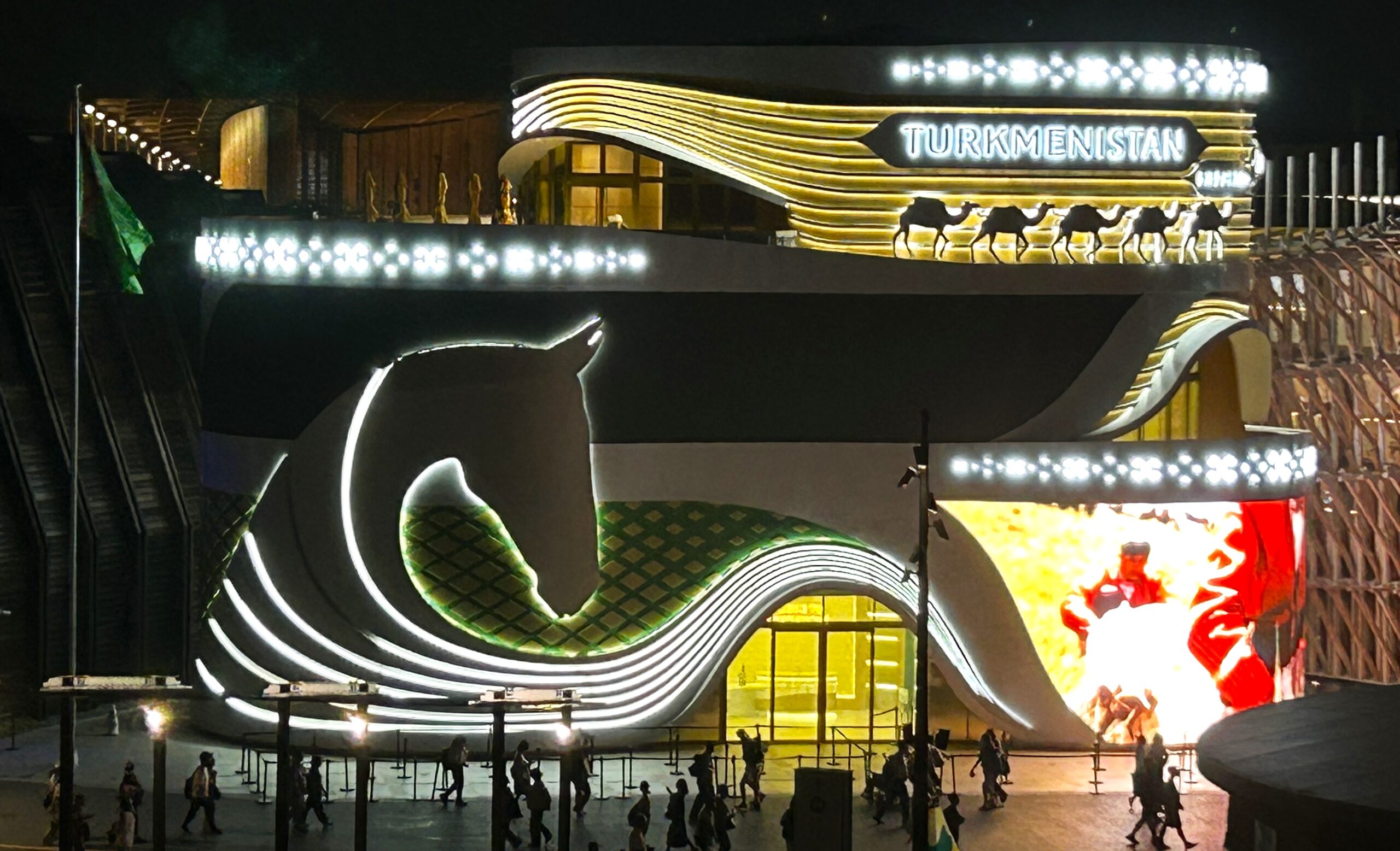
The Turkmenistan Pavilion; image: TCA, Stephen M. Bland

The Turkmenistan Pavilion dazzles with three lavish floors beneath an iconic, rounded-triangular ceiling that symbolizes circulation, sustainability, and the flow of life. On the ground level, an epic immersive video left the Japanese audience gasping as it honored Turkmenistan’s great men, legendary horses, and loyal dogs, while women appeared only in fleeting roles.

The second-floor shifts to the present, celebrating modern achievements, from the smart city of Arkadag to advances in industry, finance, and science. The space unfolds as an eclectic mix of books, jewelry, rugs, and even everyday objects like bottles of oil. At its center, a glowing holographic orb lends a Star Wars-like quality to the story of medicinal plants.

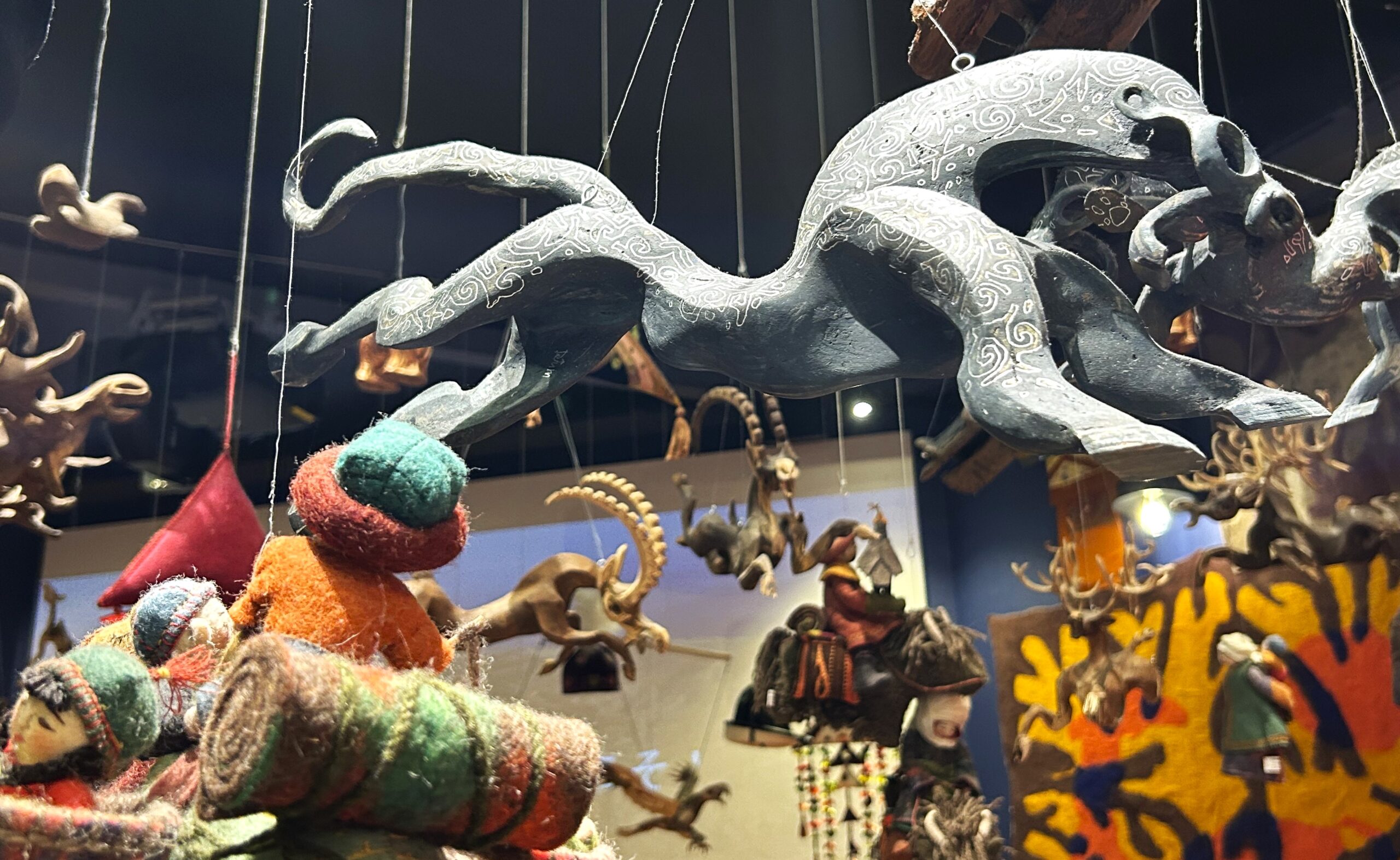
The third level celebrates Turkmen cultural treasures, with handmade carpets and delicate national embroidery on display. Guests can savor organic Turkmen cuisine in a national restaurant, or unwind on an open terrace shaded by traditional gazebos. The theme, “Inspiring a Better Tomorrow,” runs through every detail. By July, the pavilion had already welcomed more than a million visitors, securing its place as one of the Expo’s star attractions.

On the bottom floor, the gift shop tempts visitors with pricey fridge magnets, funky sunglasses, and finely woven rugs. There’s even a chance to slip into traditional garbs, as two Japanese chaps did, grinning as they donned the outfits, and clearly enjoying the transformation.

Ippei Okuma and Gen Nero channel their inner Turkmen at the Turkmenistan Pavilion; image: TCA, Stephen M. Bland

It’s an ironic twist. For years, Turkmenistan has been one of the most closed countries in the world, often ranked just behind North Korea in its isolation. Most foreigners can only enter through an accredited Turkmen travel agency, their every move trailed by a government-approved guide. The alternative, a five-day transit visa, is rarely granted. On top of that, Turkmenistan continues to enforce some of the world’s toughest entry requirements, including mandatory PCR tests for all arrivals at Ashgabat International Airport, long after most countries dropped pandemic restrictions.

Hints of change are in the air, however. Rumors suggest the regime is considering easing rules and making the country more accessible to visitors. For a state so tightly sealed, even the possibility of a softer stance feels momentous.

Kyrgyzstan Pavilion; image: TCA, Stephen M. Bland

Tajikistan Pavilion; image: TCA, Stephen M. Bland

Join us again soon for the second stop in our Expo 2025 series, as we explore the award-winning Uzbek Pavilion. A fusion of heritage and ingenuity, it offers a striking vision of Uzbekistan’s concept of a green tomorrow.

U.S.–Turkmenistan Rapprochement: Energy, Neutrality, and Digital Geopolitics

For more than three decades, Turkmenistan has stood apart from its neighbors. Since declaring independence in 1991, it has built its foreign policy around “permanent neutrality,” a status formally recognized by the United Nations in 1995. Neutrality has meant avoiding military alliances, steering clear of regional blocs, and limiting international engagement to carefully managed bilateral relationships. Ashgabat has been especially cautious in its dealings with Washington, keeping contacts minimal while relying overwhelmingly on China to buy its natural gas.

That posture is beginning to shift. In 2025, the outlines of a quiet rapprochement between Turkmenistan and the United States are visible. The latest round of Annual Bilateral Consultations (ABCs) in Washington, coupled with Ashgabat’s more active role in the C5+1 regional dialogue, suggests a gradual warming. On September 19, 2023, Turkmen President Serdar Berdimuhamedov participated in the first C5+1 multilateral summit alongside the U.S. and regional counterparts, highlighting Ashgabat’s more active role in the platform. At the heart of this cautious opening are three themes: energy dependence, security on Turkmenistan’s southern border, and the geopolitics of digital connectivity.

Annual Bilateral Consultations: A Structured Dialogue

The ABCs were launched in 2010 as part of a U.S. initiative to formalize engagement with all five Central Asian states. They are yearly, structured meetings between senior officials that review the state of bilateral relations across political, economic, and security issues.

In August 2025, Foreign Minister Rashid Meredov met Secretary of State Marco Rubio in Washington for the 11th ABC. According to the U.S. State Department release, the two sides “underscored their commitment to advancing U.S.-Turkmenistan relations, including through security cooperation, increased economic and investment opportunities, the advancement of religious freedom, and deepening engagement through the C5+1 diplomatic platform.” The statement was deliberately brief and omitted sensitive matters such as the partial visa restrictions Washington imposed on Turkmen citizens earlier that year. But the very fact of the meeting, following years of minimal contact, marked a notable warming.

From Episodic Contacts to Broader Cooperation

The rapprochement has begun to take shape in concrete ways. Trade between the two countries, though still small, nearly doubled in 2024 to reach $218.5 million. Turkmenistan exported textiles, chemicals, and gas-related equipment, while U.S. exports included aviation technology, electronics, and agricultural machinery. Overall, the trade volume remained the second-lowest among Central Asian states, but the sharp increase pointed to a deliberate effort to expand ties. Reflecting this momentum, on June 8, 2025, Turkmenistan’s Foreign Minister Rashid Meredov met with the Executive Director of the Turkmenistan–U.S. Business Council, Eric Stewart, to discuss cooperation across sectors, including energy, cybersecurity, green technology, and education.

Security cooperation has grown more visible. Turkmenistan’s long border with Afghanistan has long been a vulnerability, and while Ashgabat avoided involvement in the U.S.-led war, it quietly welcomed assistance to reinforce border defenses and counter trafficking. The U.S. has provided equipment, training, and support for Turkmen border services, a low-profile effort documented in a Congressional Research Service report. Turkmenistan has invested over a billion dollars in Afghan infrastructure projects – power lines, roads, and railways – while also backing the long-delayed TAPI pipeline.

Turkmen officials and international backers have long promoted the TAPI pipeline as a stabilizing project that would tie Afghanistan’s fragile economy into a regional energy corridor, creating transit revenue and jobs that could help anchor security along Turkmenistan’s southern border. While Washington has generally favored Turkmenistan’s diversification of export routes, direct endorsement of gas swap deals that transit Iran is unlikely given U.S. sanctions policy, meaning American support is more apt to focus on routes west across the Caspian or south via TAPI.

Humanitarian and environmental programs have been another strand. According to MENAFN, citing USAID, joint water management programs in 2024 “helped reduce water losses in irrigation systems by 10% in pilot regions.” Recently, however, USAID’s footprint inside Turkmenistan has shrunk, with many governance and civil society initiatives curtailed. Religious freedom and human rights remain points of friction – Turkmenistan is still listed by the U.S. as a “country of particular concern” – but their inclusion in the ABC agenda signals that Washington sees room for dialogue.

Positioning Within C5+1

The rapprochement is also framed within the C5+1 format, a diplomatic platform that brings together the five Central Asian states and the United States. Established in 2015, it has grown in importance: in September 2023, U.S. President Joe Biden hosted the first-ever C5+1 presidential summit in New York. For Turkmenistan, the most reticent of the five, active participation represented a shift.

By engaging through C5+1, Ashgabat has signaled that closer ties with Washington are part of a regional process rather than a bilateral alignment that might compromise neutrality. The State Department’s 2025 readout explicitly cited “deepening engagement through the C5+1 diplomatic platform” as a priority, underscoring that bilateral warming is designed to complement multilateral cooperation. For Washington, ensuring Turkmenistan’s participation means that no Central Asian state is left outside U.S. regional outreach.

Gas Wealth and Dependency

Turkmenistan’s geopolitical weight comes from its vast reserves of natural gas. According to the Carnegie Endowment, the country holds approximately 13.4 trillion cubic meters of proven gas reserves, the fourth largest in the world after Russia, Iran, and Qatar. By comparison, the United States has about 12 TCM, while Saudi Arabia has less than 9. The centerpiece is the giant Galkynysh field, one of the largest deposits on earth.

Yet these riches have created a textbook case of dependence. Hydrocarbons provide over 50% of GDP, 90% of export revenue, and 80% of fiscal income. In 2024, petroleum and gas made up nearly 85% of total exports. Turkmenistan exports roughly 35 bcm of gas annually to China, making Beijing not just its primary market but a pivotal anchor of its energy economy, and highlighting the strategic asymmetry that gives China outsized influence in Turkmenistan’s export strategy.

Turkmenistan’s export profile mirrors that of Azerbaijan or Iraq, with hydrocarbons dominating and few alternative sectors, unlike Kazakhstan’s uranium and metals. Diversification strategies have long been discussed but remain mostly aspirational. For Ashgabat, projects such as TAPI, swap deals via Iran to Turkey, Iraq, and Azerbaijan, and a potential Trans-Caspian pipeline are strategically vital. For Washington, only TAPI and the Trans-Caspian appear to fit U.S. diversification goals; Iran-based swaps are viewed cautiously – permitted in some cases (to Azerbaijan) but sanction-sensitive in others (notably with Iraq).

Digital Geopolitics: The Caspian Cable

Energy is not the only game. Digital connectivity has become another arena where U.S.-Turkmenistan rapprochement has resonance. Central Asia’s internet traffic has traditionally flowed north through Russia, creating vulnerability to disruption and surveillance. The proposed Trans-Caspian Fiber-Optic Cable aims to change that.

Backed by Kazakhstan and Azerbaijan as part of a “Digital Silk Way,” the cable will run under the Caspian Sea to connect Central Asia directly with the South Caucasus and Europe. In April 2025, the U.S.-based firm Pioneer Consulting was awarded the contract to supervise construction. The system is designed to carry up to 400 terabits of data per second, creating a fast, reliable corridor that bypasses Russia and Iran.

Some regional observers have suggested that whoever builds these “pipes of the digital future” will shape how data flows. That does not mean U.S. firms will block Russian or Chinese content – a cable only carries traffic; it is not a media platform. Still, control of infrastructure matters. The Caspian link lessens dependence on Russian networks, makes internet access more reliable, and gives the region more exposure to competing ideas that can encourage democratic change. By providing an alternative path, the Caspian link reduces reliance on Russian networks and diminishes Moscow’s ability to throttle or monitor regional traffic.

Washington is aiming to link Central Asia’s connectivity to open, secure networks in line with the State Department’s Clean Network initiative, which is seeking to safeguard digital infrastructure from authoritarian interference. The project holds both commercial promise and geopolitical weight. In Turkmenistan – where internet access remains tightly censored – the immediate effects will be limited. Over time, however, faster and cheaper international connections could boost trade and regional integration, while giving the United States a strategic foothold in Central Asia’s digital future.

Strategic Significance

For Ashgabat, engagement with Washington can complement its long-standing policy of neutrality. By diversifying partnerships – whether through pipelines or fiber cables – Turkmenistan strengthens its options and enhances resilience. Such diversification is increasingly a feature of its foreign and economic policy.

For Washington, the incentive is presence and dialogue. Engagement is framed in terms of supporting Central Asian sovereignty, expanding energy and digital connectivity, and contributing to regional stability in a space where multiple powers, including Russia and China, play leading roles.

The relationship remains cautious and bounded by restraint. No one expects Turkmenistan to abandon its neutral course, nor for the U.S. to become a dominant partner, but the shift from limited contact to more structured engagement is significant. Outcomes will be measured less in communiqués than in concrete projects: gas pipelines beyond existing routes, fiber-optic cables across the Caspian, and gradual improvements in regional infrastructure.

In the end, the outreach underscores a simple reality: in Turkmenistan, where neutrality is doctrine and isolation has long been the default, even incremental steps toward diversified cooperation are notable. For the United States, which emphasizes secure and resilient infrastructure, those steps are worth supporting. For Turkmenistan, it expands its room for maneuver. And for the broader region, practical connections – both physical and digital – offer opportunities that all partners can recognize as contributing to stability and development.

Uzbekistan Jordan Relations Advance with Landmark State Visit

King Abdullah II of Jordan paid a state visit to Uzbekistan on August 25-26 at the invitation of President Shavkat Mirziyoyev. The visit, his first since the establishment of diplomatic relations, marked a milestone in bilateral ties and culminated in the signing of 15 agreements spanning politics, trade, investment, education, and culture.

A Historic Visit with Symbolic and Strategic Weight

Mirziyoyev welcomed King Abdullah with full ceremonial honors in Samarkand, including flag displays, a guard of honor, and performances of national songs and dances. The leaders visited prominent cultural sites, including the Shah-i-Zinda complex, Amir Temur’s mausoleum, and Registan Square, where the Jordanian monarch received an overview of Uzbekistan’s rich historical heritage.

King Abdullah also visited the tomb of Qutham ibn al-ʿAbbas, a revered early Islamic preacher in Samarkand. The Jordanian delegation toured the “Eternal City” cultural park, which showcases Uzbekistan’s traditional crafts, architecture, and customs.

Expanding Economic and Diplomatic Cooperation

The official program commenced on August 26 at the Congress Center in Samarkand. Following the ceremonial welcome, the leaders visited an exhibition of Uzbekistan’s export-oriented products. The showcase featured a range of goods from key industries such as pharmaceuticals, chemicals, mining, textiles, agriculture, IT, and jewelry. King Abdullah praised Uzbekistan’s industrial development and called for increased business-to-business collaboration.

During bilateral talks, the two sides agreed to elevate their relationship to a comprehensive partnership. Discussions focused on expanding political dialogue, boosting trade and investment, and strengthening cooperation in science, education, tourism, and culture.

To formalize the partnership, the two countries agreed to establish a joint intergovernmental commission and a business council by the end of the year, and to convene an Uzbek-Jordanian business forum. They also outlined plans for cooperation in smart agriculture, geology, healthcare, and the textile industry.

Broad-Based Agreements and International Alignment

Fifteen agreements and memoranda were signed during the visit, including:

  • An extradition treaty
  • A bilateral investment promotion agreement
  • A visa waiver agreement
  • Cooperation protocols in higher education, scientific research, agriculture, veterinary medicine, tourism, and standardization

The two leaders also reiterated their commitment to close coordination within international organizations, including the United Nations and the Organization of Islamic Cooperation.

Honoring Partnership and Future Prospects

In recognition of his role in strengthening bilateral ties, Mirziyoyev was awarded Jordan’s highest state honor, the Order of Al Nahda (“Renaissance”), presented personally by King Abdullah II.

“I accept this award with great honor, as a recognition of our joint efforts to expand multifaceted cooperation and a sign of friendship and respect for the people of Uzbekistan, who are laying the foundations for the Third Renaissance in our country,” Mirziyoyev said.

The visit concluded with a joint statement and mutual invitations for future high-level exchanges, reaffirming both countries’ shared ambition to elevate Uzbekistan-Jordan relations to a new strategic level.