Football fans across Kazakhstan are preparing for arguably the biggest sporting occasion in the country’s history on Tuesday. Kairat Almaty play their first ever home Champions League game against the mighty Real Madrid at the Almaty Central Stadium.
The arrival of Madrid’s Galácticos has electrified the city, with fans camping outside the Intercontinental Hotel in Almaty just to catch a glimpse of the visiting superstars.
Kairat lost their first match 4-1 to Sporting Lisbon, a scoreline that the management felt didn’t do justice to a spirited performance. “The team lost focus for about five minutes, conceding three goals, but never gave up and scored a goal in the Champions League – the first in our club’s history. That experience is valuable,” Kairat Boranbaev, the club’s president, told The Times of Central Asia at the club’s training complex this week.
“We understand that the Champions League has the 36 best teams in Europe, so the level is extremely high. We don’t stress about the result; the team gains huge experience.” Boranbaev said, proudly adding that six Kairat academy products played in the match.

Kairat Almaty President, Kairat Boranbaev; image: TCA, Joe Luc Barnes
A Ten-Year Journey
The fifty-nine-year-old president and business magnate is not surprised his club has reached the higher echelons of European football. “This strategic work was built more than ten years ago, and we have been moving toward it all these years. I think it’s a natural result, a systematic effort by our club.”
Boranbaev says that when he took over the club’s presidency in 2012, the facilities were well below par. Kairat is traditionally Kazakhstan’s most storied club, their famed black-and-yellow jerseys representing all-Kazakhstan in the Soviet Top League in the communist years. But they had fallen on hard times in the independence era, even splitting into two rival clubs for a time.
“When we arrived, there was only one burned-down base from Soviet times,” Boranbaev told TCA. “We started developing, learning what football really is. Today, all the infrastructure is established, youth player development is in place, and the coaching staff training is organized. That’s why the results we’ve achieved today are the outcome of years of stable, professional management.”
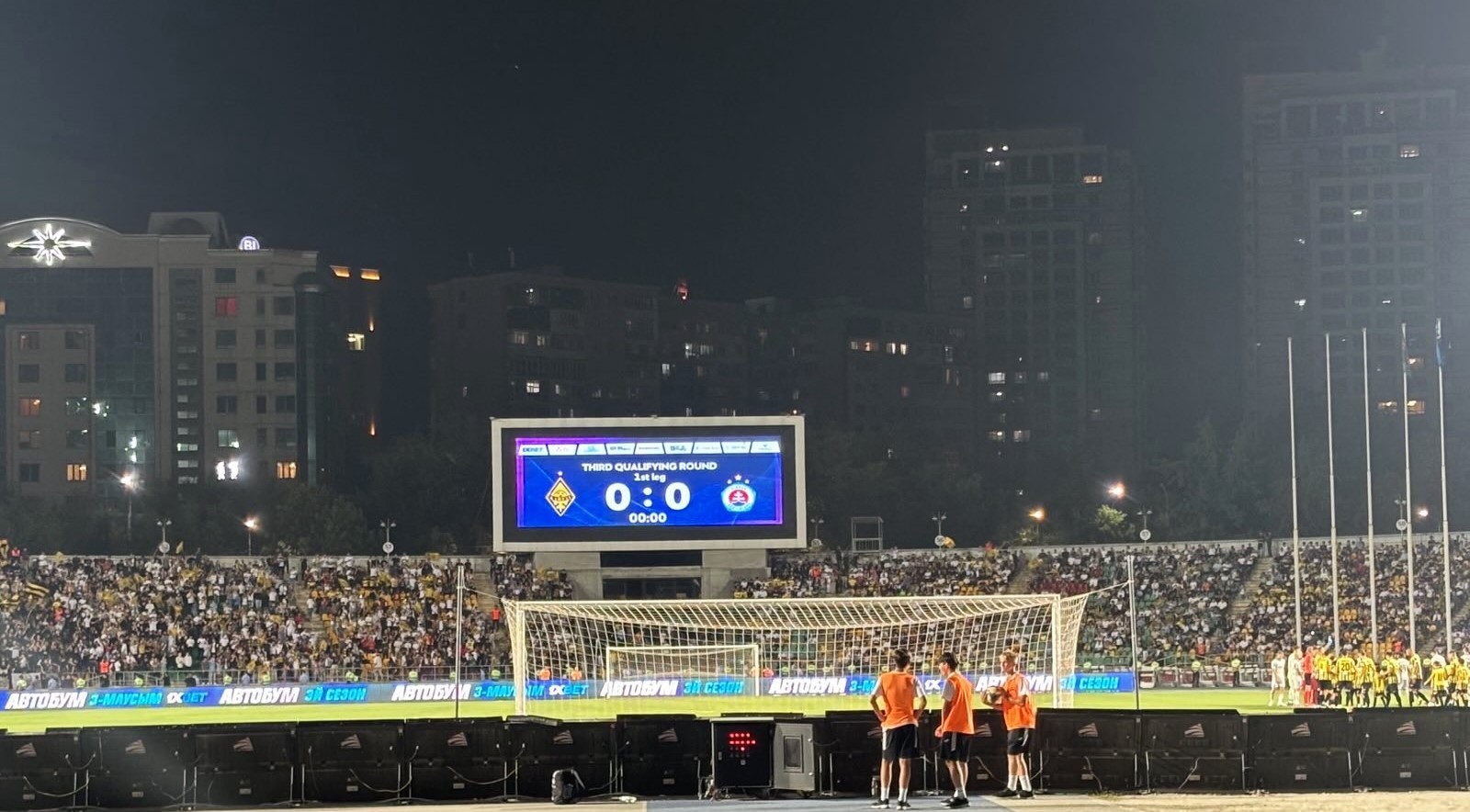
Kairat Almaty’s third qualifying round tie against Slovan Bratislava; image: TCA, Joe Luc Barnes
Nurturing Youth
Kairat differs from other Kazakh teams in the emphasis they place on their academy. While clubs such as FK Astana and Aktobe often import talent rather than investing in grassroots football, Kairat aims to develop its own.
The club’s most famous academy product is seventeen-year-old Dastan Satpaev, who will move to London side Chelsea upon turning eighteen. But during TCA’s tour of the stadium complex, we bump into the club’s newest teenage star, Sherhan Kalmurza, the eighteen-year-old goalkeeper who has been catapulted into the first XI due to injuries to other senior players. “He’s become famous,” booms Boranbaev. “He now has 40,000 Instagram followers after just two games!”
Kairat’s president notes that while the club respects the experience of foreign players – which includes Belarus’ Valeriy Gromyko and Portuguese forward Jorginho – the club’s priority is its academy, which caters to children from the age of six, with thirteen branches across the city. From fourteen onwards, prospective starlets live in boarding schools by the club’s academy.

Training facility in Besagash, on the outskirts of Almaty; image: TCA, Joe Luc Barnes
The Visit of the Galácticos
The arrival of the world’s most famous football team is perhaps a bigger prize than victory itself. Fans are struggling to contain their excitement. Rauan Mutair, 24, part of a group of fans that runs Kairat Makhabbatim, an Instagram page dedicated to the club, tells of his excitement when he saw that Kairat would be playing against Real Madrid. “My heart started racing,” he told The Times of Central Asia. “The Champions League is a great school and a grand stage; it’s a historic opportunity for the players and the city.”
Mutair went to his first game over a decade ago and was enchanted by the energy of the stadium: “The black-and-yellow sea, the sound of the drums captured me instantly. That feeling has never faded,” he said fondly.
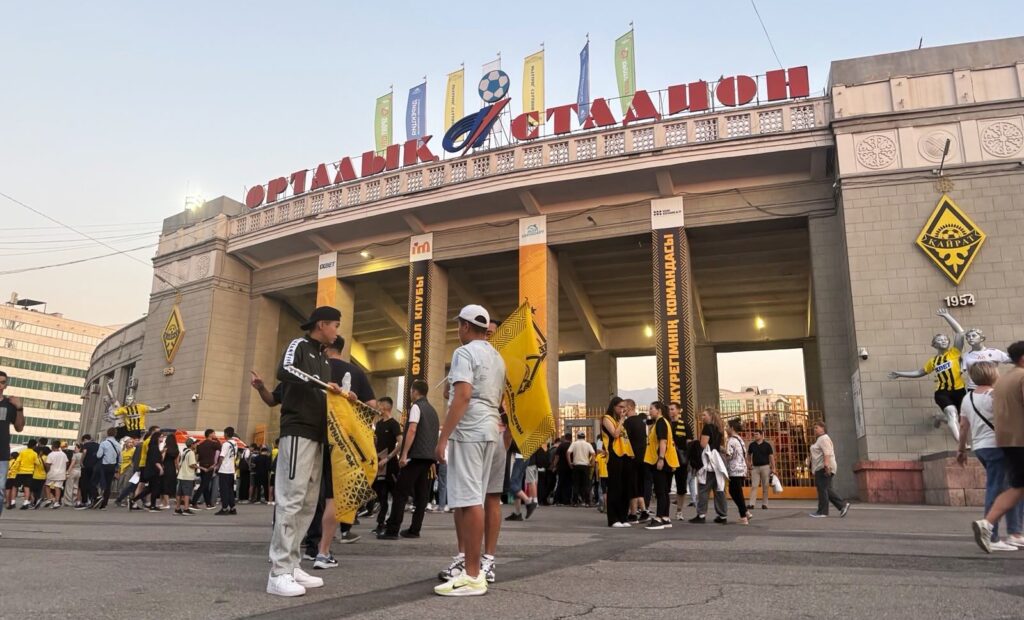
Fans sing in both Russian and Kazakh, which reflects the city’s cosmopolitan history. It’s not unusual to hear “Алма-Ата, столица мира” (Alma-Ata, capital of the world) sung in Russian, followed by “Алға, Қайрат!” (Forward, Kairat!) ringing out in Kazakh from the terraces in the city’s Central Stadium.
Mutair promises that for the visit of Madrid, the supporters will pull out all the stops in support of their side. He promises a large banner (or tifo), drums, and call-and-response chants between different parts of the stadium.
The question, of course, is who will be in the stadium to see the big game. The visit of Madrid has opened some old wounds about inequality in the city. Fans who watched the four qualifying matches for the competition paid as little as 1,500 tenge ($2.80) for tickets in some cases. For the visit of Real Madrid, the minimum price for a ticket will be 75,000 Tenge, or $140.
But perhaps this should be expected. Stars do not often visit Central Asia. The biggest touring Western stars tend to be musicians – 2025 has seen Robbie Williams, the Backstreet Boys, and Jennifer Lopez. The minimum prices for these events were 50,000 tenge ($90) for the Backstreet Boys, and slightly under that for J-Lo. But, whilst these are all big names, they were at the top of their game around two decades ago. Real Madrid brings that rare cachet: world-class performers who are at their peak right now.
This means that the 20,000 or so tickets available for one of the biggest sporting events of Kazakhstan’s history are seeing stratospheric demand. On September 23rd, when the tickets went on sale, online retailer Ticketon reported over a million simultaneous users in the queue for tickets.
“We understand that Champions League group-stage matches are different from qualifiers,” said Boranbaev. “Our season ticket holders get priority to buy their seats. We aim to make tickets accessible to all. One problem is scalpers, but we will limit to two tickets per person to prevent resale.”
These scalpers have nevertheless been doing a roaring trade in Telegram groups, with some “VIP” tickets going for 430,000 tenge ($783), or the price of the monthly rental of an average two-bedroom apartment in the city center.
Flights from the capital Astana to Almaty have spiked on the Tuesday before the game, and on Wednesday morning for the return trip, suggesting that wealthy Kazakhs from across the country are flying in.
The idea of money and power buying their way past ordinary people is perhaps embodied by the club president himself. Boranbaev, whose daughter Alima married the former president’s grandson, leveraged his ties to the ruling family to build influence in oil, gas, real estate, and retail. At one point, he was the 14th most influential individual in Kazakhstan. However, after the protests of Bloody January, which saw Nazarbayev’s star fall, he was imprisoned for embezzlement after being convicted of stealing $30 million from a gas contract. However, he struck a deal with the state to hand over major assets and funds, and was released from prison in November 2023.
His phoenix-like return to grace rankles with many city residents who see that just as a man can buy his way out of the justice system, the rich can buy their way into football matches.
Boranbaev told The Times of Central Asia that he had been in discussions with Almaty’s mayor about creating a fan zone for the game, but these promises have come to nothing.

Kairat Almaty hosting FK Aktobe at the Almaty Central Stadium; image: TCA, Joe Luc Barnes
Spending Spree
Spent wisely, however, the windfall from this game has the potential to develop the club. Plans are afoot for a new stadium, and Mutair would like to see improved sports science and an even better academy.
For now, though, fans are focused on the present, and Mutair is even holding out hope for an unlikely upset.
“We’ll enjoy the game as a large-scale celebration, but on the pitch it’s about pragmatism: discipline, resilience under pressure, capitalizing on set pieces. Even a single goal would be historic.”