• KGS/USD = 0.01144 0%
  • KZT/USD = 0.00196 -0%
  • TJS/USD = 0.10899 -0%
  • UZS/USD = 0.00008 -0%
  • TMT/USD = 0.28490 0%
  • KGS/USD = 0.01144 0%
  • KZT/USD = 0.00196 -0%
  • TJS/USD = 0.10899 -0%
  • UZS/USD = 0.00008 -0%
  • TMT/USD = 0.28490 0%
  • KGS/USD = 0.01144 0%
  • KZT/USD = 0.00196 -0%
  • TJS/USD = 0.10899 -0%
  • UZS/USD = 0.00008 -0%
  • TMT/USD = 0.28490 0%
  • KGS/USD = 0.01144 0%
  • KZT/USD = 0.00196 -0%
  • TJS/USD = 0.10899 -0%
  • UZS/USD = 0.00008 -0%
  • TMT/USD = 0.28490 0%
  • KGS/USD = 0.01144 0%
  • KZT/USD = 0.00196 -0%
  • TJS/USD = 0.10899 -0%
  • UZS/USD = 0.00008 -0%
  • TMT/USD = 0.28490 0%
  • KGS/USD = 0.01144 0%
  • KZT/USD = 0.00196 -0%
  • TJS/USD = 0.10899 -0%
  • UZS/USD = 0.00008 -0%
  • TMT/USD = 0.28490 0%
  • KGS/USD = 0.01144 0%
  • KZT/USD = 0.00196 -0%
  • TJS/USD = 0.10899 -0%
  • UZS/USD = 0.00008 -0%
  • TMT/USD = 0.28490 0%
  • KGS/USD = 0.01144 0%
  • KZT/USD = 0.00196 -0%
  • TJS/USD = 0.10899 -0%
  • UZS/USD = 0.00008 -0%
  • TMT/USD = 0.28490 0%
08 December 2025

Uzbekistan Raises Concern over Treatment of its Migrants in Russia

Uzbekistan has urged Russia to pay greater attention to reports of mistreatment and rights violations involving Uzbek migrant workers living and working in Russia. The issue was formally raised on May 2 during a meeting in Tashkent between Uzbekistan’s Deputy Foreign Minister Bobur Usmonov and Russian Ambassador to Uzbekistan Oleg Malginov.

According to Uzbekistan’s Ministry of Foreign Affairs, Usmonov expressed deep concern over the growing number of reports detailing abuse and harsh treatment of Uzbek migrants. He emphasized that such cases constitute violations of the rights and freedoms of Uzbek citizens, which should be safeguarded under the laws of their host country.

The two officials also reviewed priority areas of bilateral cooperation, including upcoming events on both bilateral and multilateral agendas. They confirmed that collaboration in the consular and legal sectors remains strong. Regular consultations are held on consular issues, and a joint working group on labor migration continues to operate, focusing on employment and migration processes.

“Protecting the rights and interests of citizens is at the center of our cooperation,” the Uzbek side said in an official statement. Topics discussed included pre-departure language and vocational training, simplifying the work permit application process, and ensuring that migrants comply with Russian legal requirements upon arrival.

Meanwhile, on May 3, Uzbek President Shavkat Mirziyoyev and his Russian counterpart Vladimir Putin held a phone call to discuss deepening their strategic partnership. The leaders reviewed cooperation in trade, industry, and regional business, and praised the recent Innoprom. Central Asia exhibition in Tashkent. They also noted expanding ties in education, culture, sports, and tourism.

Just days earlier, on April 29, a delegation from Uzbekistan, led by Deputy Prosecutor General Shohrukh Aminov, visited Moscow for the first session of a joint labor migration working group. Both parties agreed to enhance legal migration frameworks and to ensure fair and dignified treatment of migrant workers. The Uzbek government reiterated its expectation that Russian authorities will investigate the reported abuses and keep their Uzbek counterparts informed of the outcomes.

Supreme Court of Kyrgyzstan Speaks Out Against Racial Discrimination

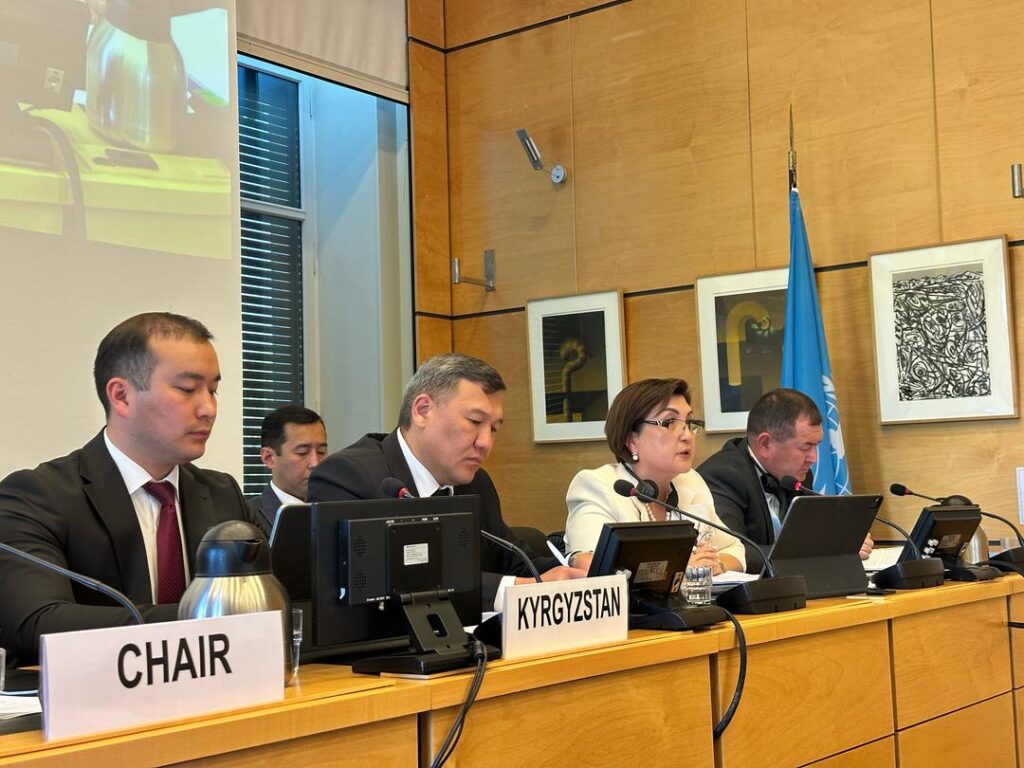
Deputy Chair of the Supreme Court of Kyrgyzstan, Nurgul Bakirova, presented a report during the 115th session of the UN Committee on the Elimination of Racial Discrimination, held in Switzerland.

In response to committee questions, Bakirova affirmed that Kyrgyz law prohibits discrimination on any grounds, racial, ethnic, or national. She emphasized that the Supreme Court ensures effective legal protection for all individuals, regardless of origin. Kyrgyz courts apply both domestic and international legal standards, and a mechanism exists to challenge legislation that violates anti-discrimination principles.

Since 2019, over 400 Kyrgyz judges have undergone training in human rights protection and compliance with international norms. Bakirova also noted that crimes motivated by racial, ethnic, or religious hatred are treated as offenses with aggravating circumstances under Kyrgyz law.

“Kyrgyzstan remains committed to the principles of equality, justice, and respect for diversity. We recognize that combating racial discrimination is not only an international obligation but also an important step towards a harmonious and inclusive society,” she said.

It is worth noting that May 5 marks Constitution Day in Kyrgyzstan. Since its adoption in 1993, the constitution has been amended 12 times. The most recent constitutional referendum was held in 2021.

Kazakhstan Reduced Fish Exports Last Year

Kazakhstan exported 23,400 tons of fish products in 2024, marking a decline from the previous year despite an overall 7% growth in domestic fish production. The figures point to a significant rise in domestic consumption of fish.

According to the Ministry of Agriculture of Kazakhstan, 72 enterprises are currently engaged in fish processing, with 20 of them supplying products to the European Union. Kazakhstani fish products, over 50 types in total, are exported to 21 countries. However, the 2024 export volume fell short of the 25,300 tons reported in 2023, which included 11,800 tons of processed fish, a slight increase over 2022.

In contrast, domestic consumption has surged. The domestic market absorbed 94,600 tons of fish products in 2024, up 7% compared to 2023.

“The state actively supports the development of aquaculture. Subsidies to the industry have increased ninefold since 2021, reaching KZT 4.5 billion ($8.7 million) in 2024. Kazakhstan provides reimbursement of up to 25% of investment costs, 30% of feed costs, and 50% of the cost of purchasing young fish, broodstock, and veterinary drugs,” the Ministry of Agriculture stated.

The number of fish farms in Kazakhstan has doubled in the past three years, reaching 600. In 2024, investments in fixed assets in the fishing industry exceeded KZT 5.2 billion ($10.1 million).

Despite this growth, concerns remain about the ecological health of regional fish stocks. As previously reported by The Times of Central Asia, the Caspian sturgeon population has plummeted by 90% amid an ongoing environmental crisis.

Binance Founder to Advise Kyrgyzstan President on Digital Assets

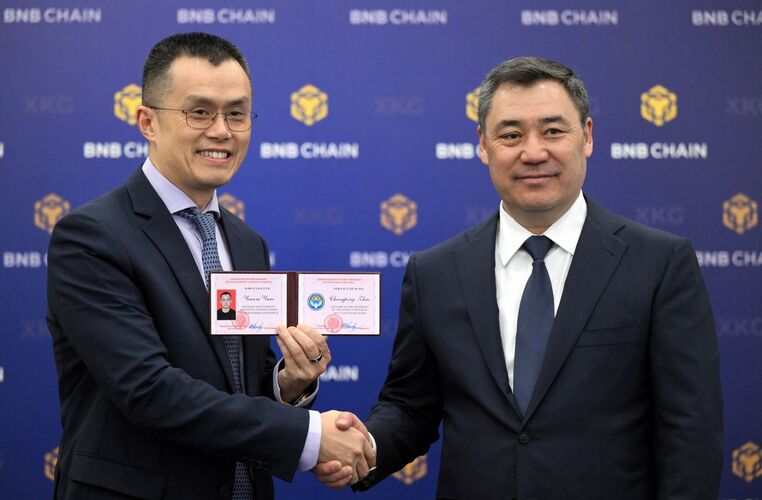
On May 3 in Cholpon-Ata, President Sadyr Japarov met with Changpeng Zhao, founder of Binance, the world’s largest cryptocurrency exchange, to discuss the future of digital assets and blockchain technologies in Kyrgyzstan.

The meeting focused on the development of the country’s digital asset ecosystem, the introduction of blockchain technology into public administration, and measures to bolster cybersecurity. Japarov emphasized that Kyrgyzstan is actively promoting digital assets, particularly through the planned introduction of a national digital currency, the digital som.

Changpeng Zhao expressed his readiness to support Kyrgyzstan’s digital transition by consulting and training local specialists involved in developing and implementing the digital som. During the meeting, Japarov presented Zhao with a certificate appointing him as a public adviser to the President of Kyrgyzstan on the development of digital assets.

The following day, May 4, Japarov chaired the inaugural session of the National Council for the Development of Virtual Assets and Blockchain Technologies in Cholpon-Ata. Zhao was officially accepted as a member of the Council, which was established to formulate a unified state policy on virtual assets and promote their use in governance and key economic sectors.

Japarov outlined the Council’s main areas of focus:

  • Enhancing financial literacy and supporting educational programs
  • Strengthening cybersecurity and protecting users from digital fraud
  • Integrating blockchain technologies into public administration systems

“Interest in cryptocurrency is growing every year in Kyrgyzstan, and blockchain technologies and digital assets are becoming the basis of a new financial system,” Japarov stated.

Earlier, the National Investment Agency of Kyrgyzstan signed a Memorandum of Cooperation with Zhao. Under the agreement, Binance will assist in developing blockchain infrastructure, creating a national cryptocurrency reserve, and training professionals in blockchain technology, virtual asset management, and cybersecurity.

Despite USAID Funding Cuts, Kyrgyzstan Plans to Reintroduce Goitered Gazelle at Issyk-Kul

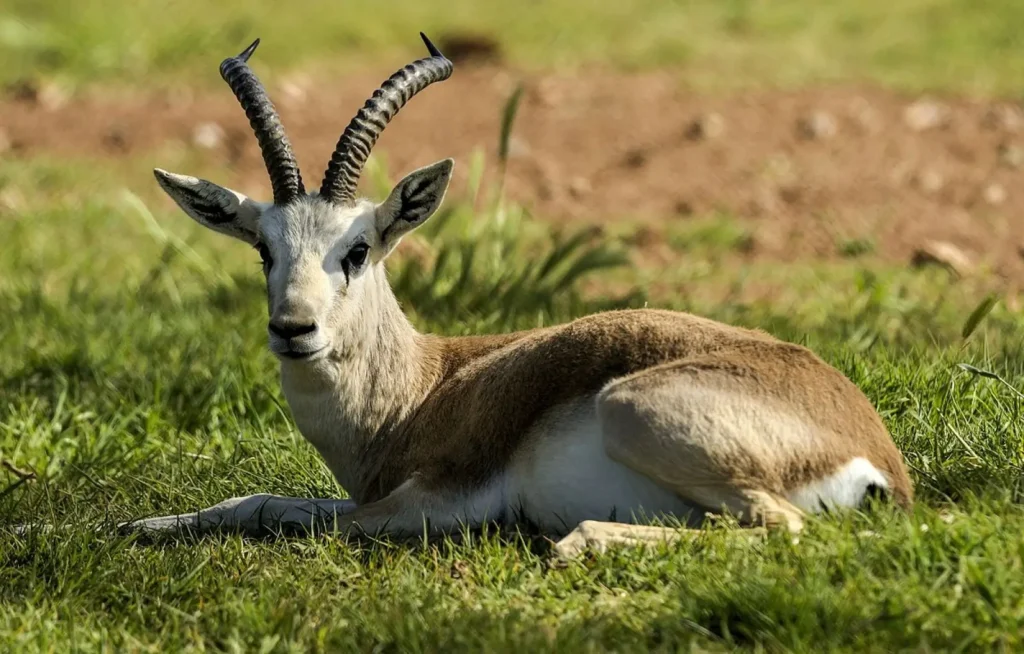
Kyrgyzstan has launched an ambitious project to restore the population and natural habitat of the goitered gazelle on the southern shore of Lake Issyk-Kul, a region once home to these graceful creatures. Led by the Argali Public Fund, Ilbirs Fund, and the Gulistan farm, the reintroduction effort marks a significant step toward reversing the species’ decline and restoring balance to the local ecosystem.

Reviving a Lost Species

The goitered gazelle, an elegant herbivore from the bovid family, was once abundant in the Issyk-Kul region. However, its population collapsed after the 1930s due to widespread poaching and the conversion of natural landscapes for agricultural and economic development. Today, the species is listed in Kyrgyzstan’s Red Book of endangered species, making their conservation an urgent priority. Found across Central Asia — from Kazakhstan and Uzbekistan to Iran and beyond — the gazelle is integral to maintaining the balance of steppe and desert ecosystems.

On the southern shore of Issyk-Kul, conditions remain favorable for the return of the goitered gazelle. However, decades of human activity and habitat loss have driven them away, leaving reintroduction as the most viable path to restoration. The project employs a “soft release” approach, starting with a semi-free adaptation phase. Animals are first acclimatized and allowed to breed in a controlled environment before being released back into the wild. This method reduces the risks associated with sudden release and ensures a higher survival rate.

The Project in Action

Currently, the Gulistan farm houses a herd of 43 gazelles. By the end of the year, the number is expected to grow to 60, with the first batch of 25 animals scheduled for release in 2025. Organizers aim to release an additional 15-20 gazelles annually, slowly building a self-sustaining wild population. If conservation measures, particularly anti-poaching efforts, prove successful, the gazelle population in Issyk-Kul could reach 500 within the next decade.

Gazelles play an essential role in their environments, feeding on thorny and toxic plants that other species avoid. This behavior helps control invasive vegetation and supports the overall health of the ecosystem. Their presence also benefits predators such as wolves and snow leopards, creating a natural chain of biodiversity.

Broader Impact on Biodiversity and Ecotourism

The reintroduction of the goitered gazelle represents more than just species preservation; it is a step toward restoring the ecological integrity of the Issyk-Kul landscape. A thriving population of gazelles can boost biodiversity by fostering healthier, more balanced ecosystems. Their grazing patterns promote plant regeneration, which in turn supports a variety of other species, from insects to birds of prey.

Furthermore, the project has significant potential to bolster Kyrgyzstan’s ecotourism sector. Issyk-Kul is already a popular destination for outdoor enthusiasts, and the presence of rare and protected wildlife like the goitered gazelle could attract even more visitors. Eco-friendly tourism initiatives could offer guided safaris to observe the gazelles in their natural habitat, providing educational opportunities while generating revenue for local communities. President Japarov has underscored the importance of halting illegal hunting, urging communities to see the gazelle as a symbol of natural heritage rather than a source of meat or trophies.

A Collaborative Effort

The success of the reintroduction project depends on a unified effort between conservationists, local authorities, and communities. Adequate anti-poaching measures, public awareness campaigns, and sustained funding will be critical to ensuring long-term results. Organizations such as the World Wildlife Fund (WWF) and other biodiversity agencies could play a vital role in supporting the initiative.

Kyrgyzstan’s restoration of the goitered gazelle at Issyk-Kul is an example of how targeted conservation efforts can rectify past ecological damage. By combining science, policy, and grassroots support, the project not only seeks to revive a species but also to restore a vibrant natural space that benefits both wildlife and humanity.

Wider Efforts and Funding Threats

Projects such as reintroducing the goitered gazelle in Kyrgyzstan and ongoing efforts to revive saiga antelope populations in Kazakhstan demonstrate Central Asia’s commitment to conservation. Kazakhstan is home to around 2.8 million saiga antelope, equivalent to 99% of the global population, up from a low point of just 39,000 in 2005. However, challenges such as funding, poaching, and ensuring community support remain significant. Despite these hurdles, success stories highlight the value of combining science, local collaboration, and strict enforcement of environmental protections to rebuild the region’s delicate natural balance.

Kyrgyzstan is also at the forefront of snow leopard conservation, working to protect this iconic and endangered species whose habitats span the country’s rugged mountain ranges. Efforts include anti-poaching measures, habitat preservation, and cooperation with worldwide initiatives like the Global Snow Leopard and Ecosystem Protection Program (GSLEP). Local organizations run awareness campaigns, while protected areas such as the Sarychat-Ertash Nature Reserve offer critical safe habitats. In December 2023, President Japarov signed a decree “On recognizing the snow leopard as a national symbol of the Kyrgyz Republic”. Protecting the snow leopard is vital for biodiversity and maintaining the health of mountain ecosystems where this apex predator regulates prey populations and supports ecological stability.

However, as previously reported by TCA, the suspension of USAID to foreign aid programs poses a massive threat to projects to restore the balance to local ecosystems.

“Ninety percent of our environmental projects are supported by USAID,” Askar Davletbayev, an ecologist at the Institute of Biology under the Kyrgyz Academy of Sciences told TCA in January 2025. “The Kyrgyz government has limited funds, so both NGOs and ministries turn to external donors. Most projects will likely shut down. For example, I received USAID and UNDP funding to restore [goitered] gazelle populations. I purchased and bred the animals, but now I don’t know where we’ll find the money to continue.”

Record-Breaking Carpet Unveiled at Tulip Festival in Kazakhstan

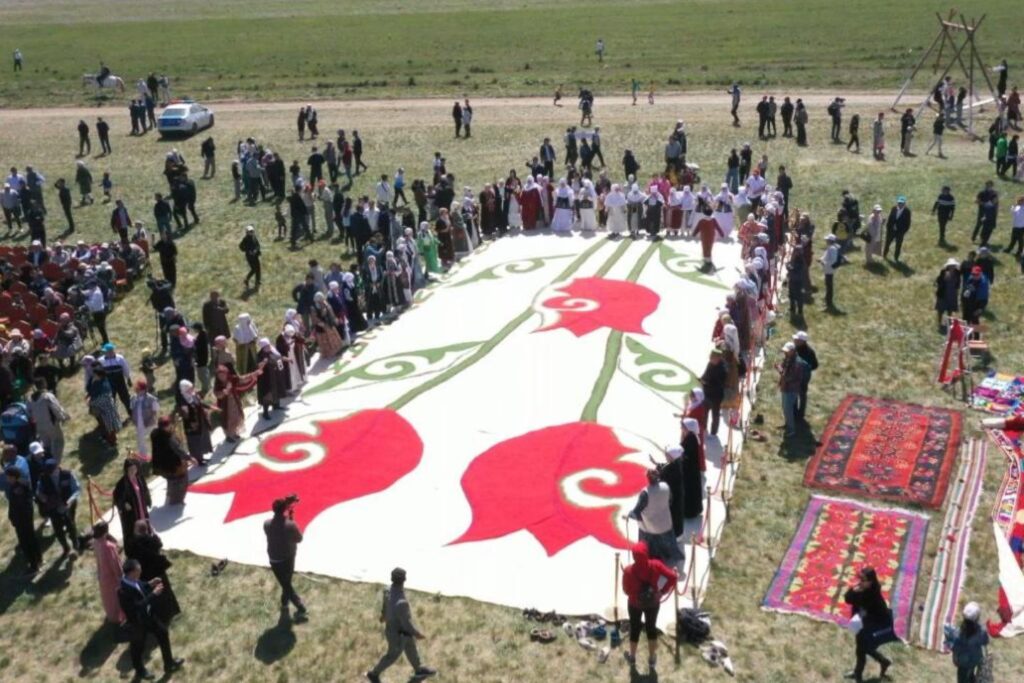
A massive felt carpet crafted by 100 master artisans has been officially recognized by the Kazakhstan Book of Records during the international “Qyzgaldaq Mura” (“Tulip Heritage”) festival in the Zhambyl region. Measuring 200 square meters, the carpet was created using the traditional wet felting technique and adorned with tulip motifs, symbolizing the region’s cultural identity.

Renowned designer Aidarkhan Kaliev developed the carpet’s ornamentation, celebrating both craftsmanship and the region’s natural heritage. The finished work will be installed under protective glass at Auliye-Ata Airport, where it is expected to become a regional cultural landmark.

The festival attracted approximately 5,000 participants from Kazakhstan and abroad, including guests from Germany, Ukraine, Kyrgyzstan, the Netherlands, Russia, China, Turkey, and India. The event featured historical exhibitions, national games, artisan displays, and a vibrant concert program. The region’s tulip fields, home to 18 species, 10 of which are listed in the Red Book of endangered species, were a highlight for visitors.

Despite its cultural success, the festival drew logistical criticism. Numerous attendees reported transportation difficulties, with some being dropped off 10 kilometers from the venue and forced to walk. Aspandiyar Seisebayev, head of the Zhambyl Region Department of Entrepreneurship and Tourism Development, attributed the issues to unexpectedly high turnout and challenging terrain in the mountainous area.