• KGS/USD = 0.01143 -0%
  • KZT/USD = 0.00192 -0%
  • TJS/USD = 0.10820 0.19%
  • UZS/USD = 0.00008 0%
  • TMT/USD = 0.28575 0%
  • KGS/USD = 0.01143 -0%
  • KZT/USD = 0.00192 -0%
  • TJS/USD = 0.10820 0.19%
  • UZS/USD = 0.00008 0%
  • TMT/USD = 0.28575 0%
  • KGS/USD = 0.01143 -0%
  • KZT/USD = 0.00192 -0%
  • TJS/USD = 0.10820 0.19%
  • UZS/USD = 0.00008 0%
  • TMT/USD = 0.28575 0%
  • KGS/USD = 0.01143 -0%
  • KZT/USD = 0.00192 -0%
  • TJS/USD = 0.10820 0.19%
  • UZS/USD = 0.00008 0%
  • TMT/USD = 0.28575 0%
  • KGS/USD = 0.01143 -0%
  • KZT/USD = 0.00192 -0%
  • TJS/USD = 0.10820 0.19%
  • UZS/USD = 0.00008 0%
  • TMT/USD = 0.28575 0%
  • KGS/USD = 0.01143 -0%
  • KZT/USD = 0.00192 -0%
  • TJS/USD = 0.10820 0.19%
  • UZS/USD = 0.00008 0%
  • TMT/USD = 0.28575 0%
  • KGS/USD = 0.01143 -0%
  • KZT/USD = 0.00192 -0%
  • TJS/USD = 0.10820 0.19%
  • UZS/USD = 0.00008 0%
  • TMT/USD = 0.28575 0%
  • KGS/USD = 0.01143 -0%
  • KZT/USD = 0.00192 -0%
  • TJS/USD = 0.10820 0.19%
  • UZS/USD = 0.00008 0%
  • TMT/USD = 0.28575 0%
13 December 2025

Kazakhstan Boosts Vocational Training as Demand for Blue-Collar Workers Surges

Kazakhstan is experiencing a growing demand for blue-collar workers, particularly in the construction, agriculture, manufacturing, and healthcare sectors, according to Deputy Minister of Labor and Social Protection Askar Biakhmetov.

In 2024, a total of 979,000 job seekers found employment in Kazakhstan, including 714,000 individuals who secured permanent jobs, Biakhmetov stated.

Kazakhstan’s Labor Market Development Concept aims to increase the number of high-quality, well-paid jobs from 2.5 million in 2024 to 3.8 million by 2029.

To achieve this, the Ministry of Labor and Social Protection has expanded vocational training programs:

  • In 2023, 67,500 people participated in short-term vocational courses
  • The Skills Enbek online training platform trained 57,700 people, of whom 14,600 secured jobs after completing their courses
  • The platform currently offers 858 online courses, including 311 free courses, aimed at helping individuals gain new skills or improve their qualifications

Kazakhstan has declared 2025 the “Year of Blue-Collar Professions” to highlight the importance of vocational careers. “The total demand for labor over the next six years is estimated at 1.6 million workers. Of these, around 900,000 jobs will require vocational education, while more than 400,000 positions will be in blue-collar professions,” Biakhmetov stated.

Meanwhile, the government is taking steps to reduce reliance on foreign labor. Svetlana Zhakupova, Minister of Labor and Social Protection, announced that Kazakhstan’s annual foreign labor quota will be reduced from 22,000 to 15,000 in 2025.

As Kazakhstan continues to modernize its labor market, the government is prioritizing workforce development through training initiatives and employment programs, ensuring sufficient skilled labor for the country’s growing economy.

Chinese Company to Build Waste Recycling Plant in Osh

China’s Hunan Junxin Huanbao KG Invest will build a solid waste incineration plant in Osh, Kyrgyzstan’s second-largest city, as part of a project to generate electricity from municipal waste.

According to the Osh municipality, Mayor Jenyshbek Toktorbayev signed an agreement with the Chinese company during his visit to Changsha, the capital of China’s Hunan Province, in early March.

The agreement includes the preparation of a feasibility study, with construction set to begin in the coming months. The project is expected to cost $90 million.

Similar Project Underway in Bishkek

The Times of Central Asia reported that Hunan Junxin Huanbao KG Invest is already implementing a similar waste recycling project in Bishkek, Kyrgyzstan’s capital. The company is currently constructing a solid waste recycling plant at Bishkek’s sanitary landfill.

The facility will generate electricity by incinerating municipal solid waste. In its initial phase, the plant will process 1,000 tons of waste per day, with plans to expand capacity to 3,000 tons daily. The project’s total investment is estimated at $95 million, with construction expected to be completed by December 2025.

Addressing Kyrgyzstan’s Waste Crisis

Solid waste management has been a long-standing challenge in Kyrgyzstan, particularly in its largest cities, Bishkek and Osh. The construction of modern recycling plants marks a significant step toward tackling waste issues while simultaneously contributing to sustainable energy production.

Tajikistan Steps Up Efforts to Combat Obesity and Malnutrition

The Food and Agriculture Organization (FAO) of the United Nations , in collaboration with Tajikistan’s Ministries of Health and Agriculture, has launched an initiative to develop national nutrition guidelines aimed at promoting sustainable food systems. The project was presented at a national workshop focused on improving public health through better nutrition.

Rising Obesity Rates in Tajikistan

Tajikistan has experienced a steady increase in obesity over the past 11 years. In 2012, 46.3% of the population was classified as overweight; by 2023, this figure had risen to 51%. During the same period, obesity rates increased from 13.4% to 17.4%.

Despite these concerns, food insecurity and malnutrition remain significant challenges in the country. FAO’s acting representative in Tajikistan Aghasi Harutyunyan says that addressing these issues requires a collaborative approach: “This [initiative] is an important milestone for Tajikistan in developing a healthy eating framework based on sustainable food systems. All stakeholders in the food system have a responsibility to ensure that consumers have access to nutritious food. Through collaboration, we can develop policies that improve nutrition and strengthen the country’s agri-food system.”

Food Security and Nutritional Deficiencies

Although there have been some positive trends, food security remains a major concern for many Tajik citizens. According to Nushervoni Bilol, deputy director of the National Nutrition Centre, ongoing issues include lack of trained specialists, weak laboratory infrastructure, insufficient equipment, limited international support, and low government funding for nutrition initiatives.

Health Ministry Data on Nutrition Trends

A 2023 report from Tajikistan’s Ministry of Health highlighted both improvements and continuing challenges in the country’s nutrition landscape:

  • The rate of exclusive breastfeeding among infants under six months increased from 34% (2012) to 41% (2023).
  • The proportion of stunted children decreased from 23% to 14%.
  • Anemia rates among women of childbearing age and children under five dropped to 35-36% (down from 41.2%).
  • However, acute malnutrition remained at 5.6%, and the number of overweight individuals continues to rise.

As Tajikistan works to improve public health and food security, experts emphasize the need for greater investment in nutrition programs, better-equipped laboratories, and stronger collaboration with international partners.

Kazakhstan Introduces AI Regulation Bill to Ensure Human Oversight

Deputies of the Mazhilis, the lower house of Kazakhstan’s parliament, have introduced a draft law titled On Artificial Intelligence. The legislation proposes a complete ban on digital systems that make decisions without human intervention.

The bill was presented by one of its key developers, Mazhilis deputy Ekaterina Smyshlyayeva, who emphasized the need for a transparent and effective legal framework for integrating AI into Kazakhstan’s economy.

“President Kassym-Jomart Tokayev has repeatedly highlighted the importance of AI development and issued relevant directives. During a recent visit to the Artificial Intelligence Development Center, he stressed the need for a balanced approach to AI regulation. On one hand, it is a matter of security; on the other, it is essential for development. Striking this balance is crucial,” Smyshlyayeva stated.

To address security concerns, the bill seeks to prohibit fully autonomous AI systems that operate without human oversight, aiming to reduce the risk of unintended consequences.

AI Classification and Regulation

The proposed legislation classifies AI systems by risk level:

  • High-risk: AI systems that impact human life and health or are used in public administration will be subject to strict regulation.
  • Medium-risk: These systems require oversight but with fewer restrictions.
  • Low-risk: AI systems in this category can be developed without regulatory intervention.

The bill also calls for the creation of a National AI Platform, a state-led technological infrastructure for AI development, training, and testing.

Additionally, lawmakers propose restrictions on AI applications that assess individuals based on social, biometric, or behavioral characteristics. The bill also seeks to ban AI technologies designed to manipulate human behavior. Violations of these provisions would result in administrative penalties under a newly proposed amendment to the Code of Administrative Offenses.

Lawmaker Expresses Fear of AI

During the bill’s presentation, MP Anas Bakkozhayev openly admitted his concerns about artificial intelligence, stating that AI threatens national traditions and intellectual independence.

“I view AI with caution, sometimes even fear. This path leads to degradation. Humans should think and analyze for themselves. Otherwise, where are we headed? Are we merely following global AI trends? What about our traditions, culture, and intellectual capabilities? I fear AI,” Anas Bakkozhayev said.

He also criticized the use of AI by Kazakh officials, arguing that neural networks have become a tool for bureaucrats who prioritize their superiors’ opinions over independent thought. Furthermore, he raised concerns about AI chatbots, such as ChatGPT, potentially gathering sensitive data that could threaten national security.

Kazakhstan’s AI Landscape

As previously reported by The Times of Central Asia, the Chinese robotics company AgiBot recently signed an agreement with Kazakhstan’s Ministry of Digital Development, Innovation, and Aerospace Industry to establish a joint venture for AI-powered robotics in Kazakhstan’s industrial facilities.

However, the expansion of AI remains a contentious issue in Kazakhstan’s parliament. Last December, Smyshlyayeva’s colleague, MP Magerram Magerramov, proposed restricting the use of ChatGPT and other generative AI tools in schools, arguing that their overuse weakens students’ critical thinking and problem-solving skills.

Kazakh Government Prepares for Battle with Big Business Over Tax

Kazakhstan’s government is entering a critical phase of its tax system overhaul, which is set to conclude by Nauryz, the country’s most significant Turkic holiday, beginning on March 21. The deadline for the ultimatum issued by Prime Minister Olzhas Bektenov to major businesses, accused of exploiting tax loopholes, will expire in the second half of March. The question remains: What happens next?

Tax Reform: Eliminating Preferences

The government has been pushing for tax reform, aiming to abolish a range of tax benefits, some of which date back to 2008 during the global financial crisis. However, the main point of contention now is the Special Tax Regime (STR), a more recent initiative.

The STR was introduced in 2021 as a response to the economic crisis caused by the COVID-19 pandemic. Today, 2.3 million taxpayers in Kazakhstan operate under this system, yet only 8% (137,000 entities) are value-added tax (VAT) payers. Additionally, 81% of registered entities use the simplified tax declaration regime, with 85% reporting annual incomes of up to 15 million KZT ($30,000).

Ultimatum to Developers

Following a report by Minister of Finance Madi Takiyev on tax evasion practices, Prime Minister Bektenov singled out two of Kazakhstan’s largest construction companies, BI Group and BAZIS, accusing them of using legal loopholes to avoid paying fair taxes.

“Unscrupulous entrepreneurs are exploiting various tax optimization schemes and paying amounts that do not match their billion-dollar revenues. We have a full list of such companies, including major developers like BI Group, BAZIS, and others, as well as well known restaurant chains, fitness clubs, and businesses across multiple industries,” Bektenov said.

He then issued a demand: companies must voluntarily submit revised tax declarations within two weeks and pay appropriate taxes.

Shortly afterward, it was revealed that BI Group was ordered to pay 11.9 billion KZT ($23.8 million) in additional taxes, while BAZIS must pay 4.6 billion KZT ($9.2 million) for 2022 and 2023.

Developers Deny Allegations

In response, both companies denied the accusations.

BAZIS stated that its subsidiary structure was created to comply with Kazakhstan’s equity participation laws, not for tax evasion.

“This is a legal requirement under Kazakhstani legislation, and we fully comply with it,” the company said.

BAZIS also emphasized that it is regularly monitored by tax authorities and expressed concern over Bektenov’s remarks.

BI Group, for its part, insisted that its tax deductions are audited annually by both state bodies and independent international firms such as KPMG and Ernst & Young.

“The company has been audited annually for the last 10 years by KPMG and Ernst & Young, and no violations have been found,” BI Group stated.

Ties to the Government

BI Group has had close ties to the Kazakh government. In 2020, the company was tasked with building modular hospitals during the COVID-19 crisis. However, in 2021, the project came under corruption investigation, though the company was ultimately cleared.

BI Group’s owner, Aidyn Rakhimbayev, remains a highly influential businessman. He is ranked 11th on Forbes Kazakhstan’s list of the country’s wealthiest individuals, with a fortune of $886 million.

BAZIS, founded in 1991 by Alexander Belovich, is another major player in Kazakhstan’s real estate sector. Today, it is owned by his son, Pavel Belovich, and the family ranks 14th on Forbes Kazakhstan’s list of the 75 most influential business figures.

Government vs. Influencers

This is not the first time the government has taken an aggressive approach to tax collection. One of the earliest moves in its tax enforcement campaign was a high-profile crackdown on social media influencers.

Last year, Kazakhstan’s State Revenue Committee accused top bloggers of collectively evading 70 billion KZT ($140.3 million) in taxes. The move sparked public backlash, but the government stood firm, setting a precedent for its broader tax enforcement strategy.

Targeting Foreign Corporations Next?

The government’s next target appears to be foreign corporations operating in Kazakhstan’s natural resources sector.

At an expanded government meeting in January 2025, the country’s president Kassym-Jomart Tokayev instructed the Cabinet to renegotiate profit-sharing agreements (PSAs) for Kazakhstan’s largest oil and gas projects.

“The implementation of production-sharing agreements has allowed Kazakhstan to establish itself as a reliable energy supplier. These projects significantly contribute to our socio-economic development. However, such large investments require long-term planning. The government must now accelerate negotiations to extend PSA contracts, possibly under more favorable terms for Kazakhstan,” Tokayev said.

The push for revised PSA agreements has strong backing from parliament, nationalist experts, journalists, and industry analysts. The battle over taxation, which began with social media influencers and Kazakh developers, now seems set to escalate to an even larger showdown, with major international players such as Chevron, Eni, Shell, and TotalEnergies.

The Journeys of Kazakh Fairy Tales to the United States

The Kazakh people have always been dedicated to preserving and advancing their culture and literature and sharing them with the world. Over the thirty-plus years since independence, the Kazakh state has actively sought valuable historical records and archival materials about its people. It is remarkable to discover that during the Soviet era, numerous Western travelers explored Kazakhstan’s territory, documenting their observations on traditions, daily life, religion, and political perspectives in books that were later published in English.

In the fall of 2023, with funding from the Bolashak program, I started a project to research the history of the Kazakh people and steppe based on the English-language accounts of Western travelers who visited the steppe in the late 19th and early 20th centuries. Although I started this project when I was working as a newspaper reporter in Kazakhstan, there was no way to access the database of large libraries abroad.

Nineteen Kazakh Fairy Tales and Mary Lou Masey

Kazakh-American relations did not begin solely after the collapse of the Soviet Union but can be traced back to the late 19th century. This is evident from old books written in English and printed by major American publishers, which I discovered in archival collections. While exploring the catalogs at George Washington University’s Gelman Library, I came across an intriguing book titled Stories of the Steppes, retold by Mary Lou Masey and illustrated by Helen Basilevsky. Published in 1968 by the David McKay Company, Inc. in New York, this book reflects Masey’s fascination with Central Asian culture. Having traveled to the region with her husband, Jack, she introduced American readers to its rich heritage through this collection. The book features 19 folktales from Russian sources, not as literal translations but as engaging retellings that remain faithful to the original plotlines.

The cover of Stories of the Steppes, retold by Mary Lou Masey

In this work, Masey presents traditional Kazakh folktales, including fairy tales, satirical stories about daily life, humorous tales and stories about animal, as well as narratives about both wise and foolish individuals. In the preface, she notes that while some reflect Russian cultural influence and others share common elements with global folklore, the collection remains distinctly Kazakh. It captures a unique way of life and showcases the remarkable artistry of the wandering storytellers who passed these tales down through the generations.

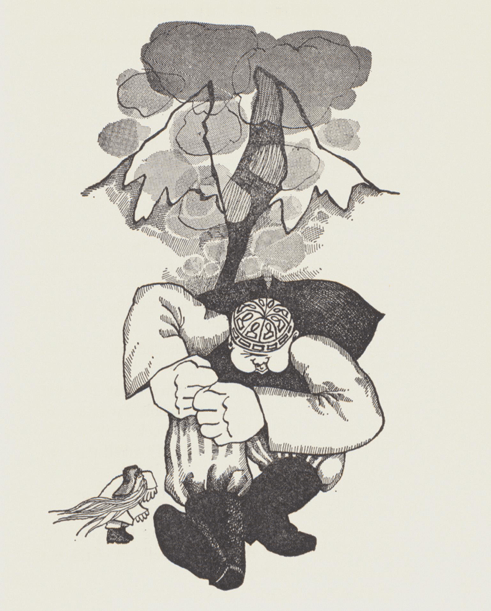
Illustration of the fairy tale “The One-Eyed Giant” from the book by Mary Lou Masey, 1968

As I flipped through the pages of this book, I became curious about its author. A writer and researcher with a background in International Studies, Masey earned her B.A. from Ohio State University with a major in Russian. She authored four children’s books published by David McKay: Branislav the Dragon (1967), Stories of the Steppes (1968), The Picture Story of the Soviet Union (1971), and Teddy and the Moon (1972).

In adapting Kazakh folktales for Western readers, particularly children, Masey prioritized preserving the essence and richness of the originals rather than providing direct translations. She notes that some of these stories resemble familiar European folktales, which likely trace their origins back to the East. For instance, the story “Old Man and Kurai” shares similarities with the Grimm brothers’ “The Brave Little Tailor”, which exists in countless variations and is believed to have originated in Asia. Through her comparisons, Masey highlights the many connections between Kazakh folklore and global storytelling traditions, emphasizing the cultural links between Kazakhstan and the wider world.

The illustration of the fairy tale The Woodcutter`s Daughter from the book by Mary Lou Masey, 1968

Western explorers who traveled across the Kazakh steppes documented their observations with accuracy and fairness. Some even noted in their writings that Russian policies intentionally misrepresented the name of the Kazakh people, referring to them as “Kyrgyz.” They provided historical explanations to correct this distortion. In Stories of the Steppes, Masey offers a similar clarification for her readers, stating: “Throughout the nineteenth century, the Kazakhs were mistakenly called ‘Kirghiz,’ a name belonging to a distinct people who now have their own republic. This misnaming may have been partly an effort to differentiate them from the Cossacks, who had also adopted the term ‘Kazak,’ a Turkic word meaning ‘freedom’ or ‘wanderer.’”

The illustration of the fairy tale The Old man and Kurai from the book by Mary Lou Masey, 1968

I was also intrigued by how the author used illustrations to help readers visualize Kazakh folktales. For instance, in the story “One-Eyed Giant”, the accompanying illustration vividly depicts a strong and fearless giant declaring, “I can do anything.” The clothing worn by each character in the illustrations is distinctly Kazakh in style, reinforcing the cultural authenticity of the tales.

It is evident that the author aimed to showcase Kazakh culture, traditions, and folklore through her work. Similarly, in “Salakbay and the Fox”, the character of Salakbay closely resembles a typical Kazakh boy tending to livestock on the vast steppes. With a staff in his hand, a traditional Kazakh hat on his head, a black coat draped over his shoulders, and sturdy boots on his feet, the illustration provides English-speaking readers with a clear and accurate depiction of a young Kazakh nomad’s appearance and way of life.

While translating Kazakh fairy tales, Masey preserved certain Kazakh words, providing English explanations alongside them. For instance, she kept the word Aidagar and clarified its meaning as “dragon.” This approach reflects her respectful attitude toward the cultures of other nations. Regarding the fairy tale “Salakbay and the Fox””, Masey noted that it belongs to an ancient oral storytelling tradition found across Europe, Siberia, and even as far as India, likening it to the well-known tale “Puss in Boots”.

Mary Lou Masey journeyed to various countries within the former Soviet Union during the 1960s. It is likely that during her travels, she became deeply familiar with the rich culture of the Kazakh people. Among the many nations of the Soviet Union, she chose to focus on Kazakh folktales, compiling them into her book. While this was a meaningful literary endeavor for her, for us, it represents a significant contribution to the recognition and appreciation of Kazakh folklore.

“Aldar-Kose” and The Fairy Tale Tree

The book The Fairy Tale Tree, housed in the Gelman Library at the University of Washington, serves as evidence that Kazakh fairy tales reached American readers much earlier than commonly thought. The Kazakh tale “Aldar-Kose and His Magic Cloak” was included in an anthology of world folktales published by G.P. Putnam’s Sons in New York City in 1961. This collection was compiled by Vladislav Stanovsky and Jan Vladislav, with an English translation by Jean Layton. The translation of this fairy tale into English was highly successful, as the language feels natural, and the story remains engaging and accessible to American readers.

Published more than fifty years ago, these two books introduced several Kazakh fairy tales to English-speaking readers, complete with illustrations that authentically depict the Kazakh way of life, traditional clothing, and historical worldview. Cultural exchange plays a crucial role in fostering connections between nations, and from this perspective, Mary Lou Masey’s efforts in translating and publishing Kazakh folktales in the 1960s represent a valuable contribution to Kazakh-American cultural relations. Folktales are an essential part of Kazakh heritage, and the fact that they reached American readers half a century ago is a remarkable milestone for Kazakh culture.