

• KGS/USD = 0.01144 0%
  • KZT/USD = 0.00212 0%
  • TJS/USD = 0.10456 0.19%
  • UZS/USD = 0.00008 0%
  • TMT/USD = 0.28490 0%
  • KGS/USD = 0.01144 0%
  • KZT/USD = 0.00212 0%
  • TJS/USD = 0.10456 0.19%
  • UZS/USD = 0.00008 0%
  • TMT/USD = 0.28490 0%
  • KGS/USD = 0.01144 0%
  • KZT/USD = 0.00212 0%
  • TJS/USD = 0.10456 0.19%
  • UZS/USD = 0.00008 0%
  • TMT/USD = 0.28490 0%
  • KGS/USD = 0.01144 0%
  • KZT/USD = 0.00212 0%
  • TJS/USD = 0.10456 0.19%
  • UZS/USD = 0.00008 0%
  • TMT/USD = 0.28490 0%
  • KGS/USD = 0.01144 0%
  • KZT/USD = 0.00212 0%
  • TJS/USD = 0.10456 0.19%
  • UZS/USD = 0.00008 0%
  • TMT/USD = 0.28490 0%
  • KGS/USD = 0.01144 0%
  • KZT/USD = 0.00212 0%
  • TJS/USD = 0.10456 0.19%
  • UZS/USD = 0.00008 0%
  • TMT/USD = 0.28490 0%
  • KGS/USD = 0.01144 0%
  • KZT/USD = 0.00212 0%
  • TJS/USD = 0.10456 0.19%
  • UZS/USD = 0.00008 0%
  • TMT/USD = 0.28490 0%
  • KGS/USD = 0.01144 0%
  • KZT/USD = 0.00212 0%
  • TJS/USD = 0.10456 0.19%
  • UZS/USD = 0.00008 0%
  • TMT/USD = 0.28490 0%

Opinion: The U.S. Dollar Loses Its Luster as the Uzbek Som Shines

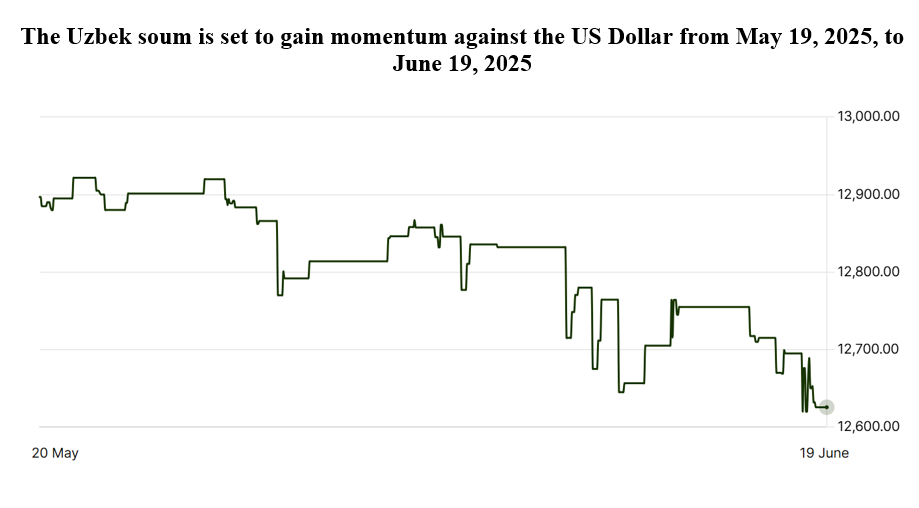
From May 20, 2025, to June 19, 2025, the U.S. dollar declined from 12,885 Uzbek som to 12,625 som, reaching its lowest level since early December 2023. This trend is anticipated to persist. Over the past 30 days, the dollar has depreciated by 2.08% against the som.

The Central Bank of Uzbekistan adheres to a flexible exchange rate mechanism, commonly referred to as a floating exchange rate. This approach allows the value of the Uzbek som to be primarily influenced by market forces of supply and demand, rather than being fixed or pegged to another currency. In the context of Uzbekistan, the Central Bank defines the market-determined exchange rate, permitting the som to fluctuate freely based on the interactions between buyers and sellers in the foreign exchange market.

In 2017, Uzbekistan transitioned to a flexible exchange rate regime, aligning the som with market conditions and narrowing the gap between the official and parallel exchange rates. This move is expected to enhance export competitiveness, as noted by the European Bank for Reconstruction and Development (EBRD). While the market predominantly determines the exchange rate, the Central Bank reserves the right to intervene in the foreign exchange market to mitigate excessive fluctuations or address significant imbalances. However, it does not maintain a fixed exchange rate. The primary objective of the Central Bank is to uphold price stability, ensuring low and stable inflation. The flexible exchange rate regime empowers the Central Bank to utilize interest rates as a tool to influence inflation and manage the overall economy. Since 2020, the Central Bank of Uzbekistan has been implementing an inflation targeting framework that guides its monetary policy decisions, including those related to the exchange rate.

Uzbekistan has recently achieved a remarkable milestone, with its international reserves soaring to an unprecedented $49.6 billion, primarily driven by a substantial increase in gold prices. This significant figure, recorded at the end of last week, represents the highest level of international reserves since the Central Bank of Uzbekistan began tracking this data in 2013.
Uzbekistan has been on a remarkable journey of financial growth, marked by a sustained increase in its reserves over the past five months. Since the beginning of the year, the country’s reserves have increased by an impressive $8.48 billion, reaching a new historic high of $49.66 billion. In May alone, the reserves saw a substantial boost of $410.2 million, translating to a 0.8% increase compared to April.

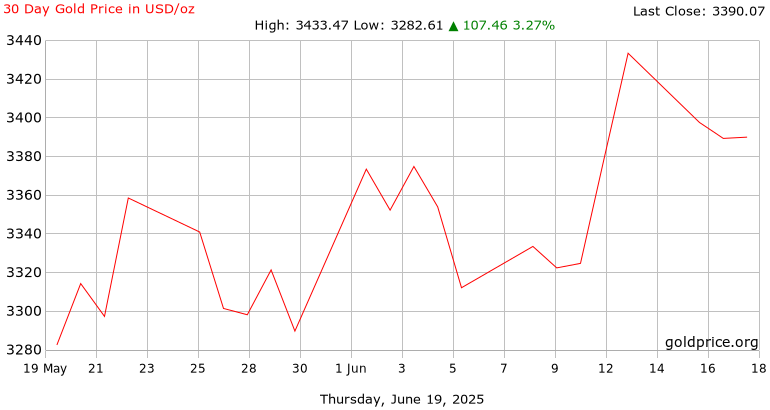
This consistent upward momentum not only highlights the resilience of Uzbekistan’s economy but also demonstrates its ability to adapt and thrive in a dynamic global landscape. Central to this financial ascent has been the role of gold, which has enjoyed significant demand due to its elevated prices in international markets. Over the last month, gold prices surged by 3.27%, rising from $3,280 to $3,390.07 per ounce. When examining the broader trends, it is evident that gold has significantly appreciated, with a striking 25.5% increase since the start of this year and an even more impressive 41.3% surge over the past year. Factors contributing to the strong performance of gold include changes in U.S. trade policies under President Donald Trump, a growing preference among several nations to transact internationally using non-dollar currencies, and ongoing geopolitical tensions in the Middle East, especially between Iran and Israel.

From February to April, Uzbekistan maintained an active approach by selling approximately 12 tons of gold each month. However, there was a significant decline in sales in May, which plummeted to just 30,000 troy ounces, equivalent to approximately 0.9 tons. Currently, the total physical volume of gold held in the country’s reserves stands at 11.43 million troy ounces, or 355.5 tons, marking the lowest level since June 2022.

Despite the reduced physical volume, the value of gold within the reserves increased by $2.2 million in May, reaching a total of $37.65 billion. In addition to gold, Uzbekistan’s foreign currency reserves also experienced noteworthy growth, adding $411.9 million to reach a total of $11.44 billion, the highest level since December 2022. In a strategic effort to diversify its financial portfolio, the Central Bank of Uzbekistan has been proactive in making investments; in May alone, it allocated an additional $2.4 million into securities, boosting the overall value of its securities holdings to $706.3 million. These strategic decisions reflect Uzbekistan’s unwavering commitment to fortifying its economic foundation and enhancing the stability of its international reserves for the future.

How can we interpret the recent appreciation of the Uzbek som? Over the past month, the U.S. dollar has experienced a decline against many currencies, including the som, as illustrated above. The Uzbek som has notably gained strength, reaching a point it hasn’t seen against the dollar in recent times. According to various sources, this shift marks the som’s best performance in the last ten months, showcasing a decrease in the dollar’s value when measured against the som. This trend is reflected in daily trading results and can be attributed to several influencing factors. Increased remittances from abroad, a rise in foreign investment, stabilization of currencies among trading partners, and a surge in global gold prices are all contributing elements to this upward trajectory.

While predicting short-term exchange rate dynamics can be challenging, there is a reasonable expectation for the Uzbek som to maintain a stable exchange rate against the dollar into 2025. It is essential to note that this appreciation of the Uzbek currency may not necessarily impact the export of local manufacturing products, as the country’s primary resources are derived from minerals and gold. From a policy perspective, this development presents an intriguing opportunity. The passage highlights the critical need to develop a high-skilled education system, aligning with President Shavkat Mirziyoyev’s vision of establishing Tashkent as a leading financial center in the near future. However, it raises an important question: Are the education leaders in Uzbekistan sufficiently equipped to achieve this ambitious objective?


The views expressed in this article are those of the author and do not necessarily reflect the official policy or position of the publication, its affiliates, or any other organizations mentioned.


Uzbekistan Joins BRICS Bank, Strengthening Global Ties

Uzbekistan’s bid to join the New Development Bank (NDB), commonly known as the BRICS Bank, has been officially approved, marking a notable step for the country as it seeks to enhance its engagement within the global financial and economic framework. Established by Brazil, Russia, India, China, and South Africa, the NDB aims to finance sustainable development projects and offer alternatives to traditional Western-led financial institutions such as the IMF and the World Bank.

Membership was also approved for Colombia, with applications from Ethiopia and Indonesia currently under review.

A New Opportunity for Uzbekistan

Uzbekistan’s membership in the BRICS Bank provides a potential avenue to strengthening economic ties with major emerging markets. The country’s strategic position in Central Asia and its natural resources present opportunities for investments in infrastructure, renewable energy, and agriculture, aligning with the bank’s priorities on sustainable development.

Uzbekistan’s recent economic reforms aimed at liberalization and improved governance make the BRICS Bank a practical partner for securing diversified funding sources for large-scale initiatives.

Role of the BRICS Bank and Implications

The NDB focuses on funding projects in emerging economies to promote growth while reducing dependence on traditional Western lenders. Since its inception in 2014, the bank has supported initiatives in renewable energy, infrastructure, and technology. The inclusion of Uzbekistan indicates the NDB’s interest in expanding its reach beyond its founding members.

Uzbekistan’s entry into the BRICS Bank takes place in the context of shifts in the global economic landscape, as countries seek new financial partnerships. For Uzbekistan, this step aligns with its foreign policy approach of maintaining balanced ties with global powers while engaging with the West, the Middle East, and neighboring countries.

China, a driving force within the NDB and the Belt and Road Initiative (BRI), sees Uzbekistan’s strategic location as beneficial for advancing regional trade and connectivity, while Russia could view the membership as a positive development for maintaining close regional ties while navigating geopolitical challenges.

Shared Priorities

For the NDB, Uzbekistan offers a gateway to further investments in Central Asia, aligning with its mission to support emerging markets.

For Uzbekistan, meanwhile, membership represents a significant development in its integration into international financial networks, potentially opening up opportunities for sustainable development projects that could contribute to the country’s economic growth and strengthen its global standing.

The BRICS summit in 2025 will be held in Rio de Janeiro on July 6 and 7.

Moody’s Upgrades Outlook on Uzbekistan’s Credit Rating to Positive

Moody’s Ratings has revised Uzbekistan’s credit outlook from stable to positive, while affirming its long-term issuer rating at Ba3, a level that denotes speculative or non-investment grade status. The improved outlook reflects increased confidence in the country’s ongoing structural reforms and governance improvements.

According to Moody’s, Uzbekistan’s efforts to strengthen public sector governance and liberalize key sectors such as energy could enhance policy effectiveness and lay the foundation for sustainable economic growth. Recent steps include restructuring the supervisory boards of all state-owned enterprises (SOEs) and banks, with an increased presence of independent members. The government is also advancing legislation on conflict of interest, asset declaration, and whistleblower protections, measures that signal a broader commitment to transparency.

The energy sector reforms highlight the government’s readiness to undertake challenging but necessary changes. Tariffs have risen sharply as part of a phased plan to achieve full cost recovery by 2027-2028. While inflationary pressures persist, the government has sought to mitigate their impact through targeted increases in public sector wages and pensions and by scaling back subsidies.

Privatization remains central to Uzbekistan’s reform strategy. The government plans to reduce the state’s share in the banking sector from 65% to 46%, following the successful privatization of Ipoteka Bank. The recently established National Investment Fund, managed by Franklin Templeton, will oversee holdings in 18 major enterprises. Initial public offerings are planned for several large firms, including Navoi, Uzbekistan’s largest taxpayer.

Moody’s forecasts GDP growth of 5.8% in 2025 and 5.7% in 2026, supported by increased investment in energy and transport infrastructure under the Uzbekistan 2030 Strategy and rising levels of foreign direct investment. The fiscal deficit declined to 3.3% of GDP in 2024 and is projected to remain below 3% in the coming years.

Although Uzbekistan’s public debt remains moderate, liabilities linked to SOE borrowing and public-private partnership (PPP) projects are increasing. To manage these risks, the government has imposed caps on new PPPs and now requires official approval for external borrowing by state-owned entities.

Moody’s also pointed to persistent institutional weaknesses, low per capita income, and governance concerns, as well as regional geopolitical risks. However, the agency noted that if current reform momentum continues and economic indicators improve further, an upgrade to the country’s credit rating is possible.

Uzbekistan’s credit profile is bolstered by its diversified economy, strong growth outlook, and prudent fiscal management. With continued reforms and growing investor confidence, the country appears increasingly well-positioned for long-term economic stability.

Saiga Conservation Clash: Kazakhstan Aids China, Russia Struggles

Kazakhstan will transfer 1,500 saigas to China to help restore the species’ population in the western regions of the People’s Republic of China. The announcement came during a bilateral meeting between President Kassym-Jomart Tokayev and Chinese President Xi Jinping. President Xi expressed gratitude for the initiative, reaffirming China’s commitment to restoring the population of this antelope species.

Returning to Their Historical Habitat

On June 18, Minister of Ecology Yerlan Nysanbayev elaborated on the decision, explaining that the move is part of an effort to support the long-term sustainability of the species by reintroducing it to its historical range.

“Kazakhstan is currently home to 99% of the world’s saiga population. Since 2003, when only 2,500 individuals remained, we have grown the population to more than five million,” Nysanbayev said.

The minister emphasized that the transfer will proceed only after a joint scientific assessment by Kazakh and Chinese experts, who will evaluate potential resettlement zones, available food sources, and optimal transport methods.

When asked whether the move aimed to reduce saiga numbers in response to farmers’ complaints, Nysanbayev dismissed the idea.

“Can 1,500 animals really affect the overall population or solve issues like agricultural damage? This is absolutely irrelevant,” he stated.

Nysanbayev also underscored the importance of international cooperation in biodiversity conservation.

“The saiga population has historically extended beyond Kazakhstan, into Mongolia, China, Russia, and Turkmenistan,” he added.

Ongoing Tensions Between Wildlife and Agriculture

Despite conservation successes, conflicts between saigas and agricultural interests remain a serious concern.

In 2022, farmers in the West Kazakhstan and Akmola regions reported significant crop losses and property damage caused by saigas, with some even calling for a state of emergency to be declared in the West Kazakhstan Region.

In response to growing tensions, the government included saigas in the list of species subject to regulation in late 2023. Authorities initially planned to capture up to 200,000 animals, but logistical challenges led to the approval of a limited culling. This shift enabled meat-processing plants to begin producing canned saiga meat.

However, in February 2024, the Ministry of Ecology suspended population control measures following President Tokayev’s public call to protect this iconic symbol of the Kazakh steppe.

Nevertheless, in March 2025, during a meeting of the National Kurultai, President Tokayev acknowledged the strain on agriculture and raised concerns about potential epizootic risks and broader ecological pressures.

“Agriculture is suffering. There are risks of a worsening epizootic situation. Overall, the burden on the ecosystem has increased,” Tokayev said.

Minister Nysanbayev later confirmed that discussions about potential future regulation are ongoing. “It will take time for science to thoroughly study the situation again,” he said.

Options under consideration include culling through corrals or selective shooting, with final decisions to be guided by scientific recommendations.

Saiga Migration Threatens Saratov Farmers’ Livelihoods

In Russia, meanwhile, farmers and agricultural leaders in the Novouzensky district of the Saratov region have appealed to President Putin for help, citing a severe threat to their livelihoods from saigas migrating from the Kazakh steppes. They claim the influx of these animals has made farming, livestock raising, and forage harvesting almost impossible, putting their enterprises at risk. Novaya Gazeta reports that while only about 100 saigas typically reside in the region, this spring saw an unprecedented migration of around a million saigas, according to the local authorities.

UNDP and Japan Launch Initiative in Uzbekistan to Reduce Emissions and Boost Energy Efficiency

Uzbekistan has launched a new international initiative aimed at cutting greenhouse gas emissions and improving energy efficiency in public infrastructure. Spearheaded by the United Nations Development Programme (UNDP) in partnership with the Government of Japan and Uzbekistan’s Ministry of Economy and Finance, the project targets key sectors including schools, hospitals, kindergartens, and public transportation.z

According to UNDP Uzbekistan, the initiative seeks to bolster the country’s resilience to energy-related challenges driven by increasingly extreme weather conditions. Many public buildings in Uzbekistan suffer from outdated infrastructure and significant energy loss, resulting in elevated emissions and burdensome utility expenses. The project will focus on upgrading facilities with thermal insulation, energy-efficient windows, heat pumps, and solar panels to address these inefficiencies.

A central objective is to enhance indoor comfort throughout the year, particularly in regions experiencing extreme seasonal temperatures. The installation of modern heating and cooling systems is expected to make classrooms and hospital wards more sustainable and livable. The initiative will also extend to green mobility, supporting the introduction of electric buses, the development of charging infrastructure, and the deployment of air pollution monitoring systems along urban transport routes.

A distinctive feature of the program is its use of the Joint Credit Mechanism (JCM), which provides Uzbekistan with access to advanced Japanese technology and investment. This mechanism facilitates international collaboration on carbon reduction and supports the country’s transition toward cleaner technologies.

The initiative aligns with Uzbekistan’s climate commitments under the Paris Agreement. The government has pledged to cut greenhouse gas emissions by 35 percent and raise the share of clean energy to 25 percent by 2030. According to UNDP representatives and officials from the National Agency for Energy Efficiency, the project is not only designed to meet environmental targets but also to improve public health and alleviate the financial strain caused by inefficient energy systems.

This latest endeavor builds on previous sustainable development projects in Uzbekistan. Notably, a European Union and UNDP-backed program has supported the country’s fish farming industry by providing eco-friendly equipment to enhance water quality and reduce energy consumption.

Kazakhstan Launches 2025 Year of China Tourism

On June 16, Astana hosted the official launch of the Year of China Tourism in Kazakhstan. The opening ceremony was attended by Kazakh Minister of Tourism and Sports Yerbol Myrzabosynov and Chinese Minister of Culture and Tourism Sun Yeli, underscoring the growing cultural and economic ties between the two countries.

Minister Myrzabosynov emphasized that tourism has become a vital bridge in strengthening people-to-people connections between Kazakhstan and China. The 2025 initiative follows the success of the Year of Kazakhstan Tourism in China in 2024, declared by Presidents Kassym-Jomart Tokayev and Xi Jinping as part of ongoing bilateral cooperation.

A centerpiece of this year’s initiative is the implementation of the Welcome Chinese program, which aims to tailor Kazakhstan’s hospitality and tourism services to meet the needs of Chinese visitors. The program includes efforts to improve language accessibility, offer Chinese-style amenities in hotels, and develop guided tours designed specifically for Chinese tourists.

According to the Kazakh Ministry of Tourism and Sports, the Year of Kazakhstan Tourism in China yielded significant results. In 2024, Kazakhstan welcomed 655,000 tourists from China, a 78% increase compared to 367,000 in 2023. The surge in travel was further supported by the mutual visa-free regime introduced in November 2023. Under this agreement, citizens of both countries can travel visa-free for up to 30 days per visit, with a maximum of 90 days within a 180-day period. The visa exemption applies to tourism, medical visits, business travel, and transit.

Officials expect that the Year of China Tourism in Kazakhstan will not only boost inbound travel from China but also deepen economic, cultural, and diplomatic cooperation between the two nations.



