Few countries have more patriotic supermarkets than Britain. Whether it’s a sortie through the sausage section, or browsing the fruit aisle, customers are almost guaranteed to be confronted with the red, white and blue of the Union Jack.
In a country not famed for its food, it’s perhaps strange to see the national flag given such prominence. The practice is far less common in continental Europe. Nevertheless, over the past decade there has been a push, propelled by an odd alliance of environmentalists and nationalists, to source homegrown food. Retailers have cottoned onto this and seem glad to leave the customer with the warm, bucolic feeling that they have aided embattled farmers, reduced their carbon footprint, and even helped to correct the country’s balance of payments deficit by buying British.
“Supermarkets get more than just the profit margin for the [British] fruit they sell,” says Dr Lydia Medland, a research fellow at Bristol University. “We call it farmwashing: they get publicity, they get kudos; they use this ripe, fresh, local image to sell more products.”
There’s only one snag. The people who pick the fruit and vegetables which are then packaged up with British flags, are not exactly local.
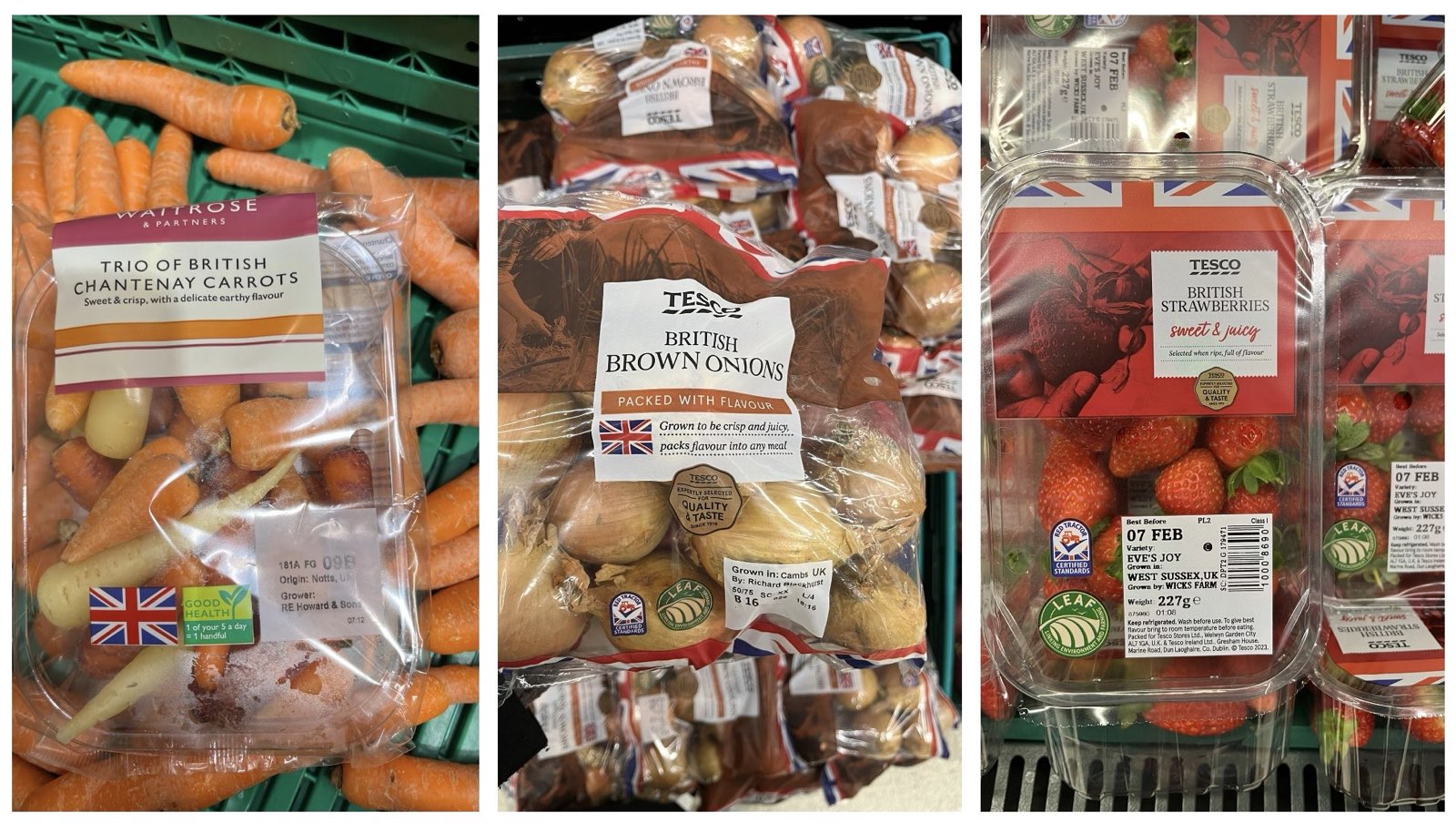
British flags adorn food packaging in the country’s supermarkets.
Images: Yvonne Mould (left); Elke Morgan (center and right)
Central Asia and Britain: An Unlikely Match
Seasonal workers have been traveling to the island of Britain for over a hundred years. In the nineteenth century, farmers would travel across the Irish Sea to help bring in the harvest. However, in the late 1990s, the number of people arriving on seasonal visas began to rise significantly. This was followed in the 2000s by a spike in workers from Europe, taking advantage of visa-free access to Britain’s labor market under the auspices of the European Union. They served as a pool of flexible, cheap workers for a farming industry that was being increasingly squeezed by the buying power of the country’s major supermarket chains.
When Britain voted to leave the EU in 2016, the farming industry panicked at the prospect of losing much of this cut-price labor force. They successfully lobbied the government to relaunch the Seasonal Worker Visa program on a trial basis. Originally designed in the 1940s for European students, the scheme was repackaged to empower private recruitment agencies to hire workers from across the world to work in the fields for six months a year. When the visa debuted in 2018, 2,500 people came. By 2021 – the year that freedom of movement between Britain and the EU officially ended – the government had already raised the quota to 30,000.
At the other end of Europe, the collapse in the value of the Russian Ruble since the start of 2023, combined with a crackdown on foreign laborers, has seen a mass exodus of Central Asians from Russia. By October 2024, there were around 30% fewer migrants in the country than there were on the eve of the Covid-19 pandemic.
Central Asian governments are actively seeking to create new employment opportunities for their citizens abroad to reduce reliance on Moscow. As a result, almost from nowhere, the UK Seasonal Worker Visa has become one of the hottest tickets in town. By 2023 (the last year for which the British Home Office has provided figures), almost 70% of these visas were granted to Central Asian nationals.
| Country of residence |
Seasonal Work Visas
issued in 2023 |
Percentage of total visas
issued in 2023 |
| Kyrgyzstan |
7,958 |
24.3% |
| Tajikistan |
5,665 |
17.3% |
| Kazakhstan |
5,014 |
15.3% |
| Uzbekistan |
4,091 |
12.5% |
| Ukraine |
2,535 |
7.7% |
| Moldova |
2,163 |
6.6% |
| Others |
5,298 |
16% |
Source, British Home Office
When it works, the scheme makes economic sense for all concerned. On the right farm at the right time of year, workers can expect 60-70 hours of work at the British minimum wage, which this year will be raised to £12.21 ($15) per hour. Working 70-hour weeks means potential wages, after tax and accommodation, of almost £3,000 ($3,700) per month.
“The farm rewarded good work, almost everyone received bonuses,” says Maksat, a farmworker from northern Kyrgyzstan who spent the first of his two years in England working on an apple orchard in Kent, in the southeast of the country. He asked to be referred to by his first name only. “The English know that if you give one person more, others will also want to work harder to get more as well. They are smart people; this is how they conquered the whole world!” he laughs.
The huge sums quoted above help to sell the idea of working in Britain to people back home; average monthly wages in Uzbekistan and Kyrgyzstan hover slightly above $400, whereas in Tajikistan they are as low as $240.
However, given the seasonal nature of the business, 70-hour weeks are hard to guarantee. Doolotbek Bektimov, who comes from a village in Kyrgyzstan’s Batken region, was delighted at the long hours he was given picking zucchini in Cornwall, southwest England, but after transferring to a tomato farm in Kent, he found his weekly workload was reduced to no more than 35 hours.
The accommodation, mandated to cost no more than £9.99 per day, is quite spartan, usually consisting of five people sharing a caravan. Other costs that must be considered are the visa, transport to work, medical insurance, and, especially, flights.
“My outbound flight ticket via Istanbul cost close to $400 as I bought it at the last minute,” says Bektimov. “People often have to do this because as soon as the visa is issued, you need to fly out there to make the most of the six months. The return flights are closer to $200.”
Nevertheless, despite these costs, he says he managed to come home with around one million Kyrgyz Som (around $12,000).

Left: Visa centers are opening across Bishkek promoting work in countries other than Russia.
Right: Bureaux de Change are increasingly accepting British Pounds. Images: Joe Luc Barnes
Lacking Leverage
The scheme is not without its critics. Chief amongst them is the idea of employer sponsorship itself, says Andrei Savitski of the Work Rights Centre, a charity that campaigns for employment justice. “Your visa is tied to your employer, and that employer has a level of bargaining power over you. That means workers might not wish to state grievances, or they might tolerate certain conditions that they otherwise wouldn’t.”
Bektimov agrees with this assessment. “You can’t complain; and if you do, the supervisors always reply in a very rude manner. If you don’t like something, then your contract will be stopped immediately.”
Daniyar and his wife Guljan, who traveled together to England, said they were warned before they arrived that the work would not be easy. “They made it very clear that the hours would be long and tiring, and that we should not complain about this. So, we knew what to expect,” says Guljan.
This vulnerability is exacerbated by the fact that many workers have taken on debt to come to Britain. The results of the British government’s Seasonal Workers Survey 2023 found that around 40% of respondents took out a loan, either from friends, family, or a formal institution, to fund their upfront costs.
This is particularly prevalent in Uzbekistan, where nearly half of workers reported having to pay extra fees for training, medical exams, or payments to the migration ministry. Source: Gov.uk
“All the risk burden lands on the worker,” says Dr. Medland. “There’s no independent trade union scheme that’s incorporated… it’s so much worse than the system before Brexit where EU migrants could come with full access to the labor market, full access to social services, they could bring their families, and they could come and leave. It was a more equal relationship.”
Troubleshooting
With such a new scheme, the British government has moved quickly to iron out some of the more egregious issues, one of which has been the number of scams involving fake firms promising non-existent jobs. Britain’s Gangmaster and Labour Abuse Authority has worked with both Uzbekistan and Kyrgyzstan to stamp out this trade, signing deals in 2023 to share information about specious recruitment agencies. In Kyrgyzstan, the government’s official migration portal means there is now a state-approved route for applicants, with no fees to pay aside from the visa (£298/$350).
Another step forward has been the requirement, since April 2023, for sponsors to provide a minimum of hours 32 hours work per week. At the scheme’s inception, for all the talk of 70-hour weeks, many workers were on so-called “zero-hours contracts” and were left in the lurch when work dried up.
Such precarity pushed some to the black market. Javlon, from the Sughd region of Tajikistan, who asked that his name be changed to protect his identity, harvested apples on a farm in Gillingham, around 50 kilometers from London, in October 2022. At the end of the harvest, he was told there was no more work for him. Frustrated, he got in touch with friends who quickly found him casual work in the construction sector. “Previously I worked on a construction site in Russia, so I found work doing that in England. It was very good money, much better than farming,” he said.
Even since the introduction of the 32-hour mandate, many workers continue to turn to the illegal labor market when work dries up. Maksat tells of his second trip, where he too worked in the black market after his contract on a vineyard near Chichester ended.
“There were five hundred of us, all with our contracts cut,” he said. “And of course, I’d already seen how many people work illegally, how easy it was. I went to a town called Kingston, just southwest of London; there was a car wash run by Albanians and they had many illegal workers. I spent two weeks working there. Then at the end of November, according to the contract, the recruitment agency provided another farm job, so I went to Manchester and worked until the end of the visa.”
He also alleges that some participants in the seasonal visa scheme simply used it as a means for more permanent illegal migration to Britain.
“There was just one guy who went with us, he flew to London, and people were waiting to collect him at the airport train station. He didn’t even work for one day. There were others on the farm who also fled to London. I guess everyone, as they say, has one life. I think lots of people must do it. I used to think that in England there were only the English,” he laughs. “And then I saw… Oh my, how wrong I was! I think this is why people talk about a migration crisis.”
Dr. Medland, however, believes that such stories are overstated. “One of the main responsibilities of the scheme operators is to ensure that the workers return. If the scheme operators can’t prove a very high returns percentage of people they sponsor, they are liable to lose their license.” She cites a House of Commons briefing which stipulates that this return percentage must be as high as 97%.
A Sustainable Long-Term Program?
Despite these problems, the scheme is proving popular in a region where job opportunities are sparse. All workers interviewed for this article signaled their intention to return to Britain in 2025. The British government, while under increasingly intense pressure to reduce migration and claiming to want to move towards automation in the agricultural sector in the long term, has nonetheless set a quota of 45,000 seasonal worker visas this year, and has extended the scheme as a whole until 2029.
For the foreseeable future a good chunk of local, home-grown, British food is likely to be harvested by Central Asian hands. For Dr. Medland, the issue is systemic: “Everybody in the food chain is under pressure. The just-in-time production demanded by the supermarkets creates a year-round demand for a very homogenous product at short notice and at speed. The migration system has been put in place to support that.”