• KGS/USD = 0.01144 0%
  • KZT/USD = 0.00217 0%
  • TJS/USD = 0.10456 0%
  • UZS/USD = 0.00008 0%
  • TMT/USD = 0.28490 0%
  • KGS/USD = 0.01144 0%
  • KZT/USD = 0.00217 0%
  • TJS/USD = 0.10456 0%
  • UZS/USD = 0.00008 0%
  • TMT/USD = 0.28490 0%
  • KGS/USD = 0.01144 0%
  • KZT/USD = 0.00217 0%
  • TJS/USD = 0.10456 0%
  • UZS/USD = 0.00008 0%
  • TMT/USD = 0.28490 0%
  • KGS/USD = 0.01144 0%
  • KZT/USD = 0.00217 0%
  • TJS/USD = 0.10456 0%
  • UZS/USD = 0.00008 0%
  • TMT/USD = 0.28490 0%
  • KGS/USD = 0.01144 0%
  • KZT/USD = 0.00217 0%
  • TJS/USD = 0.10456 0%
  • UZS/USD = 0.00008 0%
  • TMT/USD = 0.28490 0%
  • KGS/USD = 0.01144 0%
  • KZT/USD = 0.00217 0%
  • TJS/USD = 0.10456 0%
  • UZS/USD = 0.00008 0%
  • TMT/USD = 0.28490 0%
  • KGS/USD = 0.01144 0%
  • KZT/USD = 0.00217 0%
  • TJS/USD = 0.10456 0%
  • UZS/USD = 0.00008 0%
  • TMT/USD = 0.28490 0%
  • KGS/USD = 0.01144 0%
  • KZT/USD = 0.00217 0%
  • TJS/USD = 0.10456 0%
  • UZS/USD = 0.00008 0%
  • TMT/USD = 0.28490 0%

Parents of Olympic Gold Medalist Ilia Malinin Skated for Uzbekistan

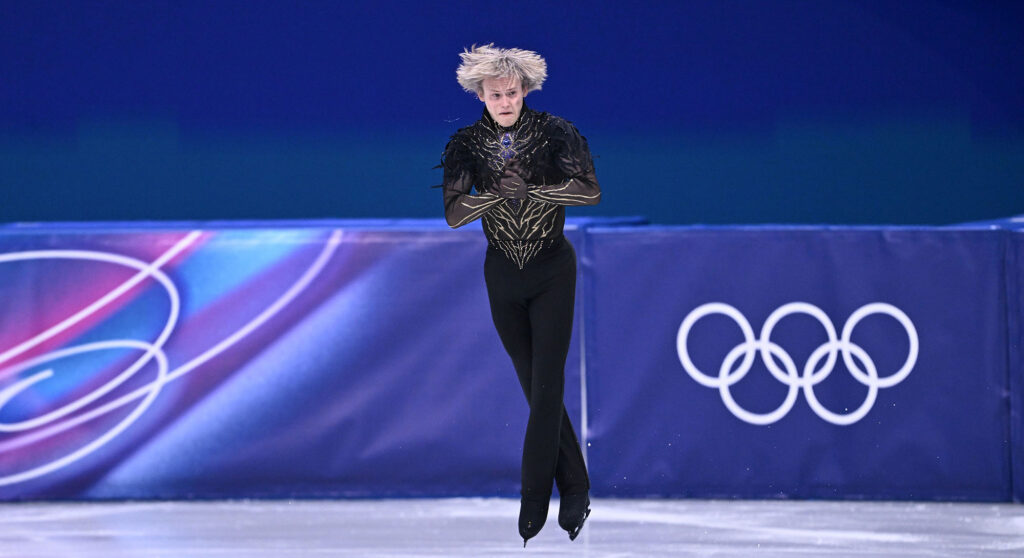
Known as the “Quad God,” American figure skater Ilia Malinin helped the United States win a team gold medal at the Winter Olympics with a performance that included a rare backflip. The young star is building on a family legacy: his Russia-born parents, Tatiana Malinina and Roman Skorniakov, skated at the elite level for Uzbekistan for many years.  

“It runs in the family,” the Olympic Games organization said on social media. 

Malinina, 53, and Skorniakov, 49, decided to compete in figure skating for Uzbekistan after its independence from the Soviet Union, which collapsed in 1991. They represented the country at the Winter Olympics at Nagano, Japan in 1998 and Salt Lake City in the United States in 2002. Both were national champions in Uzbekistan and the couple coached each other at one point.

They moved to the United States and got jobs as skating coaches in Virginia. Their pupils included son Ilia, who was born in the U.S. in 2004 and took up skating when he was a young boy.  

Malinin, 21, got the “Quad God” nickname because of his ability to perform the extremely difficult quadruple axel jump. But it was his team event backflip, a move that was once banned partly because it was considered too dangerous, that really fired up the crowd in Milan on Sunday. He stuck the landing on one skate. Tennis champion Novak Djokovic was in the audience and put his hands on his head in awe after Malinin’s daring maneuver on the ice. 

Malinin’s grandfather on his mother’s side was also a figure skater.  His younger sister has also competed in the sport. 

His mother Tatiana Malinina said that she and her husband initially didn’t want their son to get serious about figure skating. After all, they were well aware of the time, sacrifice and dedication that is required to succeed at the highest level.

“When our son was born, we were thinking, ‘Oh no, we’re not going to do this anymore,´” Malinina said in an International Skating Union interview. 

But young Ilia would show up at the skating rink, making his own programs to music. His parents taught him a few things but didn’t push him. Over time, the young boy’s talent, discipline and focus on excellence became apparent. 

Now Malinin is the two-time defending world champion. At a news conference last week, ahead of the Winter Olympics, he said he had been learning how to handle expectations and use them to channel his motivation and deliver on the ice.  

“I’m honestly thankful for all the pressure and the attention,” Malinin said.

A Eurasian Imprint on Judo’s Paris Grand Slam

The Paris Judo Grand Slam took place on February 7–8 at a sold-out Accor Arena, drawing more than 20,000 spectators to one of the sport’s most prestigious annual events.

Held under the auspices of the International Judo Federation (IJF) as a flagship stop on the IJF World Tour, the competition carried significant world-ranking points early in the qualification cycle for the Los Angeles 2028 Olympic Games. Nearly 500 athletes from 78 countries participated.

While Japan and France dominated the medal table at the Paris Judo Grand Slam, the tournament also underscored a quieter but enduring force in international judo: the sustained competitive influence of Central Asia and the South Caucasus.

Japan topped the medal table with gold medals from Takeshi Takeoka (–66 kg), Yuhei Oino (–81 kg), Goki Tajima (–90 kg), and Dota Arai (–100 kg). France secured three home victories through Shirine Boukli (–48 kg), Sarah-Léonie Cysique (–57 kg), and Romane Dicko (+78 kg).

The remaining titles reflected the tournament’s global reach. Balabay Aghayev delivered gold for Azerbaijan at –60 kg, Distria Krasniqi won –52 kg for Kosovo, Rafaela Silva captured –63 kg for Brazil, Makhmadbek Makhmadbekov claimed the –73 kg title representing the United Arab Emirates, and Szofi Özbas secured the –70 kg title for Hungary, according to official IJF results.

While Azerbaijan is geographically part of the South Caucasus, its Turkic cultural ties, Soviet-era sporting systems, and shared wrestling traditions closely align with Central Asia’s judo landscape. Aghayev’s gold for Azerbaijan, alongside Makhmadbekov’s –73 kg victory, highlighted transnational athlete pathways rooted in a common Eurasian combat sports tradition.

Makhmadbekov—an ethnically Tajik judoka born in Russia—has represented the United Arab Emirates in international competition since 2024, reflecting the increasingly transnational nature of elite judo careers.
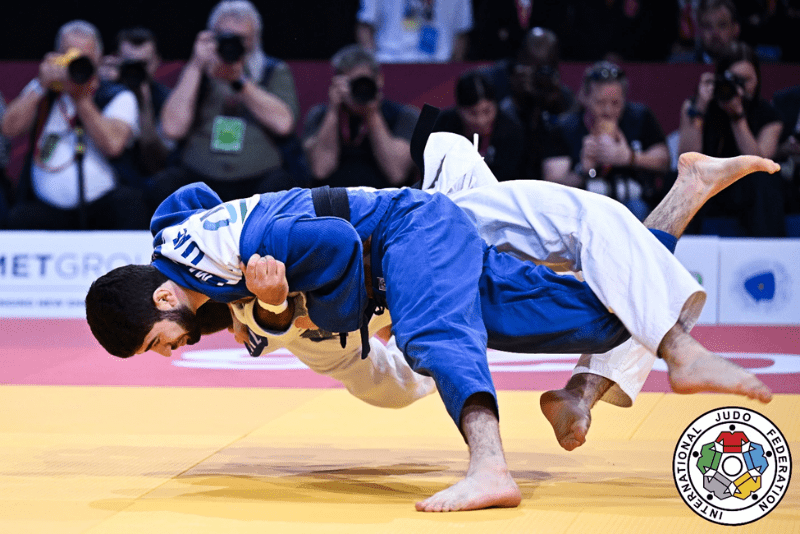
73 kg Final: Makhmadbek Makhmadbekov (United Arab Emirates) vs. Manuel Lombardo (Italy); image: Tamara Kulumbegashvili

Kazakhstan’s national judo team reinforced that regional presence by concluding the Paris Grand Slam with three bronze medals, one of its strongest results in the tournament’s history. Aman Bakhytzhan reached the podium in the –60 kg division, while Abylaikhan Zhubanazar (–81 kg) and Nurlykhan Sharkhan (–100 kg) added further medals on the second day.
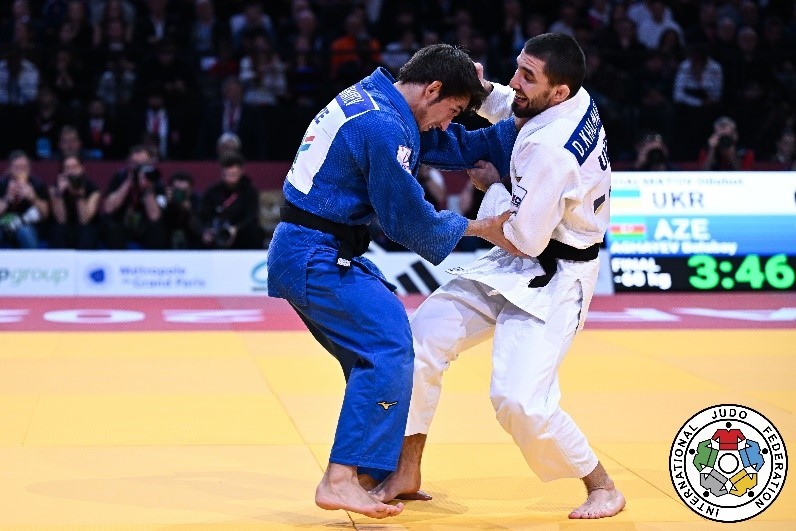
60 kg Final: Balabay Aghayev (Azerbaijan) vs. Dilshot Khalmatov (Uzbekistan); image: Tamara Kulumbegashvili 

Martial arts occupy a distinctive place across Central Asia and Azerbaijan, where indigenous wrestling traditions long predate modern Olympic disciplines. Styles such as kurash in Uzbekistan, kazakh kuresi in Kazakhstan, and gushtingiri in Azerbaijan, alongside their more traditional forms such as gulesh and zorkhana-influenced pekhlivan wrestling, emphasize balance, explosive throws, and physical control. These attributes remain clearly visible in contemporary judo.

These traditions continue to be showcased at events such as the World Nomad Games and regional festivals across Central Asia and the Caspian region. They were further refined during the Soviet era, which institutionalized sports and established the region as a major development base for elite combat athletes.

Since gaining their independence, Central Asian countries, as well as Azerbaijan, have continued to produce high-level judoka, with shared coaching lineages and training systems consistently feeding the top tiers of international competition. Olympic champions such as Yeldos Smetov from Kazakhstan, Diyora Keldiyorova from Uzbekistan, and Elnur Mammadli from Azerbaijan, alongside long-time world-level contenders including Abiba Abuzhakynova, point to the region’s sustained presence at the sport’s highest level—a pattern previously noted by The Times of Central Asia during its coverage of the Paris 2024 Olympic cycle.

That influence extends beyond the competitors themselves. Following the conclusion of the opening-day contests in Paris, Timur Kemell, a member of the official International Judo Federation (IJF) ceremony delegation of Kazakh origin, took part in presenting the medals. Kemell has been active in regional and international judo governance and development, participating in events organized under the auspices of the IJF.
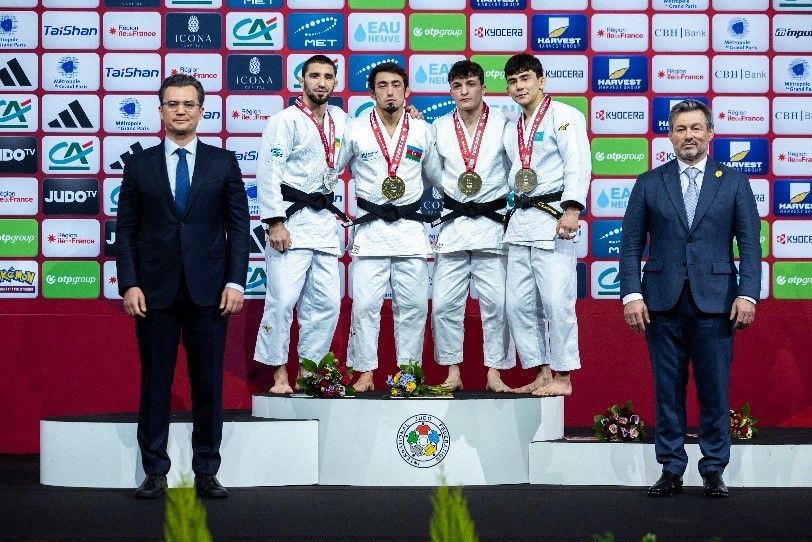
Day 1 Medal Ceremony: Timur Kemell, Dilshot Khalmatov, Balabay Aghayev, Izhak Ashpiz, Aman Bakhytzhan, and David Inquel at the Paris Judo Grand Slam; image: International Judo Federation (IJF)

The Paris Judo Grand Slam was officially opened by the International Judo Federation, with Marius Vizer, President of the IJF, and Stéphane Nomis, IJF Vice President and President of the French Judo Federation, leading the ceremony. Award presentations throughout the event also featured figures from sport and culture, including David Inquel, Albano Carrisi, Corinne Virulo-Cucchiara, Igor Tulchinsky, and Erika Merion, underscoring the tournament’s institutional and international stature.

At the Paris Judo Grand Slam, Eurasia’s role was not defined by flag dominance or overall medal totals, but by something more enduring: a deeply rooted martial-arts culture that continues to shape the technical and competitive foundations of international judo on one of the sport’s most visible global stages.

Kazakhstan and Kyrgyzstan Resume Data Sharing on Reservoirs and Transboundary Rivers

Kazakhstan and Kyrgyzstan have renewed formal cooperation in hydrometeorology, agreeing to exchange key hydrological data on major reservoirs and transboundary rivers, a development officials say is vital for regional flood management and agricultural planning.

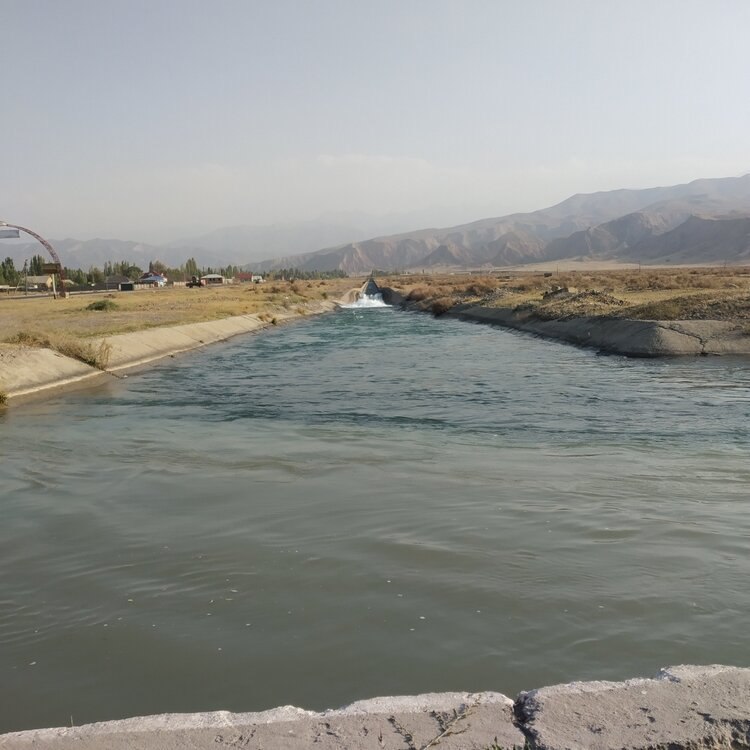
The agreement covers data exchange on the Kirov, Orto-Tokoy, and Toktogul reservoirs, all located in Kyrgyzstan but directly influencing downstream water supply in Kazakhstan.

The signing took place on February 9 in Astana, where Kyrgyzstan’s First Deputy Minister of Emergency Situations Mambetov Muratovich and Kazakhstan’s First Deputy Minister of Water Resources and Irrigation Nurlan Aldamzharov endorsed a 2026-2028 cooperation program between Kazhydromet and the Kyrgyz Hydrometeorological Service.

Key Components of the Agreement

The three-year program includes:

  • Regular exchange of hydrological data on shared rivers and reservoirs
  • Joint forecasting of basin runoff and water accumulation
  • Mutual hazard and storm warnings
  • Scientific and technical collaboration
  • Professional exchange between agencies

Describing the agreement as an achievement of “water diplomacy,” Aldamzharov emphasized that timely data is critical to protecting populations and infrastructure downstream, especially during peak water flow and flood risk periods.

Strategic Role of Kyrgyz Water Infrastructure

Kyrgyzstan plays a pivotal upstream role in Central Asia’s water system, delivering seasonal irrigation flows to southern Kazakhstan’s Turkistan, Kyzylorda, and Zhambyl regions via the Chu, Talas, and Syr Darya rivers.

Each of the reservoirs included in the data-sharing agreement serves a distinct strategic function:

  • Kirov Reservoir: Located in Kyrgyzstan’s Talas region, near the Kazakh border; vital for irrigating farmland on both sides.
  • Orto-Tokoy Reservoir: Situated on the Chu River, which flows into Kazakhstan, it regulates seasonal supply for downstream agriculture.
  • Toktogul Reservoir: Kyrgyzstan’s largest, located on the Naryn River, the principal tributary of the Syr Darya, one of Central Asia’s main water arteries feeding Kazakhstan and Uzbekistan.

According to Kazakhstan’s Ministry of Water Resources, during the 2025 growing season, Zhambyl region received 160 million cubic meters of water via the Chu River and 427.5 million cubic meters via the Talas River under existing water allocation frameworks.

Water Stress Ahead of Growing Season

Authorities warn that the Syr Darya basin continues to experience low-flow conditions. Reduced inflows to the Naryn-Syr Darya system are threatening irrigation reliability for the upcoming agricultural season. The Toktogul Reservoir may reach near-record low levels, heightening risks for downstream farmers.

In response, agricultural authorities in southern Kazakhstan have urged the adoption of water-saving irrigation technologies, a shift away from water-intensive crops, and greater reliance on drought-resistant varieties-steps that make access to reliable hydrological forecasts increasingly urgent.

Uzbekistan Bets on Digital Schools to Turn Demographic Growth into Human Capital

With one of Central Asia’s youngest populations and a rapidly changing economy, Uzbekistan is betting that education – particularly digital and inclusive schooling – can determine whether demographic growth becomes an economic asset or a long-term challenge.

Officials from Uzbekistan’s Ministry of Preschool and School Education say the country’s education system is being reshaped to support a development model centered on human capital, equal opportunity, and modern skills. The reforms are anchored in the national Uzbekistan 2030 Strategy, which identifies education and human capital development as central pillars of long-term economic and social transformation.

Around 6.8 million students are enrolled in almost 11,000 general education schools across Uzbekistan, while the preschool system now includes over 38,000 institutions serving children nationwide. While access has expanded significantly over the past decade, disparities in quality – particularly between urban centers and rural regions – remain a persistent challenge.

Digital Education as a Strategic Lever

To address these gaps, the Ministry is increasingly turning to online and blended learning. Digital platforms are being used to deliver standardized educational content nationwide, offering students in remote areas access to lessons and teaching materials that were previously unavailable.

An official from the Ministry described online education as “a complementary tool rather than a replacement for traditional schooling,” emphasizing its role in supporting both students and teachers.

Pilot projects supported by UNICEF have tested inclusive digital school models that combine classroom instruction with online resources in underserved regions.

Beyond student learning, digitalization is also reshaping how the education system is managed.

Electronic education management systems now allow authorities to track attendance, learning outcomes, and regional disparities more systematically, supporting data-driven policymaking and resource allocation.

Teachers at the Center of Reform

Teacher capacity remains one of the most critical variables in the success of digital reform.

Online professional development programs, including short-format training under initiatives such as ISHONCH 2030, are being used to help teachers and school leaders adopt modern practices. Officials argue that digital tools can reduce teacher workload and support independent learning.

However, they also acknowledge that technology alone cannot solve systemic challenges without sustained investment in training, infrastructure, and long-term support.

Aligning with Global Development Priorities

Uzbekistan’s education reforms broadly align with findings from World Bank analytical work on human capital and growth, which highlights education quality, digital skills, and reduced regional inequality as long-term priorities. The report highlights the importance of digital skills, reduced regional inequality, and closer alignment between education systems and labor market needs.

The Ministry says these priorities are increasingly embedded in national policy. Cooperation with international partners – including the World Bank, UNICEF, the Global Partnership for Education, and the European Union – supports curriculum reform, digital infrastructure expansion, and efforts to narrow regional gaps in learning outcomes.

Education and skills development were also highlighted as core priorities at the 2024 Country Platform meeting, reinforcing the sector’s strategic importance within the broader Uzbekistan 2030 agenda.

The Road to 2030

By the end of the decade, the Ministry of Preschool and School Education aims to introduce a nationwide “digital school” model. The vision includes stable internet access in all schools, electronic grading systems, and unified digital platforms connecting students, teachers, and administrators.

Future curricula are expected to place greater emphasis on critical thinking, digital literacy, environmental awareness, and skills relevant to a green and digital economy.

Reducing disparities between urban and rural schools – and ensuring full access for vulnerable and disabled children – remains a central objective.

While implementation challenges persist, particularly in infrastructure and teacher capacity, officials stress that education reform is a long-term investment rather than a quick policy win.

As Uzbekistan navigates economic transition and demographic pressure, the effectiveness of its preschool and school education reforms may prove decisive – not only for individual students, but for the country’s development trajectory over the next decade.

Uzbekistan and Islamic Development Bank Sign $164 Million Agreements for Roads and Schools

Uzbekistan and the Islamic Development Bank (IsDB) have signed new financing agreements totaling $164 million to support major infrastructure and education initiatives, further deepening a partnership that plays a key role in the country’s long-term development strategy.

The agreements were formalized on February 8 in AlUla, Saudi Arabia, during the Second AlUla Conference for Emerging Market Economies.

Prior to the signing, both sides held bilateral talks focused on scaling up cooperation across transport, education, and other high-priority sectors. The discussions emphasized the importance of projects that strengthen regional connectivity and human capital.

Road Infrastructure: 4R40 Project

One agreement allocates $70 million under the IsDB’s broader $192 million commitment for the 4R40 road project. The funds will support the reconstruction of 143 kilometers of the Dashtabad-Zaamin-Bakhmal-Galyaaral highway, as well as the rehabilitation of 30 kilometers of local and rural roads in the Jizzakh region.

The road upgrades are expected to ease transit bottlenecks, enhance safety, and improve access to markets and public services for approximately 200,000 residents. The project will also strengthen regional links to the M39 international transport corridor.

Education Reform: SmartEd Project

The second agreement covers $94.06 million, part of a total contribution of $160.25 million for the SmartEd project, a national initiative aimed at transforming Uzbekistan’s education system.

Funds will be used to build and equip 58 new schools and expand existing institutions with an additional 2,431 classrooms. The initiative targets nearly 73,000 students annually, with provisions for specialized training for over 36,000 teachers and administrators. The project is designed to promote a competency-based, inclusive education system.

A Broader Partnership

These new agreements build on earlier commitments. At the first AlUla conference in February 2023, Uzbekistan and the IsDB signed $299 million in financing deals, laying the foundation for the infrastructure and education reforms now entering the implementation phase.

Kyrgyzstan Launches e-Permit System for Freight Transport to China and Turkic States

Kyrgyzstan has launched a new digital system for international freight transport, replacing paper permits with an electronic platform for cross-border trucking to China and several Turkic states.

The Ministry of Transport and Communications introduced the e-Permit system in January 2026, allowing domestic carriers to obtain permits online for shipments to China, Uzbekistan, Azerbaijan, and Turkey.

Previously, Kyrgyzstan and China operated under a fixed annual quota of paper permits exchanged on a parity basis; 130,000 permits were issued in 2025 alone. The digital platform eliminates in-person applications, significantly reducing queues and administrative burden.

According to the ministry, the new system has cut processing times from up to 24 hours to just 10 minutes. Officials say it enhances transparency, improves administrative efficiency, and helps reduce the risk of corruption.

Regional Logistics Strategy

The launch of e-Permit is part of Kyrgyzstan’s broader effort to position itself as a regional logistics hub. Authorities view streamlined cross-border transport procedures as essential to boosting trade, especially as the country expands its economic ties with neighboring and Turkic states.

Integration with TRACECA

The e-Permit rollout follows Kyrgyzstan’s December 2025 accession to the multilateral permit system of the Transport Corridor Europe-Caucasus-Asia (TRACECA).

Membership in TRACECA allows Kyrgyz carriers to conduct bilateral and transit shipments using a single multilateral permit across participating countries, including Armenia, Georgia, Moldova, Romania, Turkey, and Ukraine.

Officials say the integration will lower transport costs, reduce delivery times, and facilitate broader access for Kyrgyz exports to European, Turkish, and Black Sea markets.