• KGS/USD = 0.01144 0%
  • KZT/USD = 0.00193 -0%
  • TJS/USD = 0.10811 -0.28%
  • UZS/USD = 0.00008 0%
  • TMT/USD = 0.28490 0%
  • KGS/USD = 0.01144 0%
  • KZT/USD = 0.00193 -0%
  • TJS/USD = 0.10811 -0.28%
  • UZS/USD = 0.00008 0%
  • TMT/USD = 0.28490 0%
  • KGS/USD = 0.01144 0%
  • KZT/USD = 0.00193 -0%
  • TJS/USD = 0.10811 -0.28%
  • UZS/USD = 0.00008 0%
  • TMT/USD = 0.28490 0%
  • KGS/USD = 0.01144 0%
  • KZT/USD = 0.00193 -0%
  • TJS/USD = 0.10811 -0.28%
  • UZS/USD = 0.00008 0%
  • TMT/USD = 0.28490 0%
  • KGS/USD = 0.01144 0%
  • KZT/USD = 0.00193 -0%
  • TJS/USD = 0.10811 -0.28%
  • UZS/USD = 0.00008 0%
  • TMT/USD = 0.28490 0%
  • KGS/USD = 0.01144 0%
  • KZT/USD = 0.00193 -0%
  • TJS/USD = 0.10811 -0.28%
  • UZS/USD = 0.00008 0%
  • TMT/USD = 0.28490 0%
  • KGS/USD = 0.01144 0%
  • KZT/USD = 0.00193 -0%
  • TJS/USD = 0.10811 -0.28%
  • UZS/USD = 0.00008 0%
  • TMT/USD = 0.28490 0%
  • KGS/USD = 0.01144 0%
  • KZT/USD = 0.00193 -0%
  • TJS/USD = 0.10811 -0.28%
  • UZS/USD = 0.00008 0%
  • TMT/USD = 0.28490 0%
10 December 2025

U.S. Senate Confirms Julie Stufft as Ambassador to Kazakhstan

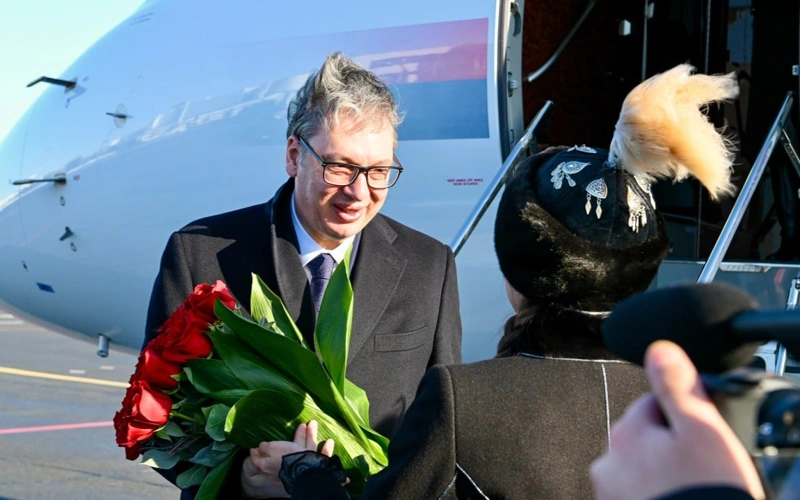
On October 7, the United States Senate confirmed Julie Stufft as the new U.S. Ambassador to Kazakhstan, approving her nomination by a vote of 51 to 47, and marking the first new U.S. envoy to Astana under President Donald Trump. A career diplomat and Senior Foreign Service Minister-Counselor, Stufft previously served as Deputy Assistant Secretary for Visa Services. During her July 2025 confirmation hearing, Stufft outlined her priorities, citing the security of U.S. citizens, energy cooperation, and critical minerals partnerships as top priorities. “If confirmed, my primary task will be to ensure the safety of all Americans in Kazakhstan, including my embassy and consulate staff,” she said.

Stufft emphasized Kazakhstan’s strategic importance as a key U.S. partner in Central Asia, highlighting opportunities for expanded economic cooperation, particularly in energy and critical minerals. “Today, we stand on the threshold of a new era of trade and energy cooperation with Kazakhstan, a world leader in uranium production, a major oil exporter, and a holder of vast reserves of critical minerals,” she said.

Stufft added that she intends to collaborate with the Bureau of Economic, Energy, and Business Affairs, the U.S. International Development Finance Corporation, the Export-Import Bank, and the private sector to deepen bilateral economic ties and promote U.S. prosperity.

Stufft’s confirmation received some bipartisan support, with Senators Jeanne Shaheen (D-NH) and Steve Daines (R-MT) praising her professional experience and diplomatic capabilities.

She succeeds Daniel Rosenblum, who retired in December 2024 after 28 years of service in the State Department. Her nomination was formally submitted by the White House and approved by President Donald Trump in the summer of 2025.

Stufft is a career diplomat and a member of the Senior Foreign Service. Before her appointment, she served at the Bureau of Consular Affairs. Her previous overseas postings include assignments in Russia, Poland, Ethiopia, Moldova, and Djibouti. She also served on the National Security Council, coordinating efforts to protect Americans during the COVID-19 pandemic.

Stufft holds degrees from Case Western Reserve University and Duke University. She speaks Russian, Romanian, French, and Polish. In 2023, she received the Presidential Award for Distinguished Service and has earned seven State Department awards over her career.

“We must actively oppose violence against women and girls,” she said, underscoring her commitment to gender equality as part of U.S. foreign policy. Stufft is a fellow of the International Women’s Forum (2021-2022) and participated in the MIT Center for International Studies’ Seminar XXI program (2014-2015).

RC Cola Launches Production Facility in Southern Kazakhstan

A beverage production plant under the global RC Cola brand has officially opened in the Turkestan region of Kazakhstan. Operated by Beibars Bottlers, the facility is located in the village of Kumisbastau in the Tulkubas district and is designed to produce up to 120,000 tons of beverages annually, according to the regional administration.

The product line includes RC Cola carbonated drinks, bottled water, and other non-alcoholic beverages. The project attracted $16.7 million in investment, with plans to supply both the domestic market and neighboring Central Asian countries.

“The new plant features production lines based on advanced German and Italian technologies, along with an environmentally friendly, multi-stage water purification system,” the local mayor’s office said. “Water is drawn from wells 170 meters deep and tested in leading laboratories in the US and Italy.”

The facility has created 100 new jobs and contributed to local infrastructure development. As part of the project, more than 6 kilometers of 35 kV power lines, a new $1.3 million substation, a gas pipeline, and treatment facilities have been constructed.

The opening ceremony was attended by RC Cola International General Manager Francis Lampera and project investor Amangeldy Nurov, founder of Beibars Bottlers LLP. They stated that the launch will boost RC Cola’s presence in Central Asia and solidify its footprint in the Kazakh market.

RC Cola (Royal Crown Cola) was founded in 1905 by American pharmacist Claude A. Hatcher. It was the first brand to introduce canned soda and a caffeine-free diet cola. The brand is now owned by Keurig Dr Pepper and distributed internationally through RC Cola International.

As previously reported by The Times of Central Asia, RC Cola competitor The Coca-Cola Company recently inaugurated a new production plant in Uzbekistan, which is also part of the company’s expansion strategy in the Turkestan region.

Kazakhstan Investigates Telegram Founder Pavel Durov for Swimming in Protected Kolsai Lake

Pavel Durov, founder of the Russian messaging app Telegram, may face an administrative fine in Kazakhstan after posting a video of himself swimming in Kolsai Lake, a protected natural area where swimming and fishing are prohibited.

Durov arrived in Kazakhstan in early October to participate in the Digital Bridge 2025 forum in Astana, later visiting Almaty. During the trip, he shared a video on his own Telegram channel that showed him emerging from the waters of Kolsai Lake in the Almaty region. The post sparked widespread reaction on social media, given the lake’s status as part of a national park with strict visitation rules.

Under Kazakh law, violations of protected area regulations are punishable by a fine of up to $72.

The Kolsai Lakes National Park administration confirmed that an official investigation is underway. Deputy Chairman of the Administrative Police Committee, Alexei Milyuk, said the case has been referred to the Ministry of Ecology and Natural Resources.

“We have collected materials based on media reports and social media posts, registered them, and forwarded them to the appropriate authorities,” Milyuk told reporters. “The question of bringing Pavel Durov to justice is now being considered by the environmental authorities.”

He added that penalties may be limited to a warning, with $72 being the maximum fine.

Durov later posted a follow-up video showing himself holding a metal rod, stating that he had entered the water to retrieve an object he noticed protruding from the lakebed in an effort to clean the area.

During his visit, Durov also announced the launch of Telegram’s AI Lab at the Alem.ai International Artificial Intelligence Center in Astana.

Kyrgyzstan Warns of Potential Fuel Shortage

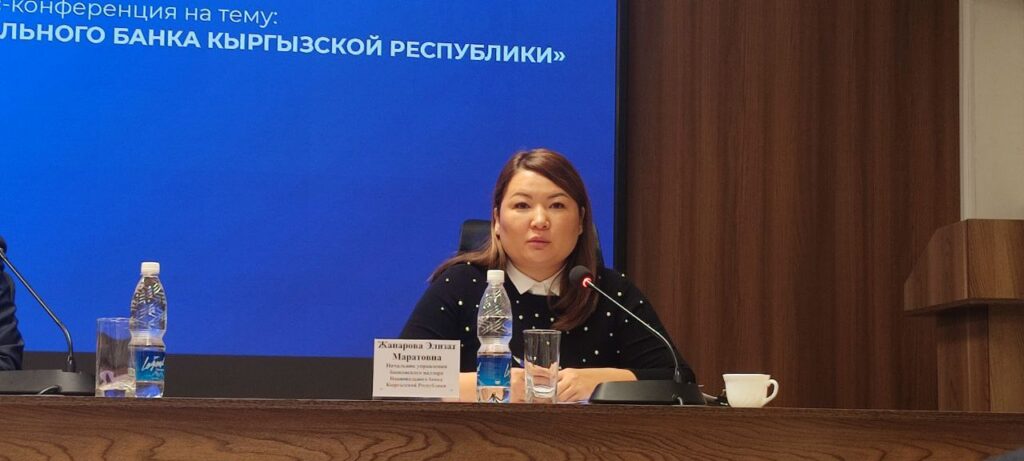
Kyrgyzstan’s Antimonopoly Regulation Service has urged oil traders to avoid unjustified price increases and to ensure continuous fuel supplies, amid concerns about dwindling gasoline reserves.

According to participants in a recent meeting convened by the Antimonopoly Regulation Service, including representatives from the presidential administration, the country’s current gasoline reserves are sufficient for only one month.

Oil traders attributed recent price hikes at gas stations to rising wholesale prices at Russian refineries and a reduction in fuel shipments from Russia, Kyrgyzstan’s primary supplier.

“Following the meeting, proposals were prepared to stabilize the situation on the fuel market, which will be sent to the Ministry of Economy and Commerce,” the Antimonopoly Regulation Service said in a statement.

The regulator called on market players to “maintain fair competition,” refrain from unjustified price increases, and prevent disruptions in fuel availability. Traders reportedly pledged to maintain uninterrupted supplies through the end of the year, despite ongoing challenges in Russia.

Kyrgyzstan relies heavily on Russian fuel imports, which it receives at preferential rates and without export duties. However, deliveries have fallen due to scheduled maintenance at Russian refineries and recent attacks on oil infrastructure.

Fuel industry representatives said a new supply agreement with Russia for 2026 is expected to be signed by the end of this year.

Kazakhstan Maintains Diplomatic Balance Following Gaza Ceasefire

On Monday, the Palestinian group Hamas handed over the final 20 surviving hostages to Israel in a two-stage exchange, reportedly mediated with the involvement of Qatari representatives. By midweek, the outcome of the latest ceasefire attempt between Israel and Hamas may become clearer. On October 13, U.S. President Donald Trump addressed the Knesset in Israel, before traveling to Egypt for a summit. The hostages had been held for more than two years, mirroring the duration of Israel’s military campaign that has reverberated across the region.

The two-stage exchange formed part of a broader ceasefire framework backed by the United States, Egypt, and Qatar. Washington has framed the deal as a cornerstone of its renewed Middle East peace initiative, which aims to establish a long-term truce and pave the way for gradual reconstruction in Gaza. Trump described the agreement as the “beginning of a new security architecture for the region,” though analysts caution that deep mistrust between the parties could still derail implementation.

The ongoing war in the Middle East is impacting Kazakhstan, as it is across Central Asia. Anti-Israeli sentiment has grown in this majority-Muslim country, though the government continues to advocate for a balanced and diplomatic approach. For Astana, maintaining neutrality amid the polarized reactions to the war is not just a matter of diplomacy, but also a matter of regional stability. Kazakhstan’s leadership views itself as a potential bridge between Muslim-majority nations and Western partners, drawing on its history of multivector foreign policy. Officials stress that Astana’s engagement is guided by the principles of dialogue and international law rather than religious or ideological alignment.

A Delicate Diplomatic Position

Kazakhstan has consistently supported international peacekeeping efforts. On September 30, President Kassym-Jomart Tokayev backed Trump’s Gaza peace plan, and on October 9, Tokayev welcomed the ceasefire agreement in the Gaza Strip and the release of hostages, as announced by his press secretary, Ruslan Zheldibay. Tokayev commended the mediation efforts of Egypt, Qatar, and Turkey, and acknowledged the contributions of the United States and President Trump in advancing peace negotiations in the region.

Kazakhstan recognized the State of Palestine in 1992 and established diplomatic ties. While economic relations remain minimal, the recognition holds symbolic political significance. At the same time, Kazakhstan maintains relatively strong relations with Israel, with a notable volume of bilateral trade. The country’s longstanding diplomatic stance emphasizes the principle of “two states for two peoples.”

Bilateral trade between Kazakhstan and Israel exceeded $450 million in 2023, driven primarily by exports of Kazakh metals and imports of Israeli technology and agricultural products. Cooperation in water management, healthcare, and defense technologies has continued despite regional instability. Kazakh officials have also emphasized the importance of Israeli investment in innovation and renewable energy sectors.

Kazakhstan’s diplomatic position has been reiterated consistently. In November 2023, the Ministry of Foreign Affairs reaffirmed that the only sustainable solution to the conflict lies in the creation of two sovereign states.

Amid intensified hostilities in October 2023, Israel imposed a blockade on Gaza. At that time, 76 Kazakhstani citizens, 161 individuals including family members, were reported in the Gaza Strip. One Kazakhstani woman and her Palestinian daughter were killed during Israeli shelling. Dozens sought evacuation, which commenced in November after negotiations with Israel.

Despite its support for Palestinian self-determination, Kazakhstan has maintained constructive ties with Israel. Following the collapse of the USSR, a significant number of Kazakh Jews emigrated to Israel, strengthening people-to-people connections. However, the war has strained personal, social, and business relationships.

In September 2023, Air Astana launched its first direct flight between Almaty and Tel Aviv. The route was suspended a month later due to regional security concerns.

Still, diplomatic engagement continues. On October 8, 2025, Kazakhstan’s Minister of Foreign Affairs, Yermek Kosherbayev, held a phone call with his Israeli counterpart, Gideon Saar, to discuss bilateral cooperation and the implementation of high-level agreements.

Public Sentiment and the Risk of Radicalization

Social media has amplified the emotional impact of the Gaza conflict in Kazakhstan. Hashtags supporting Palestinians have trended on local platforms, while pro-Israel voices often faced online backlash. Analysts say this digital polarization has blurred the line between political critique and religious hostility, prompting media regulators to call for “responsible discourse” in online spaces.

While analysts say most Kazakhstani citizens view the Middle East conflict as “not our war,” the escalation in Gaza has triggered a surge in anti-Israeli sentiment, with rising religiosity across Central Asia contributing to a more emotionally charged public discourse.

In December 2023, Israel’s National Security Agency raised its threat level for Central Asia, advising Israeli citizens to “avoid non-essential” travel to Kazakhstan, Uzbekistan, Kyrgyzstan, and Turkmenistan. The advisory surprised many, as there had been no reported anti-Semitic incidents in Kazakhstan at the time.

In contrast, in October 2023, violent riots erupted in Makhachkala, Russia, following the arrival of a flight from Tel Aviv. Thousands stormed the airport in what authorities described as an anti-Semitic pogrom, resulting in dozens of arrests.

Similar incidents were reported in parts of Western Europe, including France and Germany, which experienced a rise in anti-Semitic attacks. However, no comparable travel advisories were issued for those countries or for Russia. Several Western European countries, such as France and Germany, were upgraded to Level 2 (“exercise increased caution”), reflecting elevated, but what were comparatively perceived to be lower risk levels.

In response, Kazakhstan’s Ministry of Information and Social Development expanded its programs on interfaith tolerance and online monitoring of extremist narratives. The government has also increased cooperation with international partners to counter hate speech and prevent radicalization, emphasizing prevention through education and community engagement rather than repression.

In April 2025, concerns were raised domestically over proposals to relocate a Jewish cemetery near the mausoleum of Khoja Ahmed Yasawi in Turkestan. Public figure Turarbek Kusainov linked these calls to rising anti-Semitism and criticized some sermons by religious figures as inciting hatred against Jews and Christians. “In speeches by some imams and leaders within the Spiritual Administration of Muslims of Kazakhstan, Jews are described as a people upon whom God’s wrath has fallen,” said Kusainov in an interview. “This language fosters interreligious hostility and promotes anti-Semitic narratives. Christians are also labeled as ‘lost’ in similar rhetoric.”

Kusainov and other civil society members have submitted appeals to government bodies calling for action against hate speech. He emphasized Kazakhstan’s long tradition of religious coexistence, noting the peaceful presence of Bukhara Jews and various Christian communities in the region.

Despite isolated incidents and growing tensions, Kazakhstan remains committed to interfaith harmony and dialogue, as evidenced by Astana hosting the 8th Congress of Leaders of World and Traditional Religions in September 2025, where Tokayev called on “religious figures to help prevent global chaos, reminding politicians of common sense, goodwill, and moral responsibility.” The Kazakh authorities continue to take steps to protect religious sites of all faiths, and there are currently no organized domestic movements demanding Palestinian statehood.

Ultimately, Kazakhstan’s approach to the Middle East crisis reflects its broader foreign-policy philosophy: a multivector strategy that balances relations with the West, the Islamic world, and regional partners. By maintaining dialogue with both Israel and Palestine, Astana is seeking to preserve internal cohesion while reinforcing its image as a responsible actor in international peacebuilding.

Uzbekistan’s Akbar Juraev Takes Three Golds at World Weightlifting Championships

Uzbek weightlifter Akbar Juraev delivered one of the standout performances of the 2025 World Weightlifting Championships by claiming three gold medals in the men’s 110 kg class, breaking world records and asserting his dominance in the sport.

The championships, held October 2–11 in Førde, Norway, drew nearly 500 athletes from 87 countries to compete under the auspices of the International Weightlifting Federation (IWF). On Day 9, the 110 kg division was one of the marquee finals, especially as two Uzbek Olympic champions – Juraev and Ruslan Nuridinov – faced off in the same category. 

Juraev, 25, came in with a formidable résumé: already a world champion in 2021 and 2023, and an Olympic gold medalist from Tokyo 2020. After a near-miss at the 2024 Paris Games, where he took silver in the 102 kg class, Juraev said he was “back at my right weight” and hungry for redemption. 

In Norway, Juraev delivered a flawless sequence. On his third snatch attempt he lifted 196 kg, setting a new world record in the snatch. He followed that with a 232 kg clean and jerk, reaching a combined total of 428 kg, also a world record. He even attempted 245 kg in the clean and jerk, later joking that he was “just messing around.”

After the victory, Juraev said, “I am back at my right weight. I can eat properly, train properly. I feel good, very happy.” He added that last year’s Olympic disappointment still drives him: “That’s why I have silver and not gold.” 

Juraev’s sweep of snatch, clean & jerk, and total golds made him a three-time world champion.

Meanwhile, his compatriot Nuridinov, the 33-year-old veteran and Rio 2016 Olympic champion, also shone in Førde. He lifted 186 kg in the snatch and 228 kg in the clean and jerk, earning two bronzes (in clean & jerk and total) with a combined 414 kg. His performance underscored not only his own resilience but also Uzbekistan’s continuing dominance in the world of weightlifting.