• KGS/USD = 0.01144 0%
  • KZT/USD = 0.00193 -0%
  • TJS/USD = 0.10876 0.55%
  • UZS/USD = 0.00008 0%
  • TMT/USD = 0.28490 0%
  • KGS/USD = 0.01144 0%
  • KZT/USD = 0.00193 -0%
  • TJS/USD = 0.10876 0.55%
  • UZS/USD = 0.00008 0%
  • TMT/USD = 0.28490 0%
  • KGS/USD = 0.01144 0%
  • KZT/USD = 0.00193 -0%
  • TJS/USD = 0.10876 0.55%
  • UZS/USD = 0.00008 0%
  • TMT/USD = 0.28490 0%
  • KGS/USD = 0.01144 0%
  • KZT/USD = 0.00193 -0%
  • TJS/USD = 0.10876 0.55%
  • UZS/USD = 0.00008 0%
  • TMT/USD = 0.28490 0%
  • KGS/USD = 0.01144 0%
  • KZT/USD = 0.00193 -0%
  • TJS/USD = 0.10876 0.55%
  • UZS/USD = 0.00008 0%
  • TMT/USD = 0.28490 0%
  • KGS/USD = 0.01144 0%
  • KZT/USD = 0.00193 -0%
  • TJS/USD = 0.10876 0.55%
  • UZS/USD = 0.00008 0%
  • TMT/USD = 0.28490 0%
  • KGS/USD = 0.01144 0%
  • KZT/USD = 0.00193 -0%
  • TJS/USD = 0.10876 0.55%
  • UZS/USD = 0.00008 0%
  • TMT/USD = 0.28490 0%
  • KGS/USD = 0.01144 0%
  • KZT/USD = 0.00193 -0%
  • TJS/USD = 0.10876 0.55%
  • UZS/USD = 0.00008 0%
  • TMT/USD = 0.28490 0%
11 December 2025

Kyrgyzstan to Open 100 Overseas Polling Stations for 2025 Parliamentary Elections

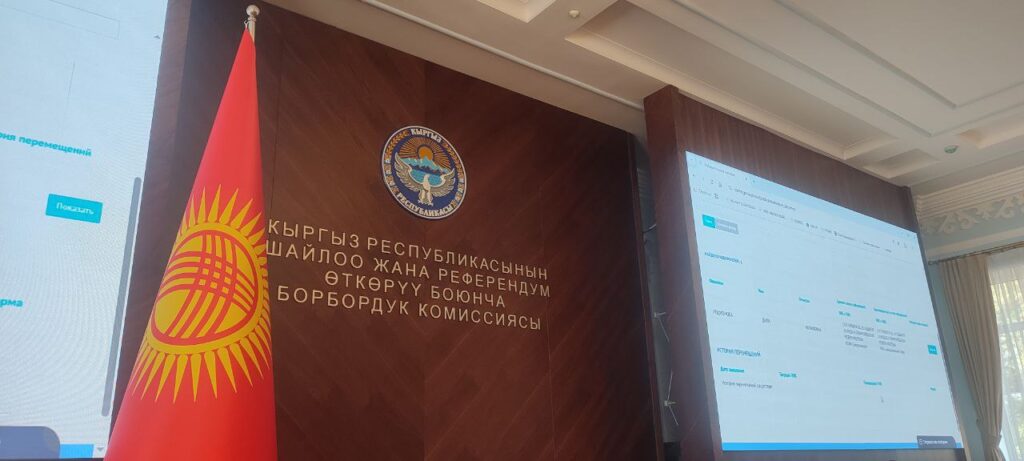
The Central Election Commission and Referenda (CEC) of Kyrgyzstan will open 100 polling stations abroad for the parliamentary elections scheduled for November 30, 2025, nearly double the number established during the previous election cycle, when 51 polling stations operated globally. The announcement was made by CEC Chairman Tynchtyk Shainazarov during a press conference in Bishkek.

According to Shainazarov, the largest number of polling stations will be set up in Russia, 40 in total, including seven in Moscow and others across major Russian cities. Approximately 400,000 Kyrgyz citizens are officially registered as residing in Russia, the highest figure among all foreign countries.

Additional polling stations will be opened in Turkey (8), the United States (6, including two in Chicago), South Korea (4), Italy (3), and in Germany and China (2 each). Several other capital cities worldwide will also host single polling stations.

Shainazarov noted that the CEC has already dispatched five teams to Russian cities to conduct trial runs of the voting process. Test elections will be held on October 10, 20, and 30 in both Kyrgyzstan and Russia to identify potential technical or procedural issues.

“I urge our citizens living in Russia to come and observe how the new system will function, how the equipment operates and how it prints ballots corresponding to the voter’s home district. Seeing the process firsthand will help people understand how the upcoming elections will be conducted,” Shainazarov said.

Responding to a question from The Times of Central Asia about whether Kyrgyz citizens abroad would be able to vote remotely, Shainazarov confirmed that remote (electronic) voting has been fully suspended for the 2025 parliamentary elections. The decision, he said, was made to reduce the risk of vote-buying and electoral manipulation.

“Electronic voting allows people to vote from home using a smartphone. Technically and legally, we are ready for it, but the risk of vote-buying remains too high; a candidate could pay voters and verify how they voted. That is unacceptable,” he explained.

An exception will be made for voters who are physically unable to travel to polling stations due to medical reasons. In such cases, election commission staff will visit voters at home with the necessary equipment, provided a prior request is submitted to the CEC.

This year’s elections will also introduce a new voting system: ballots for candidates from different constituencies will be printed directly at polling stations. According to the CEC, this measure is intended to help prevent ballot fraud and enhance transparency.


Kyrgyzstan Releases Its First Climate Action Transparency Report

On October 7, Kyrgyzstan’s Ministry of Natural Resources, Environment, and Technical Supervision unveiled its first Biennial Climate Action Transparency Report, marking a key step in aligning with international climate obligations.

The report was developed with contributions from government agencies, academic institutions, the private sector, and civil society, with support from the United Nations Development Programme (UNDP). It outlines the country’s progress in addressing climate change, current greenhouse gas (GHG) emissions, climate risk preparedness, and the external support it has received.

According to the report, Kyrgyzstan’s total GHG emissions in 2023 amounted to 19.38 million tons of CO₂ equivalent. At the same time, the country’s forests, soils, and other ecosystems absorbed 10.31 million tons, resulting in net emissions of 9.07 million tons of CO₂ equivalent. The report notes that this “climate safety net” provides a valuable natural buffer that should be protected and expanded.

The energy sector remains the largest source of emissions, accounting for more than half of the total. However, emissions from transport, electricity generation, and heating have declined significantly since the early 1990s, largely due to the adoption of cleaner technologies and improved energy efficiency. Agriculture is the second largest contributor to emissions, primarily driven by livestock farming, with levels remaining relatively stable over recent decades.

The submission of the transparency report is a requirement under the Paris Agreement, the international climate treaty signed by Kyrgyzstan in 2016.

Beyond fulfilling a global commitment, transparent reporting is also a pathway to unlocking funding from international financial institutions, climate funds, and private investors. According to the report, improved transparency can help attract investment in energy efficiency, renewable energy, sustainable water management, climate-smart agriculture, and disaster risk reduction, critical elements in Kyrgyzstan’s strategy to achieve carbon neutrality by 2050.

Kazakhstan and Germany Partner on Sustainable Water Management

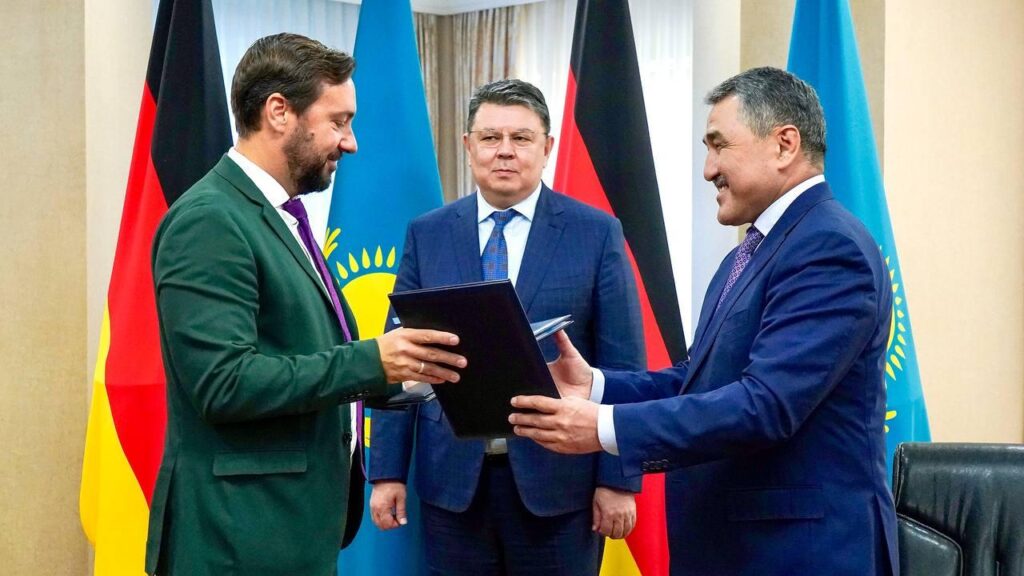
Kazakhstan’s Ministry of Water Resources and Irrigation and the German Water Partnership (GWP) signed a Strategic Partnership Agreement on October 8 aimed at enhancing bilateral cooperation in sustainable water management.

The agreement will allow Kazakhstan to adopt international best practices and advanced water-saving technologies, strengthen climate resilience in the water sector, improve flood and drought response, and expand training for water-sector professionals.

GWP is Germany’s leading water-sector network with a strong international focus. It brings together around 300 companies, trade associations, and institutions from business, science, and research.

German expertise is already contributing to Kazakhstan’s digital projects in water resource forecasting, modeling, and accounting. German technologies are also being used in the construction of hydraulic infrastructure across the country.

Following the signing, Deputy Prime Minister Kanat Bozumbayev and GWP Managing Director Boris Greifeneder discussed plans to deepen cooperation. One key proposal was the establishment of a Kazakh-German Water Innovation Hub, to be housed at the Information and Analytical Center of the Ministry of Water Resources and Irrigation, with GWP’s support.

In a related initiative, the Kazakh-German University (DKU), the National Academy of Sciences of Kazakhstan, and the Kazakh National Agrarian Research University, supported by Germany’s Hanns Seidel Foundation, recently launched a new scientific and educational hub: the Kazakh-German Nexus Institute.

Headquartered in Almaty, the Nexus Institute will focus on developing evidence-based policies for sustainable land and water use in Central Asia.

Water resource management remains a critical priority for Kazakhstan, particularly in the country’s arid southern regions where agriculture depends heavily on efficient irrigation systems.

Kazakh Lawmakers Propose Extending Import Benefits for Electric Vehicles

Olzhas Nuraldinov, a member of the Mazhilis, Kazakhstan’s lower house of parliament, has proposed that Prime Minister Olzhas Bektenov extend the country’s preferential import regime for electric vehicles (EVs). Under the Customs Union Commission’s Decision No. 130 of November 27, 2009, electric vehicles can currently be imported into Kazakhstan duty-free. However, the regulation imposes a quantitative cap, no more than 15,000 EVs in total, and is set to expire on December 31, 2025.

As of September 25, 2025, more than 13,000 electric vehicles had been imported under the scheme, accounting for 87.2% of the quota, according to Kazakhstan’s State Revenue Committee. Lawmakers argue that it is unlikely the 15,000 vehicle threshold will be reached by year’s end and are therefore urging the government to extend the deadline.

“Once the preferential regime expires, electric vehicle prices will rise by 30-40%, which will reduce demand and slow the development of eco-friendly transport,” Nuraldinov said in a formal parliamentary appeal to the prime minister. “We propose extending the preferential import regime for at least three more years and, if necessary, raising the issue with the Eurasian Economic Commission.”

According to Nuraldinov, EV imports increased twelvefold in two years, from 1,245 units in 2022 to 15,700 in 2024. Some of these imports occurred outside the preferential framework, as roughly 1,900 vehicles can still be imported duty-free under the current quota.

Despite this growth, electric vehicles still represent just 0.5% of all registered vehicles in Kazakhstan, compared to 35% in China and more than 22% in the European Union. Kazakhstan has over 6.4 million registered vehicles, more than 70% of which are over ten years old and emit five to seven times more pollutants than newer models, Nuraldinov noted. “Ending these benefits would undermine efforts to improve air quality and worsen environmental conditions,” he warned. “In Almaty, where the population exceeded 2.3 million this year, 80% of air pollution comes from vehicle emissions. Meanwhile, the electric transport sector has begun forming its own ecosystem, creating jobs, service centers, assembly sites, and a growing network of charging stations. Their number has increased from 200 to 1,200 nationwide.”

As The Times of Central Asia previously reported, some lawmakers voiced concern in February about the potential strain that a growing EV fleet could place on Kazakhstan’s energy infrastructure.

World Bank: Central Asia to Lead Regional Growth in 2025 Despite Global Slowdown

Economic growth in Europe and Central Asia (ECA) is slowing but remains resilient amid global and regional challenges, according to the World Bank’s latest Europe and Central Asia Economic Update: Jobs and Prosperity, released on October 7, 2025.

The report projects GDP growth in the region at 2.4% in real terms this year, down from 3.7% in 2024. The slowdown is primarily attributed to weaker growth in Russia. However, excluding Russia, which accounts for about 40% of the region’s total economic output, growth is expected to hold steady at approximately 3.3% in both 2025 and 2026.

“Developing economies in the region need bold reforms to turn resilience into stronger growth in productivity, output, and jobs,” said Antonella Bassani, World Bank Vice President for Europe and Central Asia. She stressed the importance of strengthening the private sector, improving education systems, and attracting more private investment to generate quality employment and address demographic changes.

Central Asia remains the fastest-growing subregion for the third consecutive year, with growth expected to rise from 5.7% in 2024 to 5.9% in 2025. The World Bank attributes this momentum to increased oil production in Kazakhstan, higher remittance inflows, and rising public and private investment.

Turkey and Poland are also highlighted for their strong performance, with forecast growth rates of 3.5% and 3.2%, respectively, supported by solid consumer demand and capital investment.

Despite these positive signals, the World Bank warns that sluggish growth and weak reform momentum are exacerbating challenges in the labor market. While employment across the ECA region has expanded by 12% over the past 15 years, particularly in the services sector, many of the new jobs are low-skilled and offer limited income potential.

Demographic shifts pose another challenge. The region’s working-age population is projected to shrink by 17 million in the coming decades, especially in Eastern and Central Europe and the Western Balkans. In contrast, Central Asia and Turkey are expected to see population growth, intensifying the need to generate sufficient employment opportunities.

The report recommends that countries invest in infrastructure, education, and private-sector development to improve productivity. “Each country can tailor its approach to best use its assets, human talent, physical infrastructure, institutions, and natural resources,” said Ivailo Izvorski, World Bank Chief Economist for Europe and Central Asia.

In Central Asia, economic growth is expected to be driven by expansion in agrifood and livestock processing, transport and logistics along Eurasian trade corridors, renewable energy investment, and tourism development. The World Bank notes that these sectors, supported by the region’s cultural and natural heritage, could help position Central Asia as one of the world’s most dynamic emerging markets.

Opinion: Uzbekistan’s Winds of Change – A Blueprint for Renewable Energy Transformation in Central Asia

For much of its post-Soviet history, Uzbekistan’s energy system has been defined by natural gas. Its abundant domestic reserves provide a cheap and reliable source of electricity generation, export revenues, and industrial growth. However, this reliance has come at a cost, including vulnerability to fossil fuel volatility, carbon emissions inconsistent with global climate commitments, and an energy profile increasingly at odds with international investment trends.

Today, a new landscape is emerging in Uzbekistan’s energy sector. The vast steppes and desert plateaus of the Karakalpakstan and Navoi regions have emerged as some of the most promising areas for wind turbines and energy sector development. This transformation could redefine not only Uzbekistan’s energy security but also the regional energy map of Central Asia.

A Decade in the Making: From Pilot to Pioneer

This story begins in 2020, when the United Arab Emirates’ renewable energy developer Masdar signed an agreement to construct the Zarafshan Wind Farm in the Navoi region. Initially, this was not a pilot project, as its proposed capacity was about 500 MW, making it the largest wind project among the Central Asian countries at the time. Its symbolism pulsed with an energy no less powerful than the current itself. For Uzbekistan, which had no operating commercial wind capacity, the project marked a significant shift from concept to execution. The Zarafshan Wind Farm reached financial close in 2020, commenced construction in 2022, and was officially inaugurated in December 2024 by Uzbekistan’s President Shavkat Mirziyoyev. Developer reports describe it as one of the largest operational wind farms in Central Asia. It represented a step forward toward sustainability and a message of resolve for energy resilience. In a region where fossil fuels still dominate, Uzbekistan has positioned itself as a regional leader in large-scale wind energy production..

Scaling Beyond Zarafshan: Kungrad and Nukus

The breakthrough at the Zarafshan Wind Farm signaled the dawn of a larger journey. Subsequently, Saudi Arabia’s ACWA Power, a giant in renewable energy, agreed to set up the Kungrad Wind IPP. This project includes a transformative complex of three 500 MW wind farms with a total capacity of 1.5 GW of power generation. According to project plans, it will also be accompanied by a 300 MW battery energy storage system (BESS) and roughly 1,450 kilometers of new transmission infrastructure. This single project surpasses Uzbekistan’s earlier renewable efforts and, when completed, will represent one of the most significant clean energy undertakings in the region.

Similarly, the Nukus II wind farm-plus-storage project, which secured financing from the Asian Development Bank (ADB) and other partners in mid-2025, seeks to expand renewable energy use, reduce reliance on fossil fuels, cut greenhouse gas emissions, and strengthen energy security. It includes building and operating a 200 MW wind power plant, a 100 MWh battery storage system, a 44 km transmission line, and an upgrade of the 220 kV Beruniy substation. This integration of renewables with flexible storage represents a new phase of Uzbekistan’s energy transition, one where renewables are not simply added to the grid but actively enhance its stability. Furthermore, the project aligns with Uzbekistan’s Country Partnership Strategy 2024–2028, which focuses on a green energy transition and private sector growth. It also supports ADB’s Energy Policy by promoting renewable energy, inclusive access, and efficiency through private participation.

Why BESS Storage Matters

Battery energy storage systems (BESS) are often treated as an optional add-on in early renewable markets. The integration of battery storage is perhaps the most significant innovation in Uzbekistan’s wind rollout. In most emerging markets, wind projects are added to the grid without storage, creating operational challenges when supply and demand do not align. Uzbekistan, however, is embedding storage at scale from the outset in flagship projects like Kungrad and Nukus II. In an energy grid system that is still dominated by gas plants, battery systems allow wind power to be time shifted, absorbed when the wind blows strongest and dispatched during demand peaks, especially in the evenings when households rely on electricity the most. This reduces reliance on fossil fuels, conserves valuable hydrocarbons for export, and cuts emissions. The decision to link wind with BESS demonstrates strategic foresight. In a country where natural gas is both a domestic staple and a crucial source of foreign currency, Uzbekistan’s green shift is not symbolic but operationally resilient.

National Targets and Regional Leadership

Uzbekistan has declared ambitious targets for renewable energy. According to the International Energy Agency’s (IEA) Energy Policy Review 2022, the country aims to install 8 GW of solar and wind capacity by 2026 and 12 GW by 2030, including 7 GW of solar and 5 GW of wind. Officials have also suggested that renewables could account for 25–40% of electricity generation by 2030. Large solar PV projects (100–500 MW) are planned mainly for the central and southern regions, while wind farms of similar scale will be concentrated in the northwestern region, which includes Jizzakh, Samarkand, Bukhara, Kashkadarya, and Surkhandarya.

In its 2021 updated Nationally Determined Contribution (NDC) under the Paris Agreement, Uzbekistan raised its renewable target to 12 GW by 2030. These goals are not merely aspirational; they are supported by structural reforms, international financing, strategic partnerships, and active construction. Regionally, Uzbekistan is positioning itself as the first Central Asian country to scale wind energy production to the gigawatt level. This strategic vision is not only environmental but also reflects several key national priorities:

  • Energy security: Reducing domestic reliance on gas and ensuring a stable electricity supply.

  • Export diversification: Conserving valuable hydrocarbons while attracting green investment.

  • Public-private partnerships (PPP): Encouraging other Central Asian states to meet energy demand through foreign direct and clean energy investment.

  • Geostrategic alignment: Strengthening the nation’s position within regional and global power dynamics.

Challenges at the Crossroads

However, this energy shift cannot be described as a harmonious process. It is marked by structural, institutional, and technological constraints that challenge both policy coherence and the state’s ability to implement reforms effectively, complicating the overall transition. Critical and formidable challenges continue to impede progress, including:

  • Grid absorption: Uzbekistan must modernize its transmission infrastructure to efficiently integrate renewable energy generated in remote regions such as Karakalpakstan and Navoi. Delays in this effort could jeopardize project performance and undermine investor confidence.

  • Environmental protection: The expansion of large-scale wind facilities must be balanced with ecological management. Particular attention is required to protect migratory bird routes and fragile desert ecosystems, in line with international environmental compliance standards.

  • Supply chain and institutional readiness: As global competition for turbines, rare earth materials, and storage technologies intensifies, Uzbekistan must improve its procurement systems, logistics networks, and regulatory frameworks. Strategic partnerships, local capacity building, and stronger inter-agency coordination are essential to contain costs, prevent delays, and ensure transparent and efficient project execution.

Winds of Sustainability and Resilience

The significance of Uzbekistan’s wind transition extends beyond megawatts. The winds blowing across Karakalpakstan and Navoi are not just natural forces; they represent the currents of change. Every megawatt of wind generation conserves valuable hydrocarbons for export, a key revenue source, while reducing domestic emissions and generating foreign exchange. In addition, the reduction of emissions strengthens Uzbekistan’s position in international climate commitments and its diplomatic standing in global climate forums. The rapid expansion of renewable energy will also contribute to clean energy expertise that can be shared across the region. Over time, Uzbekistan will be capable of exporting electricity, knowledge, and policy leadership across Central Asia. Economically, the green transition is stimulating new supply chains, generating employment in construction and maintenance, and fostering technology transfer through global partnerships. Socially, it shows that Uzbekistan is moving beyond its carbon-intensive past and advancing toward a sustainable, innovation-driven future shaped in the desert steppe.

Therefore, Uzbekistan’s wind journey is about more than turbines and megawatts. It reflects a clear national vision and strategic direction. It began with Masdar’s first agreements in 2020, advanced through the landmark Zarafshan project in 2024, and continues with major developments such as ACWA Power’s 1.5 GW Kungrad and the ADB-supported Nukus II hybrid projects in 2025. Although challenges persist in grid infrastructure, environmental protection, and financial systems, the country’s progress toward a cleaner energy future remains steady and determined. Uzbekistan’s evolving renewable energy model has the potential to achieve its 2030 targets and establish itself as a regional blueprint for sustainable energy transformation while contributing to economic growth, environmental management, and resilience.

The views expressed in this article are those of the author and do not necessarily reflect the official policy or position of the publication, its affiliates, Samarkand State University, or any other organizations mentioned.