• KGS/USD = 0.01144 0%
  • KZT/USD = 0.00192 -0%
  • TJS/USD = 0.10849 0.37%
  • UZS/USD = 0.00008 0%
  • TMT/USD = 0.28490 0%
  • KGS/USD = 0.01144 0%
  • KZT/USD = 0.00192 -0%
  • TJS/USD = 0.10849 0.37%
  • UZS/USD = 0.00008 0%
  • TMT/USD = 0.28490 0%
  • KGS/USD = 0.01144 0%
  • KZT/USD = 0.00192 -0%
  • TJS/USD = 0.10849 0.37%
  • UZS/USD = 0.00008 0%
  • TMT/USD = 0.28490 0%
  • KGS/USD = 0.01144 0%
  • KZT/USD = 0.00192 -0%
  • TJS/USD = 0.10849 0.37%
  • UZS/USD = 0.00008 0%
  • TMT/USD = 0.28490 0%
  • KGS/USD = 0.01144 0%
  • KZT/USD = 0.00192 -0%
  • TJS/USD = 0.10849 0.37%
  • UZS/USD = 0.00008 0%
  • TMT/USD = 0.28490 0%
  • KGS/USD = 0.01144 0%
  • KZT/USD = 0.00192 -0%
  • TJS/USD = 0.10849 0.37%
  • UZS/USD = 0.00008 0%
  • TMT/USD = 0.28490 0%
  • KGS/USD = 0.01144 0%
  • KZT/USD = 0.00192 -0%
  • TJS/USD = 0.10849 0.37%
  • UZS/USD = 0.00008 0%
  • TMT/USD = 0.28490 0%
  • KGS/USD = 0.01144 0%
  • KZT/USD = 0.00192 -0%
  • TJS/USD = 0.10849 0.37%
  • UZS/USD = 0.00008 0%
  • TMT/USD = 0.28490 0%
11 December 2025

President Launches Six Green Power Plants with Total Capacity of 2.4 Gigawatts

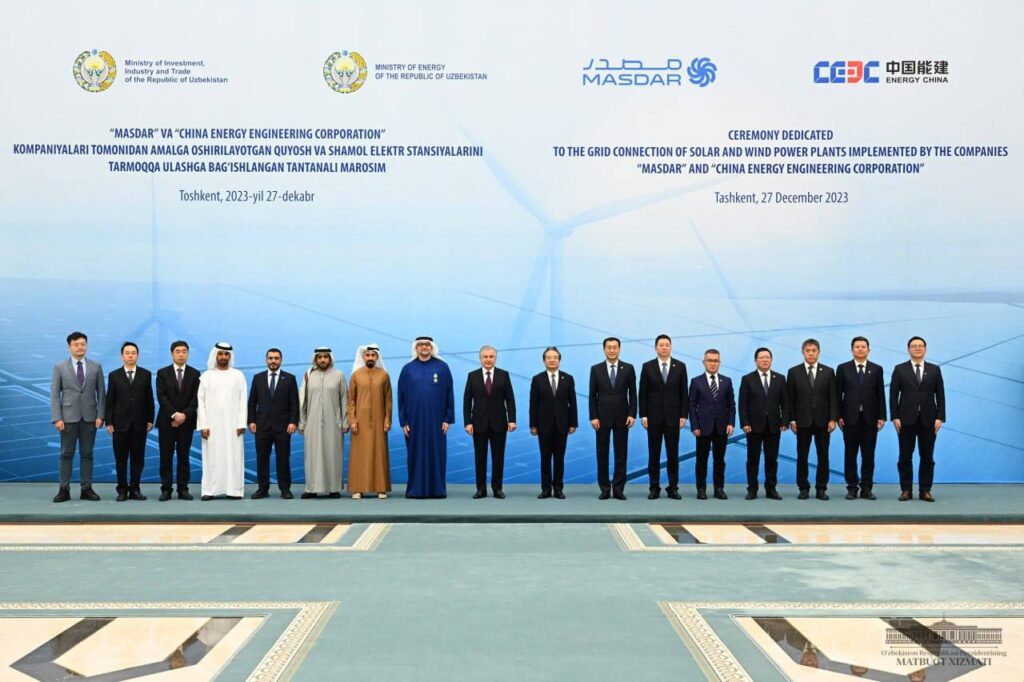
On December 27th, President of Uzbekistan, Shavkat Mirziyoyev took part in a ceremony of commissioning and connecting to the power grid of five solar and one wind power plants in six regions of the country. The event was attended by top executives from Masdar, China Energy Engineering Corporation, China Energy International Group, China Gezhouba Group, SEPCO III, and Dongfang Electric Corporation, which implemented the investment projects.

Speaking at the launch ceremony, Mirziyoyev said that today, “we are standing at an important event, which opens yet another bright page in the history of our country: six large solar and wind plants with a total capacity of 2,400 megawatts are to be connected to the grid”.

The first phase of the three solar power plants has been built in Jizzakh, Samarkand and Surkhandarya regions by the UAE-based company Masdar. This company has also built a modern wind power station in the Tomdi district, and its 100-megawatt capacity was also commissioned during the ceremony.

Gezhouba Group launched the construction of the first 400-megawatt solar power plants in Bukhara and Kashkadarya. Once commissioned, the President said, these projects worth $2 billion will generate six billion kilowatt-hours of electricity and save up to two billion cubic meters of natural gas.

Moreover, two million homes in Uzbekistan will be provided with an uninterrupted and guaranteed electric energy supply.

Gazprom Eyes Central Asia Amid European Sanctions

Facing a shortfall in European gas exports due to Western sanctions, Gazprom anticipates it will sell 34 billion cubic meters of unexported gas to Central Asia, according to recent reports.

“In light of the ongoing changes in the global energy market, Gazprom remains committed to ensuring a reliable gas supply to Russian consumers and bolstering export capabilities. A key focus for the company in this regard has been fostering collaboration with Kazakhstan, Uzbekistan, and Kyrgyzstan,” Gazprom stated in a press release.

The company confirmed a drop in gas exports to Europe of 34 billion cubic meters in the first eleven months of 2023, marking levels not seen since 1996. An earlier announcement by the Ministry of Energy of Uzbekistan unveiled a 15-year gas purchase agreement with Gazprom, extending the deal to include Kazakhstan, which involves a new pipeline construction.

In October, reports indicated the commencement of Russian gas deliveries to Uzbekistan through Kazakhstan. However, the specifics of this arrangement have not been disclosed to date.

Alexey Miller, Gazprom’s chief, outlined plans to expand the Central Asia gas pipeline system in November, highlighting memoranda signed with Uzbekistan, Kazakhstan, and Kyrgyzstan, and expressing optimism that the project will rejuvenate this pipeline network.

During the Soviet era, gas from the region was transported to Russia via the Central Asia–Center gas pipeline. After the USSR’s dissolution, the pipeline ceased operations and deteriorated, requiring substantial refurbishment to enable gas supplies from Russia to Central Asia. Miller noted the completion of the initial repair stage of the Central Asia-Center gas pipeline, facilitating gas delivery to Uzbekistan via Kazakhstan.

Earlier this year, Tashkent inked a two-year gas supply contract with Gazprom amounting to approximately 2.8 billion cubic meters annually. Despite these developments, details regarding the pricing of the purchased gas remain undisclosed. Which according to Uzbekistan’s Energy Minister, Zhurabek Mirzamakhmudov, is “in alignment with national interests and market dynamics.”

Raids Target Illegal Medicine Sales in Remote Turkmen Villages

Law enforcement agencies in the Mary Velayat district have initiated crackdowns on citizens engaging in the unauthorized sales of medicines,Radio Azatlyk has reported. While these actions target what authorities deem to be illegal, individuals conducting the trades in remote areas argue that they’re simply filling a crucial gap in essential healthcare access.

Sellers in remote villages assert that they offer commonly used medications like analgin and paracetamol, which, to their understanding, don’t require a doctor’s prescription. These traders claim to have procured these medicines from city pharmacies and to simply be reselling them at a slight markup in areas lacking facilities.

“Our village lacks pharmacies. Ambulance services have substantial delays, sometimes failing to arrive. People turn to us for antipyretics when they’re stricken with a fever at night. We offer a service that pharmacies don’t provide. We aren’t breaking any laws,” emphasized one villager engaged in medicine sales.

Another trader echoed this sentiment, stating, “We’re simply providing a service to our community.” Moreover, these merchants assert that they inform local district police officers about their activities, believing this communication suffices as adherence to the regulations.

However, plainclothes police officers have been actively involved in operations targeting this unauthorized trade. During these raids, authorities confiscate medicines and detain the traders, issuing substantial fines.

The scenario underscores a wider issue of inadequate medical facilities and pharmacy access in rural areas. Rural residents complain about delayed and inadequate ambulance services, exacerbating their struggle to access essential medical aid. Shortages of crucial medicines in both rural and urban pharmacies have been recurrent issues in Turkmenistan. Inconsistent availability of medications was reported earlier this year, highlighting a systemic challenge. Additionally, instances of medical professionals capitalizing on pharmaceutical shortages for extra profits surfaced in December of the previous year.

Trading medicines in Turkmenistan requires the possession of a valid license, and according to local legislation, sales should be conducted exclusively by individuals with a secondary or higher pharmaceutical education. This tension between unauthorized sales and healthcare gaps in remote regions presents a complex challenge in need of resolution.

Investigation Launched into Mobile Operators

The Agency for the Protection and Development of Competition of the Republic of Kazakhstan has established that in 2023, a significant price increase from 7.7% to 57.3% was recorded according to the tariff plans of mobile operators, who increased the cost of services provided on more than 30 plans with a monthly subscription fee.

“Taking into account paragraph 3 of Article 199 of the Entrepreneurial Code in connection with the repeated detection of signs of anti-competitive coordinated actions in the calendar year, the Agency has now launched investigations against mobile operators Kcell JSC, MT–S LLP (Tele2/Altel) and Kar-Tel LLP (Beeline) under Article 170 of the Entrepreneurial Code,” the Agency for the Protection and Development of Competition of the Republic of Kazakhstan said in a statement.

Earlier, the Agency had detected signs of anti-competitive coordinated actions by mobile operators in setting the cost of calls per minute and SMS services. In this regard, notifications were sent to mobile operators to reasonably reduce their pricing. The Agency stated that in case of non-compliance by the operators within an established time-frame, an investigation would be launched.

Tajikistan in Penultimate Place in English Language Proficiency

According to Education First, Tajikistan ranked 112th among 113 countries ranked in English language proficiency ratings, followed solely by the Democratic Republic of the Congo, Radio Ozodi has reported. In 2020, Tajikistan ranked last.

In the report, Russia ranks 41st, Kyrgyzstan – 90th, Uzbekistan – 93rd, and Kazakhstan – 104th. The Netherlands, Singapore and Austria top the list.

The International Educational Center for English Language Education First was founded in 1965 in Sweden. EF is the largest private educational institution in the world, with 600 branches in more than a hundred countries.

Contrary to the report, representatives of the Ministry of Education and Science of Tajikistan believe that in recent years the level of English language proficiency has improved in the country. The press secretary of the Ministry of Education and Science, Navruz Jumamurod, said that English language learning is well-established in the country and a vivid proof of this is the participation of almost 8,000 students from Tajikistan in international Olympiads. “This is also one of the indicators that participants from Tajikistan speak English well,” he noted.

Are the teaching methods outdated?

In the capital’s school No. 55, English is taught using the old method – reading and translating texts, as well as using the Q&A format. In this school, ten teachers teach 2,093 students, with English lessons taking place twice a week.

Matluba Makhmadkulova, the deputy director of the school, said that in recent years the interest of schoolchildren in learning English has grown. “Students are divided into groups and study lessons in special classes,” she added.

In this school, as in many others in the country, the method of teaching English has not changed much since Soviet times and is often reduced to reading and translating texts. But many modern teachers consider such a technique to be ineffective.

English teacher Bakhtiyor Davlatmuradov mainly teaches at private language centers. In his opinion, it is important to use new methods when teaching English.

“The main problem is ignorance about some of the innovations of modern teaching. Another problem is the limited use of modern technology in the classroom. Yes, teachers are trying very hard, but now it’s the 21st century we need to use technology. For example, you can show some videos, that is, make the lesson interactive,” he explained.

“A lot depends on the young people themselves”

Mukhaye Nozimova, who taught English in Tajikistan for many years, is now studying modern ways of teaching the language in London. According to her, to improve the situation it is necessary to reform the country’s education system, though on the other hand, she believes the level of English-language proficiency depends on the young people themselves.

“Today, there are many online classes, and even free online courses on social networks which allow young people to learn English or any other language on their own,” she said.

Tajik youth prefer to study English in private educational centers, but throughout the country not everyone has the means to study at such institutions.

According to official information, today more than 8,000 instructors teach English in schools. Due to low salaries, however, many teachers prefer to work not in general education schools, but in international organizations, or to opt for a career as a translator.

Group-IB Opens First Digital Crime Resistance Center in Central Asia

TASHKENT – On December 26th, Group-IB, a leading force in cybersecurity technology combating digital crime, revealed the inauguration of its pioneering Digital Crime Resistance Center (DCRC) in Central Asia. Located in Tashkent, this state-of-the-art facility marks Group-IB’s expansion strategy, aimed at proactively confronting cyber threats worldwide, notably those originating from Russian-speaking hacker communities.

Choosing Tashkent for their newest DCRC underlines Group-IB’s recognition of Uzbekistan’s economic significance and its potential to emerge as a global cybersecurity hub. The memorandum signed between the Central Bank of Uzbekistan and Group-IB in August 2023 further emphasizes the collaboration to counter cyberattacks and elevate cybersecurity measures.

Group-IB plans to fortify its engagement with Uzbekistan’s higher education sector, emphasizing investment in the country’s youth and its tech industry.

Dmitry Volkov, CEO of Group-IB, highlighted, “Selecting Tashkent, Uzbekistan as the site for our fifth Digital Crime Resistance Center globally is a strategic move to heighten our understanding of Russian-speaking threat actors. Cybercrime knows no borders, necessitating a comprehensive approach. By establishing a DCRC in Tashkent, Group-IB aims to elevate cybersecurity standards not only in Uzbekistan but across the broader Central Asian region.”