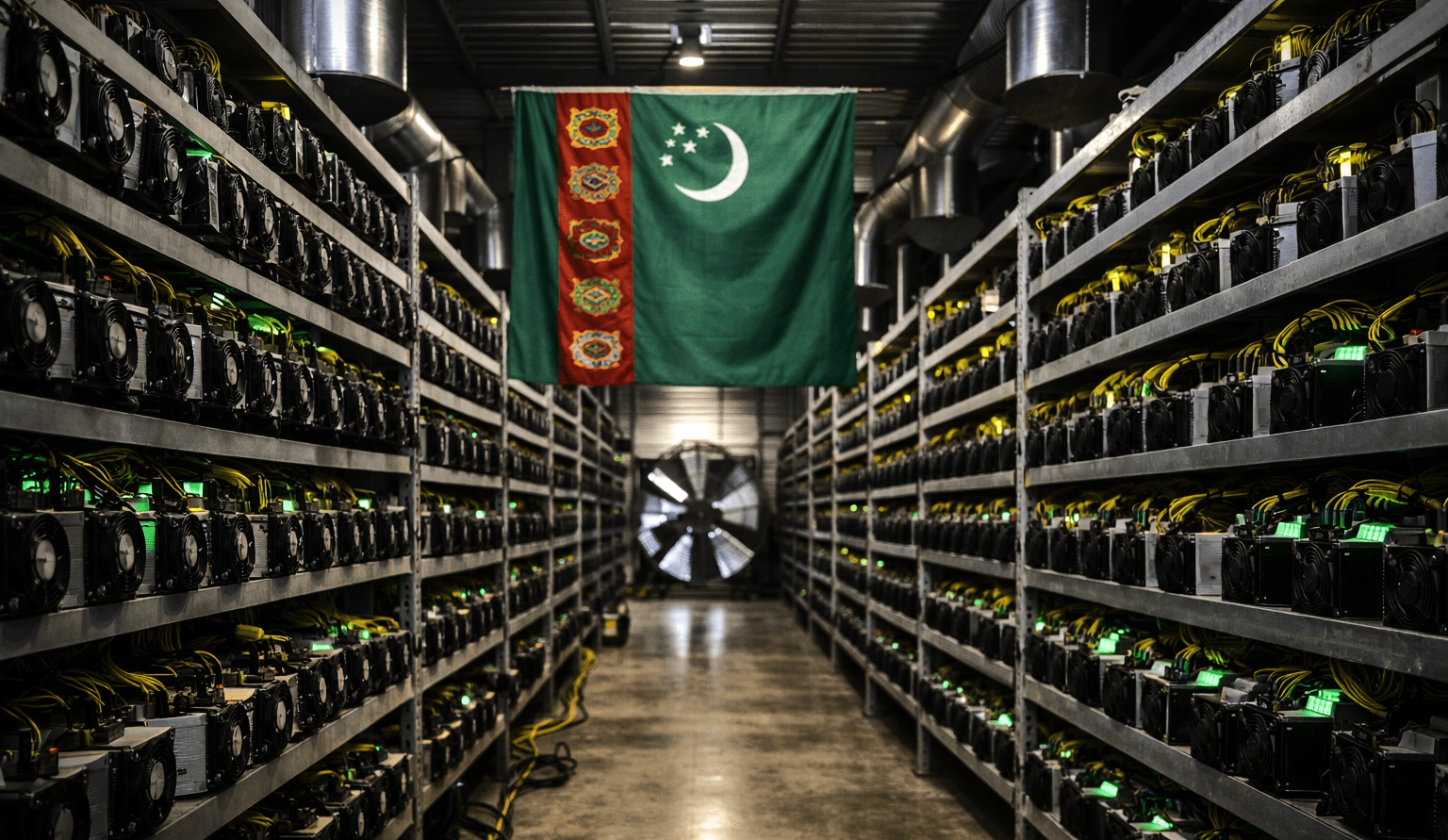
Turkmenistan has taken a rare step toward opening a tightly controlled economy by legalizing cryptocurrency mining and the operation of crypto exchanges under a new “Law on Virtual Assets”. First reported by The Times of Central Asia in early December 2025, the law came into effect on January 1, 2026, creating a state-run licensing system overseen by the Central Bank of Turkmenistan, while keeping strict limits on how crypto can be used inside the country.
The legal change, signed by President Serdar Berdimuhamedov, brings “virtual assets” under civil law, meaning that crypto is treated as property, rather than money. Under the framework, cryptocurrencies are not recognized as legal tender and cannot be treated as a currency or security for domestic payments.
As previously reported by The Times of Central Asia, the law covers the creation, storage, issuance, and circulation of virtual assets. It also states that the government is not responsible for losses incurred through crypto platforms or for drops in asset value. Mining rights are available to individual entrepreneurs and legal entities that register electronically with the central bank, and the law explicitly bans “hidden mining” that uses someone else’s computing resources without permission.
For exchanges and related service providers, the licensing requirements are central. Licensed firms can offer exchange, transfer, storage, and management services, and conduct initial offerings, but they must follow customer identification rules aligned with anti-money-laundering controls. The law also places strict limits on who can operate crypto exchanges inside Turkmenistan. Individuals and legal entities registered in offshore jurisdictions are barred from establishing exchanges, and founders with offshore bank accounts are disqualified from obtaining licenses, reinforcing a framework designed to keep ownership and control within a tightly regulated domestic system.
Advertising restrictions further underscore the government’s cautious approach. Crypto service providers are prohibited from making promises of profitability or offering inducements to attract customers. Promotional materials must include explicit warnings that virtual assets are not state-backed and may lose value, reflecting official concerns over speculation and consumer risk.
The shift is widely seen as significant for one of the world’s most closed economies, though structural constraints remain. Turkmenistan’s heavily regulated internet environment poses a challenge for both trading platforms and large-scale exchange operations, particularly those requiring uninterrupted access to global networks. The move also fits within a broader effort to reduce reliance on gas exports by cautiously diversifying the economy.
The commercial question now is whether legal clarity and access to low-cost electricity can outweigh these limitations. The model combines ultra-cheap energy with a license-driven regulatory system, a structure that may attract some miners while deterring firms that depend on flexible compliance regimes or unrestricted connectivity.
Across Central Asia, governments have taken divergent approaches to regulating digital assets. Kazakhstan has experimented with special regulatory zones and later expanded oversight nationwide. Turkmenistan’s approach is more centralized, creating a narrow legal pathway that keeps regulatory authority concentrated with the state and the central bank.
The government has signaled incremental openness in other areas, including the introduction of electronic visas, yet Turkmenistan remains among the most restrictive environments in the world for media and internet access. That combination makes the new crypto law both notable and uncertain in its likely impact: mining and exchange businesses now have a legal route into the country, but the same state controls that shape daily life will determine whether the sector becomes a meaningful hub or remains a tightly managed niche.