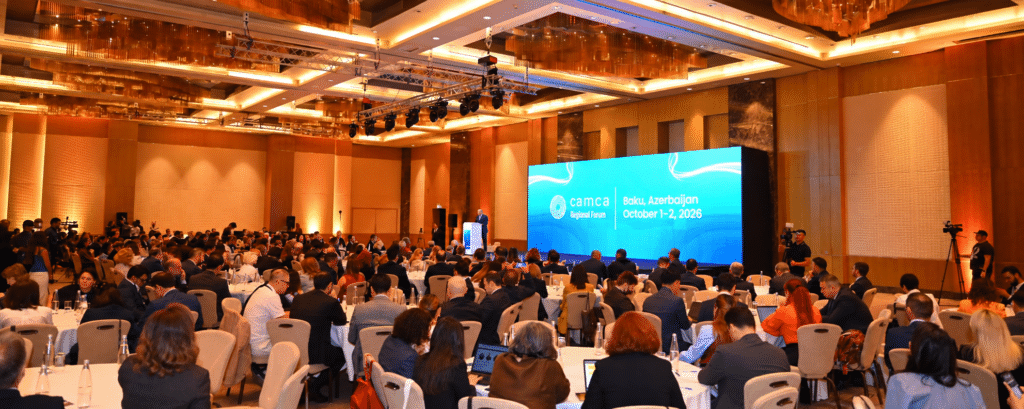
What would it take for a fintech company that succeeds in one CAMCA country to enter another without starting from zero? That question guided a roundtable on the next digital Silk Road at the CAMCA Regional Forum in Baku.
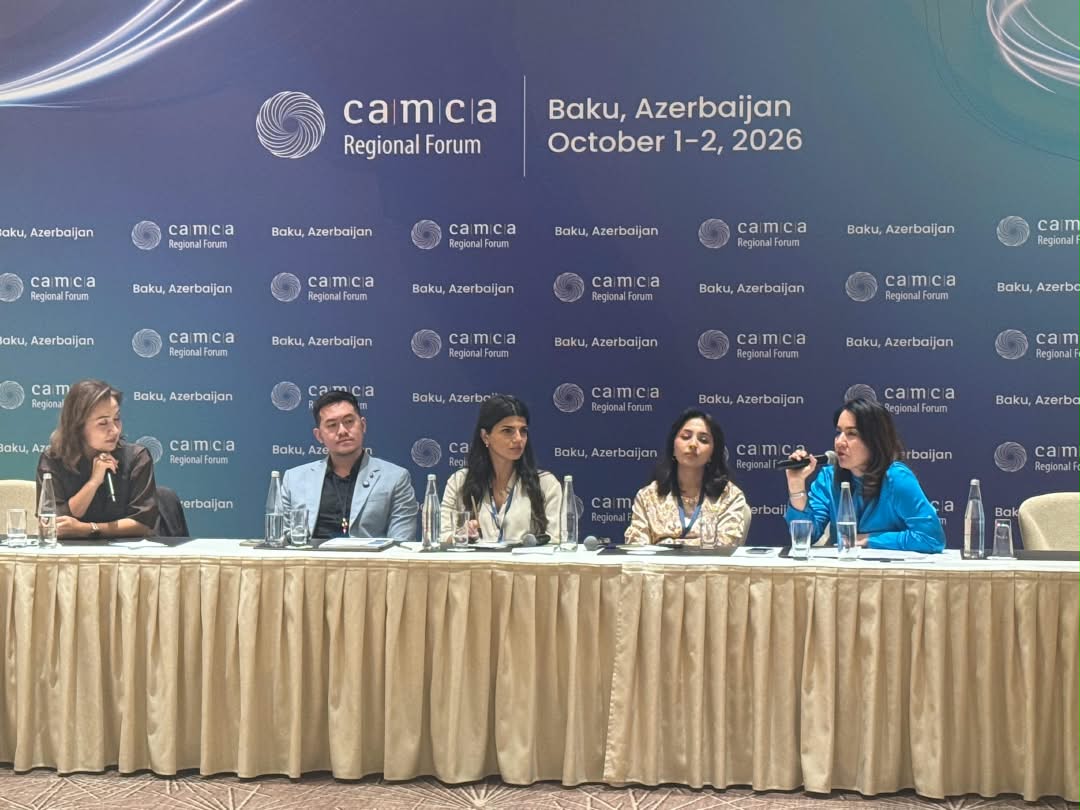
The discussion brought together leaders in financial services, investment, and technology from a region spanning Central Asia, the Caucasus, Mongolia, and Afghanistan. As moderator, I wanted to move beyond the broad ambition of regional connectivity and examine what companies need to operate across borders: working payment systems, partnerships, regulatory clarity, and a path to their first customer in a new market.
The panel featured Tughra Musayeva, Head of Innovations at PASHA Financial Holding; Jenny Jenish kyzy, Product Owner at MBank Junior and a CAMCA Network member from Kyrgyzstan; Muna Shukurova, Managing Director of Alif in Uzbekistan and a CAMCA Network member from Tajikistan; and Jonathan Low, Founder and Group CEO of Ampyre Group and Biptap.
A central theme was financial infrastructure. The speakers explored the potential for pilots using existing platforms to connect CAMCA markets, including cross-border payments, business settlements, digital wallets, and new settlement technologies. Such pilots would require regulators and private companies to work together on defined problems and learn from results.
Mr. Low argued that the region has an opportunity to make deliberate choices about the systems it wants to build:
“Most regions overregulate before they even know what they’re building. CAMCA has an advantage here, it can watch Europe’s and ASEAN’s fintech buildout and skip the mistakes instead of repeating them and learn what works. But that only works if you decide what you want first. Regulation should follow the vision, not replace it. And the tool that actually unifies a region this spread out is banking orchestration, new technology stitching fragmented markets into one functioning system.”
Expansion also raises a practical question for companies already active in more than one market: which capabilities can travel, and which parts of a product must change? Requirements for licensing, identity checks, anti-money-laundering controls, infrastructure, and consumer behavior differ across countries.
Ms Shukurova drew on Alif’s experience of entering other CAMCA markets:
“Regional expansion is not a copy-paste exercise. You can replicate technology, risk expertise and operating capabilities, but the product still has to be built around local regulation, infrastructure and customer behavior. The core can travel; the market fit has to be local.”
The panel then turned to the role of established financial groups. For a startup, a successful pilot can demonstrate that a solution works. It becomes more valuable when that result helps the company find a partner or customer in its next market. Corporate networks and regional investors can help make that step less costly.
Ms Musayeva described the gap between proving a product and expanding it:
“In our region, a startup does not scale simply because its technology is scalable. It scales when the ecosystem reduces the cost of entering the next market. Today, a founder who has proven a solution in Tashkent still arrives in Baku or Almaty as a stranger, with no relationships, no references and no first customer. That is the gap we are trying to close. When a pilot succeeds in one of our group companies, it becomes a reference for the next, and a startup tested in one country can find its first client in another without starting from zero. This is also why our investments through INMerge VC have been regional from the start. Our countries face remarkably similar challenges, and the founders who solve them are building for the whole region, not for one market. If corporates, investors and regulators make that next step easier, we stop building separate national ecosystems and start building one regional market for innovation.”
The discussion identified areas where greater coordination could ease that journey, including payments, digital identity, data standards, licensing, consumer protection, and cross-border settlement. Progress in each area would need to account for local rules and market conditions while making it easier for companies to connect their services.
Ms Jenish kyzy emphasized that adding technology alone is not enough:
“Fintech scalability is not the same as growth: it comes not simply from adding more digital technology, but from building ecosystems that connect financial services with customers’ broader needs and create value across multiple services and markets.”
The next step is to turn these ideas into specific collaborations: a payment problem that partners can test, a pilot with a clear route into another market, or an introduction that gives a proven startup its first regional customer. That is how interoperability can become commercial connectivity—and how CAMCA’s separate innovation ecosystems is already begin to work together.
The views expressed in this article are those of the author and do not necessarily reflect the official policy or position of the publication, its affiliates, or any other organizations mentioned.