• KGS/USD = 0.01143 0%
  • KZT/USD = 0.00206 0%
  • TJS/USD = 0.10684 -1.11%
  • UZS/USD = 0.00008 0%
  • TMT/USD = 0.28571 0%
  • KGS/USD = 0.01143 0%
  • KZT/USD = 0.00206 0%
  • TJS/USD = 0.10684 -1.11%
  • UZS/USD = 0.00008 0%
  • TMT/USD = 0.28571 0%
  • KGS/USD = 0.01143 0%
  • KZT/USD = 0.00206 0%
  • TJS/USD = 0.10684 -1.11%
  • UZS/USD = 0.00008 0%
  • TMT/USD = 0.28571 0%
  • KGS/USD = 0.01143 0%
  • KZT/USD = 0.00206 0%
  • TJS/USD = 0.10684 -1.11%
  • UZS/USD = 0.00008 0%
  • TMT/USD = 0.28571 0%
  • KGS/USD = 0.01143 0%
  • KZT/USD = 0.00206 0%
  • TJS/USD = 0.10684 -1.11%
  • UZS/USD = 0.00008 0%
  • TMT/USD = 0.28571 0%
  • KGS/USD = 0.01143 0%
  • KZT/USD = 0.00206 0%
  • TJS/USD = 0.10684 -1.11%
  • UZS/USD = 0.00008 0%
  • TMT/USD = 0.28571 0%
  • KGS/USD = 0.01143 0%
  • KZT/USD = 0.00206 0%
  • TJS/USD = 0.10684 -1.11%
  • UZS/USD = 0.00008 0%
  • TMT/USD = 0.28571 0%
  • KGS/USD = 0.01143 0%
  • KZT/USD = 0.00206 0%
  • TJS/USD = 0.10684 -1.11%
  • UZS/USD = 0.00008 0%
  • TMT/USD = 0.28571 0%

Viewing results 7 - 12 of 551

Opinion: Silk Seven or the OTS? Central Asia May Not Have to Choose

A new proposal circulating in Washington – the Silk Seven Plus (S7+) initiative – aims to reshape Central Asia by linking its five post-Soviet states with Afghanistan and Pakistan into an integrated economic region. Azerbaijan is also seen as a potential addition. The idea, advanced by the New Lines Institute for Strategy and Policy, is straightforward: connect landlocked Central Asia to the Black Sea and Arabian Sea through new trade corridors. On paper, the bloc looks compelling. The seven countries form a contiguous zone in the heart of Eurasia, potentially turning geography from a constraint to an advantage. “Central Asia needs an organization built by Central Asian states and for Central Asian states,” said Justin Burke, a resident senior fellow at the New Lines Institute, at a recent event in Washington. “If Central Asia can speak with one voice rather than five different voices, that will make it a more reliable investment destination.” There are signs of momentum. Kazakhstan’s President Kassym-Jomart Tokayev and Uzbekistan’s President Shavkat Mirziyoyev made back-to-back visits to Pakistan earlier this year, highlighting regional connectivity. Proponents argue that if Afghanistan stabilizes, the Silk Seven could become a formidable cluster. But that is a big “if.” It also raises a deeper question: why construct a new, geographically convenient bloc when an existing organization – the Organization of Turkic States (OTS)—already offers something deeper: shared language, history, and identity? While the Silk Seven spans broadly Muslim-majority countries, it is linguistically and culturally diverse. The grouping spans Turkic-speaking Central Asia, Persian-speaking Tajikistan, and Indo-Aryan Pakistan. ASEAN offers a cautionary example. Despite decades of cooperation, its religious, linguistic, and geopolitical diversity – combined with consensus-based decision-making – has often prevented it from speaking with one voice, particularly on China. In The Clash of Civilizations, Samuel Huntington wrote that when ASEAN was created in 1967 by Indonesia, Malaysia, the Philippines, Singapore, and Thailand, it was an organization of “one Sinic, one Buddhist, one Christian, and two Muslim member states.” Such multicivilizational regional organizations have limits, he said. The Silk Seven risks similar limitations. The OTS, by contrast, rests on a narrower but deeper foundation: its core members—Azerbaijan, Kazakhstan, Kyrgyzstan, Turkey, and Uzbekistan—share closely related languages and overlapping historical experiences. Tucked away in the eight-page document issued after the informal OTS summit earlier this month was a revealing signal of intent: clauses dedicated to cataloguing Turkic cultural heritage, promoting youth engagement through Khiva’s designation as the 2026 Youth Capital, and launching a “Turkic Heritage” digital platform. Together, they show that the OTS is actively building a shared cultural space. Yet even as members emphasize common heritage, differences remain over how far the organization should evolve politically. Kazakhstan’s President Kassym-Jomart Tokayev, the summit host, stressed in his remarks that “the Organization of Turkic States is neither a geopolitical project nor a military organization,” but rather “a unique platform” for cooperation across trade, technology, culture, and humanitarian ties. Azerbaijan’s President Ilham Aliyev struck a more ambitious note, saying that “the Turkic world must grow into one of the influential geopolitical centers of the 21st century,” and pledging...

UN General Assembly Adopts Kyrgyzstan-Led Resolution on Border Disputes

On May 20, the United Nations General Assembly adopted by consensus a Kyrgyzstan-backed resolution titled “Peaceful Settlement of Border Disputes,” Kyrgyzstan’s Foreign Ministry announced. More than 40 countries co-sponsored the document. The resolution was presented by Kyrgyzstan jointly with Tajikistan and Uzbekistan. According to the ministry, the main purpose of the resolution is to share with the international community the historic achievement of the three Central Asian countries in resolving border disputes through peaceful means, including dialogue and negotiations, in accordance with the UN Charter and international law. The resolution proposes what Kyrgyz officials described as a simple and universal principle: when states face border disputes, the way forward should be peaceful, lawful, and based on dialogue. According to the ministry, the Central Asian achievements highlighted in the resolution offer the international community an example of good-neighborly relations and peaceful dispute resolution. The adoption of the resolution is another confirmation of the ability of Kyrgyzstan and its neighbors to peacefully resolve complex issues that had remained unsettled for decades, the ministry stated. Kyrgyzstan, Tajikistan, and Uzbekistan have recently resolved long-standing border delimitation disputes in the Ferghana Valley inherited after the collapse of the Soviet Union. During a summit in Khujand, northern Tajikistan, on March 31, 2025, Kyrgyzstan’s President Sadyr Japarov, Tajikistan’s President Emomali Rahmon, and Uzbekistan’s President Shavkat Mirziyoyev signed a historic agreement on the junction point of the three countries’ state borders, effectively ending decades-long territorial disputes. The three leaders also inaugurated the Friendship Stele, marking the exact point where the borders of the three countries meet. The monument symbolizes friendship among the three nations, the resolution of long-standing border issues, and a new stage of regional cooperation. The Times of Central Asia previously reported on Kyrgyzstan’s initiative to establish the Dostuk (Friendship) International Trade and Economic Park jointly with Tajikistan and Uzbekistan in the border area where the three countries meet. The proposed project is expected to increase cross-border trade, attract investment, and create new economic opportunities across the region.

Japarov Calls for Support of Kyrgyzstan’s Bid for UN Security Council Seat

Kyrgyz President Sadyr Japarov has called on world leaders to support Kyrgyzstan’s candidacy in the election for non-permanent members of the United Nations Security Council, scheduled for June 3, 2026, for the 2027-2028 term. In a statement published on his Facebook page, Japarov said Kyrgyzstan has the backing of the other Central Asian countries and is prepared to promote “pragmatic and depoliticized solutions” on the international stage. According to the president, the underrepresentation of small, developing, and landlocked countries in the Security Council “undermines the sustainability of the entire architecture of collective security.” “This is not a political preference but an objective necessity,” Japarov said. He argued that intensifying geopolitical competition, the erosion of universal international law, and ongoing armed conflicts in Europe, Africa, and the Middle East continue to test the resilience of the international system. “More than $3 trillion is spent annually on military conflicts worldwide. These resources could provide humanity with a decent life. If these expenditures were directed toward greening the planet and eradicating hunger, our world could become a flourishing garden,” the Kyrgyz leader said. Japarov emphasized that Kyrgyzstan is not part of military blocs and does not participate in confrontational geopolitical formats, which he said allows the country to maintain a “balanced, independent, and pragmatic position” on international issues. The president also highlighted Kyrgyzstan’s peaceful settlement of border delimitation issues with neighboring states, describing it as an example of how even highly sensitive security disputes can be resolved through negotiations. Japarov devoted particular attention to Kyrgyzstan’s work within the UN Human Rights Council, to which the country has been elected three times. According to him, Bishkek continues efforts to strengthen democracy, human rights, and the rule of law. The claim comes amid continued scrutiny of Kyrgyzstan’s domestic political trajectory. International observers and rights groups have raised concerns in recent years over pressure on independent media, civil society, and opposition figures, while the authorities have argued that tighter regulation is needed to protect stability and national interests. Japarov also pointed to the introduction of quotas for women, youth, ethnic minorities, and people with disabilities under amendments to the law “On the Election of the President of the Kyrgyz Republic and Deputies of the Jogorku Kenesh,” adopted in 2025. Japarov claimed that Kyrgyzstan ranks first in the world for women’s parliamentary representation. However, Inter-Parliamentary Union data shows that Kyrgyzstan has 30 women in its 90-seat parliament, or 33.3% of deputies. The IPU has instead identified Kyrgyzstan as recording the largest increase in women’s parliamentary representation among countries that held parliamentary renewals in 2025. The president stressed that Kyrgyzstan remains committed to the principles of non-proliferation and disarmament and, if elected to the Security Council, would promote preventive diplomacy, mediation mechanisms, nuclear disarmament, and addressing the growing nexus between climate and security issues. Japarov noted that Kyrgyzstan was among the initiators of the Central Asian Nuclear-Weapon-Free Zone and signed the Treaty on the Prohibition of Nuclear Weapons in 2025. He also said Bishkek intends to devote particular...

Opinion: Middle Powers and the “Voice of the Region” – Is Central Asia Becoming a Coordinated Actor?

Against the backdrop of growing global fragmentation and the weakening of universal international institutions, the role of so-called middle powers is increasing. These are states able to influence regional agendas without possessing great-power status. In this changing system, Central Asia is gradually moving beyond its long-standing image as a geopolitical periphery and is beginning to act more like a region with shared interests. For decades, the region was viewed mainly as a space where the interests of external powers, including Russia, China, the U.S., and others, intersected. Today, that paradigm is beginning to shift. Central Asia is showing greater signs of agency through what may be described as a cluster effect: individually, the countries have limited influence, but collectively they form an important transit hub between Europe and Asia, a growing market, a significant resource base, and a strategic security zone. This creates the conditions for a more coordinated regional position, even if a single regional voice is still emerging rather than fully formed. C5+Azerbaijan as a Foundation for Regional Architecture The institutional foundation of this process is the Central Asian leaders' consultative format, which is now expanding through Azerbaijan's participation. That is turning what was once a C5 dialogue into a looser C5+Azerbaijan, or C6, framework focused on transport, energy, and practical cooperation. Within this framework, the countries of the region are learning to act in a more coordinated manner without supranational pressure. In practice, this process is developing through three main areas. The first is transport and logistics. Azerbaijan's participation has strengthened efforts to make the Middle Corridor more coherent, though the route still faces bottlenecks in capacity, customs coordination, and Caspian crossings. Through tariff coordination, simplified border procedures, and investment in port and rail infrastructure, Central Asia and the Caucasus are increasingly functioning as parts of a single transport artery. That gives the region a faster option for cargo between China and Europe, even if it remains far smaller than traditional maritime routes. Shipping goods via the Suez Canal or the northern route can take between 35 and 45 days, whereas the Middle Corridor can reduce transit times to around 13-21 days under favorable conditions. According to forecasts cited by BCG, shipping volumes along the route could increase three- to fourfold during the current decade. Beyond logistics, the project is creating a new economic framework for the region. Its status as a crossroads is attracting investment in transport hubs and manufacturing facilities along the route, with the potential to turn transit corridors into zones of economic growth. This gives participating countries not only transit revenue but a stronger basis for long-term strategic resilience. The second major area is energy integration, where historical disputes over water and fuel resources are increasingly being supplemented by models of joint development. The Kambarata HPP-1 hydropower project in Kyrgyzstan, being developed with Kazakhstan and Uzbekistan, has created an important precedent for shared management of water and energy interests. The project is expected to support cleaner electricity generation while helping stabilize irrigation flows...

OTS Summit in Turkistan Reveals Strains Beneath Turkic Unity

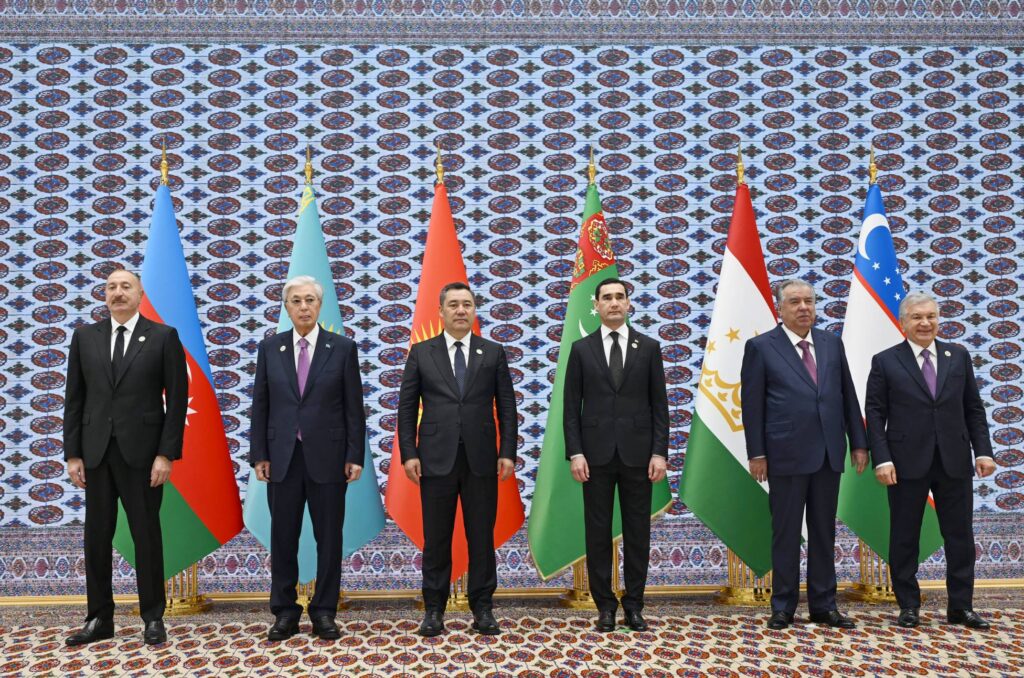
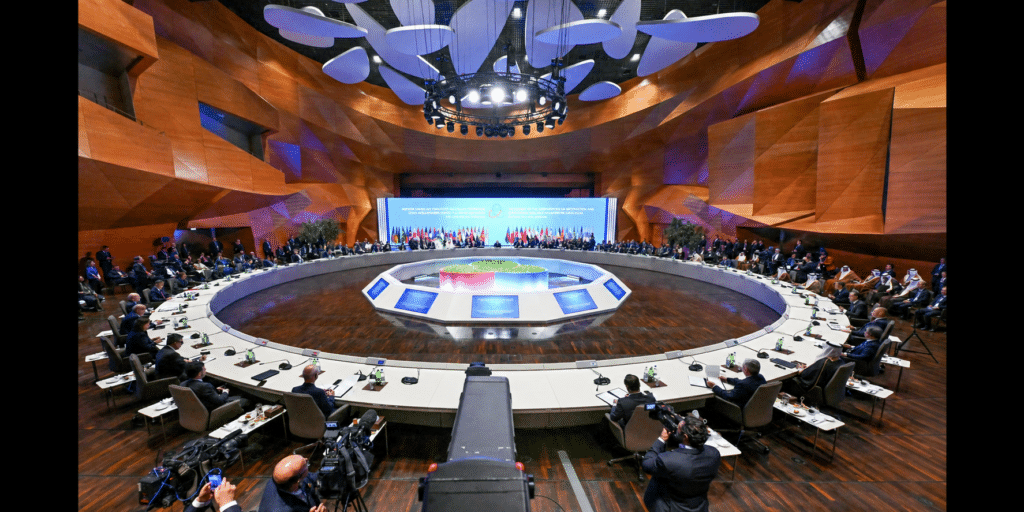
Last Friday, the Kazakh city of Turkistan, officially promoted as the “spiritual capital” of the Turkic world, hosted an informal summit of the Organization of Turkic States (OTS). The official theme was artificial intelligence and digital development, but the meeting also highlighted older questions about the OTS’s political identity, its relationship with Russia, and Ankara’s influence within the Turkic world. Because the gathering was informal, much of what took place remained behind closed doors. Yet public statements, official readouts, and subsequent commentary offered clues about the tensions and competing agendas within the organization. The summit brought together the presidents of Turkey, Azerbaijan, Kyrgyzstan, and Uzbekistan, as well as Tufan Erhurman, president of the Turkish Republic of Northern Cyprus, which is recognized only by Turkey. The meeting followed Turkish President Recep Tayyip Erdoğan’s state visit to Kazakhstan, during which the two countries signed 15 agreements, including a Declaration on Eternal Friendship and an Enhanced Strategic Partnership between Kazakhstan and Turkey. In Turkistan, summit participants visited the mausoleum of Khoja Ahmed Yasawi, where Erdoğan donated a handwritten Quran manuscript to the historic site. Leaders also launched the construction of a Center for Turkic Civilization. The presidents of Kazakhstan and Uzbekistan separately visited a newly built mosque donated to Turkistan by Tashkent. Despite the atmosphere of symbolism and fraternity, however, the summit also exposed clear differences between Ankara’s wide-ranging vision for the OTS and Astana’s insistence that the organization should remain a practical cooperation platform. Those differences became especially visible in President Kassym-Jomart Tokayev’s speech at the summit. “Recently, opinions have been voiced portraying our organization as a military alliance. It is obvious that those spreading such speculation pursue malicious goals and seek to sow discord. Kazakhstan considers it necessary to reject such positions,” Tokayev said. “The Organization of Turkic States is neither a geopolitical project nor a military organization. It is a unique platform aimed at strengthening trade, economic, technological, digital, cultural, and humanitarian cooperation among brotherly nations.” Kazakh political analyst Daniyar Ashimbayev argued that Tokayev’s remarks reflected a growing internal debate within the OTS. “On the one hand, some media interpreted his words as a response to foreign experts warning about the emergence of a ‘Turanic NATO.’ On the other hand, it should be noted that some fellow presidents within the OTS persistently promote the development of military cooperation. Kazakhstan is equally persistent in defining which forms of interaction it considers acceptable within the organization,” Ashimbayev wrote. Another analyst, Andrei Chebotarev, also argued that the core message of Tokayev’s speech was to frame the OTS primarily as a platform for economic, technological, digital, cultural, and humanitarian cooperation. “In this context, he rejected the idea of transforming the organization into a military-political bloc. This sent a signal both to pan-Turkic political forces interested in such a transformation and to political elites in countries that view the organization’s activities with caution,” Chebotarev said. Chebotarev also noted that Tokayev referenced the “OTS+” format launched at the organization’s previous summit in Azerbaijan and voiced support...

Erdoğan Visit Puts Trade, Transit, and Turkic Economic Integration at Center of Kazakhstan’s OTS Push

Turkish President Recep Tayyip Erdoğan’s visit to Kazakhstan comes as Astana is trying to give the Organization of Turkic States a more practical economic role, linking trade, investment, transport, digital development, and business financing across the Turkic world. The visit centered on three connected events: Erdoğan’s official visit to Astana, the sixth meeting of the Kazakhstan-Turkey High-Level Strategic Cooperation Council, and the informal summit of the Organization of Turkic States in Turkistan. Erdoğan arrived in Astana ahead of talks with President Kassym-Jomart Tokayev, while Turkish media reported that the agenda included transport links through the Middle Corridor, Caspian transit routes, energy security, logistics, defense industry cooperation, trade and investment. The visit also carried strong symbolic staging. According to Akorda, Erdoğan’s aircraft was escorted by Kazakh Air Defense fighter jets after entering Kazakhstan’s airspace. At Astana airport, he was greeted by an honor guard, children waving the flags of Kazakhstan and Turkey, and military helicopters displaying the national symbols of both countries. Erdoğan later said the welcome had brought his delegation “enormous joy,” adding, “We certainly will not forget this.” [caption id="attachment_48862" align="aligncenter" width="1280"] Kazakh aircraft fly over Astana during the ceremonial welcome for Erdoğan. Image: Akorda[/caption] The OTS summit is being hosted by Kazakhstan on May 15 in Turkistan under the theme “Artificial Intelligence and Digital Development.” According to the organization, the summit is intended to advance cooperation on artificial intelligence, digital innovation, emerging technologies, public services, sustainable economic growth, and regional connectivity. The digital theme reflects Kazakhstan’s effort to give the OTS a more practical economic role, beyond its cultural and diplomatic foundations. Ahead of the summit, Astana hosted a business forum on May 13 under the title “Economic Integration and Cooperation of the OTS Countries: New Opportunities in Industry, Agro-Industrial Complex, Logistics and Digitalization.” Kazakhstan’s prime minister’s office said the forum brought together state bodies, financial institutions, chambers of commerce, international organizations, and business representatives from OTS countries. Kanat Sharlapayev, chairman of the Union of Chambers of Commerce and Industry of Turkic States and of the presidium of Kazakhstan’s Atameken National Chamber of Entrepreneurs, urged Turkic countries to move toward deeper industrial and digital integration. He said the task was to create a unified digital environment, reduce the distance between producers and consumers, increase transparency, and speed up transactions. The forum also discussed plans for joint industrial facilities and manufacturing zones along transport corridors, an idea that would push OTS cooperation beyond transit toward processing and value-added production. Deputy Prime Minister and Minister of National Economy Serik Zhumangarin used the forum to frame OTS cooperation as one of Kazakhstan’s foreign economic priorities. He said the OTS countries form a market of more than 170 million people and have significant industrial, transport, agricultural, and human potential. He also said the main task was to move from declarations to joint projects, new production, technology alliances, and mutual investment. Silk Way TV reported that Murat Karimsakov, chairman of the Kazakh Chamber of International Commerce, said trade turnover among OTS countries increased...