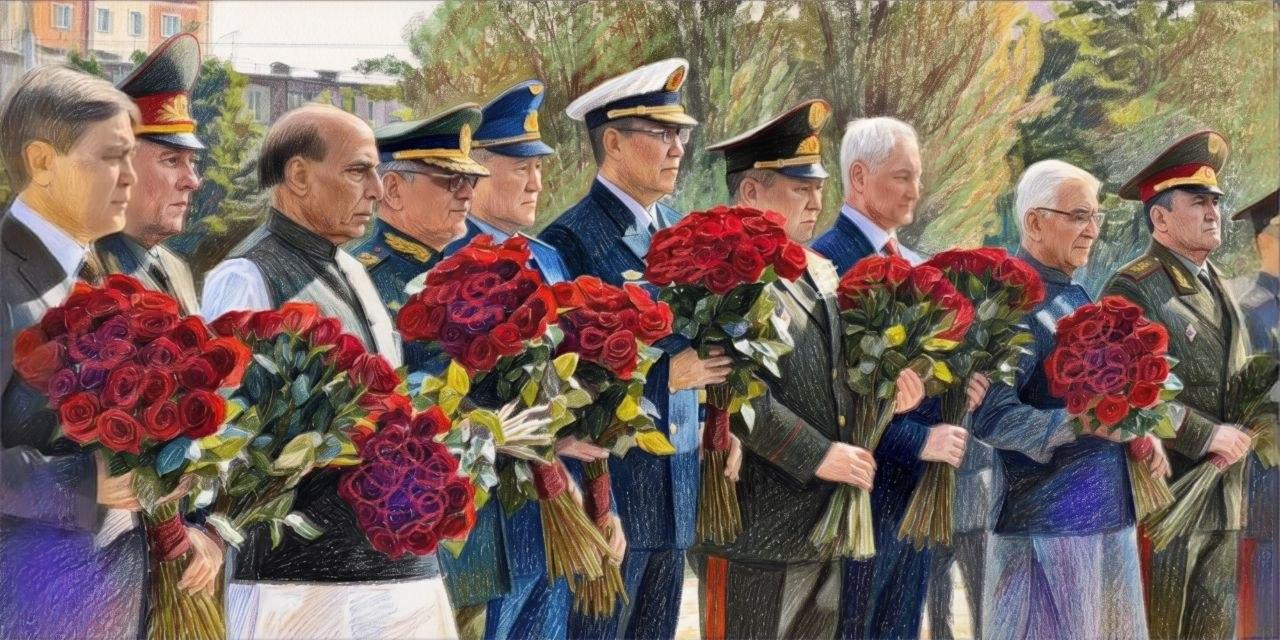
The April 28 meeting of defense ministers from the member states of the Shanghai Cooperation Organization (SCO), held in Kyrgyzstan’s capital, Bishkek, received relatively modest coverage in Central Asia and China. Russia’s Ministry of Defense, however, used the routine gathering to send a sharper message: Moscow remains opposed to any non-regional military presence in Central Asia.
According to the SCO Secretariat, the meeting was attended by defense ministers from member states, the organization’s Secretary-General, and the director of the Executive Committee of the SCO’s Regional Anti-Terrorist Structure.
“During the meeting, the parties held a substantive exchange of views on pressing regional and international security issues, noting persistent challenges and threats, including international terrorism, extremism, transnational crime, as well as emerging risks in information and cybersecurity,” the SCO said in a general statement.
The statement also emphasized the need to strengthen trust between the armed forces of member states, expand practical cooperation, conduct joint exercises, exchange experience, and develop mechanisms for military cooperation within the SCO.
China’s Defense Minister Dong Jun used similar institutional language. According to Xinhua, Dong said the SCO should uphold the international order, improve security governance, and “eliminate the sources of turmoil and conflict through shared development.” He also called for deeper defense and security cooperation among member states.
Kazakhstan’s Defense Minister Dauren Kosanov presented a report on the country’s approach to strengthening regional security, developing cooperation within the SCO, and improving joint responses to contemporary challenges, according to Kazakhstan’s Ministry of Defense. The ministry said participants also discussed the expansion of practical cooperation between defense agencies and approved a cooperation plan for SCO defense ministries for 2027.
Defense ministers from Uzbekistan and Kyrgyzstan also held bilateral talks on the sidelines of the meeting, discussing military-technical cooperation, joint training, experience-sharing among officers, and initiatives aimed at strengthening regional security. Uzbek media described the talks as being held in a constructive and friendly atmosphere.
Russian Defense Minister Andrei Belousov adopted a markedly different tone. His remarks were not limited to general SCO language about counterterrorism or cyber threats. They directly targeted the possible presence of outside powers in Central Asia.
“We are closely monitoring attempts by non-regional states to establish a military presence and address logistical tasks in Central Asia. We consider this unacceptable,” Belousov said, according to RIA Novosti.
Belousov also expressed concern about Syria, Lebanon, Afghanistan, and the humanitarian crisis in Gaza, warning that militants from crisis zones could infiltrate neighboring countries, including the SCO space. Belousov further argued that U.S. activity in the Asia-Pacific region was having a destabilizing effect.
“Their efforts to reshape the regional security system into a U.S.-centric model by strengthening military-political structures under Washington’s control provoke tensions, undermine regional stability, and increase the risks of armed conflict,” he said.
The contrast was striking. The SCO Secretariat spoke in broad terms about common threats and institutional cooperation. China emphasized development, governance, and multilateral stability. Russia used the same setting to issue a direct warning over Central Asia.
Iran added another layer to the meeting’s harder security tone. The Times of Central Asia previously reported that Iranian Deputy Defense Minister Reza Talaei-Nik used the Bishkek meeting to propose expanded defense cooperation with SCO partners, saying Tehran was ready to share its defensive capabilities with “independent countries,” especially SCO member states. The statement reinforced the sense that the Bishkek meeting was not only about routine SCO defense coordination, but also about how several member states are positioning the organization as a platform resistant to Western military pressure.
In Russian pro-state commentary, Belousov’s speech was quickly framed not only as a warning to Washington, but also as a message to Central Asian partners. Political commentator Natalya Starichkova described the statement as “clearly demanding” and argued that it was addressed not only to “non-regional states,” but also to SCO and CSTO partners in Central Asia.
“Some of them have recently been actively exploring participation elsewhere — or showing excessive responsiveness to ‘non-regional’ proposals,” she wrote.
Her interpretation is not official policy. But it reflects a wider Russian anxiety: that Central Asian states, while maintaining security ties with Moscow, are also widening their diplomatic, economic, and defense contacts with other powers.
Just days before the Bishkek meeting, Belousov met Chinese Defense Minister Dong Jun in Moscow. According to Vedomosti, the Russian minister highlighted regular contacts between Presidents Vladimir Putin and Xi Jinping and emphasized the “special importance” of military cooperation between Russia and China. Reuters, citing Beijing, reported that the two defense ministers agreed to enhance strategic communication and deepen practical cooperation across military fields.
Belousov’s remarks fit into a broader pattern in which Russia and China have increasingly used SCO platforms to promote overlapping security concepts: opposition to outside military influence, support for state sovereignty, and a preference for regional security arrangements not led by the West.
For Central Asia, this overlap is significant. The region has long tried to balance Russia, China, the West, Turkey, and other partners without being locked into a single security orbit. Moscow’s Bishkek message was therefore not just about Washington. It was also a reminder to Central Asian governments that Russia still sees the region as a core security space where outside military involvement will be treated as a direct challenge.
China’s position is more carefully phrased. Beijing tends to speak through the language of development, governance, and stability, rather than direct warnings. Yet its vision for Eurasian security also leaves little room for a Western military role in Central Asia. The SCO provides a forum where these Russian and Chinese preferences can reinforce one another, even when their rhetoric differs.
Belousov’s Bishkek speech should therefore be read less as an isolated Russian outburst than as a signal delivered inside a favorable multilateral setting. Moscow used the SCO platform to warn against Western military or logistical activity in Central Asia. Beijing did not need to echo the warning directly for the broader message to be clear.
The SCO meeting itself may have been routine, but Belousov’s intervention was not. It showed how Russia is using regional security forums to restate its opposition to outside military involvement in Central Asia, while relying on an institutional environment in which China’s language about security governance and external interference gives that message wider political resonance.