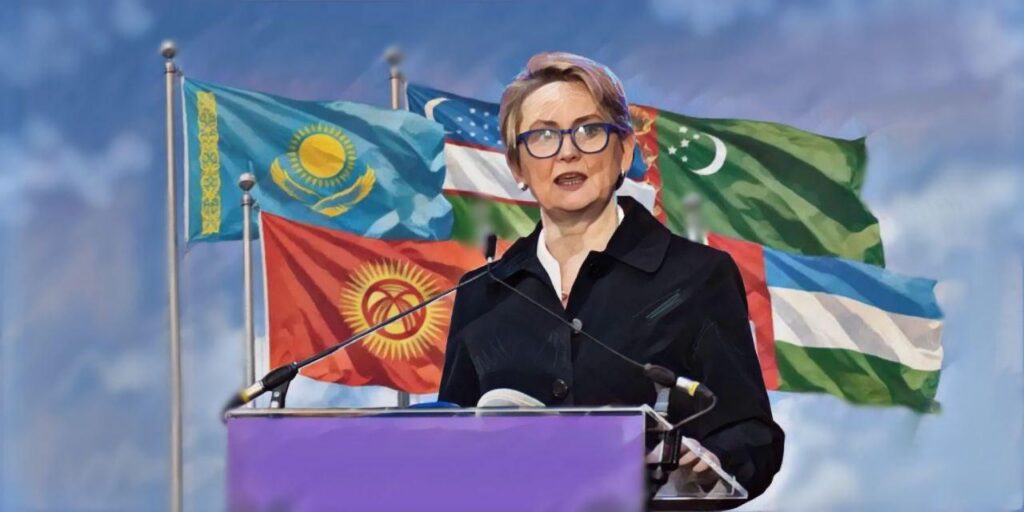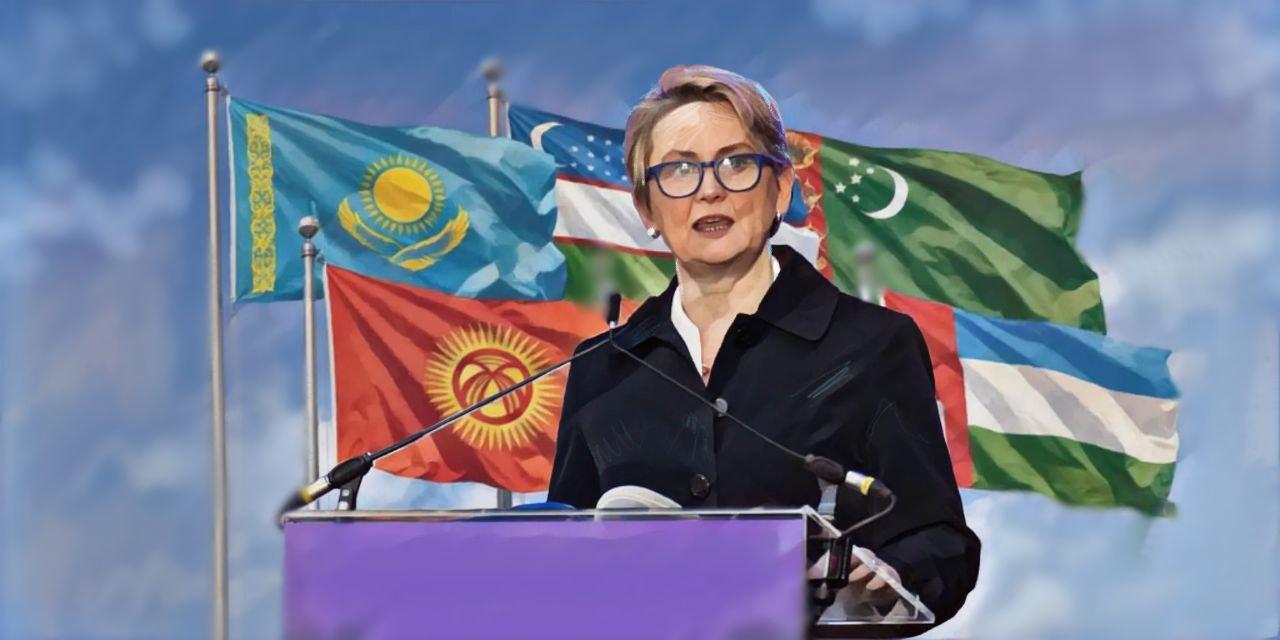
On February 26, 2026, the foreign ministers of Kazakhstan, Kyrgyzstan, Tajikistan, Turkmenistan, and Uzbekistan met in London with United Kingdom Foreign Secretary Yvette Cooper at Lancaster House for the inaugural “Central Asia–UK” (CA5+UK) ministerial. Official statements described it as the first time since independence that all five Central Asian foreign ministers have met jointly with a UK foreign secretary in a single forum. They also presented the meeting as the start of a structured ministerial channel, intended to convene regularly, that can carry regional priorities while leaving bilateral agendas in place.
The United Kingdom is framing the new CA5+UK channel as a replacement for scattered bilateral visits: a single ministerial venue can set shared priorities and route them into investment and services work. For the five Central Asian states, it adds another external track, widening options without forcing institutional choices. Public statements point to a practical agenda focused on trade and investment, transport connectivity, energy transition, and critical minerals, with security present chiefly as background context. The enabling layer of finance, standards, education, and professional services is also included.
How the London Program Unrolled
On February 25, meetings took place at the British Parliament as part of the London schedule. The five ministers met with House of Commons Speaker Sir Lindsay Hoyle and held a session with the All-Party Parliamentary Group for Central Asia, chaired by Pam Cox. The meetings in Parliament complemented the ministerial session at Lancaster House by widening contact beyond foreign ministries. The discussion emphasized committee-to-committee contacts, visits, and exchange of legislative practice as a complement to intergovernmental diplomacy. Parliamentary relationships and staff channels can carry attention between ministerial sessions, assisting with follow-up after cooperative contacts have been publicly established. They represent a second continuity layer: implementation often turns on routine access and working familiarity rather than on formal statements alone.
Between the parliamentary program and the ministerial delegations, they also met with the United Kingdom business community at a reception in London. This was a practical companion to the new format, aiming at the conversion of diplomatic intent into projects that can be financed and executed. Kazakhstan’s Foreign Minister Yermek Kosherbayev cogently highlighted the Astana International Financial Centre (AIFC), which operates under English common law with an independent court and arbitration system and British judges in the AIFC Court. Beyond the plenary session, a ministerial working lunch provided a venue to follow up on such initiatives.
Early deliverables were not multilateral but bilateral. Kazakhstan and the United Kingdom signed a strategic roadmap on critical minerals through 2027 and paired it with education moves, including a licensed Coventry University campus in Almaty and plans involving British secondary and higher education institutions. Uzbekistan reported a Memorandum of Understanding on healthcare services that it presented as a platform for building pharmaceutical manufacturing capacity, alongside separate discussions with investment and finance counterparts in London. Turkmenistan cited a 2026–2027 cooperation program between foreign ministries, and Tajikistan continued to emphasize investment and cooperation in science and education.
CA5+UK Launches with Bilateral Packages
The CA5+UK forum launches another “plus-one” mechanism in a region where major partners are now structuring their engagement through repeatable formats. In line with that engagement, the UK initiative concerns not so much building a new institution as attaching deal-enabling capacity to already existing projects. Kazakhstan’s foreign ministry underscored the breadth of the bilateral agenda and noted that ratification of the 2024 Strategic Partnership and Cooperation Agreement would widen the platform for cooperation. At the CA5+UK, Foreign Minister Yermek Kosherbayev confidently presented Kazakhstan as the region’s connectivity hub, noting that 13 major transit corridors cross Kazakhstan and that about 85% of overland cargo between Europe and Asia moves through its territory.
For the five delegations, the practical payoff is direct access to counterparties that can price risk, mobilize capital, and sustain follow-up between ministerial sessions, without narrowing external options. The schedule described by Uzbekistan’s foreign ministry paired political meetings with implementation-oriented discussions, including the healthcare MoU mentioned above, and separate talks with Standard Chartered Bank on financing large industrial projects as well as with Benoy on urban and transport planning, including New Tashkent and regional master plans. Kyrgyzstan used the Kyrgyz-British Business Council meeting to widen the investor pipeline around critical minerals and banking cooperation, with the emphasis on market access and capital-raising, rather than on a single signed headline document.
Even in a UK-facing commercially oriented format, once banks, insurers, and logistics providers are involved, projects are shaped by compliance screening, sanctions exposure, and risk pricing. Kyrgyz Foreign Minister Jeenbek Kulubaev warned that unilateral restrictive measures could affect trade, economic, and financial cooperation with the United Kingdom and called for dialogue to keep commercial ties from being pulled into political disputes. The practical effect is a tilt toward projects with clearly identified counterparties, documented compliance pathways, and predictable dispute-resolution procedures acceptable to financiers. Transactions that raise screening burdens close more slowly or at higher cost; taking these conditions into account, Kosherbayev described the new track as results-oriented and stressed “tangible results.”
CA5+UK in the “Plus-One” Field
The CA5+UK joins several other “plus-one” formats that Central Asian governments can sequence against one another. Germany’s Z5+1 has been presented as a tool-driven work channel that can move through German instruments while remaining compatible with European Union programming. The United States–led C5+1 is framed as a standing diplomatic platform for regional solutions and joint work across multiple agencies. China has relied on leader-level summitry and formal political upgrading, including a treaty-based umbrella for long-horizon cooperation. The UK format is different: it can succeed without a heavy institutional superstructure if it repeatedly converts priority sectors into financeable transactions under UK documentation and risk standards. It will look viable if it becomes a routine mechanism rather than an annual event.
What is needed for that is an early decision on the next ministerial date, accompanied by the naming of contacts to carry the work between meetings. A small but visible pipeline of projects that reach financing and implementation steps would be another indicator, even if no project is a big headline. For the Central Asian five, the CA5+UK is useful if it increases execution capacity without narrowing external options or forcing institutional lock-in. The format can give them access to instruments that make projects financeable, particularly where counterparties depend on legal predictability and transaction support. The potential cost is that a larger number of channels increases the premium on intraregional coordination, because different timetables and financing terms can complicate the coordination of project selection and messaging.