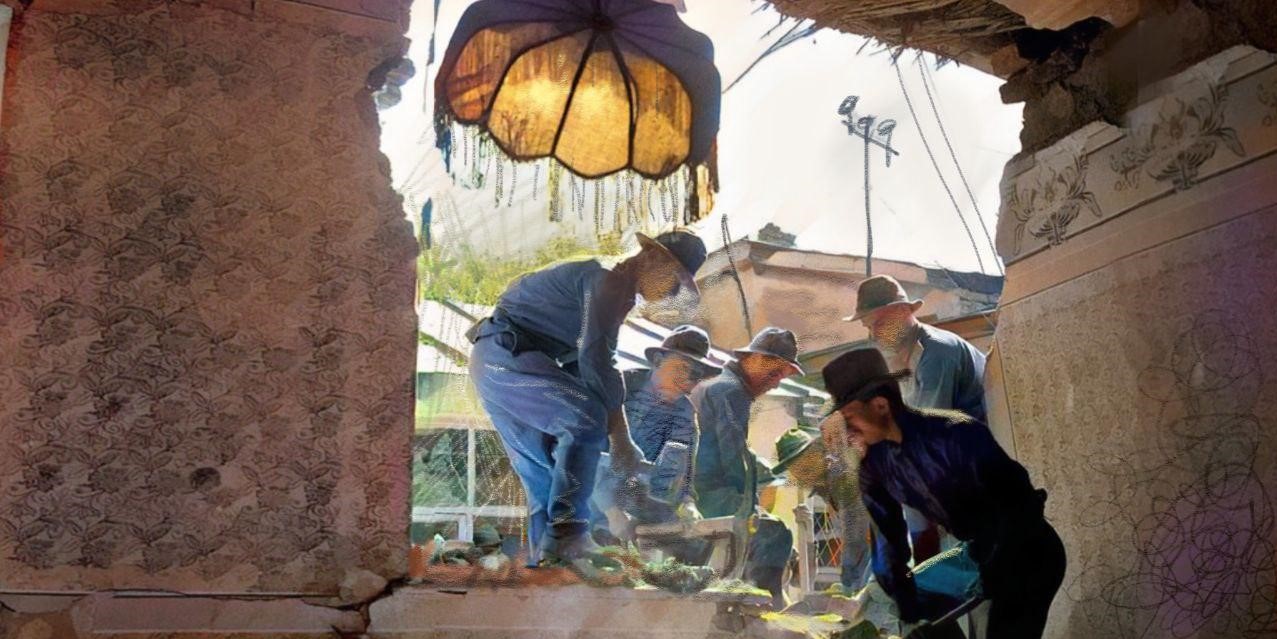
In a recent livestream with a Russian nationalist commentator, prominent Kazakh political analyst Marat Shibutov was asked what threat most concerns Kazakhs today. While his interlocutor expected a geopolitical answer, perhaps Russia’s military might or imperial ambitions, Shibutov’s response reflected a deeply local fear shared by many in Almaty: a devastating earthquake.
Given the region’s seismic history, his concern is far from misplaced. A powerful natural disaster could strike a crippling blow to Almaty, Kazakhstan’s economic and cultural heart, and potentially derail the country’s broader development ambitions.
A History of Devastation
Almaty lies within the Almaty Seismic Zone, a high-risk area in southeastern Kazakhstan known for producing powerful earthquakes. Several historically significant tremors, Vernensky, Keminsky, Kemino-Chuisky (1936), Chiliksky, Sary-Kamyshsky, and Dzhambulsky, were named after their epicenters.
The Verny earthquake struck early on May 28 (June 9 in the modern calendar), 1887. Measuring 7.3 on the Richter scale, it destroyed nearly 1,800 stone buildings and over 800 wooden structures. The epicenter was located just 10-12 kilometers south of the city on the northern slope of the Zailiyskiy Alatau, at a depth of about 60 km.
The second major disaster, the Kemin earthquake, occurred on December 22, 1910 (January 4, 1911, by modern reckoning). It struck the Chon-Kemin, Chilik, and Chon-Aksu valleys, with a magnitude of 8.2. Tremors lasted for five minutes, followed by strong aftershocks. The epicenter was about 40 km from Verny, in the eastern Zailiyskiy Alatau.
On June 21, 1938, another major quake, later named the Kemin-Chui earthquake, originated at the mouth of the Bolshaya Kemin River. Though its epicenter registered between magnitude 8 and 9, public memory of the event is surprisingly faint. In Almaty, the quake struck at around 5 a.m., jolting residents from sleep. Tremors reached magnitude 6, but most people remained calm.
Panic in 2024
This was not the case in January and March 2024, when strong tremors triggered widespread panic in Almaty. Some residents jumped from balconies or stairwells, sustaining injuries. Others fled the city in cars, causing major traffic jams.
The panic was most pronounced among residents of modern high-rises. Until the 2000s, Almaty had largely avoided such construction due to seismic safety concerns, a principle rooted in Soviet urban planning. Developers now claim modern technologies ensure these buildings can withstand earthquakes but many residents remain unconvinced.
This mistrust has sparked public protests against large-scale development projects, including by members of the Mazhilis, Kazakhstan’s lower house of parliament.
Adding to concerns, Soviet-era buildings have significantly deteriorated. Aging infrastructure, waterlogged basements, and amateur renovations, including the removal of load-bearing walls, have further weakened the housing stock. In the event of a major quake, widespread destruction is likely and experts agree that the national budget alone could not absorb the resulting financial fallout.
Is the Kemin Fault Awakening?
Following the March 2024 earthquake, seismic expert and former head of Kazakhstan’s seismic monitoring network, Mukhtar Khaidarov, warned that the epicenter may have been in the Kemin fault zone, a possible precursor to a larger quake.
His concerns were echoed by officials two months later.
“The possibility that the epicenter of the strongest Kemin earthquake is beginning to become active cannot be ruled out, but since there are no reliable prediction methods, it is not yet possible to give a definite answer,” said Elizaveta Esenjigitova, deputy director of the National Scientific Center for Seismological Observation and Research under the Ministry of Emergency Situations.
In response, mandatory earthquake drills have resumed in Almaty, involving schools, universities, and civil servants. Emergency assembly points, often school buildings, are being prepared, with medical staff and rescue workers trained to respond. The military has begun rehearsing the deployment of mobile hospitals and refugee camps. Body bags are being stockpiled, and land is being reserved for mass burials.
These measures, though discreet, indicate that officials are treating the risk of a major earthquake as both real and imminent.
A Regional Threat
Almaty is not alone. Central Asia has a long history of deadly earthquakes.
- Ashgabat, 1948: A 7.3 magnitude quake struck the capital of the Turkmen SSR on the night of October 5-6. With the epicenter nearly directly beneath the city, tens of thousands were buried under collapsed buildings. Official estimates list 40,000 dead, though many suspect the true number was much higher. Nearly 9,000 residents were evacuated over the following weeks.
- Tashkent, 1966: An earthquake struck directly beneath Tashkent, leveling parts of the old city. It destroyed over 2 million square meters of housing and displaced 78,000 families, more than 300,000 people. Within 3.5 years, the Soviet government had completely rebuilt the city using modern, multi-story designs.
- Kayrakkum, 1985: On October 13, an 8.0 magnitude quake struck near the Tajik city of Kayrakkum. Its epicenter lay beneath the Kayrakkum Reservoir. Dozens of settlements were devastated. Though the official death toll was only 29, survivors have long disputed that figure. Reconstruction took years; many lived in trailers for months or longer.
Preparedness vs. Probability
While major earthquakes remain unpredictable, the seismic risks in Central Asia are undeniable and growing. Almaty, as the region’s largest economic hub, has the most to lose. And while current efforts suggest that authorities are finally preparing for the worst, the question remains: will it be enough?