In Moscow, before Russia’s full-scale invasion of Ukraine, Joe Luc Barnes met residents who distrusted their government but believed its assurances that war was not coming. The shock that followed opens his book, Farewell to Russia: A Journey Through the Former USSR.
Barnes, a journalist, editor and contributor to The Times of Central Asia, has visited all 15 former Soviet republics since February 2022. His book explores how people have built their lives since independence, and how deeply Russia remains woven into them.
Speaking to TCA, Barnes recalls meeting rural residents in Central Asia who were more supportive of Russia than their urban, Russian-speaking counterparts. He also reflects on why Russia remains a destination for young people seeking opportunities, despite the discrimination many face there.
TCA: At the start of the book, you describe Muscovites’ conviction that Russia would not invade Ukraine. What sustained that certainty, and how did people respond when events shattered it?
Joe Luc Barnes: I think it was mainly down to people not wanting to believe it. The amazing thing is that Muscovites (and Russians at large, in my experience) are fully aware that their government is full of crooks whom they wouldn’t trust with anything, but simultaneously most of them are in lockstep with the Kremlin’s foreign policy position.
The war started just as Russia was trying to get the country vaccinated against Covid. In the end, the government struggled to persuade even 50% of people to have a single dose of the vaccine, but meanwhile those same people were sure the Kremlin was telling the truth when it said that its soldiers were massing on Ukraine’s borders as part of “routine exercises”.
When the war did begin and that illusion collapsed, the main reaction was shock. For the first few days, there was a kind of numbness over the city. Many people had friends or relatives in Ukraine; others were stunned that something they had been denying had actually come to pass. Many in their 20s or 30s were disgusted with their government and began to look for a way out of the country. But people were generally focused on looking after themselves – worrying about things like finances, getting money out of their bank accounts, things like that.
I think there was also a belief among many that it would be a short war. When I left Russia in March 2022, I don’t think I, or anyone around me, expected the war to still be raging four and a half years later.
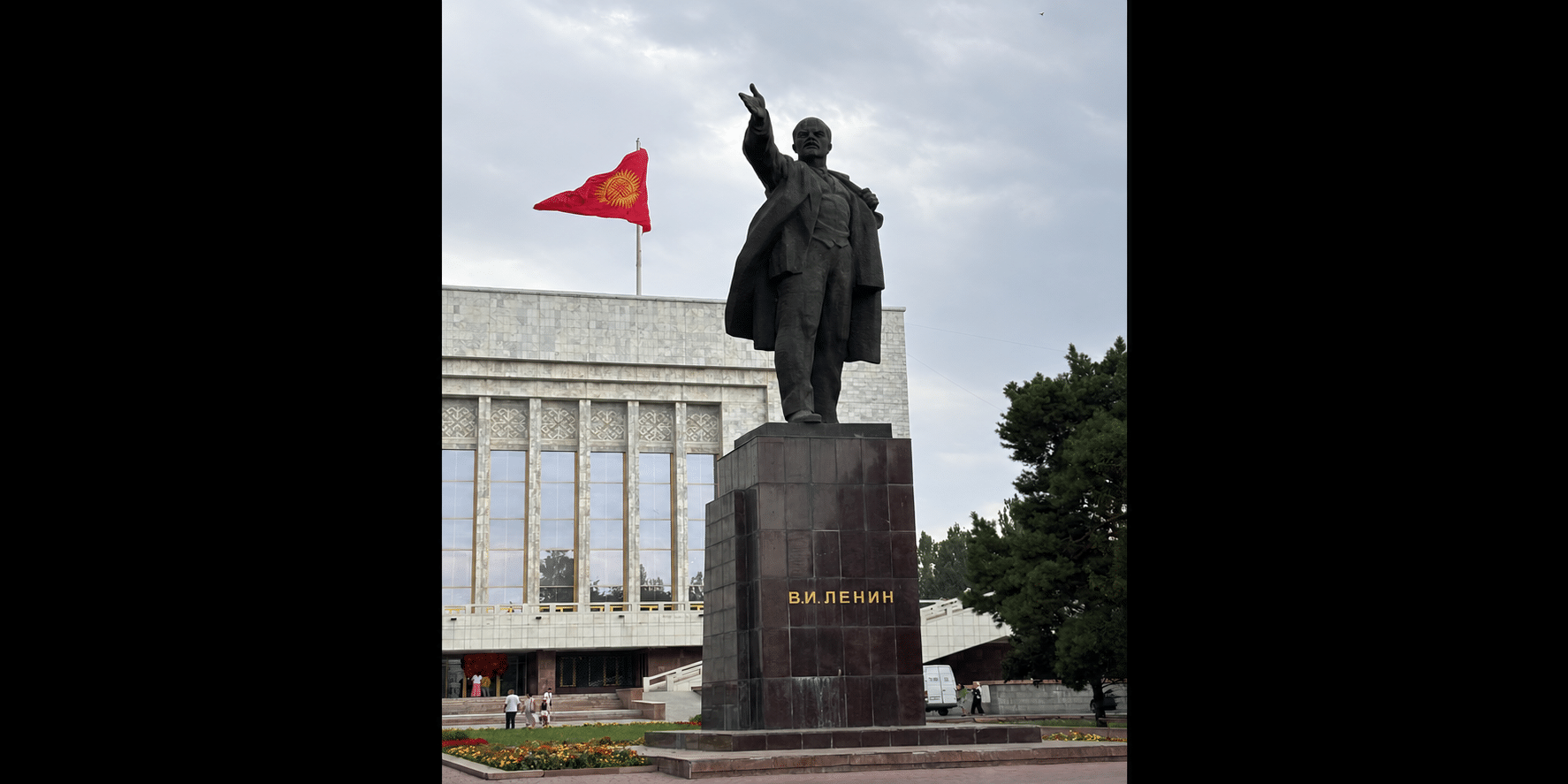
Lenin still stands in Bishkek, though not on his original plinth. Image: Joe Luc Barnes
TCA: Your title suggests a departure from Russia. Where in Central Asia did that feel most real, and where did everyday life complicate the idea?
Joe Luc Barnes: I think in urban Central Asia, you can often feel like you’re in a Russian city. People speak Russian, you get around using Yandex Taxi, your mobile provider is Beeline, and architecturally you still have the Soviet apartment blocks, trolleybuses and street underpasses. Over 70% of the books in bookshops in Tashkent, Bishkek and Almaty are in Russian, and there are Russian chains from Sportmaster to Dodo Pizza, Myata Lounge to Black Star Burger. Even Harat’s “Irish” Pub comes from Irkutsk (it is indeed a long way to Tipperary!).
However, that is partly a reflection of my own lifestyle. If you spend your time in bars and coffee shops, you’re inevitably going to encounter a more Russian or European lifestyle. Spend more time in the bazaar, the chaihana or the mosque, and obviously the situation looks very different. In rural Central Asia, this is even more the case. You can go to mountain communities in Kyrgyzstan and meet traditional herdsmen, or go to villages in Uzbekistan, and it can feel as if the Soviet Union never happened.
But Central Asia wouldn’t be fun without its ironies – the funny thing is that rural people I encountered were often more supportive of Russia than their urban, Russian-speaking counterparts. Funny old world.
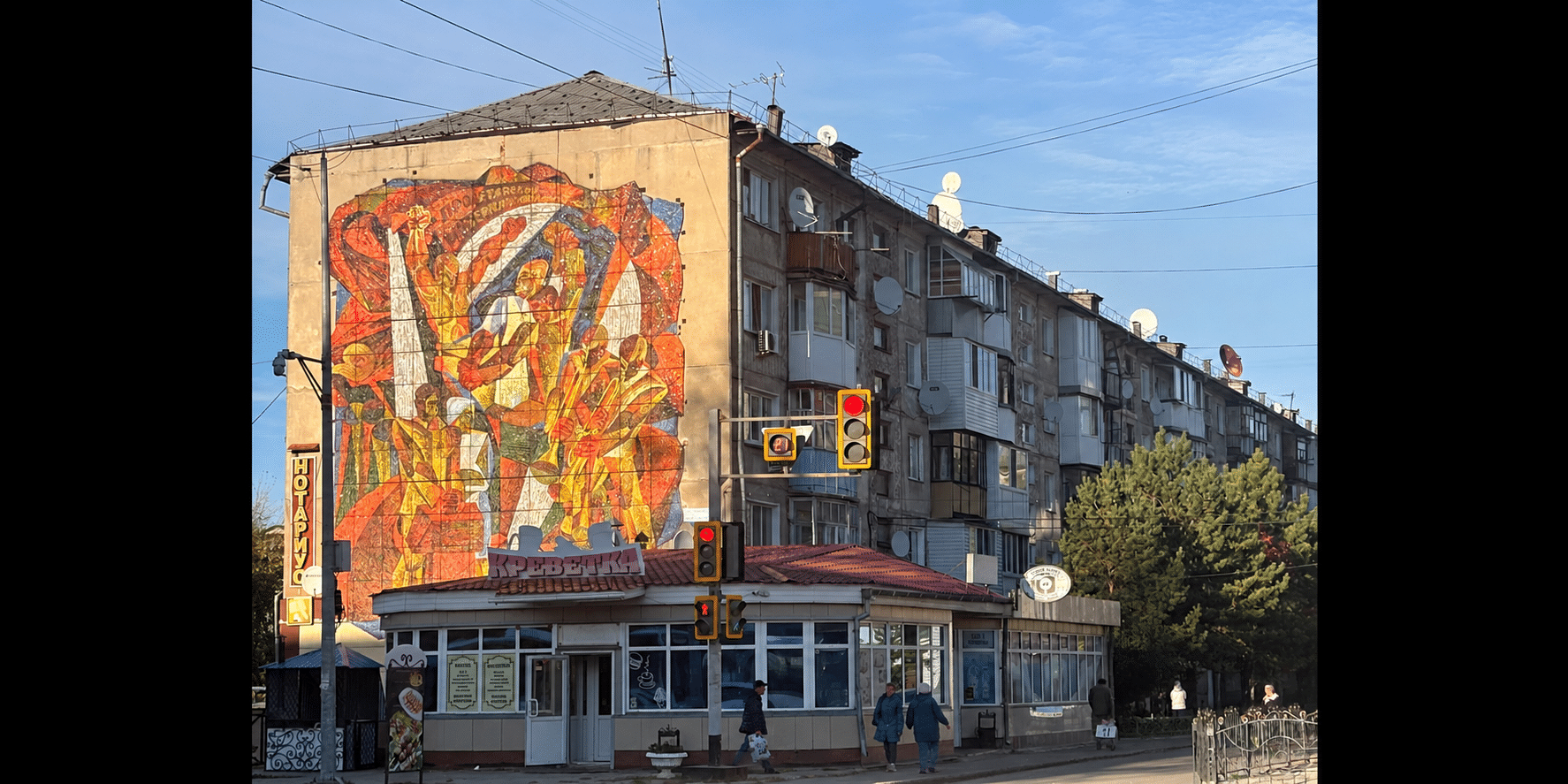
Soviet-era mosaics, like this one in Petropavl, are still a common sight in many Central Asian cities. Image: Joe Luc Barnes
TCA: When younger people spoke about their futures, where did they imagine building their lives? What did those conversations reveal about Russia’s place in their world?
Joe Luc Barnes: In Tajikistan, I was asked to give a talk to a hall of students about the potential to study in England. It was awkward as, in Britain, we tend to see foreign students as a cash cow to prop up a university sector which otherwise haemorrhages money. Evidently, in Tajikistan, the poorest of all the former Soviet republics, there weren’t many people able to stump up $50,000 a year for an education. So I talked about scholarship options – and there is a brilliant scholarship programme offered by the British government called Chevening, but it is very competitive.
Anyway, I went round the room and about 70% of people had one or both parents working abroad – mainly in Russia, some in Qatar or Turkey. One statistic that blew me away about Tajikistan is that remittances from Tajiks working abroad have accounted for almost half of the country’s GDP in recent years.
Generally, among young people there was a desire to get out if they could. This goes for almost every country – I met Azeris living in Luxembourg or Poland; Belarusians moving to Britain or the US; and Russians leaving for anywhere they could. Even in relatively rich nations like Kazakhstan or the Baltic states, there are still many people looking to leave.
However, you are right to bring up Russia. It is still the unrivalled hub for migration from Central Asia. University in Russia is cheap and high-quality, and there are also fewer language barriers. People who go there for work argue that at least Russia offers them good jobs, good wages and the chance to build a life – it’s not as if Europe or America is handing out hundreds of thousands of visas to Uzbeks, after all.
However, everyone from Central Asia and the Caucasus, even people from Moldova, would mention the racism they experienced in Russia – from difficulties at customs and being racially profiled by police to landlords with a “Slavs only” tenant policy and schoolteachers who abuse kids for having a “foreign” surname. By all accounts, it’s a universal experience.
The war in Ukraine, plus the terrorist attack at Crocus City Hall in 2024 have led to a surge in nationalism as well as a crackdown on Central Asian migrants. In some ways this has made Russia less attractive, but it has also put a squeeze on the labour supply, which means that in many cases wages are higher in Russia than they were before. So people continue to go there despite all the apparent downsides.
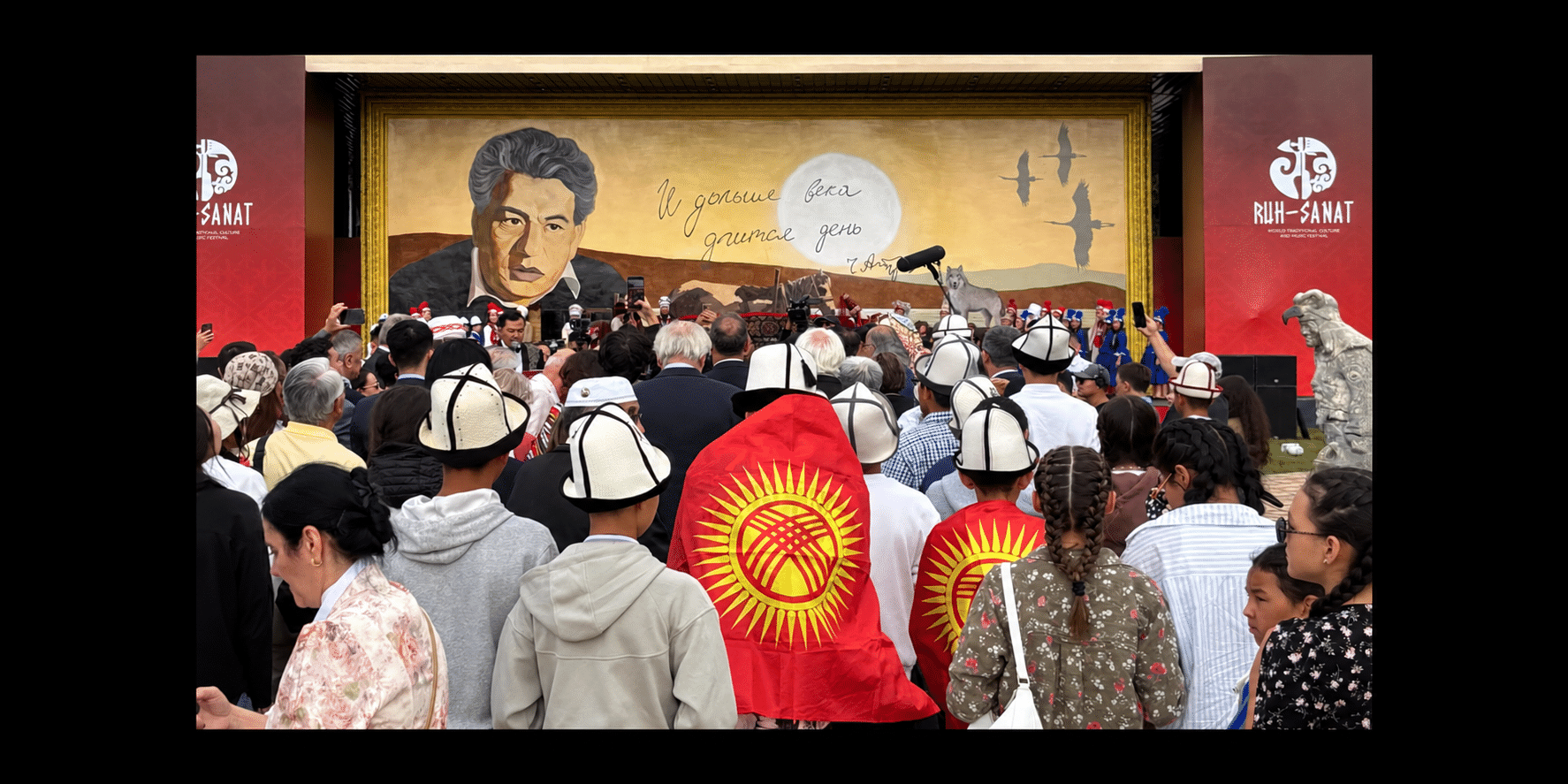
A crowd of Kyrgyz stand in front of a portrait of the country’s most famous author, Chingiz Aitmatov. Image: Joe Luc Barnes
TCA: Travel writing about Central Asia often dwells on Soviet remnants or Silk Road history. What did you encounter that belonged unmistakably to the present?
Joe Luc Barnes: One massive divide you see across the former USSR is demographic. The five Central Asian republics, plus Azerbaijan, have seen enormous growth in their populations – an increase of almost 60% since the Soviet Union collapsed in 1991. This is reflected in the culture, I think: there’s a disorder, but also a virility and positivity. When I tell someone from Central Asia that I’m childless at the age of 35, they look at me like I belong to some weird cult!
This population growth has physical consequences – go to any Central Asian city and you will see construction everywhere, the economy booming, but also horrendous smog smothering the skies in winter. Every country is desperately struggling to keep up with its swelling citizenry, and they are all heavily reliant on China to supply infrastructure. Everything from new road bridges and railways to electric vehicles and buses, 5G infrastructure and mobile phones is being imported en masse from Beijing.
One thing China can’t provide, though, is water. And that looks increasingly like it might be the key issue of the 21st century in the region. Temperatures are rising, glaciers are melting, the population and its demands are growing, and there’s only so much water to go around. That’s definitely one to watch over the next decade or so.
TCA: How did you judge what people felt safe telling you, particularly in places where criticism carries risks? Were there stories you decided you could not publish?
Joe Luc Barnes: There were some countries that I went to – Tajikistan, Turkmenistan and Azerbaijan especially – where I would keep a lower profile. Many of the more authoritarian countries require a specific visa for journalism, which restricts what you can do. However, things like travel writing and vlogging occupy an interesting legal grey area – you’re basically at the mercy of officialdom over how they decide to perceive it. So, in those countries, I didn’t thrust the fact that I was writing a book into people’s faces.
In terms of deciding what I couldn’t publish, the priority is to keep your sources safe and not needlessly expose someone to retribution for the sake of an anecdote in a travel book. There are ways of telling a story without invading people’s privacy.
However, in most places, I think there was a genuine delight that a foreigner was taking an interest in their country – it’s not as if Kyrgyzstan often makes it onto the CNN news bulletin, so generally I found that people were really keen to recount their experiences.
After all, it is a travel book; there’s a lot you can learn about a place simply by discussing people’s life stories.
TCA: As Farewell to Russia reaches American readers, which place in Central Asia would you choose to introduce potential visitors to the region, and why?
Joe Luc Barnes: In terms of ease for a visitor, it has to be Uzbekistan. It’s now visa-free for US citizens and is the only country with a direct flight to the United States (there’s a daily service from Tashkent to New York). The tourism infrastructure is the most advanced in the region – high-speed trains whizz you between cities; it has all the old Silk Road towns; there’s the Soviet history in Tashkent; and there are loads of hotels. It’s also very cheap.
Uzbekistan is also the most representative country in the region. It has half the region’s population and is the only Central Asian country to border all the others. And in terms of contemporary issues – from the disappeared Aral Sea and cotton monoculture to a hugely contentious debate about the role of women in society – it has loads of issues for researchers to get their teeth into. There’s also a fascinating cultural battle between Islam and worldly authority, the latter embodied by a modernising, technocratic government still staffed by communist apparatchiks.
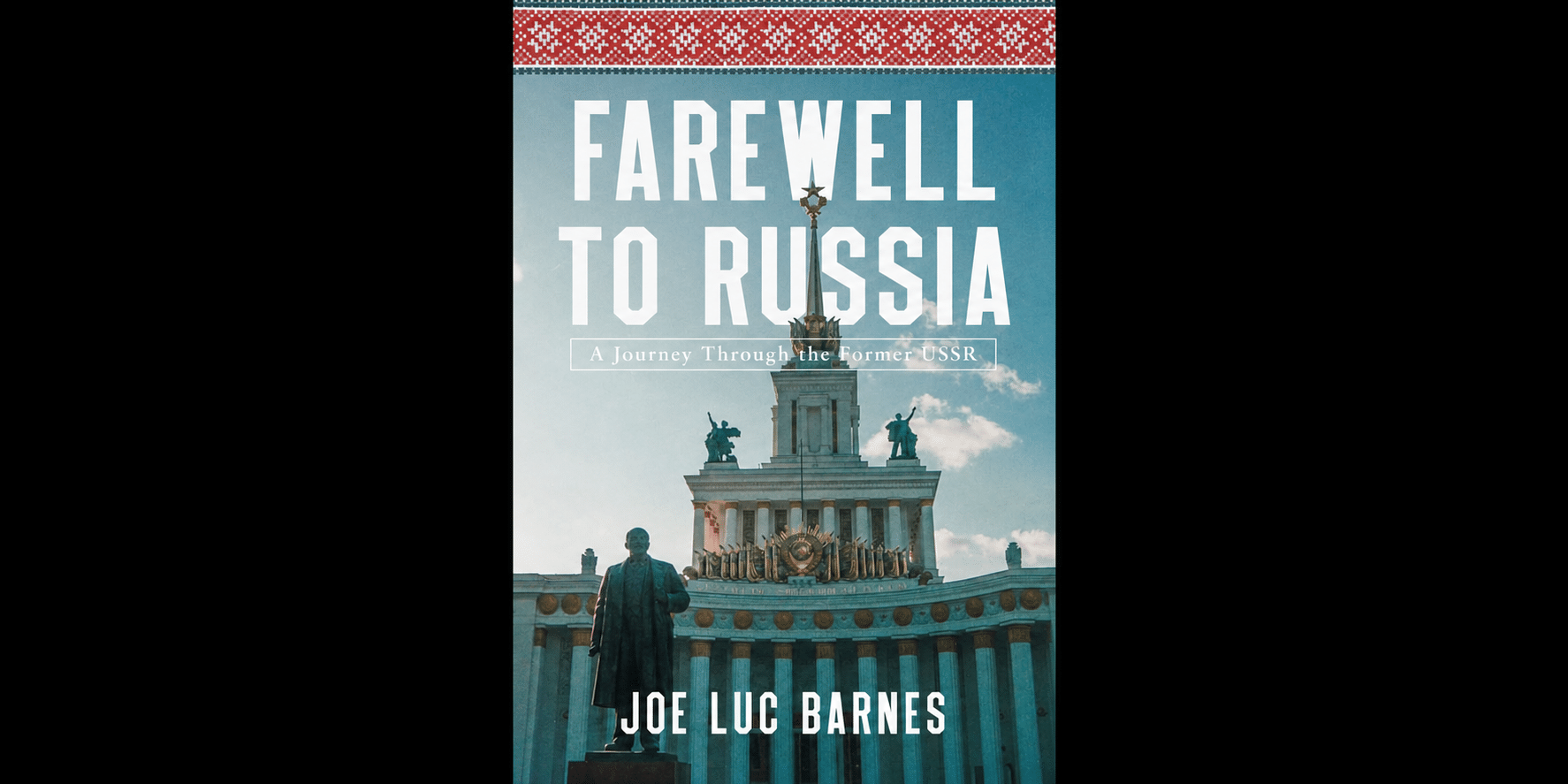
Joe Luc Barnes’s Farewell to Russia: A Journey Through the Former USSR
Joe Luc Barnes’s Farewell to Russia: A Journey Through the Former USSR was released in the U.S. by Pegasus Books on October 6, 2026.