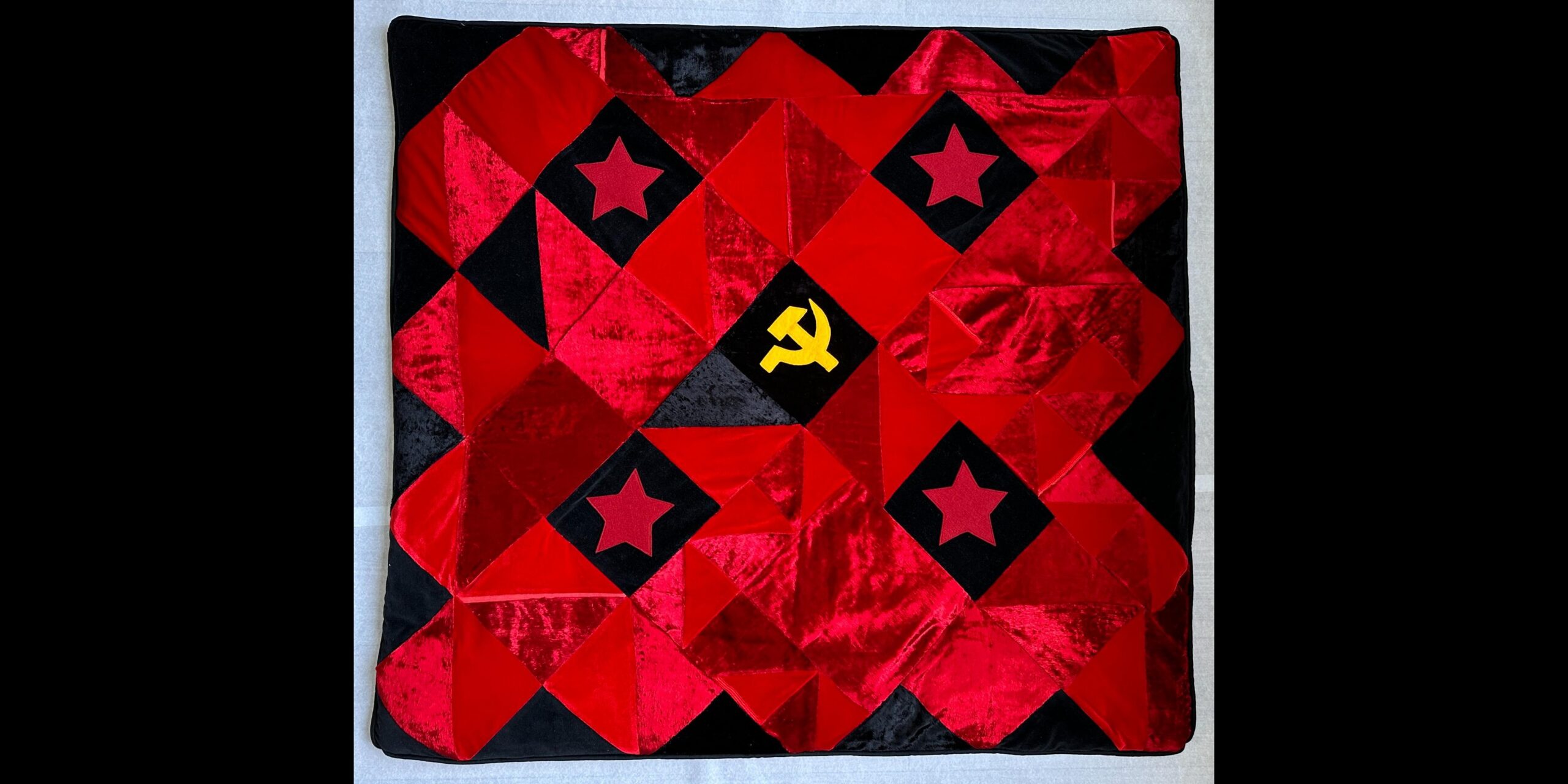
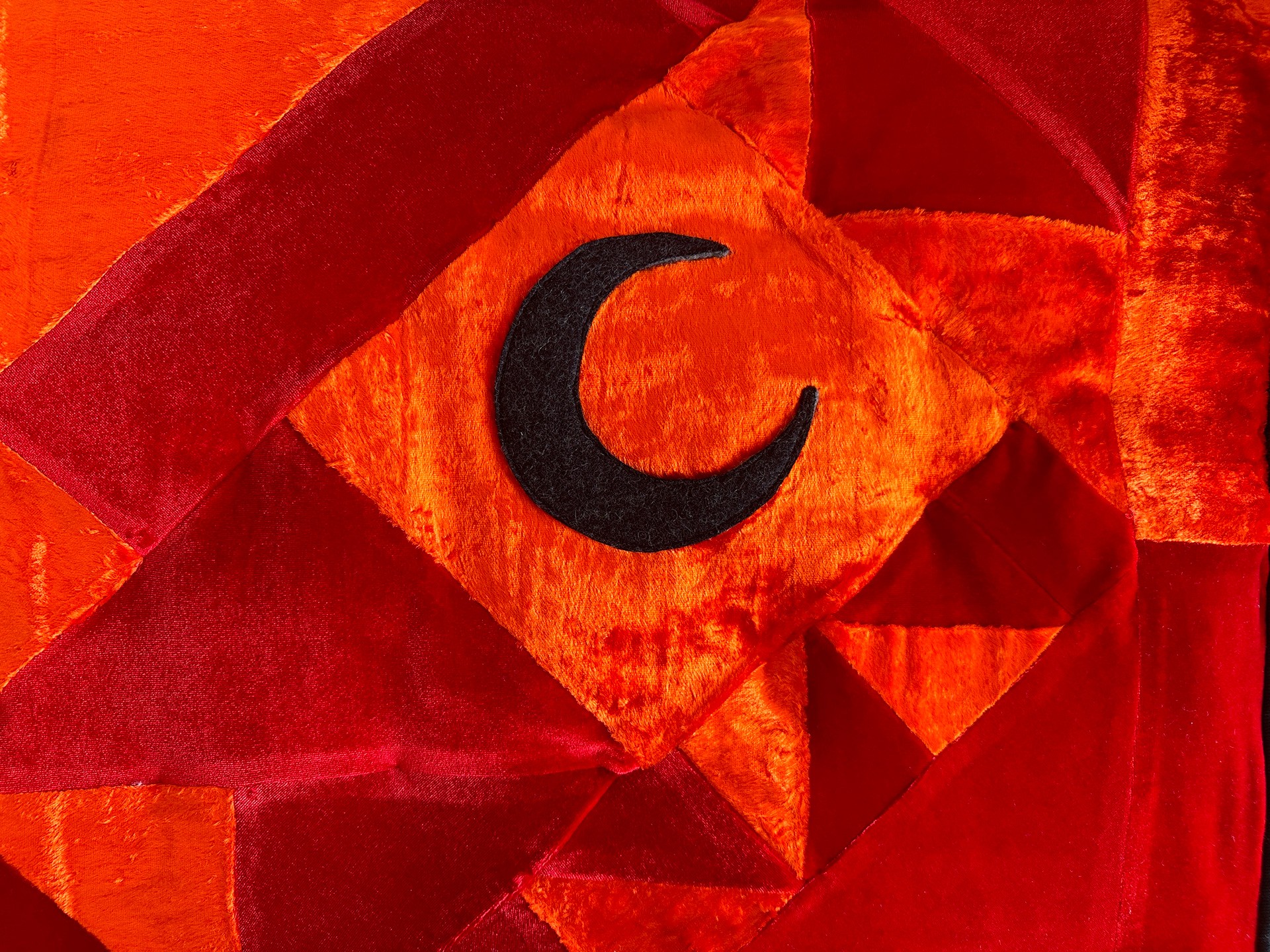
A yellow hammer-and-sickle symbol is sewn onto black, yellow, blue and red mattresses in Up on Manas, down on Sovetskaya, a powerful artwork by artist Munara Abdukakharova presented last year at Fondazione Elpis in Milan. Inspired by the traditional kurak korpe (the hand-stitched patchwork cushions and mattresses that roll up like futons), the piece reimagines a familiar domestic object as a carrier of collective memory for Central Asian migrants, often the most tangible material link to home.
Born in 1990 in Bishkek, just one year before Kyrgyzstan declared independence from the Soviet Union, Abdukakharova belongs to a generation that grew up during a profound political and cultural transition. The lingering Soviet legacy, the rise of nationalism, increasing religious influence, and the pressures of global capitalism all intersect in her work, which frequently draws on textiles, felt, and everyday objects rooted in local culture.
“The art I make is mostly narrative, based on my everyday life, and depicts broader social issues in Kyrgyzstan,” says Abdukakharova from her home in Bishkek, from where she realizes most of her work.
A finalist of the B. Bubikanova Art Prize, Abdukakharova works across embroidery, printmaking, photography, and installation. Speaking to The Times of Central Asia, she reflects on her path from architecture to contemporary art, the political realities shaping life in Bishkek, and the role artists play in questioning the direction of a young nation.
TCA: You often describe your artistic practice as emerging from observation and your everyday experience. Did you grow up in a family that was into art?
Abdukakharova: Not at all. All the members of my family are pharmacists, and while my parents wanted me to go to medical school, I couldn’t; I’m really scared of blood! (laughs) I went to an architectural school instead.
I didn’t draw as a child, but I remember really liking to dismantle objects, whether it was toys or even a chair, furniture, and trying to put it back again… something I still love to do. The passion for drawing came only later on, in high school.
TCA: Your decision to study architecture in Bishkek came at a time when many young people in Kyrgyzstan still looked toward Russia for their education. Could you describe the circumstances that led you to that choice and the cultural expectations surrounding it?
Abdukakharova: When I finished high school in 2008, studying in Moscow was still seen as the best option. Unlike how it is today, growing up in Bishkek, there was a strong belief that anything coming from the former Soviet Union was inherently good. The teacher who helped me prepare university applications only suggested schools in Moscow or St. Petersburg; other countries were never really discussed, even though I already spoke English quite fluently. Looking back, I realize how dominant that perspective was at the time.
I took a gap year, thinking that I could go to an art school later, maybe the Moscow Surikov State Academic Institute of Fine Arts. In the end, my parents didn’t let me pursue that path, and now I think it might have been for the best.
If I had gone to study in Moscow, my development as an artist and architect would probably have taken a completely different direction. It would have shaped not only my education, but my perspective on art and the way I see the world today.
TCA: How would you describe the experience of studying architecture in Bishkek?
Abdukakharova: I studied architecture for six years. The first three were okay, but the last few years were really hard. There was a lot of corruption involved, and some professors were very difficult to work with. At some point, I really thought about quitting, but still, I graduated in 2014.
The training was very academic: we studied drawing for four years, painting for two, and sculpture for one, learning classical techniques and a very disciplined way of working.
For a long time, I remembered that period as plainly bad. But now that more time has passed, I’ve started thinking that anything, good or bad, leaves some experience in your life. Even today, when people see my works, they often say it feels like I was taught as an architect.
TCA: How did you first encounter contemporary art practices?
Abdukakharova: During my third year at university, a professor invited me to do a summer internship at a museum studio connected to both architecture and contemporary art. The head of the studio is an architect and curator, and that environment introduced me to contemporary artistic practices.
From there, with two friends, we created a collective called Ten Points. We participated in a local festival for three years while we were studying. After graduation, we stopped working as a group, but I continued my path in the arts.
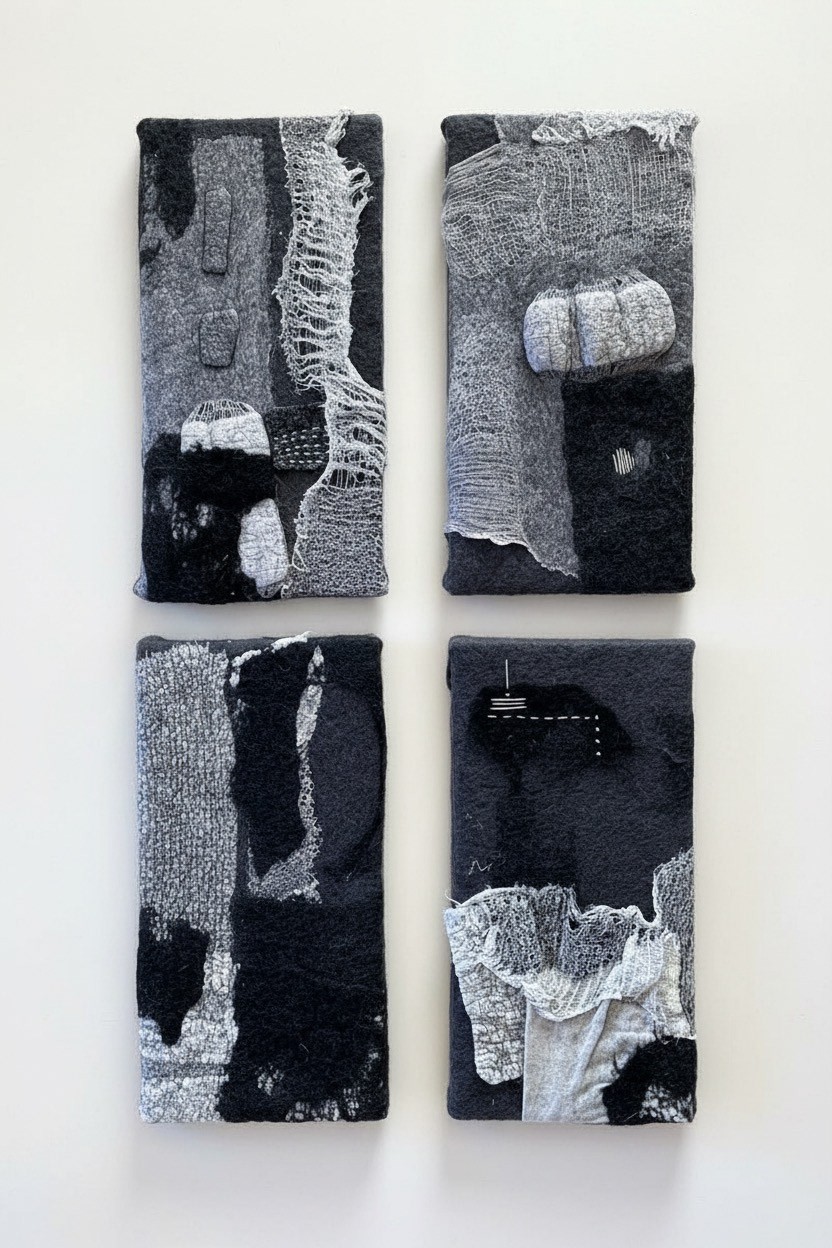
TCA: Your work frequently incorporates textiles and felt, materials deeply embedded in Kyrgyz nomadic traditions. How did you begin working with those mediums?
Abdukakharova: I started with textiles. I bought myself a small loom, and I began weaving abstract works. I showed those pieces in a group show, and that was the starting point. In 2018, I took a short course in wet-felting. A woman who is now a very close friend gave us a basic knowledge of working with wool and making felt. I really enjoyed it.
Today, I continue to explore those techniques through collaborations with local craftspeople. I’m working with a local manufacturer called Tumar. They helped me enlarge my drawings using the technique of ala-kiyiz, which is a very ancient Kyrgyz wet-felting technique for carpets, which is now under threat of disappearing.
TCA: Your work often engages with social and political realities in Bishkek, yet it rarely does so in a direct or didactic way. How do you approach political themes in your practice, and what role does art play for you in addressing these issues?
Abdukakharova: Politics is both part of my art and my life. I think it’s important to talk about social and political issues in the country, especially because today there are fewer possibilities to express disagreement publicly.
A few years ago, there were peaceful demonstrations in Bishkek. These were not aggressive protests, just quiet collective walks to show that people cared about certain issues. But in the last couple of years, demonstrations have been prohibited in the city.
Because of that, I feel that speaking about these topics through art, or even just continuing to discuss them with people around me, becomes increasingly important. Even in everyday conversations, I sometimes realize that people around me may not fully recognize certain problems, and I feel a responsibility to keep raising these questions.
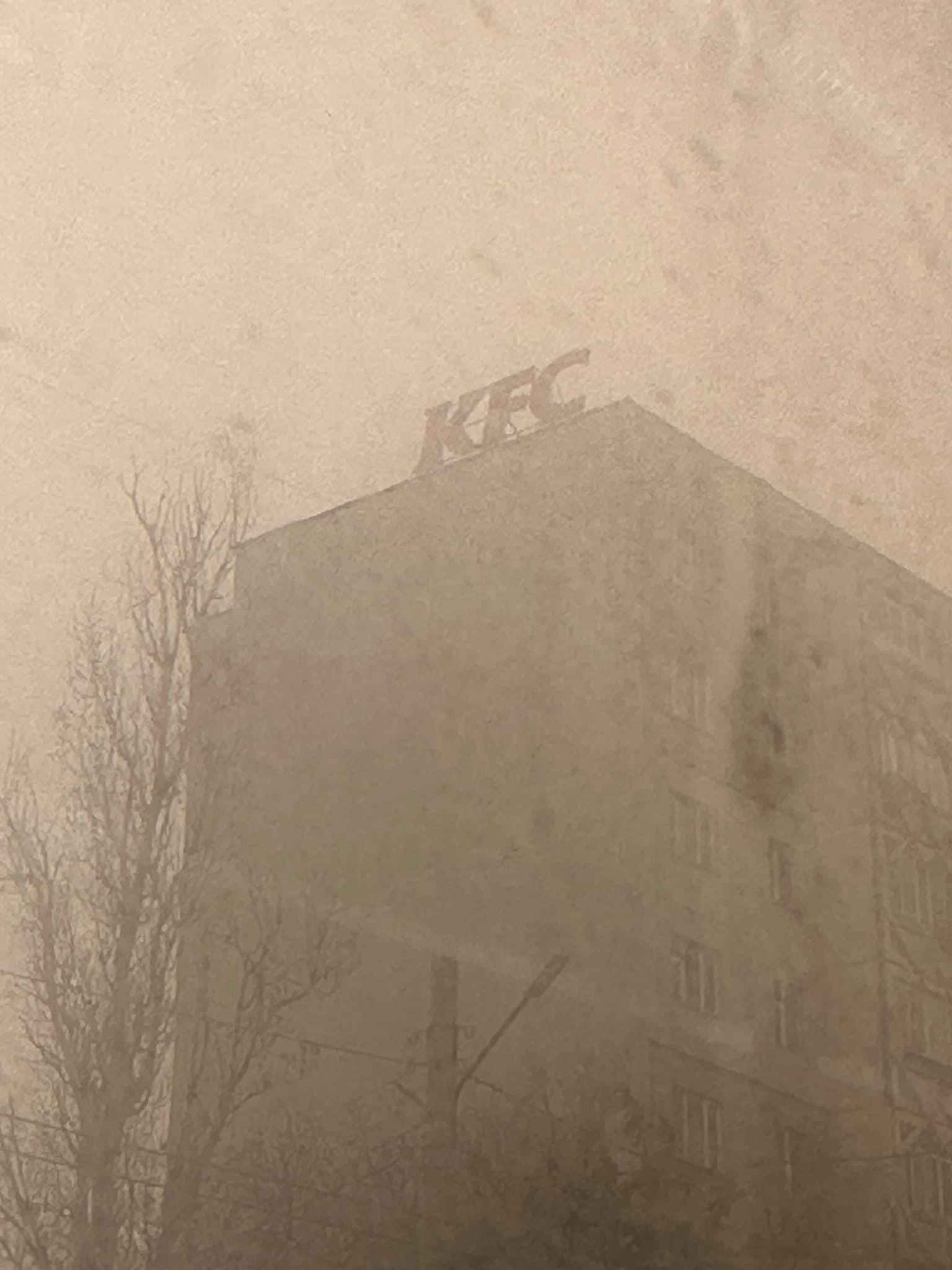
TCA: One of these concerns is air pollution in Bishkek, which you address in your ongoing series, Smog Parallel City. How did this project begin?
Abdukakharova: In winter in Bishkek, the air pollution becomes extremely heavy, and yet many people still don’t seem to realize how serious it is. Sometimes I walk through the city and see young mothers outside with their babies in strollers while the air is full of smoke, and it makes me feel very sad, because it can really affect people’s health.
For me, it is also very personal – my daughter has allergies, and I often think about how the polluted air might influence children growing up in the city. At first, I approached smoke purely as a physical condition, as the visible pollution that surrounds us; but over time, I began to understand that it could also function as a metaphor.
Now I often speak about “political smoke” as well, a kind of atmosphere of obscurity or confusion that surrounds our daily lives. So, in an abstract manner, the series continues to refer to very real environmental problems, but at the same time, it reflects a broader feeling about the conditions in which society exists today.
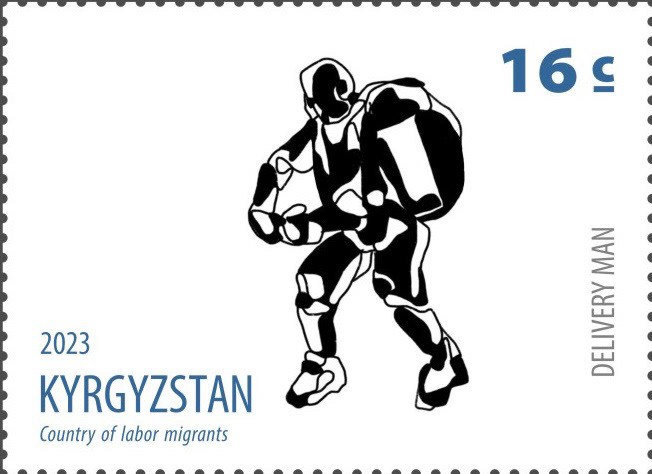
TCA: Migration is another central theme in your practice, particularly in the project Kyrgyzstan: Country of Migrants. What inspired that work?
Abdukakharova: The project was born from a reflection on national postage stamps. Usually, they show things a country is proud of: flowers, buildings, and famous athletes.
There is a lot of labor migration to Russia. Many people live in very poor conditions there. Sometimes, twenty people sleep in one room, and they endure these conditions in order to send money home. They support families and keep the economy of Kyrgyzstan alive. That’s why I dedicated the stamps to professionals, like cleaners, waitresses, delivery workers, and taxi drivers. I feel migrants are the national heroes of Kyrgyzstan.
TCA: Another work of yours, Up on Manas, Down on Sovetskaya, reflects on the many cultural and political influences shaping Bishkek today. How did you translate these ideas into the textile form?
Abdukakharova: The idea came from the titles of bus routes in Bishkek. On the buses, street names are often shortened, and when you read them, you start noticing how many different historical layers exist in the city at the same time. For example, people still say Sovetskaya or Moskovskaya; Soviet-era names that officially no longer exist, but remain in everyday language.
At the same time, there are other references, like Silk Way Street, which points to connections with China, or Manas Street, named after the Kyrgyz national hero. Seeing these names together made me think about the different influences shaping the country today: the Soviet past that still lingers in people’s memories, the increasing presence of Chinese businesses and their cheap goods in Bishkek, the growing influence of religion in rural communities, and the nationalist rhetoric in public space.
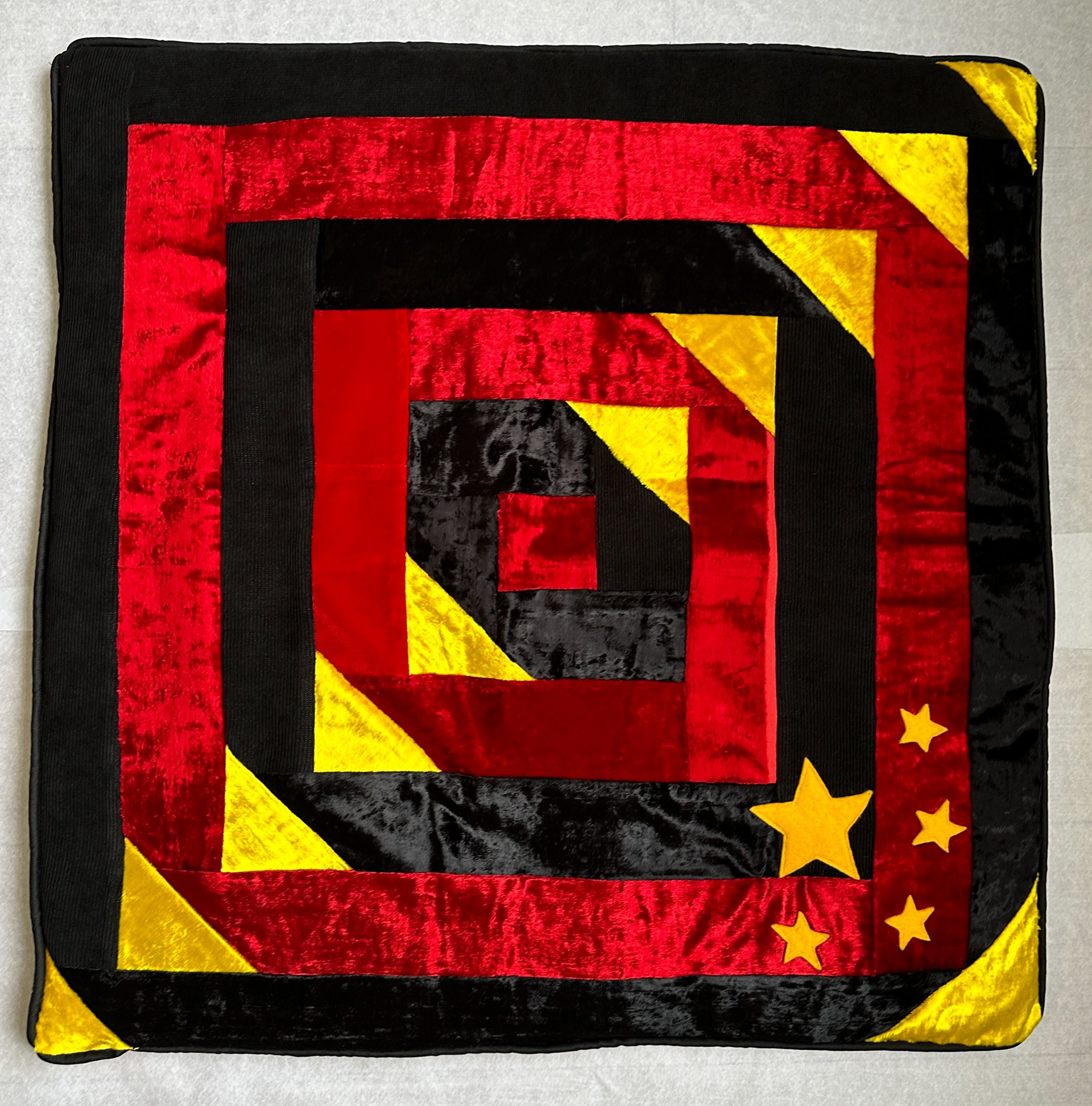
In the work, I translated these ideas into textiles using patchwork and embroidery. I stitched together pieces of fabric and incorporated the names and symbols into the surface, almost like assembling fragments of a map. The process relates to traditional Kyrgyz textile practices, where different fabrics are sewn together by hand, but here the composition becomes a way of reflecting on these overlapping histories and directions.
This got me thinking about how global political tensions reach even a small country like Kyrgyzstan. Around the war between Russia and Ukraine, for example, with friends taking different sides; I feel that for us, living in such a small country, it is important to remain united.
What matters most is that our home remains a home. At the same time, I also feel concerned about how rapidly capitalism is entering Bishkek, because it sometimes seems that we’re losing things that are essential to this place.
I’m not talking about nationalism, but about protecting what’s unique about our culture, and thinking about what we want to preserve and pass on to future generations.
TCA: What role does the community in Bishkek play in sustaining your art practice?
Abdukakharova: Most of my exhibitions are in this local context. I know that for an artist’s career, this is not considered very good, because you don’t earn much money. But the local community of artists is very important for me. They are the people who keep me here in Bishkek. I’m also very inspired by the older generation of artists. Even when the situation becomes very difficult, they remain calm and continue creating art.