• KGS/USD = 0.01144 0%
  • KZT/USD = 0.00209 0%
  • TJS/USD = 0.10528 0.19%
  • UZS/USD = 0.00008 0%
  • TMT/USD = 0.28490 0%
  • KGS/USD = 0.01144 0%
  • KZT/USD = 0.00209 0%
  • TJS/USD = 0.10528 0.19%
  • UZS/USD = 0.00008 0%
  • TMT/USD = 0.28490 0%
  • KGS/USD = 0.01144 0%
  • KZT/USD = 0.00209 0%
  • TJS/USD = 0.10528 0.19%
  • UZS/USD = 0.00008 0%
  • TMT/USD = 0.28490 0%
  • KGS/USD = 0.01144 0%
  • KZT/USD = 0.00209 0%
  • TJS/USD = 0.10528 0.19%
  • UZS/USD = 0.00008 0%
  • TMT/USD = 0.28490 0%
  • KGS/USD = 0.01144 0%
  • KZT/USD = 0.00209 0%
  • TJS/USD = 0.10528 0.19%
  • UZS/USD = 0.00008 0%
  • TMT/USD = 0.28490 0%
  • KGS/USD = 0.01144 0%
  • KZT/USD = 0.00209 0%
  • TJS/USD = 0.10528 0.19%
  • UZS/USD = 0.00008 0%
  • TMT/USD = 0.28490 0%
  • KGS/USD = 0.01144 0%
  • KZT/USD = 0.00209 0%
  • TJS/USD = 0.10528 0.19%
  • UZS/USD = 0.00008 0%
  • TMT/USD = 0.28490 0%
  • KGS/USD = 0.01144 0%
  • KZT/USD = 0.00209 0%
  • TJS/USD = 0.10528 0.19%
  • UZS/USD = 0.00008 0%
  • TMT/USD = 0.28490 0%

Astana Motors To Build New Plant In Almaty

On January 25th Kazakhstan’s president Kassym-Jomart Tokayev received the founder of Astana Motors, Nurlan Smagulov, who informed him about his company’s plans for the automotive industry in Kazakhstan, the president’s press office reported.

Mr Smagulov reported that in 2023 Hyundai Trans Kazakhstan and Hyundai Trans Almaty, subsidiaries of Astana Motors, manufactured 48,857 passenger cars and 981 commercial vehicles.

Mr Smagulov told the president that the construction of the Astana Motors Manufacturing Kazakhstan multi-brand plant in Almaty, for the production of China’s Chery, GWM (Haval), and Changan vehicles, is scheduled to be completed in February 2025. The plant’s capacity will be 90,000 vehicles per year. Of these, 60% will go for export. 

In September 2022 Astana Motors signed memoranda with Chinese automobile concerns Chery Automobile Company, Changan International Corporation, and Great Wall Motor, allowing it to manufacture these companies’ cars in Kazakhstan.

Unplanned vacations: 50,000 Aktobe Schoolchildren Missed Classes Because of Fake Terrorist Threat

In Aktobe, an attacker spread a terrorist threat to schools, after which parents did not let their children attend classes. On January 25th, an unknown culprit left a threatening message in a Telegram channel, where they spoke about plans to organize a mass shooting in schools in the city of Aktobe. The message quickly spread through social networks and parental chats, after which many parents did not let their children to go to school: out of 57924 students, only 8558 attended classes.
The police immediately found the author of the threatening messages and asked the parents of schoolchildren not to sow panic. The city administration also assured citizens that there was no threat to children, and that schools would be reinforced with security guards.
The attacker turned out to be an 18-year-old young man, who is a citizen of another country from the near abroad. A case has already been opened against him for knowingly spreading false information about an act of terrorism.
Regional authorities in Aktobe say the situation is now under the control of specialized law enforcement agencies, and there is no cause for concern. Additionally, the city administration asked parents not to unnecessarily disrupt the educational process.

Chinese Company To Build Four Power Plants in Kyrgyzstan

Kyrgyzstan’s Ministry of Energy and the China National Electric Engineering Co. Ltd. (CNEEC) have signed a memorandum of cooperation. The document provides for the construction of the Suusamyr-Kokomeren cascade of hydroelectric power plants and Kara-Keche thermal power plant, the ministry announced on January 24th

The Suusamyr-Kokomeren hydropower cascade will consist of three hydroelectric power plants with a total capacity of 1,305 MW and an annual electricity generation of 3.3 billion kilowatt-hours. These are the Karakol hydroelectric power plant (33 MW), Kokomeren HPP-1 (360 MW), and Kokomeren HPP-2 (912 MW). 

The Kara-Keche thermal power plant, which will be built at the Kara-Keche coal deposit in the country’s Naryn region, will have a capacity of 600 MW, the ministry said.

In recent years Kyrgyzstan has been looking for foreign investment to build new power generation facilities. Kyrgyzstan has for years experienced chronic power shortages, especially in the cold winter months, and has to import electricity from neighboring Kazakhstan, Uzbekistan, and Turkmenistan to meet its growing power needs.  

Tashkent To Introduce Cable Car To Help Resolve Transport Problem

The Tashkent municipality and Chinese company Beijing North Bartholet Ropeway Technology Co., Ltd. have agreed on a project to introduce a cable car service to help in solving the Uzbek capital’s transport and environmental problems, the press service of the Tashkent municipality said. 

The agreement was signed during the Tashkent mayor’s visit to the Chinese city of Shenzhen on January 23rd, where he met with the management of Beijing North Bartholet Ropeway Technology, a joint venture with the Swiss company Bartholet Maschinenbau AG, a world leader in ropeways production. 

According to the agreement, the Chinese company is going to invest in a project to duplicate ground municipal transport in Tashkent with cable taxis. The project will first be presented to the public, whose recommendations and suggestions would be taken into account by the Chinese company’s designers, the municipality said.  

The Uzbek Ministry of Ecology, Environmental Protection and Climate Change earlier this month stated that emissions from motor vehicles largely the cause for increasing levels of air pollution in Tashkent. On average 730,000 vehicles are on the move in Tashkent every day, with between 160,000 to 300,000 entering the capital from the regions. To resolve the problem, the Tashkent municipality intends to develop green public transport.

EBRD Invested More Than €1.2bn In Central Asian Economies In 2023

The European Bank for Reconstruction and Development (EBRD) says it invested more than €1.2bn ($1.3bn) in projects across Central Asia in 2023 to stimulate the region’s sustainable growth. 

Uzbekistan remained the leading recipient of EBRD funding in the region for the fourth year running, attracting more than €700m ($760m). The remaining €518m ($560m) were channeled to support projects in Kazakhstan, Kyrgyzstan, Mongolia, and Tajikistan.

In Uzbekistan, the EBRD continued investing in renewable energy power generation and low-carbon technologies. It financed the construction of three greenfield solar power plants with a total installed capacity of nearly 900 MW. The bank provided funds to ACWA Power Wind Karatau to finance the construction of a 100 MW wind power plant in the autonomous republic of Karakalpakstan. It also provided a sovereign loan to modernise 118 pumping stations and improve the sustainability of water supply for irrigation in the densely populated Fergana Valley. Samarkand became the first city in the country to join the EBRD Green Cities programme, and is planning to deploy ecologically friendly electric buses as part of this engagement. In the financial sector, the bank continued working with local financial intermediaries such as SQB, Hamkorbank and Ipak Yuli Bank to support SMEs and promote green lending. 

Highlights of the EBRD’s work in Kazakhstan include the launch of the GEFF Kazakhstan II and an investment in a local currency bond issued by the country’s transmission system operator, KEGOC. The funds will help make the country’s electrical grid more sustainable and reliable. The bank’s loan to China Power International Holding and Visor International will be used to build, operate and connect the 100 MW Shokpar wind power plant to the transmission grid. The EBRD’s loan to Kazakhstan’s largest private rolling stock operator, Eastcomtrans, will help expand container-handling capacity at one of the most congested junctions near Almaty and address the issue of bottlenecks along the Trans-Caspian corridor. Last year marked the completion of the street lighting system in Ust-Kamenogorsk (Oskemen), which allowed energy-efficient LED street lights to be installed on 150 streets. In the financial sector, the bank extended a new loan to the country’s leading microlender KMF to support green lending and women’s entrepreneurship.

In Kyrgyzstan, the EBRD supported the modernisation of water supply services in the Batken and Jalal-Abad oblasts. The bank signed a number of sovereign projects aimed at modernising key transport and energy infrastructure, which will help improve the country’s connectivity and climate resilience. These projects included loans to upgrade a 30km section of the Issyk-Kul Lake ring road, increase the reliability of the national electricity transmission and distribution grid, and rehabilitate and modernise the Lebedinovskaya hydropower plant. The EBRD also completed the Bishkek landfill project last year, which will provide major environmental benefits for the more than one million people living in the country’s capital.

The completion of three infrastructure projects in Tajikistan allowed more than 400,000 people in 13 municipalities across the country to enjoy better access to clean and safe drinking water. Last year the EBRD launched the GEFF Tajikistan II and extended new GEFF loans to Bank Arvand and microlenders Humo and Imon International. With a joint base of more than 540,000 clients and operational even in remote mountainous parts of the country, these three institutions will help bring green finance to even the smallest borrowers in Tajikistan. The EBRD offered support to local retailers and agribusiness companies under a risk-sharing scheme with the country’s largest private lender, Bank Eskhata.

Aral Sea Parallels Loom Over Lake Balkhash

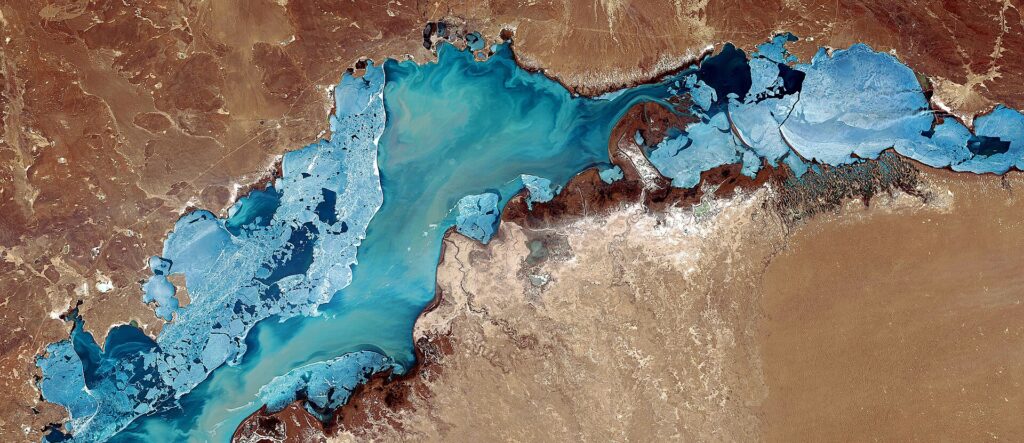
Located 175 miles north-west of the country’s largest city, Almaty, Kazakhstan’s Lake Balkhash is the fifteenth largest lake in the world. The remains of an ancient sea which once covered vast tracts of land, on its shores in the city of Balkhash, a mixture of around 68,000 mostly ethnic Kazakhs and Russians eke out a living, predominantly through fishing and mining. But like its’ sister body of water, the Aral Sea, Lake Balkhash is under threat with its inflow sources diminishing.

Fed by glaciers in Xinjiang, China, the Ili River has traditionally accounted for the vast majority of Lake Balkhash’s inflow, but according to research, as of 2021 China was blocking 40% of the river’s inflow, leading to a rise in anti-Chinese sentiments in Kazakhstan.

In 1910, Lake Balkhash had an estimated surface area of 23,464 km². As recently as the 1960s, fishermen were netting a catch of over 30,000 tons annually, but by the 1990s, this had fallen to 6,600 tons of significantly less sought-after types of fish. Between 1970 and 1987 alone, the water level fell by 2.2 meters, with projects aimed at halting this decline abandoned as the Soviet Union fell into stagnation before dissolving. Currently, the lake covers a surface area of between 16,400 and 17,000 km². Falling water levels have also led to the appearance of new islands and impacted biodiversity, with 12 types of bird and 22 vertebrates indigenous to the region listed in the Red Book of Kazakhstan as endangered, whilst the Caspian tiger is, in all likelihood, extinct. Meanwhile, contamination from mining, both local and upstream in China, have led to the lake being classified as “very dirty.”

With desertification now affecting one-third of the Balkhash-Alakol Basin, which includes Almaty, the resultant dust storms are leading to an increase in the lake’s salinity, with silt from these storms further affecting inflow. Parallels to the Aral Sea – arguably the worst man-made environmental disaster in modern history – are all too apparent.

Spanning across Kazakhstan and Uzbekistan, the Aral Sea was once the fourth largest inland body of water in the world, covering 68,000 km². The destruction of the Aral Sea first dates back as far as the U.S. Civil War, when, finding his supply of American cotton under threat, the Russian tsar decided to use the sea’s tributaries to irrigate Central Asia and create his own cotton bowl. With 1.8 million liters of water needed for every bale of cotton, the water soon began to run out. By 2007, the Aral had shrunk to one-tenth its original size.

Up until the late-1990s, the land surrounding the Aral Sea was still cotton fields; today, it’s largely an expanse of salinized grey emptiness. The desiccation of the landscape has led to vast toxic dust-storms that ravage around 1.5 million square kilometers. Spreading nitrates and carcinogens, these storms – visible from space – used to occur once every five years, but now strike ten times a year.

Once a thriving agricultural center, Karakalpakstan, home to the remaining section of the so-called Large Aral Sea, is now one of the sickest places on Earth. Respiratory illness, typhoid, tuberculosis and cancers are rife, and the region has the highest infant mortality rate in the former USSR.

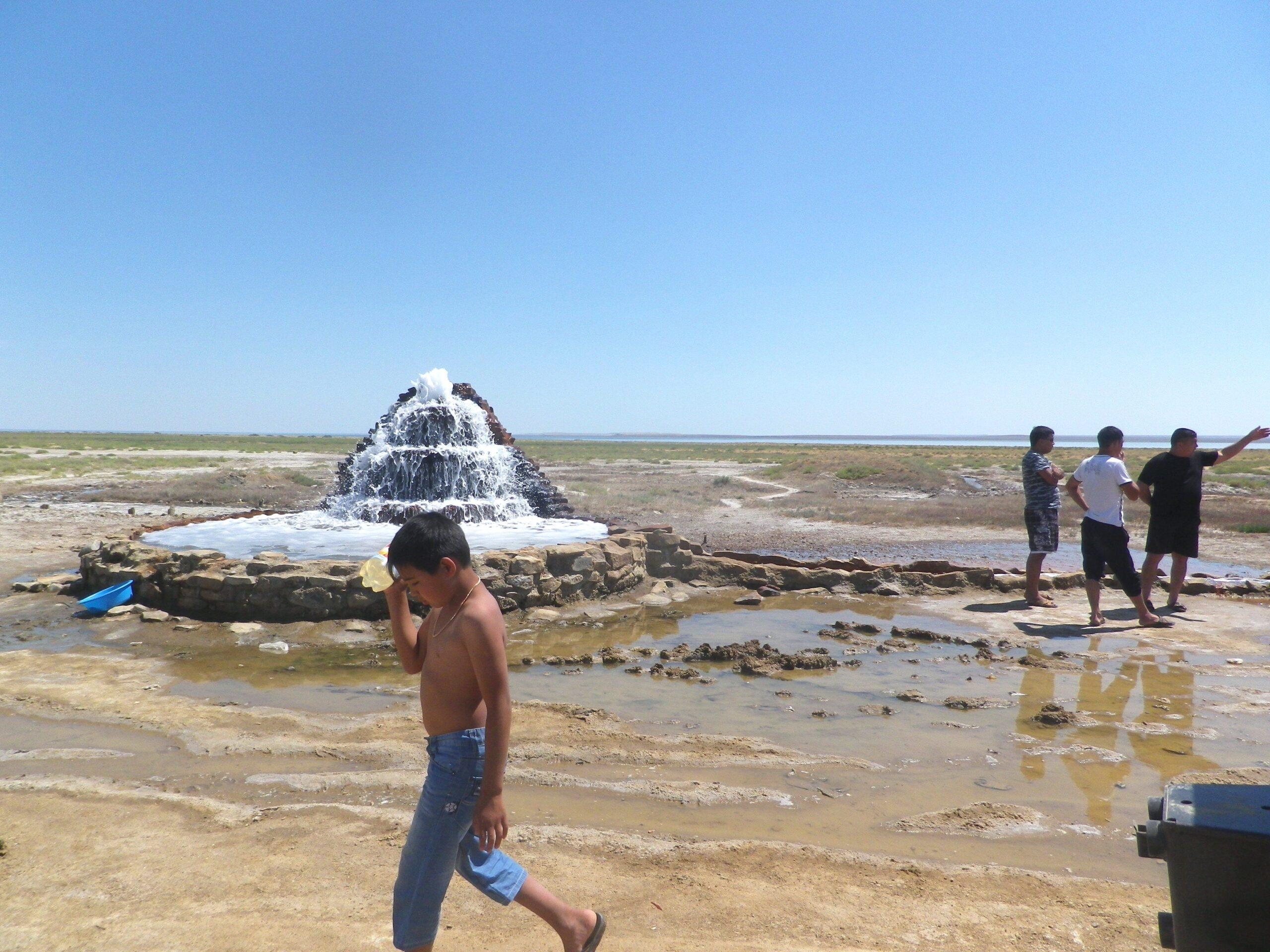
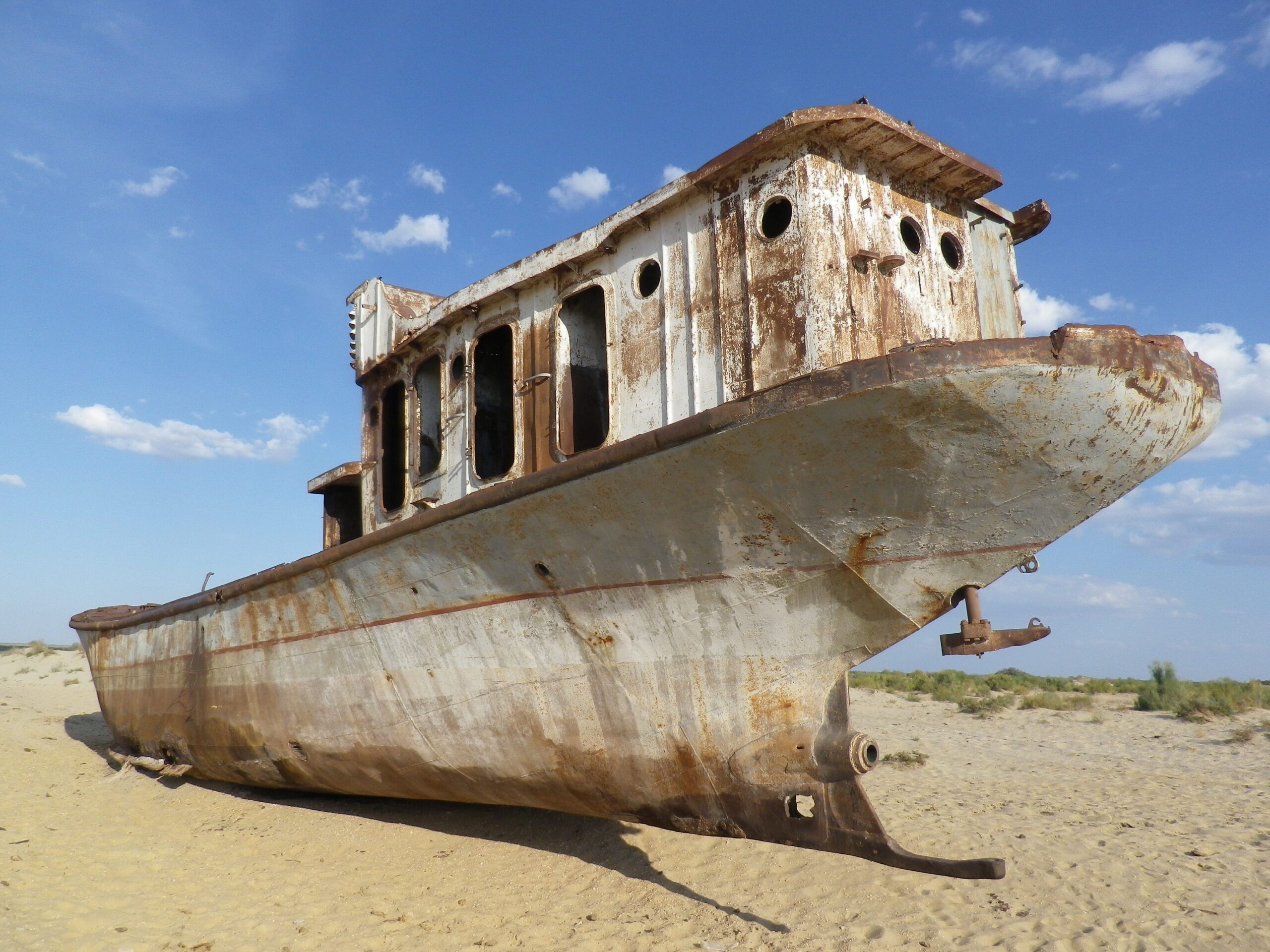
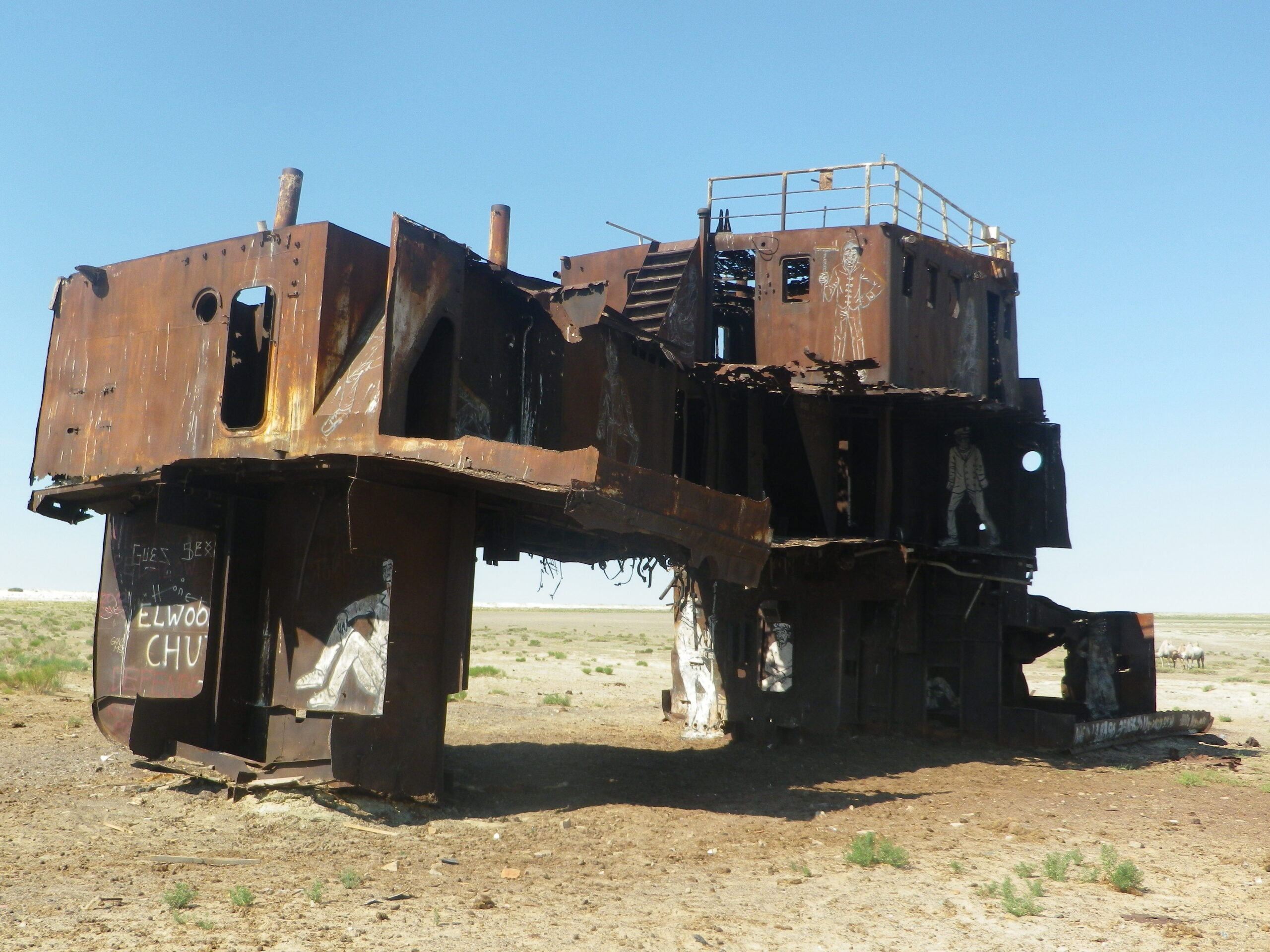
Further into the manmade desert lies the forgotten hamlet of Moynaq. At its peak, the town was home to 60,000 people, mostly fishermen and their extended families, with the Aral Sea producing up to 30% of the Soviet catch and saving Russia from widespread famine in the 1920s. Accessible only by air and ferry well into the 1970s, Moynaq also served as a popular beach resort for well-heeled bureaucrats, its airport hosting fifty flights a day at its peak. By the eighties, though, tourism had dried up. Digging channels through the sand in pursuit of the diminishing sea, Moynaq’s fishermen discarded their ships where they became grounded. With the sea’s major source, the Amu Darya River no longer reaching its historic terminus, a local saying goes: “When God loved us, he gave us the Amu Darya, when he ceased to love us, he sent us Russian engineers.”

Today, the town’s population number less than 2,000, the remnants of the sea almost two hundred kilometers away. Striped sunlight spills through the skeletal ribs of the desert ships hulls, sunbaked trawlers slowly oxidizing. Animated by history, these inert objects take on an ethereal vitality in opposition to the overwhelming sense of desolation surrounding them. Thorny grey and fuchsia pink thistles destined to become tumbleweeds shake as brackish gusts whip across the vast wasteland once so teeming with life. With the sea gone, the region is subject to searing summers and freezing winters, 500 species of bird, 200 mammals, a hundred types of fish and countless insects unique to the region all now extinct.

“Like its more notorious sibling, the Aral Sea, Lake Balkhash is an inland endorheic lake threatened by unsustainable human exploitation of its feeder river systems,” Dr. Kristopher White, an Economic Geographer and Associate Professor at KIMEP University in Almaty told The Times of Central Asia. “Also like the Aral, deficit conditions currently prevail with respect to Balkhash’s water balance. This means that inflow from the four river systems – plus other additions from precipitation on the surface and runoff – is less than the net losses resulting from evaporation from the lake’s surface plus any groundwater seepage.

“The main concern in this equation is the Ili River, which is responsible for approximately 75% of Balkhash’s water additions. That the headwaters of the Ili lie in China makes the river a geopolitically sensitive trans-boundary waterway. Dams, canals, and water withdrawals on the Chinese side have powered agricultural and industrial development in Xinjiang. As with other trans-boundary river systems, actions taken in ‘upstream’ States often negatively impact populations and aquatic ecosystems ‘downstream,’ as Kazakhstan is in this case. Being reliant upon decisions made in China, particularly those requiring the consideration of ecological integrity and sustainable use of riparian resources, has led to significant apprehension in Kazakhstan.”

Whilst organizations such as the Save Lake Balkhash International Research Project are campaigning for the designation of a “special status which legally protects lake’s ecosystem and people inhabiting lake area,” with a referendum set to be held on the construction of a nuclear power plant that would likely use water from the lake as a coolant, the situation for remains dire. Whether Lake Balkhash can be saved or is set to mirror the fate of the Aral Sea remains to be seen.