• KGS/USD = 0.01144 0%
  • KZT/USD = 0.00212 0%
  • TJS/USD = 0.10456 0.19%
  • UZS/USD = 0.00008 0%
  • TMT/USD = 0.28490 0%
  • KGS/USD = 0.01144 0%
  • KZT/USD = 0.00212 0%
  • TJS/USD = 0.10456 0.19%
  • UZS/USD = 0.00008 0%
  • TMT/USD = 0.28490 0%
  • KGS/USD = 0.01144 0%
  • KZT/USD = 0.00212 0%
  • TJS/USD = 0.10456 0.19%
  • UZS/USD = 0.00008 0%
  • TMT/USD = 0.28490 0%
  • KGS/USD = 0.01144 0%
  • KZT/USD = 0.00212 0%
  • TJS/USD = 0.10456 0.19%
  • UZS/USD = 0.00008 0%
  • TMT/USD = 0.28490 0%
  • KGS/USD = 0.01144 0%
  • KZT/USD = 0.00212 0%
  • TJS/USD = 0.10456 0.19%
  • UZS/USD = 0.00008 0%
  • TMT/USD = 0.28490 0%
  • KGS/USD = 0.01144 0%
  • KZT/USD = 0.00212 0%
  • TJS/USD = 0.10456 0.19%
  • UZS/USD = 0.00008 0%
  • TMT/USD = 0.28490 0%
  • KGS/USD = 0.01144 0%
  • KZT/USD = 0.00212 0%
  • TJS/USD = 0.10456 0.19%
  • UZS/USD = 0.00008 0%
  • TMT/USD = 0.28490 0%
  • KGS/USD = 0.01144 0%
  • KZT/USD = 0.00212 0%
  • TJS/USD = 0.10456 0.19%
  • UZS/USD = 0.00008 0%
  • TMT/USD = 0.28490 0%

28 Citizens of Kazakhstan Evacuated from Gaza Strip

According to the representative of the Embassy of Kazakhstan in Egypt, 28 citizens of Kazakhstan have been evacuated from the Gaza Strip to Egypt. According to preliminary data, there are still estimated to be ten Kazakhstan nationals trapped there. “Regarding their evacuation, everything depends on the current military situation, and on whether they will be able to reach Egypt,” said Sanjar Ualikhanov, Adviser to the Embassy of Kazakhstan in Egypt.

Oksana Helles, a citizen of Kazakhstan who had been living in Palestine addressed the situation: “Recently, we had been living in the Gaza Strip. My husband is still there, and I take this opportunity to ask for help so that he can also come to me and reunite our family. He works as a doctor, and I also worked as a nurse. We had five children, and about two weeks ago my daughter was killed; she was 19-years-old and six months pregnant. She died along with her husband, his nephews and parents.”

“I am a Palestinian, but I studied in Kazakhstan, graduated from a medical university there, and married a Kazakh, so I’m also a citizen of Kazakhstan,” said another evacuee, Elyanakh Akhmet. “Since the war began, it’s been a frightening ordeal for us. We had been building our lives for so many years, and everything was destroyed in an instant.”

All the evacuees expressed their great gratitude to the President of Kazakhstan, Kassym-Jomart Tokayev, the Ministry of Foreign Affairs, the Embassy of the Republic of Kazakhstan in Egypt, and asked for further help.

Company in Uzbekistan Sanctioned by UK

British authorities have recently imposed fresh sanctions targeting individuals and entities suspected of aiding the “Russian military apparatus,” which notably includes Uzbekistan-based company Mvizion. This expanded sanctions list encompasses 46 entities linked to weapons production or the import of defense goods for Russia, comprising thirty foreign enterprises, among them those from Uzbekistan.

A statement from UK authorities outlined, “Today’s measures will prevent Putin from outfitting his military through intermediary supply chains in Belarus, China, Serbia, Turkey, the UAE, and Uzbekistan,” citing Mvizion’s role as an intermediary in supplying spare parts to Russia.

Mvizion had previously been sanctioned by the United States in November, linked by the US Department of Commerce to drone production for the Russian armed forces.

The Unified State Register of Enterprises and Organizations shows Mvizion’s registration on June 14, 2022, with its primary activity listed as the “wholesale of electronic and telecommunication equipment and related spare parts.” Igor Nikolaevich Ievlev is identified as the sole founder and director.

David O’Sullivan, the EU Special Envoy for Sanctions, addressed Uzbekistan’s efforts to counter the re-export of European goods under sanctions to Russia, emphasizing the significance of economic diversification for the country. “We do not intend to disrupt Uzbekistan’s traditional trade relations,” he emphasized.

Civil Liberties Worsening in Kyrgyzstan Says Civicus Monitor

This year, Kyrgyzstan became one of the seven countries whose annual ranking in terms of civil liberties worsened. This is according to the report, “People’s Power under Attack – 2023” published by global civil society alliance, Civicus Monitor.

The methodology applied by Civicus Monitor sees countries divided into five categories depending on the points scored: countries with open (free) civil space, narrowed (freedoms are partially limited), partially closed (oppressive civil liberties), suppressed and closed. Kyrgyzstan scored 40 out of 100 points, and was therefore classified as a State with a suppressed (repressed) civil space. Since 2018, the republic has been included in the category of countries with a partially closed civil space.

The reasons for this downgrade were the promotion of draft laws restricting the activities of NGOs and the media, increased pressure on independent media, criminal prosecution of civil society activists, journalists and other critics of the government, and long-term ban on peaceful assemblies in the central districts of Bishkek.

Neighbors in the region also received relatively low ratings, with Turkmenistan (8 points), Tajikistan (12 points) and Uzbekistan (18 points) classified as countries with a closed civil space, whilst Kazakhstan (27 points) was classified as a state with a suppressed civil space. According to the authors, almost a third of humanity now lives in countries with a closed civil space. This is the highest percentage (30.6%) living in the most restrictive environment since the first Civicus Monitor report in 2018.

Only 2.1% of people live in open states where civil space is both free and protected. This is half as much as six years ago, the report says.

Trade Between Tajikistan and Azerbaijan Increases by 26%

Trade turnover between Tajikistan and Azerbaijan increased by more than 26% in the first ten months of this year, amounted to more than $ 5 million, the customs authorities of Azerbaijan reported, adding that $4.6 million of this is accounted for by exports to Tajikistan.

It was recently reported that Tajikistan and Azerbaijan have signed a number of cooperation agreements, particularly in investments aimed at improving the industrial sector. Among the key areas are projects for the launch of an oil refinery in the Dangara SEZ, the construction of a hydroelectric power plant in Tajikistan, and an increase in TALCO’s production capacity.

In addition, Baku is promoting an initiative to provide Dushanbe with discounts on rail transport.

Recent murder in Kazakhstan draws attention to domestic violence and gender discrimination

A very public tragedy in Kazakhstan put on display domestic violence at its worst. A quarrel in a restaurant in Astana on the evening of November 8th is reported to have resulted in the death of Saltanat Nukenova, the 31-year-old wife of Kuandyk Bishimbayev. Bishimbayev, who served as Minister of National Economy under former President Nazarbayev, was detained on the same day for suspected murder and remains under arrest awaiting trial. On November 11th, Saltanat was buried in Pavlodar.

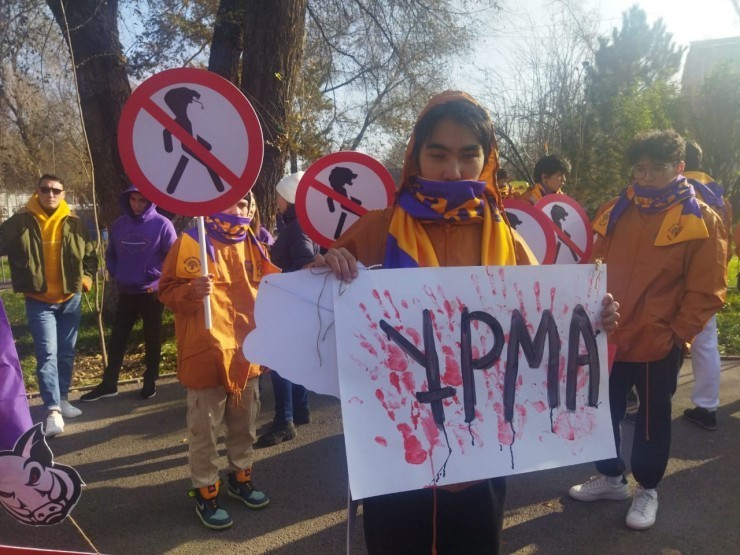
This appalling incident highlighted the urgent need for stronger protections against domestic violence. An authorized rally was held in Almaty in late November. Around 200 participants came out onto the square behind the Sary Arka cinema, holding posters and chanting slogans against domestic violence. The event was organized by a public movement called Zhana Adamdar and the attendees mostly included young people and students from the movement. Relatives of Saltanat Nukenova also took part.

The participants wanted to raise awareness about fighting any manifestation of violence against women and children. Most of the attendees were dressed in the same style, and many of them had scarves with the inscription “Say no to the animal world,” which was also the title of the rally. Speakers at the event detailed the most resonant cases of violence in recent times while the organizers of the rally held a small flash mob and arranged an installation with mannequins in cages with animal masks on them. A minute of silence was observed in honour those who died as a result of violence.

Progress in protecting women

What proceeded this public tragedy hopefully presents a silver lining. A month later, on December 8, Kazakhstan’s current President Kassym-Jomart Tokayev signed a Decree to strengthen human rights with concrete steps towards preventing violence and promoting gender equality.

The Decree instructs Kazakhstan’s government to take systematic measures to promote equal rights and opportunities in all spheres of society, as well as to overcome all forms and manifestations of gender discrimination. The decree also encompasses legislation to deter domestic violence and promotes equal rights and safety for both men and women in the Republic of Kazakhstan, as endorsed by UN Security Council resolution 13251.

It further involves legislative measures to tighten criminal liability in cases of domestic violence, which have now been implemented. These measures aim to hold perpetrators accountable and ensure that victims can get justice. Additionally, offenders of domestic violence may be required to undergo comprehensive psychological correction as part of their rehabilitation process. The Decree also asks for creating specialized units within the Ministry of Internal Affairs staffed with female officers, who can enhance the effectiveness of combating domestic violence.

While the timing of the Decree coincided with the aftermath of Saltanat’s death, there are signs that these steps may have already been in the works. President Tokayev had voiced concerns about domestic violence before the current headlines emerged. At a meeting in the Ministry of Internal Affairs in June 2023, for example, he had affirmed that “comprehensive preventive work is necessary” where “the main role is assigned to neighbourhood police inspectors”. He had further observed that “crimes committed on the basis of family and domestic conflicts can be avoided if timely measures are taken.”

The inclusion of domestic violence in the President’s reform agenda has been acknowledged by Human Rights Watch (HRW), and Tokayev appears to have included action steps recommended by HRW — such as directing the relevant authorities to increase penalties for offenders of domestic violence against women. Local experts expect that the legal code will be changed to include domestic violence as a specific class of criminal offence in the near future, thus making abusers more accountable.

A cultural change in progress

Beyond the legal, economic and political reforms, Kazakhstan is also witnessing a significant societal shift in addressing domestic violence. A notable example is the docudrama series “Zhalgyz Emessin” (translated as “you are not alone”), produced in collaboration with UN Women Kazakhstan and supported by the European Union and the government of Kazakhstan. This series features real-life stories of domestic violence survivors, and aims to raise awareness, challenge gender stereotypes, and empower survivors. The representative of UN Women Kazakhstan, Maria Dotsenko, has publicly commented on how the series has succeeded in educating a broad audience on responding to violence.

The favourable national response to the film “Baqyt” (Happiness) about domestic violence likewise indicates a changing cultural discourse in the country, confirming a societal shift towards openly acknowledging and addressing the problem of domestic violence.

The trajectory

Kazakhstan is poised to continue on a positive trajectory towards ending domestic violence and gender discrimination, which has been accelerated by the heart-breaking murder of a young woman. At the state level, a legal culture that fosters zero tolerance towards all forms of violence is beginning to emerge. Encouraging signs from the government include recent reform efforts and pledges in this direction. The ultimate evidence of progress, however, will be a significant decrease in instances of domestic violence.


Uzbekistan’s Transition to Market Economy to Accelerate

Uzbekistan’s Transition to Market Economy to Accelerate

The World Bank’s Board of Executive Directors on December 8th approved a Development Policy Operation to financially support the Government of Uzbekistan in implementing a new generation of economic, social, and climate reforms. The objective of these reforms is to expedite the country’s transition to a market economy, ensuring that economic opportunities are accessible to all citizens and creating a strong foundation for sustained growth.

In Uzbekistan, despite significant progress in the transition to a market economy, there is a need to complete this process and to shift urgently towards a greener and more equitable economic model which would help the country achieve its development and environmental goals.

The government aims to halve the poverty rate by 2026, and elevate the country to the status of an upper-middle-income economy by 2030. Achieving these objectives requires much faster growth, which is possible through reducing state control over the economy and empowering the private sector to become the primary driver of economic development.

“The World Bank’s new operation supports key government priorities, including reducing state dominance in crucial sectors such as agriculture, railway, chemicals, and energy,” said Marco Mantovanelli, World Bank Country Manager for Uzbekistan. “This will allow for greater private sector participation in the given areas. The operation also aims to strengthen social and legal protection for vulnerable groups, and address pressing issues of climate change and environmental protection.”

The World Bank will provide financial support to the government through a combination of highly concessional and low-cost loans totaling $800 million. The financing will offer the government a low-cost, long-term repayment option compared to what would be available in international financial markets, resulting in a significantly lower loan repayment cost. This, in turn, will free up more resources for the country’s urgent development priorities.

“The Government has a strong commitment to reforms that will transform Uzbekistan into a more open and competitive market economy. The World Bank is supporting the country in achieving this goal by providing the necessary expertise, international experience, and financing,” said Jasur Karshibaev, Deputy Minister of the Economy and Finance of Uzbekistan.

The financing from the World Bank operation will support the government’s reforms and actions in a number of critical areas, including:

  1. Energy sector: Establishing an independent energy regulator and implementing energy tariff reform to improve the energy sector’s performance, enhance the efficient use of energy resources, attract private investment in modernizing energy infrastructure, and promoting competition and private sector participation in the industry.
  2. Railway sector: Undertaking institutional reforms in the railway sector to modernize price setting for passenger and freight transportation and strengthen competition and the institutional environment in the industry.
  3. Chemical sector: Establishing a framework for institutional reforms in the chemicals sector and privatizing FerganAzot JSC, a large state-owned chemical plant, to liberalize the sector, attract private investments for its modernization, and enhance competition and efficiency in the industry.
  4. Agriculture sector: Abolishing the crop placement system for all crops to promote greater diversity and productivity in crop production and help address climate vulnerabilities faced by farmers.
  5. Fiscal risk management: Developing the capacity of the Ministry of Economy and Finance to evaluate, monitor and report on fiscal risks associated with the implementation of public-private partnership projects, aiming to strengthen fiscal risk management.
  6. Social Protection: Establishing the National Agency for Social Protection under the President of Uzbekistan to improve the integration, coverage, performance, and quality of social protection services delivered to vulnerable groups.
  7. Protection of women against violence: Criminalizing domestic violence and strengthening mechanisms for protecting women against physical, sexual, economic, and psychological violence.
  8. Free legal aid for vulnerable groups: Expanding eligibility for state-sponsored legal representation to low-income persons, including survivors of violence against women in civil and criminal cases, and providing more effective access to justice.
  9. Climate adaptation and environmental protection: Setting more ambitious climate and environmental targets and programs, strengthening the capacity and mandate of the Ministry of Ecology, Environmental Protection and Climate Change of Uzbekistan, and improving mechanisms for air pollution control and enforcement.
  10. Green transition: Establishing a national green taxonomy, a system used to identify economic activities and investments based on their environmental sustainability. This initiative aims to scale up action on climate change adaptation and mitigation, strengthen air pollution and emissions control, and attract investments in green projects.