Kazakhstan on Europe’s Oil Podium, but for How Long?

Kazakhstan has strengthened its position as one of the key suppliers of oil to the European Union, capitalizing on the redistribution of energy flows following the reduction of Russian crude imports. However, declining production and vulnerabilities in export infrastructure cast doubt on the country’s ability to maintain this position in the medium term.
According to official EU data, the EU remains one of the world’s largest oil importers, meeting about 97% of its demand through external supplies. In 2025, EU countries imported approximately 435 million tonnes of crude oil worth more than €212 billion. The reduction in Russia’s share from 25.8% in 2021 to 2.2% in 2025 led to a significant redistribution of flows in favour of alternative suppliers, including the United States (14.6%), Norway (12.8%), and Kazakhstan (12.8%) by crude-oil import volume.
Kazakhstan has been among the main beneficiaries of these changes. According to an Econovis Economic Research Laboratory report, the share of Kazakh supplies in European imports has increased for several consecutive years.
This growth has been driven by strong demand from European refineries for light, low-sulfur CPC Blend crude.
Alongside Kazakhstan, Azerbaijan has also strengthened its position, benefiting from Europe’s diversification efforts. A notable example is the Czech Republic, where, following the cessation of deliveries via the Druzhba pipeline, Azerbaijan accounted for more than 42% of oil imports in 2025, according to Czech import data. Kazakhstan ranked third in the Czech market with a share of around 18%, indicating the emergence of a new energy balance in the Caspian region.
Despite this favorable external environment, Kazakhstan’s oil and gas sector has faced a significant downturn. According to government data, in the first quarter of 2026, oil and gas condensate production amounted to 19.7 million tonnes, 20% less than in the same period of 2025. Oil exports declined by approximately 22% to 15.3 million tonnes, while the annual export forecast stands at about 76 million tonnes. By mid-April, however, CPC exports had risen from February levels as Tengiz resumed production, suggesting that some of the early-year disruption had eased.
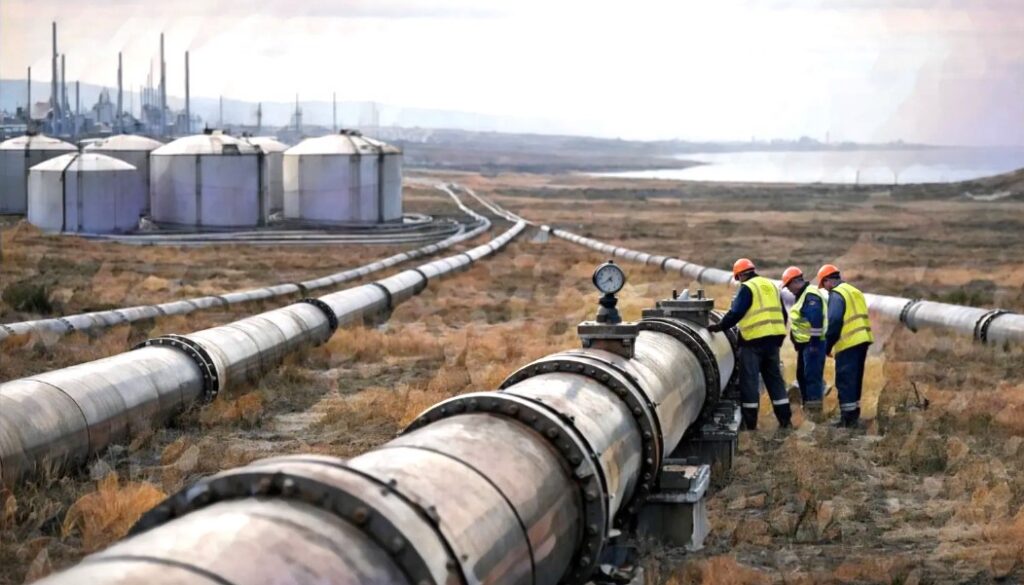
The decline is linked to disruptions in the operations of the Caspian Pipeline Consortium (CPC) and temporary shutdowns at major fields, including Tengiz. The CPC remains the key export route for Kazakh oil to Europe, transporting most of the crude through the terminal in Novorossiysk.
Economic analyst Olzhas Baidildinov said the consequences of attacks on the consortium’s infrastructure could have long-term implications.
“Oil and gas condensate production in Kazakhstan fell by 20% in the first quarter compared to January-March 2025, 19.7 million tonnes versus 24.6 million tonnes. Oil exports decreased by approximately 22% to 15.3 million tonnes. The export forecast for this year is 76 million tonnes,” he wrote on his Telegram channel.
According to his estimates, the country will once again fail to surpass the psychologically significant threshold of 100 million tonnes of annual production.
“As a result of the attacks on the CPC, at least 6 million tonnes of oil worth no less than $3.4 billion were not produced over four months. Taking into account associated costs, the total damage and lost revenue easily exceed $4 billion,” Baidildinov said.
These figures are Baidildinov’s estimates and have not been independently confirmed by the authorities or the CPC.
Disruptions in the supply of Kazakh oil have increased tensions in the European market for light crude grades. At the beginning of the year, a shortage of CPC Blend forced traders to increase purchases of North Sea grades, temporarily lifting premiums relative to the Brent benchmark. In January, Kazakh oil briefly traded at a premium to Dated Brent for the first time in a year, reflecting strong demand from European refiners, although the premium did not last, and pricing later moved back into discount. Additional volatility was driven by geopolitical risks, including the conflict in the Middle East.
Against this backdrop, Kazakhstan is seeking to expand exports to Asian markets. South Korea has agreed to purchase 273 million barrels of oil from Kazakhstan, Saudi Arabia, and other Middle Eastern countries by the end of 2026. Kazakhstan’s share amounts to about 18 million barrels, or 6.5% of the total, indicating the continued dominance of Middle Eastern suppliers.
Japan is also considering the possibility of increasing oil imports from Kazakhstan and Azerbaijan through projects involving the national company INPEX. However, such plans remain at an early stage, and alternative supply routes would extend delivery times to 25-55 days and increase transportation costs, limiting the competitiveness of Kazakh crude in Asian markets.
The decline in oil production is already affecting the broader economy. Kazakhstan’s GDP growth slowed from 6.5% in 2025 to 3% in the first quarter of 2026.
In the short term, demand for Kazakh oil in the EU is likely to remain high, particularly given the shortage of light crude grades. Nevertheless, any further disruptions in production or transportation could shift the balance of the market, intensifying competition from other suppliers.