

• KGS/USD = 0.01144 0%
  • KZT/USD = 0.00193 -0%
  • TJS/USD = 0.10866 0.55%
  • UZS/USD = 0.00008 0%
  • TMT/USD = 0.28490 0%
  • KGS/USD = 0.01144 0%
  • KZT/USD = 0.00193 -0%
  • TJS/USD = 0.10866 0.55%
  • UZS/USD = 0.00008 0%
  • TMT/USD = 0.28490 0%
  • KGS/USD = 0.01144 0%
  • KZT/USD = 0.00193 -0%
  • TJS/USD = 0.10866 0.55%
  • UZS/USD = 0.00008 0%
  • TMT/USD = 0.28490 0%
  • KGS/USD = 0.01144 0%
  • KZT/USD = 0.00193 -0%
  • TJS/USD = 0.10866 0.55%
  • UZS/USD = 0.00008 0%
  • TMT/USD = 0.28490 0%
  • KGS/USD = 0.01144 0%
  • KZT/USD = 0.00193 -0%
  • TJS/USD = 0.10866 0.55%
  • UZS/USD = 0.00008 0%
  • TMT/USD = 0.28490 0%
  • KGS/USD = 0.01144 0%
  • KZT/USD = 0.00193 -0%
  • TJS/USD = 0.10866 0.55%
  • UZS/USD = 0.00008 0%
  • TMT/USD = 0.28490 0%
  • KGS/USD = 0.01144 0%
  • KZT/USD = 0.00193 -0%
  • TJS/USD = 0.10866 0.55%
  • UZS/USD = 0.00008 0%
  • TMT/USD = 0.28490 0%
  • KGS/USD = 0.01144 0%
  • KZT/USD = 0.00193 -0%
  • TJS/USD = 0.10866 0.55%
  • UZS/USD = 0.00008 0%
  • TMT/USD = 0.28490 0%
11 December 2025

Central Asia’s Sovereignty in the Shadow of the War in Ukraine

The Ukraine war has fundamentally changed Central Asia’s strategic positioning, accelerating diversification away from Russian dependence. Kazakhstan and Uzbekistan are navigating between maintaining necessary ties with Moscow, while asserting sovereignty through expanded partnerships with China, Turkey, and the West.

The Sovereignty Imperative

When Russian forces crossed into Ukraine in February 2022, the violation of territorial integrity sent immediate shockwaves through Central Asia. For leaders whose nations had endured centuries of Russian and Soviet rule, Vladimir Putin’s denial of Ukrainian statehood carried threatening undertones. This concern proved well-founded; since 2014, Russian officials have increasingly questioned Central Asian independence, with Putin dismissing Kazakhstan as never having “any statehood,” and nationalist figures like Zakhar Prilepin suggesting the outright annexation of territories “labor migrants come from.”

This threat became tangible post-2022. Duma member Konstantin Zatulin warned that “with friends, we don’t raise territorial questions… With the rest — like with Ukraine — everything is possible,” while media personality Tigran Keosayan told Kazakhstan to “look at Ukraine carefully.” Such rhetoric has deepened Central Asia’s resolve to defend its sovereignty, even as economic and security constraints limit dramatic policy shifts.

Measured Defiance

Despite expectations in some quarters that Kazakhstan would align with Moscow following the Russian-led CSTO intervention during the January 2022 unrest, President Kassym-Jomart Tokayev defied such predictions. Sitting beside Putin in June 2022, Tokayev refused to recognize the “quasi-state territories” of Donetsk and Luhansk, drawing fierce Russian criticism. This principled neutrality, supporting neither Russia’s war nor “blindly follow[ing]” Western sanctions, has largely succeeded in keeping Kazakhstan shielded from the ire of Moscow.

Uzbekistan’s President Shavkat Mirziyoyev adopted a similar positioning, with then Foreign Minister Abdulaziz Kamilov declaring Uzbekistan’s recognition of Ukrainian territorial integrity. Though Kamilov was subsequently reassigned amid reports of Russian pressure, Tashkent has maintained its “balanced and neutral position,” refusing to endorse any territorial changes achieved through force.

Public Opinion is Divided but Shifting

The war has polarized Central Asian societies along generational and ethnic lines. In Kazakhstan, surveys show roughly 27-32% of respondents still accept the Kremlin justifications for its invasion of Ukraine, while 24-28% view Russia as the aggressor. Critically, only 15% explicitly support Russia versus 20% backing Ukraine, with the majority remaining neutral. More telling is the growing anxiety about Russia’s intentions: 26% of Kazakhstanis now consider a Russian attack on their country a possibility.

In Uzbekistan, state media control limits public polarization, but the historical memory of Russian colonization has reinforced the appreciation for independence. Prilepin’s 2023 annexation comments sparked widespread patriotic indignation, while the government’s firm rebuttal drew popular praise.

Strategic Diversification Accelerates

The war has catalyzed Central Asia’s pivot toward multiple partnerships, exploiting Russia’s distraction and resource constraints.

China is already the region’s largest economic partner. China has deepened its influence through the first China-Central Asia summit in 2023 and Xi Jinping’s pledge that Beijing “categorically opposes” interference in Kazakhstan’s internal affairs. Chinese investment in alternative corridors bypassing Russia has accelerated, while modest military cooperation provides security alternatives to Russian guarantees.

Ankara has also leveraged its shared heritage through the Organization of Turkic States, positioning itself as a cultural and security alternative. Turkish Bayraktar drones sold to Uzbekistan and Kyrgyzstan demonstrate growing defense ties, while Turkey’s mediation of the 2022 Kyrgyz-Tajik border conflict showcased its emerging role as a regional problem-solver.

Institutional Erosion

Russian-led structures also face credibility challenges. The CSTO’s failure to respond to Armenia’s appeals and its ineffectiveness during the Kyrgyz-Tajik clashes has prompted member states to seek supplementary security arrangements. Kyrgyzstan canceled a scheduled CSTO exercise in 2022, while Kazakhstan continues NATO Partnership exercises despite Moscow’s objections.

The Eurasian Economic Union similarly faces strain as members assert their economic sovereignty. Kazakhstan’s refusal of joint currency proposals and its compliance with Western sanctions monitoring demonstrate the limits to integration when national interests diverge from Moscow’s preferences.

Three Scenarios for Regional Futures

Victory for Ukraine would likely accelerate this Central Asian strategic distancing, legitimizing de-russification efforts and deeper Western/Turkish cooperation. However, economic dependencies and ethnic Russian populations would moderate the pace of change, preventing any dramatic realignment.

A negotiated Stalemate is the most probable outcome and one that would reinforce current multi-vector approaches. Central Asian states would continue diversifying partnerships while avoiding provocative moves, evolving toward strategic ambiguity rather than clear alignment.

A Russian consolidation, meanwhile, would pose the biggest challenge, potentially triggering authoritarian strengthening as leaders prepare for renewed imperial pressure. However, the war has already demonstrated Russia’s limitations, reducing Moscow’s capacity for effective coercion.

Identity and Decolonization

The conflict has accelerated “decolonizing” narratives across Central Asia. Kazakhstan has intensified efforts to counter Russian historical revisionism, with new textbooks explicitly debunking Putin’s claims about Kazakh statehood. Street renaming campaigns and monument removals, once sporadic, have also gained broader support. Similar trends have appeared in Uzbekistan and Kyrgyzstan, where the promotion of native languages and Latin scripts signals cultural independence.

Critically, governments have managed ethnic tensions carefully. Kazakhstan’s handling of Russian draft evaders, welcoming them for economic benefits while monitoring for extremist activity, demonstrates sophisticated crisis management that gives Moscow no pretext for “protection” interventions.

Constrained Transformation

More than three years into the latest installment of the Ukraine war, Central Asia has achieved a remarkable strategic realignment without triggering any Russian retaliation. The region’s leaders have successfully balanced assertions of sovereignty with pragmatic engagement, exploiting great power competition for economic and security benefits.

This represents the most significant shift in Central Asian geopolitics since the Soviet collapse, a shift toward greater autonomy within existing constraints. The war has weakened Russian dominance without eliminating it entirely, creating space for multi-polar partnerships that enhance regional sovereignty.

For policymakers in Washington, Brussels, and Beijing, Central Asia’s careful balancing act offers both opportunities and reasons for caution as the region welcomes diversified partnerships. Success requires an understanding that Central Asian sovereignty, hard-won and carefully guarded, is non-negotiable, regardless of which great power comes calling.
For policymakers in Washington, Brussels, and Beijing, Central Asia’s careful balancing act offers both opportunities and reasons for caution as the region welcomes diversified partnerships. Success requires an understanding that Central Asian sovereignty, hard-won and carefully guarded, is non-negotiable, regardless of which great power comes calling.

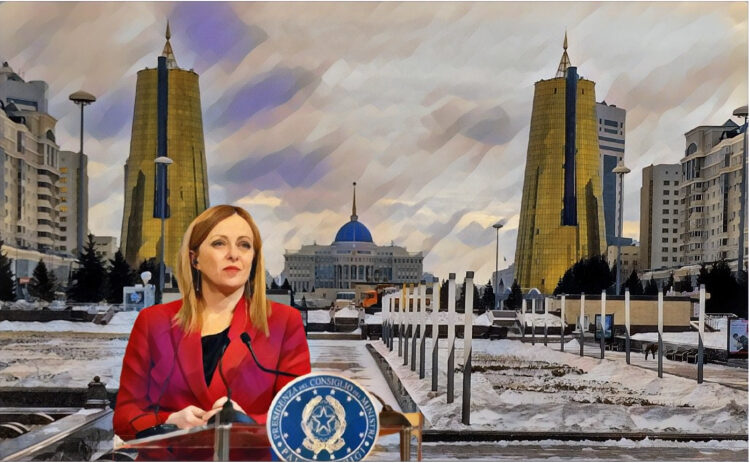
Meloni Will Attend Italy-Central Asia Summit in Kazakhstan This Week

Italian Prime Minister Giorgia Meloni, who postponed a trip to Central Asia in April because of the death of Pope Francis, has rescheduled her visit to the region for this coming Wednesday to Friday.

Meloni will travel to Uzbekistan on Wednesday and will attend a Central Asia-Italy summit during a visit to Kazakhstan on Thursday and Friday, according to her office.

The leaders of Kazakhstan, Uzbekistan, Kyrgyzstan, Tajikistan and Turkmenistan are expected to join Meloni at the summit, which is aimed at strengthening economic collaboration between Italy and Central Asia.

$15 Billion in Crypto Withdrawn from Kazakhstan Amid Calls for Tighter Controls

Approximately $15 billion worth of cryptocurrency has been withdrawn from Kazakhstan, a figure disclosed by Berik Sholpankulov, Deputy Chairman of the National Bank. The exodus highlights systemic issues in the country’s digital finance regulations.

Billions in the “Gray Zone”

According to Sholpankulov, the primary driver of this significant capital outflow has been the absence of robust regulatory frameworks governing digital finance.

“Today, the volume of crypto assets withdrawn from the country amounts to $15 billion. The fact is that there was insufficient administrative and legal regulation in place to allow citizens to invest safely,” he stated during a briefing.

In response, the National Bank plans to introduce sweeping changes, including administrative and criminal penalties for the illegal circulation of cryptocurrencies and their unauthorized transfer abroad. Sholpankulov also indicated that the authorities may soon begin naming individuals involved in illicit transactions.

“Perhaps we will also hold a briefing and announce by name who spent what in the ‘gray’ zone. But [there] will already be administrative and criminal prosecution,” he stated.

Transparency and Licensing: Key Reforms

Legislative amendments are currently under development to legitimize and open Kazakhstan’s digital asset market. The initial step will involve licensing all market participants, such as cryptocurrency exchanges and digital service providers, through the Astana International Financial Center (AIFC).

Licensed entities operating through the AIFC will enable residents to legally buy and sell digital assets. All transactions will be monitored and transparent, giving the state tools to prevent illegal financial flows.

A dedicated platform is also being launched under the National Bank to test emerging digital technologies and services before a broader rollout.

Strategic Shift Toward a Digital Economy

These reforms extend to Kazakhstan’s cryptocurrency mining sector. Large-scale operators will be permitted to build independent power plants to reduce their reliance on the national power grid, thus improving operational stability and economic feasibility.

Deputy Minister of Digital Development Kanysh Tuleushin emphasized that establishing a legal market for digital assets marks a pivotal phase in the country’s economic transformation. The relevant authorities aim to implement a fully regulated and transparent cryptocurrency market by the end of 2025.

Kazakhstan’s competitive advantages, including affordable electricity, vast space, and a supportive legal infrastructure, position it well to attract investment and build a robust digital ecosystem. If fully realized, the reform package could elevate Kazakhstan to a leading position in the region for legal cryptocurrency operations, stimulating job creation, and curbing shadow capital outflows.

Previously, The Times of Central Asia reported that MP Olzhas Kuspekov had proposed strengthening state controls over cryptocurrency circulation, including blocking access to unlicensed exchange platforms.

Kyrgyz Farmers in Naryn Region Receive Ecotourism Training

Farmers in Kyrgyzstan’s Naryn region are receiving specialized training to help them tap into the growing ecotourism market. Organized by the Kyrgyz Department of Tourism, the courses aim to equip rural communities with the skills and tools necessary to turn their agricultural operations into attractive destinations for eco-conscious travelers.

During the sessions, local farmers were introduced to tourism opportunities specific to their region. They also learned how to register and promote their services on major digital platforms such as Booking.com, TripAdvisor, Google Maps, and 2GIS.

A key focus of the training was on storytelling and digital marketing. Participants were taught how to showcase the uniqueness of their farms through reviews, videos, and visual content, tools seen as vital for attracting visitors in the digital age.

Ecotourism, and agritourism in particular, has seen a notable rise in popularity among international visitors, especially from Europe. Kyrgyzstan’s rural areas attract travelers seeking an authentic glimpse into traditional life and rich local culture.

The Kyrgyz Association of Tour Operators (KATO) notes that rural tourism is expanding steadily. In a recent report, the association highlighted the importance of proactive promotion. “The main thing is to position your business as a tourist attraction and actively promote it, attracting potential partners and customers. Income will depend on effort and imagination, because tourism is about selling new experiences and positive emotions,” KATO stated.

With tourism continuing to diversify in Kyrgyzstan, initiatives like this are seen as essential to empowering local communities and fostering sustainable economic development in remote regions like Naryn.

Kazakhstan’s Record Sugar Beet Harvest Exposes Processing Industry Failures

Kazakhstan’s sugar industry saw a record sugar beet harvest in 2024, but the processing sector was unprepared to handle the influx. The gap between agricultural production and industrial capacity has once again underscored systemic weaknesses in the sector. A detailed analysis by Energyprom.kz highlights these ongoing challenges.

Record Harvest, Limited Processing

According to the National Statistics Bureau, sugar beet cultivation reached an all-time high in 2024, with 25,000 hectares sown, a 34% increase from the previous year. Enhanced government support spurred the expansion: farmers received 25 tenge per kilogram of beets delivered for processing (up from 15 tenge), and transport subsidies were raised from 25 to 45 tenge per kilometer. These incentives encouraged investment in farm equipment and modern technologies, lifting average yields to 507 centners per hectare.

This translated into a gross harvest of nearly 1.3 million tons of beets, 2.5 times more than in 2023. However, only slightly more than half of the crop was processed. Senators in Kazakhstan’s Parliament reported that just 58.3%, approximately 700,000 tons, was processed. The remainder was either left to rot or exported, primarily to Kyrgyzstan.

The Ministry of Agriculture offered a slightly higher figure, reporting that 989,000 tons had been processed. Even so, this left hundreds of thousands of tons unutilized. Responding to parliamentary concerns, Prime Minister Olzhas Bektenov acknowledged the issue, citing “high credit burdens” on processing enterprises and “dumping” by neighboring countries as key obstacles.

Aging Infrastructure and Unrealized Potential

Kazakhstan currently has four operational sugar factories, but only three are equipped to process sugar beets. These facilities are in a state of significant disrepair: the Koksu plant is 93 years old, Merken is 91, and Taraz is 88. Although hopes had been pinned on modernizing the Taraz facility to process up to 600,000 tons annually, the planned upgrades did not materialize.

As a result, sugar production dropped despite the record harvest. In 2024, Kazakhstan produced 164,400 tons of sugar, a 25% decrease from the previous year. Meanwhile, exports surged: 143,000 tons of sugar were exported, a 7.5-fold increase. Nonetheless, imports continue to dominate the domestic market, covering 74.1% of consumption.

Crop Reductions and Financial Risks

Facing processing bottlenecks, the Ministry of Agriculture has announced plans to scale back sugar beet cultivation. In 2025, the planted area will be reduced to 18,400 hectares, a 25% decrease. The Zhambyl region will see its sugar beet area halved, while Zhetysu will experience a 20% cut.

The decision has drawn strong criticism from farmers and lawmakers. Many producers had invested heavily based on previous state projections, purchasing machinery and training personnel. “What will happen to farmers who took out loans, bought equipment, and are now faced with a revision of the state strategy? This could lead to mass bankruptcies and negate years of support for the industry,” senators warned in an appeal to the prime minister.

Strategic Setback and Future Uncertainty

Kazakhstan’s sugar industry development plan for 2022-2026 envisioned expanding cultivated areas to 38,000 hectares, boosting production to 1.8 million tons of beets and 250,000 tons of sugar annually. The ultimate aim was to raise self-sufficiency in sugar to 43% by 2026.

However, the rollback in policy and persistent infrastructure shortfalls suggest the industry is backsliding. Experts caution that without urgent investment in processing facilities, Kazakhstan risks not only missing its strategic targets but also alienating the very farmers driving growth.

Kyrgyzstan to Enforce Mandatory Car Insurance in July 2025

Beginning July 1, 2025, all vehicle owners in Kyrgyzstan will be subject to fines if they fail to obtain mandatory car insurance. Individuals found without coverage will face a penalty of 3,000 Kyrgyz soms (approximately $35), while foreigners and legal entities will be fined 13,000 soms (around $150), according to the State Insurance Organization (SIO).

The introduction of penalties is expected to promote greater discipline among drivers and boost overall insurance coverage nationwide. “Compulsory car insurance protects not only car owners but also other road users. It helps reduce social tensions, lowers the number of legal disputes, and eases the financial burden on citizens,” the SIO stated in comments to The Times of Central Asia.

Although the law on compulsory Motor Third-Party Liability (MTPL) insurance was passed in 2016, widespread public opposition and a lack of supporting infrastructure led to multiple delays in its enforcement. The most recent postponement, in January 2025, deferred fines for individuals once again. Authorities now affirm that no further delays will be made.

The SIO emphasized that the measure aligns Kyrgyzstan with international norms. “In countries with a high culture of insurance, compulsory MTPL insurance is an integral part of road safety systems. Kyrgyzstan is moving steadily in this direction,” representatives said.

Data from the National Statistical Committee shows that 7,100 traffic accidents were recorded in Kyrgyzstan in 2024, continuing a yearly upward trend. Some experts have expressed skepticism about the law’s effectiveness, citing the country’s large and growing vehicle fleet. However, the SIO remains confident in its capacity to manage the increased demand.

“Our financial model includes calculating potential risks and setting aside funds for payments. This means that even if the accident rate rises, the SIO can still meet its obligations to insured drivers on time and in full,” the organization assured.

As enforcement looms, authorities and insurers are urging the public to prepare and comply with the law to help foster a safer and more financially secure road environment in Kyrgyzstan.

